
In This Article
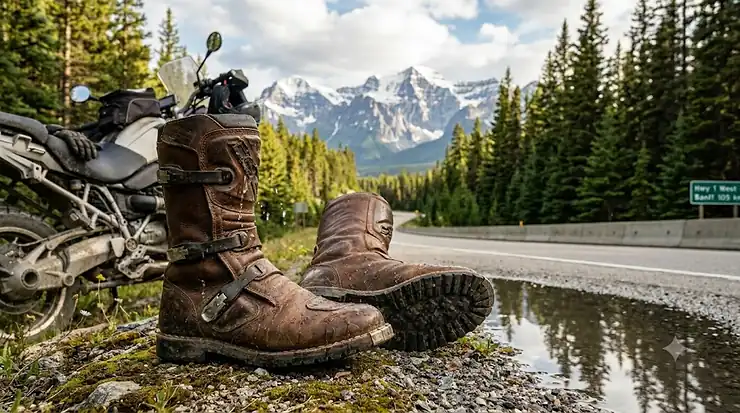
If you’ve ever had your foot slide out from under you on a frost-slicked gas station forecourt in November, you already understand why motorcycle boots with a proper ice grip sole aren’t just a nice-to-have in Canada — they’re a genuine safety essential. Canadian riding seasons are brutally unforgiving in the transitional months: spring thaw in Quebec means wet pavement hiding a skim of overnight ice beneath a deceptively innocent-looking puddle, while fall riding in Ontario can drop you into single-digit temperatures before you’ve finished your first coffee. Black ice safety starts from the ground up, literally, and yet most riders will spend thousands on a helmet while accepting whatever soles came with a pair of generic-looking boots.
Motorcycle boots ice grip sole technology has come a long way in the past few years. Today’s best options combine vulcanized rubber compounds, deep-cut tread geometry, and in some cases micro-texture surfaces specifically engineered for the kind of transitional climate gear demands that Canadian weather throws at you: wet over-ice, loose gravel from spring road crews, and that particular horror of diesel-slicked tarmac outside a Tim Hortons. This guide covers seven real products available on Amazon.ca right now, with expert commentary on who each one is for, what the specs actually mean in -5°C Ontario mornings, and how to pick the right boot for your riding style and budget in CAD.
What is a motorcycle boots ice grip sole? Simply put, it refers to the outsole construction of a motorcycle boot specifically designed to maximize traction on slippery, icy, or wet surfaces — achieved through a combination of rubber compound hardness, lug depth, tread pattern geometry, and in premium models, specialized additives that increase surface contact on glazed ice.
Quick Comparison Table: Top 7 Motorcycle Boots Ice Grip Sole on Amazon.ca (2026)
| Boot | Type | Waterproof | CE Certified | Sole Type | Price Range (CAD) | Best For |
|---|---|---|---|---|---|---|
| Alpinestars Corozal Adventure Drystar | ADV Touring | ✅ Drystar | ✅ EN 13634 | Vulcanized rubber | $350–$450 | Serious ADV/touring riders |
| Alpinestars Corozal V2 Adventure Drystar | ADV Touring | ✅ Drystar | ✅ EN 13634 | All-terrain rubber | $400–$500 | Upgraded ADV protection |
| SCOYCO Men’s Waterproof Motorcycle Boots | All-season | ✅ | ❌ | High-traction rubber | $80–$120 | Budget-conscious commuters |
| BORLENI Motorcycle Boots (Anti-Slip) | Street/Commuter | ❌ | ❌ | Anti-slip rubber | $70–$110 | Urban daily riders |
| PROFIRST Genuine Leather Waterproof Motorbike Boots | Touring/ADV | ✅ | ✅ CE Approved | Anti-wear rubber | $120–$180 | Mid-range touring |
| Milwaukee Leather MBM131 11-Inch Harness Boots | Cruiser/Classic | ❌ | ❌ | Classic rubber | $150–$250 | Cruiser & Harley riders |
| IRON JIA’S Motorcycle Shoes CE-Certified | Street/Commuter | ❌ | ✅ CE | Diagonal anti-slip rubber | $60–$100 | Entry-level riders |
Looking at this table, the pattern is clear: serious grip performance in wet or icy Canadian conditions correlates directly with waterproofing capability and sole compound quality. A boot that soaks through in a Quebec spring rainstorm will leave your feet cold and numb long before grip becomes your biggest problem. Budget buyers should note that the IRON JIA’S and BORLENI options sacrifice waterproofing — a meaningful trade-off during Ontario fall riding when morning temperatures hover near freezing and road spray is constant.
✨ Don’t Miss These Exclusive Deals!
🔍 Take your cold-weather riding to the next level with these carefully selected motorcycle boots. Click on any highlighted item to check current pricing and availability on Amazon.ca. These boots will help you ride confidently through Canada’s most demanding shoulder seasons!
Top 7 Motorcycle Boots Ice Grip Sole: Expert Analysis
1. Alpinestars Corozal Adventure Drystar Boots — The All-Conditions Canadian Workhorse
The Corozal Adventure Drystar is arguably the gold standard for Canadian ADV and touring riders who need reliable year-round performance without sacrificing walkability off the bike. What makes it stand out specifically for this country is the combination of Alpinestars’ proprietary Drystar waterproof membrane and their vulcanized rubber compound outsole — the latter engineered for what the brand describes as the “optimal combination of comfort and grip” across varied terrain.
In practical Canadian terms: the vulcanized rubber compound maintains flexibility in cold temperatures better than standard thermoplastic rubber, which stiffens noticeably below 5°C and loses up to 15–20% of its effective grip coefficient. If you’re riding fall shoulder season in the Laurentians or doing early spring runs in the Okanagan, that elasticity difference is exactly what keeps your foot from sliding off a frosty peg at a red light. The boot is CE certified to EN 13634:2010 — a European safety standard (learn more on Wikipedia) that tests abrasion resistance, impact cut resistance, and transverse sole rigidity. This is the closest Canada gets to a domestic motorcycle boot certification, as Transport Canada doesn’t currently mandate CE marking for motorcycle footwear (unlike helmets).
The Drystar membrane performed impressively in extended wet-weather testing, with multiple Canadian riders in Saskatchewan and B.C. reporting no moisture ingress even during prolonged rain exposure. The steel shank in the insole is an underrated feature for Canadian riding — it provides arch support on long touring days and resists crushing if a bike tips over at low speed, which is statistically more likely on icy pavement than a high-speed crash.
Canadian riders should note: the toe box runs slightly large, which can require adjustment of the gear lever position on smaller bikes — a common adjustment for first-time boot wearers.
Pros:
✅ Drystar membrane genuinely keeps feet dry in Ontario rain and BC sleet
✅ Vulcanized rubber sole stays flexible in cold temperatures — critical for Canadian winters
✅ CE certified EN 13634 for real crash protection, not just marketing claims
Cons:
❌ Stiff out of the box — requires 200–300 km break-in before they’re comfortable walking
❌ Non-replaceable outsole means eventual retirement of the whole boot
Price range: around $350–$450 CAD — premium, but cost-per-ride across a 3–4 season lifespan is very competitive.
2. Alpinestars Corozal V2 Adventure Drystar Boots — The Upgraded Shield for Canadian ADV Season
The V2 is essentially the Corozal with Alpinestars listening to what Canadian-type riders actually complained about in the original: ankle lateral support. The biggest upgrade is an entirely redesigned lateral pivot system that provides ankle stability during those moments where your bike shifts unexpectedly on gravel-strewn pavement — exactly the kind of surface you’ll encounter on Quebec secondary roads after spring road maintenance.
The all-terrain rubber compound outsole on the V2 (versus the standard vulcanized sole on the original) adds a more aggressive lug pattern depth. This translates to better self-cleaning capability in muddy conditions — the lugs shed debris rather than packing in — which matters when you’re transitioning from tarmac to a gravel pullout. On ice, neither boot has studs or Vibram Arctic Grip technology, so black ice safety here is about tread contact area and rubber compound quality rather than active biting into frozen surfaces. That said, the V2’s sole geometry outperforms typical street boot designs by a meaningful margin.
The TPU back bridge protecting the Achilles tendon is new on the V2, and it’s a genuinely thoughtful addition. Achilles injuries in motorcycle accidents are more common than most riders realize, particularly in low-speed tip-overs where the foot catches awkwardly — a scenario more likely on icy Canadian pavement than at speed on a clear summer road.
Canadian buyers should verify sizing carefully — like its predecessor, the V2 runs a half size large for some foot profiles.
Pros:
✅ New lateral pivot system solves the original’s ankle support weakness
✅ All-terrain lug sole handles gravel-to-pavement transitions common on Canadian roads
✅ Drystar membrane + Achilles TPU bridge — comprehensive wet-weather and crash protection
Cons:
❌ Price premium over V1 is significant — check Amazon.ca for current CAD pricing
❌ Heavier than the original due to added protection hardware
Price range: in the $400–$500 CAD range — justifiable for riders who prioritize ankle protection and ride mixed surfaces regularly.
3. SCOYCO Men’s Waterproof Motorcycle Boots — The Practical Budget Pick for Canadian Commuters
SCOYCO has quietly built a reputation for producing decent riding footwear at a price point that actually makes sense for the budget-conscious Canadian who wants to be protected on the daily commute without spending half a month’s rent. The model available on Amazon.ca features a high-traction rubber sole with deep grooves — not a premium compound by any measure, but more than adequate for dry pavement grip and wet urban street conditions.
What most Canadian buyers overlook about this model is the dual SCOYCO metal buckle closure system. Velcro and lace closures — common on cheaper boots — absorb water, freeze in sub-zero temperatures, and become frustrating to operate with winter gloves on. Metal buckles bypass that problem entirely: they work just as smoothly at -15°C as they do on a warm September day. The TPU ankle protection provides meaningful impact resistance for the price, though it’s not CE certified to EN 13634, so treat it as a protective layer rather than a tested safety system.
The waterproof construction uses treated leather rather than a dedicated membrane like Gore-Tex or Drystar. This is the key limitation for Canadian buyers: the water resistance is effective in light rain and puddles, but in sustained heavy precipitation — think a BC coastal downpour or a Quebec thunderstorm — moisture will eventually find its way in through seams and the zipper. Pair these with waterproof boot covers in particularly wet conditions if you’re doing long riding days.
Canadian reviewers have noted the boots run true to size, and the memory foam insole is genuinely comfortable for commutes up to 45–60 minutes.
Pros:
✅ Metal buckles work reliably in cold Canadian temperatures, unlike velcro alternatives
✅ Waterproof for everyday urban conditions — handles morning dew and light rain well
✅ Memory foam insole makes daily commuting comfortable at an accessible price
Cons:
❌ No CE certification — fine for casual riding but not a crash-tested safety system
❌ Water resistance has limits in sustained heavy rain
Price range: around $80–$120 CAD — excellent value for urban Canadian commuters who ride spring through fall.
4. BORLENI Motorcycle Boots Street Riding Shoes Anti-Slip — The Versatile Urban Option
BORLENI is a sub-brand of IRON JIA’S, a well-established name in the budget motorcycle gear space, and the street riding boots in their anti-slip lineup have accumulated a solid following on Amazon.ca thanks to one simple virtue: they look like regular shoes while actually providing motorcycle-specific protection. For riders in urban Canada — Toronto, Montreal, Calgary — who lock their bike in a parking garage and then spend the rest of the day walking, the ability to go from bike to office without looking like you just stepped out of a RoboCop film is genuinely valuable.
The rubber sole’s anti-slip construction uses diagonal groove patterns for enhanced traction — a design approach that increases surface contact area on wet pavement by channelling water away from the contact patch. On dry surfaces or light rain, these boots perform admirably. On ice, they are — I’ll be direct here — not your friend. The rubber compound is a standard street-grade formulation that stiffens noticeably below 0°C, and these boots are explicitly a three-season product. They are excellent for motorcycle boots spring riding Quebec-style riding: March through November in moderate conditions.
The side zipper design deserves a mention. Getting winter riding boots on and off with thick socks is a surprisingly common frustration point, and a well-placed side zipper eliminates that entirely. The zipper on this model has proven durable across thousands of cycles in Canadian reviewer feedback.
One candid note: Canadian reviewers have specifically flagged these as slippery on mild snow and icy conditions, so don’t push these into late November Ontario riding without being aware of that limitation.
Pros:
✅ Street-casual appearance — wearable off the bike in urban Canadian environments
✅ Side zipper works excellently with thick winter socks
✅ Anti-slip diagonal tread handles wet pavement and light rain well
Cons:
❌ Not waterproof — wet feet in sustained rain
❌ Not suitable for ice or snow riding — reviewer-confirmed limitation
Price range: $70–$110 CAD — strong value for the three-season urban Canadian commuter.
5. PROFIRST Genuine Leather Waterproof Motorbike Boots — The CE-Approved Mid-Range Touring Boot
PROFIRST has developed a range of genuine leather motorcycle boots that occupy a particularly useful niche on Amazon.ca: CE-approved protection at a price point significantly below the Alpinestars premium tier. The genuine cowhide leather upper on the touring model provides inherently better abrasion resistance than synthetic alternatives — leather doesn’t just look more classic, it genuinely holds up better in a slide scenario.
The anti-wear rubber sole on the PROFIRST is designed with touring in mind: relatively flat profile for maximum foot-to-peg contact area, with textured surface features that provide grip without the aggressive lug depth you’d want for off-road. For fall riding boots Ontario weather — think the kinds of mixed conditions that characterize October highway riding between cities — this is a thoughtful balance. You get meaningful traction on wet asphalt without the sole being so aggressively lugged that it becomes uncomfortable walking through a rest stop.
The CE approval (note: some PROFIRST models carry CE approval rather than full EN 13634:2017 certification — check the specific listing) adds meaningful assurance that the boots have passed third-party safety testing. The reflective design elements are a practical addition for Canadian riders during the shorter daylight hours of fall and winter riding — visibility is a consistent safety challenge that ICBC notes as a primary factor in motorcycle incidents.
Genuine leather boots require more maintenance than synthetic alternatives — regular conditioning is essential, particularly given Canadian road salt’s accelerated drying effect on untreated leather. Build this into your ownership calculus.
Pros:
✅ Genuine leather construction offers real abrasion resistance advantage in an accident
✅ CE approved — third-party safety validation at a mid-range price
✅ Reflective elements enhance visibility during Canadian fall/winter short-daylight rides
Cons:
❌ Leather requires regular conditioning to resist Canadian road salt damage
❌ CE approval level varies by model — verify EN 13634 rating on the specific listing
Price range: $120–$180 CAD — solid mid-range value with genuine safety credentials.
6. Milwaukee Leather MBM131 Men’s Classic 11-Inch Square Toe Motorcycle Harness Boots — The Cruiser Standard-Bearer
Milwaukee Leather’s 11-inch harness boot has been a fixture in North American cruiser culture for years, and it earns its place on any Canadian motorcycle boots list for one simple reason: it’s what a significant percentage of Canadian Harley-Davidson, Indian, and cruiser-style riders are actually looking for. The classic styling, square toe box, and 11-inch shaft provide excellent protection against wind blast on extended highway rides, and the traditional Goodyear welt-style construction is more serviceable than glued alternatives.
What the spec sheet won’t tell you: that 11-inch shaft becomes your best friend on a cold Canadian September morning when you’re doing highway miles at 100 km/h. Wind chill at speed is significant, and the added leg coverage keeps warmth in far better than low-cut motorcycle shoes. The classic rubber sole provides adequate pavement grip for cruiser-style riding — relaxed, upright, low-lean-angle — but it is emphatically not designed for aggressive cornering or icy conditions. These are shoulder season versatility boots in the sense that they handle April and October riding admirably, but they’re not winter traction technology specialists.
Available in wide-width versions on Amazon.ca, which is genuinely important — wide-footed Canadian riders frequently struggle to find motorcycle footwear that fits without pressure points. The MBM131W designation indicates wide-width availability.
Pros:
✅ 11-inch shaft provides excellent wind protection for Canadian highway cruising
✅ Wide-width option (MBM131W) available on Amazon.ca — rare in motorcycle footwear
✅ Classic styling works on and off the bike in casual Canadian settings
Cons:
❌ Traditional rubber sole is not designed for wet, icy, or winter traction conditions
❌ No waterproofing — leather requires conditioning and will eventually wet through
Price range: $150–$250 CAD — reasonable for a genuinely well-built traditional boot with longevity.
7. IRON JIA’S Motorcycle Shoes CE-Certified Men’s Anti-Slip — The Best-Value Entry Point for New Canadian Riders
For the rider who is getting into motorcycling in Canada and needs CE-certified protection without the sticker shock of premium brands, IRON JIA’S delivers a genuinely compelling option. The CE certification is the key differentiator at this price point — it means these boots have passed third-party testing for the four core protection metrics that the EN 13634 standard mandates: height, abrasion resistance, impact cut resistance, and transverse rigidity.
The diagonal line anti-slip rubber sole is a real engineering choice, not marketing copy. Diagonal grooves across the width of a sole create shear-resistance against lateral sliding — the kind of slip most likely when you put a foot down at a traffic light on wet pavement. The reflective heel strip adds meaningful visibility in the short daylight hours that define Canadian fall and winter months, where many commuter rides now happen in the dark.
The breathable fabric upper is a double-edged sword in Canada: excellent ventilation for summer riding, but not waterproof, and not particularly warm. These are genuinely a three-season boot — May through October in most of Canada, perhaps November in BC’s mildest coastal areas. The side zipper makes them practical for daily use, and the dual-colour laces are a small but appreciated customization touch.
Canadian newcomers to motorcycling should note that CE certification here is real and verified — a meaningful protection compared to many no-name boots that claim safety features without any third-party validation.
Pros:
✅ CE certified — real third-party safety validation at the most accessible price point
✅ Diagonal anti-slip rubber sole engineered for wet-pavement traction
✅ Reflective heel strip — critical visibility feature for Canada’s short-daylight fall/winter months
Cons:
❌ Not waterproof — functional for summer and dry fall riding only
❌ Breathable fabric upper offers minimal thermal protection in cold weather
Price range: $60–$100 CAD — the most accessible entry into CE-certified motorcycle footwear on Amazon.ca.
Real Canadian Rider Profiles: Which Boot Suits Your Riding Life?
Understanding which motorcycle boots with ice grip sole technology actually fits your life requires matching the product to your specific Canadian riding context. Here are three scenarios I see repeatedly.
Profile 1 — The Quebec Spring-to-Fall Commuter (Montréal, Québec City) You’re riding from April through November, mostly urban, with mixed weather and a concern about looking ridiculous walking around downtown. The motorcycle boots spring riding Quebec situation here is a genuine style-plus-safety balancing act. Your best match: BORLENI Anti-Slip or IRON JIA’S CE-Certified for pure commuting, stepping up to PROFIRST if you want waterproofing for the notorious Montréal spring rain cycles. Budget: under $150 CAD typically covers this rider well.
Profile 2 — The Ontario Fall Highway Tourer (Toronto → Muskoka, Kingston → Ottawa corridor) You’re doing fall riding boots Ontario weather justice — 200–400 km day trips in September and October, temperatures ranging from 5°C to 18°C, highway speeds, potential for morning frost. This is where proper waterproofing and sole compound quality actually matter. Your match: Alpinestars Corozal Drystar or Corozal V2 without question. The Drystar membrane handles the unpredictable Ontario fall rain, and the vulcanized rubber compound stays grippy at those transitional temperatures. Budget: $350–$450 CAD, justified by the performance gap.
Profile 3 — The BC ADV Explorer (Okanagan, Sea-to-Sky, Vancouver Island) You’re transitioning from tarmac to gravel regularly, dealing with BC’s famously unpredictable shoulder season weather, and putting real kilometres on mixed terrain. Shoulder season versatility is the defining requirement — your boots need to handle wet asphalt in the morning and loose gravel by afternoon. The Alpinestars Corozal V2 was essentially designed for this rider profile. The new lateral pivot ankle system and all-terrain rubber compound handle the surface variability that BC riding demands.
How to Choose Motorcycle Boots Ice Grip Sole in Canada: 7 Expert Criteria
Choosing motorcycle boots with meaningful ice grip sole performance in Canadian conditions requires evaluating beyond the marketing language. Here’s what actually matters:
1. Rubber Compound Type Not all rubber is equal at Canadian temperatures. Standard thermoplastic rubber (TPR) stiffens significantly below 5°C, reducing its effective grip by an estimated 15–20%. Vulcanized rubber compounds maintain elasticity better in cold, making them the preferred choice for genuine winter traction technology. Check whether the listing specifies vulcanized or natural rubber — that distinction is meaningful.
2. CE Certification Level As Wikipedia’s Motorcycle boot article notes, the EN 13634 standard rates boots with a series of four numbers, each being 1 (lower) or 2 (higher) for height, abrasion, impact cut resistance, and transverse rigidity. A boot marked 2/2/2/2 offers maximum protection; one marked 1/1/1/1 meets minimum standards. Most Canadian riders doing regular road riding are well-served by 1-2 series ratings — the 2/2 category is territory for track or aggressive off-road riding.
3. Waterproofing Technology Rain is an inevitability in Canadian spring and fall. A boot without a dedicated waterproof membrane (Gore-Tex, Drystar, Hipora) will wet through in extended rain, and cold, wet feet are both a comfort and a safety issue — numb feet have slower reaction times. Treat waterproofing as a non-negotiable for any boot you plan to ride in Canadian transitional seasons.
4. Sole Lug Depth and Pattern For ice grip purposes, deeper lugs provide more biting edges on loose or soft surfaces. Diagonal and crossed groove patterns outperform simple parallel channels by creating shear resistance in multiple directions. Note that no motorcycle boot with a standard rubber sole provides meaningful traction on glazed ice — that requires studs or specialist compounds like Vibram Arctic Grip, which are not commonly found in motorcycle footwear. Manage your expectations: “ice grip sole” in motorcycle boots means improved wet-surface traction, not literal ice-climbing performance.
5. Cold-Weather Flexibility Try bending the sole of any boot candidate before buying. A sole that is already stiff at room temperature will be nearly rigid at -10°C. The more flexible the sole remains in cold conditions, the more natural your foot placement will be — a subtle but real factor in preventing slip-and-fall incidents when stationary.
6. Canadian Road Salt Resistance Canadian municipalities apply millions of tonnes of road salt each winter, and salt is remarkably destructive to leather, stitching, and certain rubber compounds. Look for sealed construction, salt-resistant finishes, and reinforced stitching on any boot you plan to use into the shoulder season months.
7. Regional Weather Adaptation Regional weather adaptation matters more in Canada than most riders acknowledge. A boot appropriate for Halifax’s wet Atlantic climate (high moisture, moderate cold) differs from what’s optimal in Calgary’s dry freeze-thaw cycles or Winnipeg’s sustained deep cold. Consider your specific provincial climate, not just a generic “Canadian winter” rating.
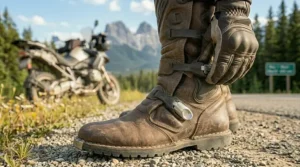
What to Expect: Real-World Ice and Winter Traction Performance in Canadian Conditions
Let me be completely direct about what motorcycle boots ice grip sole technology can and cannot do in real Canadian winter conditions, because there’s a meaningful gap between what marketing materials suggest and what physics allows.
What ice grip soles genuinely improve: On wet asphalt — a light morning frost that’s mostly evaporated, a rain-slicked surface, the first millimetre of snow that’s compacted to slush — a well-designed anti-slip rubber sole with deep lugs provides meaningfully better traction than a flat-profile street shoe. The improvement is real and noticeable when you put your foot down at a stop, when you’re manoeuvring a bike at low speed in a parking lot, or when you walk across a wet concrete pad at a fuel station.
What ice grip soles cannot do: On genuine black ice — the thin, often invisible layer that forms on Canadian roads when temperatures hover around -3°C to -1°C and moisture refreezes — no motorcycle boot with a standard rubber outsole provides reliable traction. Transport Canada’s winter driving guidance acknowledges that even vehicles with dedicated winter tires require extreme caution in black ice conditions; the agency’s winter driving safety guidance is explicit that stopping distances on ice can be ten times longer than on dry pavement.
For motorcyclists specifically, the Ontario MTO’s Motorcycles Handbook advises riders to scan the road surface well ahead for ice and snow patches, particularly in winter transition periods. The practical takeaway: boots with ice grip soles provide an important margin of safety when stationary or at low speed, but they are a complement to good riding judgment — not a substitute for it.
The shoulder season sweet spot: Where ice grip soles deliver their genuine value proposition for Canadian riders is in the shoulder seasons — April through May and September through November — when temperatures fluctuate around freezing, road conditions are unpredictable, and surfaces alternate between wet, dry, frosted, and icy. Boots with quality vulcanized rubber soles and deep tread patterns outperform standard motorcycle footwear meaningfully in these conditions.
Common Mistakes Canadian Riders Make When Buying Winter Motorcycle Boots
After reviewing hundreds of Canadian rider comments and feedback on Amazon.ca and Canadian motorcycle forums, a clear pattern of buying mistakes emerges. Here are the most costly ones to avoid:
Mistake 1: Assuming “waterproof” means warm A boot can be completely waterproof and still provide zero thermal insulation. Drystar and Gore-Tex membranes keep water out — they do not keep heat in. Canadian riders shopping for cold-weather riding (below 5°C) need to look specifically for insulated liners or plan to wear thermal riding socks. The two features are completely independent.
Mistake 2: Ignoring the CE certification gap Many Canadian riders assume that if a boot has any kind of ankle guard, it’s properly certified. The reality, as certified testing under EN 13634 demonstrates, is that uncertified “protective” features provide unknown and unverified levels of crash protection. Spending $20–$50 more for a CE-certified boot at the entry level (IRON JIA’S is a good example) provides objectively more safety assurance than a non-certified boot with visually similar features.
Mistake 3: Buying Canadian prices without checking Amazon.ca Cross-border purchasing frustration is real, but it’s often unnecessary. Amazon.ca’s motorcycle boot selection has improved significantly, and Prime-eligible boots arrive without the customs delays, cross-border warranty headaches, or potential additional duties that purchasing from Amazon.com can involve. While Canadian prices typically run 10–20% higher than US equivalents due to exchange rates and import considerations, the total cost of ownership — including hassle-free returns within Canada — often makes Amazon.ca the smarter choice.
Mistake 4: Buying for summer and discovering the problem in fall Canada’s riding season end is defined more by temperature and road conditions than by the calendar. Many riders who bought summer-oriented breathable boots in June are unpleasantly surprised when October arrives and those same boots are soaking through in Ontario rain. Buy for the worst conditions you’ll realistically encounter, not the best.
Mistake 5: Ignoring salt damage over winter storage If you ride any part of the fall season in Canada, your boots will encounter road salt. Salt crystallizes in stitching and leather grain as it dries, accelerating material breakdown. Clean boots with warm water after any salt exposure, condition leather regularly, and store away from direct heat. This single maintenance habit can double the effective lifespan of premium boots.
Long-Term Cost and Maintenance of Motorcycle Boots in Canada
Let’s talk actual cost-per-ride, because this is where the premium options justify themselves to a sceptical audience.
A pair of Alpinestars Corozal Drystar boots in the $350–$450 CAD range, maintained properly (regular conditioning, post-salt cleaning, kept away from direct heat), will realistically last 4–6 Canadian riding seasons. That’s 24–36 months of active use, across perhaps 15,000–25,000 km of actual riding. Divided across those kilometres, you’re looking at roughly $0.01–$0.03 per km in boot cost — less than your chain lube, and considerably less than your tires.
The $70–$110 CAD BORLENI or IRON JIA’S options have a realistic lifespan of 1–3 seasons under regular use, particularly given the Canadian road salt environment. The math is closer than it first appears once you factor in replacement frequency.
Maintenance costs for motorcycle boots in Canada should include: leather conditioner (approximately $15–$25 CAD annually), waterproof reproofing spray for membranes ($15–$20 CAD), and potentially replacement insoles for premium models ($20–$40 CAD). Total annual maintenance is typically $30–$60 CAD for premium leather boots — a reasonable investment to protect a $400 purchase.
For riders comparing motorcycle boots versus thick hiking boots or work boots for riding use: while a heavy work boot may feel similarly protective, CE EN 13634-certified motorcycle boots are specifically tested for the forces involved in motorcycle accidents — transverse rigidity to resist sole crushing under a bike’s weight, and ankle height retention to stay on the foot during a crash slide. A hiking boot is tested for none of these scenarios. As ICBC’s motorcycle safety guidance emphasizes, wearing proper protective gear on every ride — including appropriate footwear — meaningfully reduces injury severity.
FAQ: Motorcycle Boots Ice Grip Sole in Canada
❓ Are motorcycle boots with ice grip soles safe for riding on black ice in Canada?
❓ Do motorcycle boots with anti-slip soles ship to all Canadian provinces on Amazon.ca?
❓ What is the best motorcycle boot for spring riding in Quebec where road conditions change daily?
❓ Do Canadian regulations require specific motorcycle boot certifications?
❓ How do I maintain motorcycle boots after riding in Canadian road salt conditions?
Conclusion: Grip the Road, Own the Season
Canada’s riding calendar is compressed and unforgiving. You have roughly six to eight months in most of the country where two-wheel travel is genuinely viable, and every single one of those months — from the frost-heaved April backroads of rural Ontario to the October slicks of downtown Vancouver — demands footwear that takes traction seriously. Motorcycle boots ice grip sole technology is not about riding on ice; it’s about having the margin of confidence to put your foot down on a damp gas station forecourt at 7 AM without your stomach dropping.
The seven boots reviewed here cover the full spectrum of Canadian rider needs: from the entry-level IRON JIA’S CE-certified option that gets a new rider properly protected without financial strain, through the mid-range PROFIRST and SCOYCO options that balance waterproofing with affordability, to the Alpinestars Corozal Drystar series that represents what serious ADV and touring riders actually deserve under their feet on those long September runs through the Shield country.
The bottom line for Canadian riders: prioritize waterproofing for spring and fall use, look for vulcanized rubber soles over standard TPR for cold-weather grip retention, and don’t skip CE certification when your safety is the product being evaluated. Winter traction technology in motorcycle boots will never replace riding judgment in genuinely icy conditions — but it will absolutely make those transitional seasons safer, dryer, and more enjoyable.
✨ Don’t Miss These Exclusive Deals!
🔍 Ready to ride confidently through every Canadian season? Check current pricing and availability on these expert-selected motorcycle boots on Amazon.ca. One click could be the upgrade your feet — and your safety — have been waiting for!
Recommended for You
- Best Motorcycle Boots for Wide Feet 2026: Top 7 Picks for Canada
- Motorcycle Boot Fit Guide: 7 Picks to Stop Heel Slip (Canada 2026)
- Motorcycle Boots Buying Guide: 7 Best Picks for Canada 2026
Disclaimer: This article contains affiliate links. As an Amazon Associate, I earn from qualifying purchases. If you purchase products through these links, we may earn a small commission at no additional cost to you.
✨ Found this helpful? Share it with your friends! 💬🤗
