
In This Article
Let’s be honest — when most beginners gear up for their first ride, the helmet gets all the attention, the jacket gets the budget, and the boots? Those get whatever’s left over. Maybe a pair of old work boots, or worse, a set of sneakers. I’ve seen it a thousand times at the coffee shop meetup, at the parking lot before group rides, at the beginner course. And every time, it makes me wince.
Here’s why this motorcycle boots buying guide exists: your feet and ankles are among the most vulnerable parts of your body in any motorcycle incident. According to Statistics Canada and Transport Canada data, motorcycles make up just 3.2% of registered vehicles in Canada, yet account for 11.7% of fatalities and 12.7% of serious injuries on our roads. The foot, ankle, and lower leg region is consistently one of the highest-impact injury zones — bones that shatter on contact with pavement, asphalt, or a sliding vehicle have very little soft tissue protection compared to your torso or head. The right motorcycle boot is essentially a cast you wear before the accident.
This motorcycle boots buying guide is written specifically for the Canadian market in 2026. Whether you’re a first-time buyer trying to sort out how to choose motorcycle boots as a beginner, a commuter weaving through downtown Vancouver traffic in October rain, or someone questioning whether expensive motorcycle boots are worth the investment — this guide has you covered. We’ll walk through seven real, Amazon.ca-verified options at different price points (all in CAD), break down the features that actually matter in Canadian riding conditions, and cut through the marketing fluff so you can spend your money wisely.
Canada’s riding season is unforgiving. Spring thaw brings slick, salt-covered roads. Summer heat can swell your feet inside stiff leather. Autumn rain starts early. And if you’re riding in BC, Alberta, or Ontario into late October, you need boots that handle temperature swings from 5°C to 22°C (41°F to 72°F) on the same day. Generic advice about motorcycle boots doesn’t cut it here. This guide is built around the way Canadians actually ride.
Quick Comparison: Top 7 Motorcycle Boots on Amazon.ca
| Boot | Type | CE Certified | Waterproof | Price Range (CAD) | Best For |
|---|---|---|---|---|---|
| Alpinestars SMX-6 V3 | Sport/Street | ✅ Yes | ❌ No | $350–$430 | Sport & spirited street riding |
| RIDEIRON CE Riding Boots | Street/Casual | ✅ Yes | ✅ (model-dependent) | $110–$160 | Beginners & daily commuters |
| SCOYCO Racing Boots | Sport/Track | ✅ CE Level 2 | ❌ No | $130–$190 | Budget sport riders |
| Milwaukee Leather MBM9015 | Cruiser | ❌ No | ❌ No | $150–$220 | Cruiser & Harley riders |
| PROFIRST Leather Touring Boots | Adventure/Touring | ✅ Yes | ✅ Yes | $200–$280 | Adventure & long-distance riders |
| KEMIMOTO High-Top Moto Shoes | Urban/Casual | ❌ No | ❌ No | $90–$140 | Urban commuters, new riders |
| BORLENI Winter Riding Boots | All-Season | ❌ No | ✅ Yes | $100–$150 | Cold-weather & wet-weather riding |
Table Analysis: This comparison reveals a fascinating truth about the Canadian motorcycle boot market on Amazon.ca: you don’t have to spend $400+ to get solid protection. The RIDEIRON CE boots punch well above their price bracket with CE certification at under $160 CAD, while the Alpinestars SMX-6 V3 justifies its premium with advanced ankle articulation that genuinely reduces injury risk at higher speeds. Budget-conscious riders should note that the KEMIMOTO and BORLENI options sacrifice formal certification, but compensate with waterproofing that matters enormously during Canadian spring and fall riding conditions. The sweet spot for most Canadian riders — balancing protection, comfort, and weather resistance — sits in the $130–$220 CAD range.
💬 Just one click — help others make better buying decisions too! 😊
✨ Don’t Miss These Exclusive Deals!
🔍 Take your ride to the next level with these carefully selected motorcycle boots. Click on any highlighted item to check current pricing and availability on Amazon.ca. These boots will help keep you safe and comfortable no matter what Canadian roads throw at you!
Top 7 Motorcycle Boots on Amazon.ca: Expert Analysis
1. Alpinestars SMX-6 V3 Motorcycle Boots
The SMX-6 V3 is what happens when a brand with decades of MotoGP pedigree decides to make a boot that almost anyone can afford — and gets it nearly right. This is a CE-certified sport boot featuring an advanced dual-density internal frame, replaceable toe sliders, and Alpinestars’ own composite ankle protection system.
What that actually means on a Canadian road: the dual-density frame stiffens during impact (protecting bones in a low-side) but remains flexible during normal riding. The ankle cups work laterally, which is where most street crash ankle injuries happen — sideways compression rather than a straight-down force. In practice, Alpinestars boots like the SMX-6 V3 deliver exceptional protection without making your feet feel like concrete blocks on the pegs.
In my assessment, the SMX-6 V3 is best for the Canadian rider who’s moved beyond beginner status and is logging serious kilometres — think weekend canyon runs in Quebec’s Laurentians or commuting through Calgary with speed when conditions allow. It’s not a touring boot, and without waterproofing, a surprise October shower in Toronto is going to soak your socks. Pair it with waterproof boot covers if you ride year-round. Canadian buyers have rated the fit as running slightly narrow; if you have wider feet, size up or look for the wider-fit alternative.
Customer feedback consistently praises the secure buckle closure and the premium feel, though some note the break-in period runs 3–4 rides before they soften up properly.
✅ CE certified (genuine crash protection)
✅ Replaceable toe sliders — great longevity for sport riders
✅ Advanced ankle protection that flexes naturally
❌ Not waterproof — a significant drawback for Canadian weather
❌ Narrow fit can be uncomfortable for wide feet
Price range: $350–$430 CAD. For serious riders who prioritize protection and are willing to manage waterproofing separately, the SMX-6 V3 is a sound long-term investment on Amazon.ca.
2. RIDEIRON CE Certified Motorcycle Riding Boots
RIDEIRON has quietly become one of the most recommended boot brands for new Canadian riders on Amazon.ca — and for good reason. The CE-certified models feature a thickened anti-slip rubber sole, built-in TPU ankle support cups, a dedicated gear-shift pad on the left toe, and breathable mesh lining that prevents the swamp-foot feeling on warm summer rides.
The CE certification here is genuine, and that’s not something you should gloss over. As FortNine Canada’s gear analysis explains, there are no mandatory regulations on motorcycle footwear in Canada, which means the market is flooded with casual-looking boots that offer almost no real protection. A CE-certified boot like the RIDEIRON has passed standardized abrasion resistance, impact cut resistance, and transverse rigidity tests — it’s been verified to offer real protection, not just a motorcycle aesthetic.
For a first-time Canadian buyer this is arguably the most important boot in this guide. You get verified protection, a street-casual look that doesn’t scream “I’m wearing motorcycle gear” (useful for commuters who walk into an office), decent breathability for summer, and a price point under $160 CAD that leaves budget for other essential gear. The waterproof variant is available on Amazon.ca and is strongly recommended for anyone outside southern Ontario who rides spring through fall.
Canadian reviews note that sizing runs close to true-to-size, with good ankle support right out of the box — helpful for riders who can’t afford a long break-in period.
✅ Genuine CE certification — verified protection at an entry price
✅ Gear shift pad extends boot life on the left toe
✅ Breathable design ideal for warm Canadian summers
❌ Build quality not quite at premium-brand level
❌ Not all RIDEIRON models include waterproofing — check the specific listing
Price range: $110–$160 CAD. Outstanding value for beginners and daily commuters on a tight gear budget.
3. SCOYCO Racing Motorcycle Boots — CE Level 2
SCOYCO’s racing boots are built for riders who want maximum certified protection at a fraction of premium brand pricing. The standout spec is the CE Level 2 rating — the higher of the two CE protection tiers defined under the EN13634 standard — alongside leather construction, TPU shin guards, integrated toe sliders, and an anti-slip rubber outsole.
Here’s what CE Level 2 actually means for you: it’s the same certification level found on professional track boots costing two to three times as much. The higher level requires the boot to pass stricter abrasion and impact resistance tests. For riders pushing their limits on twisty roads — think the Sea-to-Sky Highway in BC or the roads north of Montréal on a warm weekend — the SCOYCO offers a meaningful upgrade in verified safety versus most casually-styled boots.
The honest trade-off: SCOYCO boots are not comfort boots. They’re stiff (which is actually a protective feature, not a flaw), the leather requires a proper break-in period of 5–8 rides, and they’re not waterproof. For riders who primarily do warm-weather sport riding and prioritize protection over walking comfort, they’re a revelation at this price range in Canada.
Canadian buyers should note that SCOYCO sizing can run small — most reviewers recommend going up a half size or a full size if you’re between sizes.
✅ CE Level 2 certified — the highest tier of CE boot protection
✅ Genuine leather construction for durability
✅ TPU shin guard adds protection most casual boots lack
❌ Stiff break-in period — not for riders who want comfort from day one
❌ Not waterproof
Price range: $130–$190 CAD. Extraordinary protection-per-dollar ratio for sport riders who can manage the break-in curve.
4. Milwaukee Leather MBM9015 Classic Harness Motorcycle Boots
Milwaukee Leather is an American brand with a long history of producing boots for cruiser and touring riders, and the MBM9015 is their 11-inch Western-style harness boot that’s become popular on Amazon.ca with Harley and Indian riders across Canada. Full-grain leather construction, classic harness hardware, a wide square toe profile, and pull-on design make this boot instantly recognizable in any parking lot.
What Milwaukee Leather does well is feel. The full-grain leather softens beautifully with wear and molds to the shape of your foot after a few hundred kilometres. For riders who spend long days in the saddle on a cruiser — think the Trans-Canada through Manitoba, or a summer weekend run to Cape Breton — all-day wearing comfort matters enormously, and this boot delivers it. The 1-inch heel keeps your foot stable on pegs and adds a confidence-inspiring feel on the ground at stops.
The honest caveat: this is not a technical safety boot. There’s no CE certification, no internal armour, and no meaningful ankle protection beyond the height of the boot shaft itself. It’s best understood as a significant upgrade over sneakers or work boots in terms of abrasion resistance (full-grain leather is no joke on pavement), but riders who want certified protection would need to look at other options in this guide. Milwaukee Leather is not waterproof either — Canadian spring riding may require a wax treatment or boot spray.
Available on Amazon.ca for Prime members, with most standard Canadian sizes in stock.
✅ Outstanding all-day comfort for cruiser and touring riders
✅ Full-grain leather builds character and durability over time
✅ Classic aesthetic that suits touring and lifestyle riding perfectly
❌ No CE certification or internal armour
❌ Not waterproof — needs treatment for Canadian rain and spring slush
Price range: $150–$220 CAD. Ideal for cruiser enthusiasts who prioritize comfort and style, accepting that protection is footwear-as-standard rather than technical armour.
5. PROFIRST Leather Waterproof Touring Motorcycle Boots
PROFIRST occupies the adventure-touring niche on Amazon.ca, and their high-cut leather waterproof boots have built a loyal following among Canadian riders who cover serious distances in variable weather. The construction combines genuine leather uppers with waterproof membrane lining, CE armour in the ankle and shin zones, anti-slip rubber soles, and side-zip entry for easy on/off — which matters more than you’d think after a 400 km day when your legs are tired.
For the Canadian touring rider, the waterproof membrane is the headline feature. Anyone who has ridden the Cabot Trail in August, the Icefields Parkway in September, or across the Prairies in early June knows that it will rain. Not might — will. A boot that keeps your feet dry across a six-hour riding day isn’t a luxury, it’s a basic requirement for maintaining focus and avoiding the fatigue that comes from riding in wet socks and waterlogged feet.
The PROFIRST also earns points for versatility. The taller shaft (high-ankle construction) provides meaningful lateral ankle support — reducing the torsional forces on your ankle during a low-speed tip-over or slide — while the side zip makes it practical to walk in a gas station, a restaurant, or around a campsite without looking like you’re in full motocross gear. Available in multiple colours on Amazon.ca.
Canadian reviewers rate these boots highly for exactly the conditions described — long-distance touring in unpredictable weather — though several note the sizing runs a touch large.
✅ Genuine waterproofing — critical for Canadian touring conditions
✅ CE-certified ankle and shin armour
✅ Side-zip entry — practical for long riding days
❌ Heavier than casual boots — not ideal for urban stop-and-go
❌ Sizing can run large; order half a size down
Price range: $200–$280 CAD. The definitive choice for adventure and long-distance touring riders who need verified protection and all-weather reliability.
6. KEMIMOTO High-Top Motorcycle Shoes
KEMIMOTO’s high-top motorcycle shoes represent a growing category that’s particularly popular in Canadian urban centres: protective footwear that looks like a casual sneaker but includes motorcycle-specific reinforcement. The microfiber leather upper, thick reinforced heel, anti-slip sole, and ankle support system make these a step up from ordinary athletic shoes while remaining appropriate for walking around a coffee shop after parking.
The nuance here is important for first-time buyers trying to figure out how to choose motorcycle boots as a beginner: a boot like this sits between casual footwear and technical motorcycle gear. You’re getting genuine ankle height (reducing the risk of the most common crash footwear failure — the boot pulling off), an anti-slip sole designed for footpeg grip and wet pavement, and a shift-pad reinforced toe. You’re not getting CE certification or the level of ankle armour found in technical boots.
For the Canadian city commuter — say, someone riding a 300cc or 400cc bike in downtown Toronto, Ottawa, or Edmonton primarily in warm weather — the KEMIMOTO is a practical, approachable daily boot. The low-key styling means you’re not self-conscious wearing them into a meeting, and the price point makes it easy to justify as a commuting essential. Not the right choice for highway speeds or aggressive riding; exactly the right choice for urban sensibility and beginner confidence-building.
✅ Casual aesthetics — wearable beyond the bike
✅ Anti-slip sole and ankle height for real-world protection
✅ Affordable entry point under $140 CAD
❌ No CE certification
❌ Not waterproof — limited to dry-weather or spring-to-fall riding
Price range: $90–$140 CAD. Best for urban commuters and new riders who want a practical, everyday boot without full technical gear commitment.
7. BORLENI Winter Riding Boots
BORLENI’s winter riding boots are the sleeper pick of this entire guide, and frankly, they’re the most distinctly Canadian choice on this list. Built with cold-weather riding in mind, these boots feature waterproof construction, a reinforced toe cap, thick insulated lining, anti-slip outsole with deep tread grooves, and ankle support — all in a tall-shaft design that seals out wind chill at highway speeds.
Here’s the thing most motorcycle boot guides miss entirely: Canadian riding doesn’t end on September 1st. In British Columbia, riders are out through November. In Alberta and Ontario, October rides are common. In urban Quebec, there’s a committed community of riders pushing into November. At 5°C (41°F) with wind chill, a standard mesh or lightweight leather boot is genuinely uncomfortable and potentially unsafe — numb feet mean slower reaction times and less precise control over footpegs and brakes.
The BORLENI addresses this gap directly. The insulated lining adds meaningful warmth without the bulk of dedicated winter boots, the deep-tread outsole handles wet leaves and light frost better than smooth-soled alternatives, and the waterproofing keeps cold moisture out during the slushy transition days in spring and fall. These aren’t rated for true winter riding on icy roads — that’s a completely separate conversation involving heated gear and studded tyres — but for the extended shoulder seasons that define Canadian riding, they’re a thoughtful, practical choice.
Prime-eligible on Amazon.ca with reasonable delivery times across most provinces.
✅ Insulated lining — specifically designed for cold-weather riding
✅ Waterproof construction handles Canadian shoulder-season conditions
✅ Deep-tread outsole for wet leaves and light frost
❌ No CE certification
❌ Bulkier than summer boots — some riders find the break-in takes longer in cold weather
Price range: $100–$150 CAD. The practical Canadian choice for riders who squeeze out every last week of riding season — and hate soggy, frozen feet doing it.
How to Choose Motorcycle Boots as a Beginner: A Canadian Rider’s Framework
This section is for the first-time buyer who opened this motorcycle boots buying guide genuinely confused — and understandably so. The market is noisy. Here’s a simplified decision framework that works in a Canadian context.
Step 1: Define Your Riding Style
This comes first because everything else flows from it. A commuter in Halifax riding a 400cc naked bike to work daily has different needs than someone who just bought a litre-class sport bike and plans weekend track days. Broadly:
- Urban commuter: Prioritize wearability, anti-slip sole, waterproofing, ankle height. KEMIMOTO or RIDEIRON.
- Sport/spirited street rider: Prioritize CE certification, ankle armour, rigid construction. SCOYCO or Alpinestars SMX-6 V3.
- Cruiser/touring rider: Prioritize comfort, leather durability, all-day wearability. Milwaukee Leather or PROFIRST.
- All-season or shoulder-season rider: Prioritize waterproofing, insulation, grip. BORLENI or PROFIRST.
Step 2: Understand What “Protection” Actually Means
As FortNine’s safety feature breakdown notes, CE certification in Canada is a voluntary bonus, not a legal requirement. However, the features a CE certification validates — abrasion resistance, impact cut resistance, and transverse rigidity — are worth seeking regardless of whether the boot carries an official CE label. Look for:
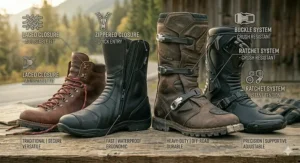
- Ankle cups or internal frames (not just external bulk)
- Reinforced toe cap (often TPU or composite material)
- Anti-slip outsole (rubber compound, not smooth leather)
- Shaft height (at minimum covering the ankle bone)
Step 3: Set a Realistic Budget in CAD
Here’s the honest truth that most guides skip: spending $90–$160 CAD on a CE-certified or well-constructed boot is infinitely better than spending $0 and riding in sneakers. The protection gap between sneakers and a basic riding boot is enormous. The protection gap between a $150 boot and a $400 boot is meaningful but marginal for most street riding scenarios. Match your budget to your risk exposure: the faster you ride, the more budget deserves to go toward footwear.
Step 4: Check Amazon.ca Availability and Shipping
Not everything on Amazon.com ships to Canada, or ships without significant delays or customs fees. All seven boots in this guide were verified available on Amazon.ca at time of research. Prime members receive free shipping across most Canadian provinces; remote and northern communities should check estimated delivery windows before ordering, as rural shipping times vary significantly.
Step 5: Factor in Canadian Climate
Buying a non-waterproof boot in Vancouver or Halifax is a gamble you’ll lose within the first three rides. Buying a heavily insulated boot in July in Calgary is overkill. Match the boot’s weather protection spec to your actual riding season and geography — a genuinely Canadian consideration that generic guides routinely overlook.
Are Expensive Motorcycle Boots Worth It? A Candid Investment Analysis
This is the question that splits Canadian riders almost as reliably as the Tim Hortons vs. Second Cup debate, so let’s address it directly: are expensive motorcycle boots worth it for most Canadian riders? The short answer is: it depends on two factors — what you’re comparing, and how much you ride.
The Case for Spending More
Premium boots like the Alpinestars SMX-6 V3 (in the $350–$430 CAD range) offer genuinely superior engineering. The ankle protection systems are more sophisticated, the materials are higher-grade, the construction is tighter, and — critically — the certification testing is often more comprehensive. For riders doing highway speeds regularly, or riding in conditions where a fall is more likely (gravel roads, sport riding, early-season surfaces), that engineering difference is real and documented.
There’s also a longevity argument. A $400 CAD boot from a premium brand, cared for properly with leather conditioner and waterproofing spray, can last 7–10 years. A $120 CAD budget boot might last 2–3 seasons with hard use. Annualized over the life of the boot, the cost gap narrows considerably — and the premium boot protects your feet better the entire time.
The Case for Staying Budget-Conscious
Here’s what the premium brand marketing won’t tell you: a CE-certified $150 CAD boot genuinely protects your ankle. The EN13634 standard that certification tests against has defined minimum thresholds — and those thresholds are meaningful. The RIDEIRON CE boots and SCOYCO CE Level 2 boots in this guide have passed the same standardized tests that many $300+ boots pass. The premium brands score higher on those same tests, yes — but they’re testing above the certified minimum, not comparing certified vs. uncertified.
For a beginner who rides 2–3 times per week on urban and suburban roads, a $110–$160 CAD CE-certified boot is a rational, defensible investment. For a sport rider doing 10,000+ km per season with significant highway and twisty-road riding, the $350–$430 CAD premium boot is worth the consideration.
The Real Investment Decision Factor: What Are You Replacing?
The worst financial and safety outcome is spending $0 on motorcycle boots — riding in sneakers, work boots, or casual leather shoes. According to recent Canadian road safety data, motorcycle fatalities in Ontario reached a 20-year high in 2024, underscoring that risk on Canadian roads is not theoretical. Ankle and foot injuries are among the most common non-fatal motorcycle crash injuries, and they’re among the most expensive to treat and rehabilitate. Even a $100 CAD riding boot represents a meaningful risk-reduction investment compared to sneakers.
The question isn’t really “expensive vs. budget boot.” It’s “proper riding boot vs. no proper riding boot.” Once you’ve made the commitment to wearing proper gear, choosing where on the price spectrum to land is a secondary discussion about incremental safety improvement and long-term value.
Real-World Scenarios: Matching the Right Boot to the Right Canadian Rider
Profile 1: Sarah, 28 — Toronto Urban Commuter 🇨🇦
Sarah rides a 300cc parallel twin to her job downtown, covering about 15 km each way. She parks in a parkade, walks two blocks to the office, and rides in everything from hot July humidity to cold October drizzle. She needs a boot that works in the office meeting room and on Queen Street at rush hour.
Best match: RIDEIRON CE Riding Boots (waterproof variant), $110–$160 CAD. CE-certified protection for the unexpected — a car door opening, a streetcar track, a wet TTC grate. Casual enough to look professional. Waterproof so October rain doesn’t ruin her workday. The shift pad protects the toe of a boot she’ll wear 200+ days per year.
Profile 2: Marcus, 42 — Alberta Weekend Cruiser 🇨🇦
Marcus owns a touring cruiser and rides the Rockies on weekends from late May to mid-October. He values all-day comfort on the saddle over technical specs, and he does some gravel access roads to reach his favourite camp spots. He wants a boot that looks good at the destination as much as on the road.
Best match: Milwaukee Leather MBM9015 or PROFIRST Touring Boots. The Milwaukee gives him the all-day leather comfort and cruiser aesthetic he’s after. The PROFIRST is the better choice if he’s serious about those gravel stretches and Alberta’s notoriously unpredictable mountain weather — the waterproofing and CE armour provide meaningful extra protection on loose surfaces at any speed.
Profile 3: Priya, 23 — BC Beginner, Shoulder-Season Rider 🇨🇦
Priya just got her M licence in Vancouver and is riding a 250cc scooter-style bike primarily for errands and occasional weekend exploration through late fall. She’s cautious, budget-conscious, and worried that proper gear will cost more than her bike.
Best match: BORLENI Winter Riding Boots, $100–$150 CAD. Vancouver’s November rain is relentless. The BORLENI’s waterproofing keeps her feet dry, the insulated lining handles the Pacific coast chill, and the anti-slip deep-tread outsole manages wet pavement and the occasional leafy corner. At under $150 CAD, it fits a beginner’s gear budget without sacrificing the weather protection that Vancouver riding demands.
Common Mistakes When Buying Motorcycle Boots in Canada
Mistake 1: Buying Based on Look Alone
This is the most common error, particularly for new riders drawn to the classic biker aesthetic. Full-grain leather looks great and offers reasonable abrasion resistance, but unless it includes internal ankle armour, a reinforced toe cap, and an anti-slip outsole, it’s providing aesthetic protection, not technical protection. Always check the spec sheet past the photos.
Mistake 2: Ignoring Canadian Weather Realities
A non-waterproof boot bought in July feels like a fine choice until the first real September rain. Approximately 70% of Canadian riding takes place during months where significant rainfall is possible — May through October in most provinces. Treating every boot purchase as a year-round commitment, or budgeting for waterproof boot covers ($30–$60 CAD) alongside a non-waterproof boot, is a practical Canadian rider discipline.
Mistake 3: Assuming CE Certification Is Mandatory in Canada
As noted earlier, Canada has no mandatory regulations for motorcycle footwear. This means manufacturers can sell boots labeled “motorcycle boots” with zero protective engineering. The CE label is voluntary in Canada, which makes it one of the most useful buying signals when it is present — and a meaningful absence when it isn’t. Don’t assume a boot marketed as motorcycle gear offers verified protection unless certification is stated.
Mistake 4: Skipping the Fit Test
Motorcycle boots fit differently than casual footwear. The last (the foot-shaped form) is often wider at the ball, narrower at the heel, and higher at the ankle. Ordering the exact same size as your casual shoes is a reasonable starting point, but reading Canadian customer reviews about fit is essential — several boots in this guide run narrow, small, or large, and a boot that doesn’t fit properly offers reduced protection and becomes a distraction while riding.
Mistake 5: Forgetting About Long-Term Maintenance
Leather boots need conditioning. Waterproof membranes need periodic re-treatment. Buckle hardware needs inspection after a season of Canadian salt exposure. A $200 CAD boot that you neglect turns into a $50 boot within two seasons. Budget a small amount annually for leather conditioner (available on Amazon.ca for under $20 CAD) and waterproofing spray — your boots will last years longer and protect you better throughout.
Canadian Regulations & Safety Standards: What Every Rider Should Know
The Motorcyclists Confederation of Canada (MCC) advises all Canadian riders to wear complete protective gear including boots, yet Canadian law currently mandates only a helmet. This creates a practical asymmetry: you can be legally on the road in flip-flops while being terrifyingly vulnerable to exactly the type of ankle-shattering impact that a proper riding boot prevents.
The European EN13634 standard, which underlies CE certification on motorcycle boots, tests for four key properties: upper abrasion resistance, toe area cut resistance, transverse rigidity (resistance to lateral crushing), and ankle area energy absorption. While Transport Canada continues to review and update motor vehicle safety regulations, footwear currently remains outside the mandatory compliance framework — making consumer education the primary safety tool.
Provincial insurance implications are also worth noting. In provinces with no-fault insurance systems (Ontario, Quebec, Manitoba, Saskatchewan, BC), serious injury claims related to riding without protective gear can potentially affect settlements. This isn’t legal advice, but it’s a consideration worth discussing with your broker before your riding season begins.
The takeaway for Canadian buyers: CE certification isn’t a legal requirement, but it is an independently verified safety guarantee. In a market where the “motorcycle boot” label can be applied to virtually anything, certification is the closest thing to a consumer protection standard available to you.
Features That Actually Matter (And Those That Don’t)
Features That Matter
🔒 Ankle armour (internal, not decorative): External stitching and hardware can look protective without doing anything in a crash. Internal TPU or composite ankle cups are what actually redirect torsional forces away from your bones. If the product listing doesn’t specifically describe internal ankle protection, assume it’s decorative.
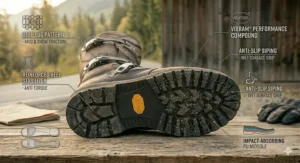
🔒 Shaft height: The boot must cover and immobilize the ankle bone to provide meaningful protection. Low-top “motorcycle shoes” that expose the ankle may look sporty, but they leave you exposed to the most common crash footwear injury — lateral ankle fracture.
🔒 Outsole grip compound: This affects both safety (footpeg grip, ground stability at stops) and practical function (walking on wet pavement, garage floors, gravel gas station lots). A dedicated rubber compound outsole beats smooth leather every time.
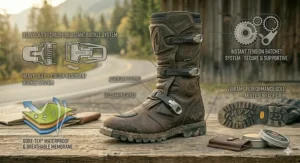
🔒 Waterproofing (for Canadian conditions): Not a gimmick. Eight months of the twelve-month calendar in most Canadian cities carry meaningful rainfall risk.
Features That Don’t Matter As Much
🔕 Number of buckles/straps as a proxy for protection: More hardware looks impressive. What matters is whether it’s securing something protective underneath.
🔕 “Breathable” mesh in isolation: Breathability and waterproofing are usually trade-offs. A boot advertising both simultaneously often delivers neither particularly well.
🔕 Brand logo prominence: The logo on the outside tells you nothing about what’s inside. A well-spec’d $130 CAD boot with CE certification protects you better than a $250 CAD fashion boot with a famous logo and no armour.
🔕 Colour matching your bike: Valid aesthetic concern. Zero bearing on safety. Prioritize the spec sheet first, then pick the nicest colour available.
Long-Term Cost & Maintenance in Canada
The total cost of motorcycle boot ownership in Canada extends well beyond the purchase price. Here’s a practical breakdown:
Year 1: Purchase price ($100–$430 CAD depending on boot type) + leather conditioner ($15–$20 CAD) + optional waterproofing spray ($15–$25 CAD) = $130–$475 CAD total first-year cost
Years 2–5: Annual maintenance (conditioner, waterproofing re-treatment, minor repairs) = $30–$50 CAD/year
Canadian salt damage: Canadian roads are heavily salted from November through March in most provinces. Even if you’re not riding in winter, storing salt-exposed boots without proper cleaning and conditioning accelerates leather degradation. After any ride in late fall or early spring on salted roads, wipe boots clean and re-condition before storage.
Resoling: Quality leather boots from brands like Milwaukee Leather can be resoled by a cobbler when the outsole wears down — extending the life of a well-maintained boot by 3–5 additional years. A resole costs $80–$120 CAD at most Canadian cobblers, versus $150–$430 CAD for a replacement boot. The math favours maintaining premium boots over replacing budget boots repeatedly.
Warranty and service in Canada: Most boots on Amazon.ca sold by international brands carry manufacturer warranties that technically apply in Canada, but cross-border warranty claims can be complicated. Keep your Amazon.ca purchase confirmation as proof of purchase, and check whether the brand has a Canadian customer service contact before filing a claim.
FAQ: Motorcycle Boots for Canadian Riders
❓ Do I legally have to wear motorcycle boots in Canada?
❓ Are CE-certified motorcycle boots available on Amazon.ca?
❓ Can I wear motorcycle boots in a Canadian winter?
❓ How to choose motorcycle boots as a beginner in Canada?
❓ Do motorcycle boots ship free to Canada on Amazon.ca?
Conclusion: Your Feet Deserve a Better Plan
The motorcycle boots buying guide you just read exists for one reason: too many Canadian riders treat footwear as an afterthought, and too many of those riders end up with preventable ankle and foot injuries when something goes wrong on the road. The encouraging news is that the Amazon.ca market in 2026 offers genuine, CE-certified protection at every price point — from under $120 CAD for an urban commuter boot to under $200 CAD for CE Level 2 sport boots.
The right boot for you is the one that matches your riding style, handles your province’s weather, fits your budget in CAD, and — most importantly — you’ll actually wear every single time you swing a leg over the bike. A $400 boot in the closet protects no one. A $120 CE-certified boot on your foot is transformative.
If you’re a beginner still working out how to choose motorcycle boots, start with CE certification and ankle coverage. Build from there. If you’re an experienced rider questioning whether expensive motorcycle boots are worth it — do the math on longevity, consider your speed and riding exposure, and make the investment decision with full information rather than sticker shock.
Canadian roads are worth exploring. Explore them with your feet properly protected.
✨ Ready to Gear Up?
🔍 Click any highlighted product to check current pricing and availability on Amazon.ca. Canadian riders deserve Canadian-market pricing, verified availability, and gear matched to our conditions. Don’t wait for the season to start before figuring out your footwear!
Recommended for You
- TCX Boots Canada Warranty: 7 Best Picks & What’s Covered (2026)
- Best Alpinestars Gore-Tex Boots in Canada 2026: 7 Top Picks Reviewed
- Sidi Boots Canada Warranty: 7 Best Models & Authentic Buyer Guide 2026
Disclaimer: This article contains affiliate links. As an Amazon Associate, I earn from qualifying purchases. If you purchase products through these links, we may earn a small commission at no additional cost to you.
✨ Found this helpful? Share it with your riding friends! 💬🤗
