

In This Article
Ask ten riders about merino wool vs synthetic base layer motorcycle gear and you’ll get eleven opinions, usually delivered at a gas station with cold hands and stronger feelings than the topic probably deserves. That’s fair, though — what you wear against your skin decides whether a two-hour ride ends in “that was glorious” or “I can’t feel my toes.” A base layer sits between your body and everything else: your jacket, your riding pants, your armour, your dignity. Get it wrong and every other piece of expensive gear you own works twice as hard for half the result.

This guide breaks down the real trade-offs between natural and synthetic fabrics for riders, using actual products, real specs, and honestly summarized review sentiment rather than marketing copy. Merino wool is a fine natural fibre that regulates temperature and resists odour even after days of wear, while synthetic blends built around polyester, nylon, or proprietary microfibers like Dryarn tend to dry faster and shrug off abrasion better. Neither one is objectively “better” — the right call depends on your climate, your commute length, and how often you’re willing to do laundry. We’ll walk through seven real products across budget, mid-range, and premium tiers, then get into the comparisons, the maintenance routines, and the mistakes that quietly ruin an otherwise good riding kit.
Quick Comparison Table
Before diving into the full product breakdown, here’s a snapshot of how merino wool and synthetic base layers stack up on the criteria that actually matter to riders.
| Criteria | Merino Wool | Synthetic (Polyester/Nylon Blends) | Best For |
|---|---|---|---|
| Warmth when damp | Retains insulating value even wet | Loses some warmth once soaked | Merino for unpredictable weather |
| Odour control | Naturally resists bacteria for days | Needs washing sooner, even with silver-ion treatments | Merino for multi-day tours |
| Drying speed | Slower, absorbs up to 30% of its weight in moisture | Fast-drying, wicks surface moisture quickly | Synthetic for hot, sweaty commutes |
| Durability under armour friction | More delicate, needs gentler care | Handles repeated abrasion and washing well | Synthetic for daily track or off-road use |
| Price range (CAD) | Generally higher per piece | Wide range, budget-friendly options common | Synthetic for cost-conscious starter kits |
The pattern here is fairly consistent with what independent motorcycle gear reviewers have found when directly comparing the two fibre types side by side under riding conditions. If you ride mostly short, sweaty commutes in a hot climate, synthetic usually wins on comfort. If you’re doing multi-day touring where laundry access is unpredictable, merino wool starts looking like the smarter investment, and this trade-off shapes almost every buying decision in this guide.
💬 Just one click — help others make better buying decisions too!😊
Top 7 Motorcycle Base Layers: Expert Analysis
We’ve grouped these seven real products across budget, mid-range, and premium tiers, covering both merino wool and synthetic construction, so you can match the material to your riding style rather than the other way around.
1. Icebreaker Merino 200 Oasis Long Sleeve Crewe — best all-round merino for cool-to-cold riding
The Icebreaker Merino 200 Oasis Long Sleeve Crewe is often treated as the reference point other merino base layers get measured against, and after digging into the spec sheet it’s easy to see why. Built from 100% merino wool at a 200 g/m² fabric weight with an 18.9-micron fibre diameter, it sits in the sweet spot between too-thin-to-matter and too-thick-to-breathe. Underarm gussets and offset shoulder seams matter more than they sound: on a bike, your shoulders are constantly rotating against a jacket, and seams sitting in the wrong spot create hot spots after an hour in the saddle.
Based on the spec comparison, this weight class works best for riders in shoulder-season temperatures — think 5°C to 15°C — rather than deep winter, where a heavier merino option pulls ahead. Reviewers consistently report that the fit runs true to size with a slightly relaxed crew neck, and testers have noted it “hits the sweet spot” between insulation and breathability without feeling delicate. The soft, next-to-skin comfort also means fewer riders report the itchiness sometimes associated with cheaper wool blends.
Pros:
- ✅ 100% merino wool resists odour across multi-day rides
- ✅ Flatlock seams and gussets reduce chafing under armour
- ✅ Versatile 200 g/m² weight suits three-season riding
Cons:
- ❌ Slower to dry than synthetic options after heavy sweating
- ❌ Premium price compared to budget merino alternatives
At around C$130-C$160 per piece, the Icebreaker Merino 200 Oasis Long Sleeve Crewe isn’t the cheapest merino option here, but the build quality and brand consistency make it a reasonable value pick for riders who want one base layer that works across most of the riding season.
2. Smartwool Classic Thermal Merino Crew — warmest merino option for deep winter touring
When temperatures drop hard, the Smartwool Classic Thermal Merino Crew is built for exactly that scenario. At a 250 g/m² interlock knit — noticeably heavier than most competitors in this list — it’s constructed from 100% merino wool with flatlock seams and a slim, layering-friendly fit. The extra grams of wool per square metre translate directly into more trapped air, which is what actually generates warmth in any insulating layer, not the fabric itself.
What most buyers overlook about heavyweight merino is that it comes with a real trade-off: reviewers have noted that while the Classic Thermal Merino is luxuriously warm, its thickness makes it “somewhat problematic for higher-output activities” where you’re generating significant body heat. For a motorcyclist sitting relatively still at highway speed with wind chill working against you, that’s usually a feature rather than a flaw — you’re not sweating from exertion the way a runner or skier would be, so the extra insulation earns its keep. Aggregated reviewer sentiment also points to durability concerns, with some buyers noting merino generally wears less well than synthetics under repeated abrasion.
Pros:
- ✅ 250 g/m² weight delivers serious cold-weather insulation
- ✅ Slim fit layers cleanly under a riding jacket
- ✅ Odour resistance holds up across long touring days
Cons:
- ❌ Can feel too warm for stop-and-go city riding
- ❌ Less durable long-term than comparable synthetic layers
Expect to pay in the C$120-C$150 range for the Smartwool Classic Thermal Merino Crew, which places it firmly in premium territory — justified if sub-zero touring is a regular part of your riding calendar.
3. Merino.tech 100% Merino Wool Base Layer Set — best value merino wool base layer
If the price tags above gave you pause, the Merino.tech 100% Merino Wool Base Layer Set is worth a close look. It’s built from superfine 17.5-micron merino wool — finer than most human hair, which is why it avoids the itch factor associated with coarser wool — and it’s offered across three fabric weights (165, 250, and 320 g/m²) so you can match the garment to your actual riding season instead of buying one compromise weight. The set is OEKO-TEX certified against harmful substances and RWS certified, meaning the wool is traceable to farms audited for animal welfare standards.
Here’s what the spec sheet won’t tell you outright: buying a mid-tier merino brand instead of a flagship label doesn’t automatically mean a worse fabric, since the raw material — fine-micron merino fibre — is largely similar across brands at this weight class. The main differences tend to show up in stitching precision and long-term shape retention rather than day-one comfort. Riders looking for the best value merino wool base layer in this category consistently point to this set as the entry point that doesn’t feel like a compromise on the wool itself.
Pros:
- ✅ Three weight options match seasonal riding needs
- ✅ Noticeably lower price than flagship merino brands
- ✅ OEKO-TEX and RWS certifications confirm sourcing standards
Cons:
- ❌ Fewer moto-specific fit features like underarm gussets
- ❌ Brand has a smaller review history than legacy wool makers
At roughly C$90-C$120 for a top-and-bottom set, the Merino.tech 100% Merino Wool Base Layer Set is the clearest budget-conscious entry point into merino wool on this list, especially for riders who want to try natural fibre before committing to premium pricing.
4. KLIM Aggressor Shirt 2.0 — best synthetic for powersports-specific durability
Built specifically “engineered for powersports” rather than adapted from general outdoor gear, the KLIM Aggressor Shirt 2.0 leans into what synthetic fabric does best: handling repeated abuse. The blend runs roughly 90% polyester and 10% spandex, giving it four-way stretch that moves with your riding position rather than fighting it. Unlike merino, this fabric is engineered primarily for fast moisture transport rather than moisture absorption, pulling sweat off the skin and pushing it toward the outer surface where it can evaporate quickly.
Based on the spec comparison, this matters most for riders who generate a lot of heat — off-road and adventure riders standing on pegs, working the bike physically, sweating harder than a highway cruiser would. Reviewers describe the fit as loose despite the spandex content, and note it handles moisture “very well with a quick drying time and decent moisture dispersion.” That loose fit is worth flagging for buyers used to compression-style synthetics; it’s closer to a technical T-shirt than a second skin, which some riders prefer under bulkier winter jackets.
Pros:
- ✅ Fast-drying synthetic blend suits high-exertion riding
- ✅ Four-way stretch supports full range of motion
- ✅ Purpose-built for powersports layering systems
Cons:
- ❌ Looser fit may bunch under tight-fitting armour
- ❌ Lacks merino’s natural multi-day odour resistance
Pricing typically lands in the C$90-C$120 range, positioning the KLIM Aggressor Shirt 2.0 as a mid-to-premium synthetic pick for riders prioritizing durability and moisture management over natural fibre comfort.
5. REV’IT! Airborne 2 Base Layer — best seamless fit for street and sport riders
The REV’IT! Airborne 2 Base Layer takes a different approach to synthetic construction, built from hypoallergenic Dryarn microfiber using 3D round knitting on a circular knitting machine. What that means practically is a garment with dramatically fewer seams than a standard cut-and-sew base layer, which matters directly under armoured riding pants where every seam is a potential pressure point against hip and knee armour. The form-fitted design is also intended to keep your outer jacket or trousers from sticking to your skin, which sounds minor until you’re peeling off gear after a hot, sweaty ride.
What most buyers overlook about seamless knitting is that it isn’t just a comfort feature — fewer seams also means fewer failure points over the garment’s lifespan, since drop stitches and seam blowouts are common wear issues on cheaper base layers. The circular knit construction also enables built-in venting sections in some Airborne variants, letting the fabric’s own structure handle airflow rather than relying purely on mesh panels. Aggregated feedback on the line describes the fabric as comfortable and effective at moisture dispersion, though at least one retailer listing shows a modest overall customer rating, suggesting fit consistency varies somewhat by size.
Pros:
- ✅ Seamless 3D knit reduces pressure points under armour
- ✅ Dryarn fabric wicks moisture and dries quickly
- ✅ Machine washable for simple maintenance between rides
Cons:
- ❌ Tight fit won’t suit riders who prefer looser layering
- ❌ Mixed customer ratings on fit consistency by size
A full top-and-bottom kit generally runs C$150-C$220, making the REV’IT! Airborne 2 Base Layer a mid-range moto-specific synthetic option built by a brand that designs exclusively for motorcycling rather than adapting ski or running gear.

6. Under Armour ColdGear Armour Fitted Mock — best budget synthetic for daily commuters
For riders who just need a functional cold-weather layer without spending gear-brand prices, the Under Armour ColdGear Armour Fitted Mock is a widely available, budget-friendly synthetic option. It’s built from 100% polyester with a dual-layer construction — a brushed, warm interior paired with a smooth, fast-drying exterior — plus four-way stretch and flat-seam construction to reduce chafing. It’s genuinely the weight of a T-shirt, which is part of the appeal: it layers under a jacket without adding bulk that makes your riding gear feel tight.
The spec sheet won’t tell you this, but the biggest practical advantage here is availability — this isn’t a specialty moto brand you have to order from overseas, it’s stocked at general sporting goods retailers across Canada, meaning you can try it on before buying. Aggregated reviewer sentiment describes it as reliably warm for the price point and praises the sweat-wicking performance, though it’s worth noting this is a general athletic base layer, not one engineered specifically for motorcycle armour compatibility, so some riders report needing to size up slightly to accommodate protective gear underneath.
Pros:
- ✅ Genuinely budget-friendly compared to moto-specific brands
- ✅ Widely stocked, so trying before buying is realistic
- ✅ Lightweight, low-bulk fit layers easily under gear
Cons:
- ❌ Not designed with motorcycle armour fit in mind
- ❌ Polyester lacks merino’s natural odour resistance
At roughly C$45-C$70 per piece, the Under Armour ColdGear Armour Fitted Mock is the most accessible entry point on this list, and a genuinely reasonable starting point for new riders building out a full kit on a budget.
7. Alpinestars Ride Tech V2 Summer Base Layer — best synthetic pick for hot-weather riding
Not every base layer conversation is about staying warm — the Alpinestars Ride Tech V2 Summer Base Layer exists specifically for the opposite problem. Designed for warm-weather riding, it uses a moisture-wicking fiber with body-mapped construction, incorporating Lycra stretch spandex through the chest and back paired with strategically placed open mesh inserts for ventilation. It’s also purposely engineered to work with Alpinestars’ own leather suits and jacket venting systems, and the compression fit is marketed to help reduce muscle fatigue on longer rides.
Here’s what the spec sheet won’t emphasize on its own: the mesh venting zones matter more than the overall fabric on a hot day, since they’re placed at high-heat zones like the underarms and lower back where sweat actually accumulates during a ride. This is a garment built for track days and summer sport riding rather than versatility across seasons, so buyers expecting a three-season layer will be disappointed — but for its intended purpose, it fills a gap none of the winter-oriented merino picks on this list can cover.
Pros:
- ✅ Mesh ventilation zones target high-sweat areas
- ✅ Compression fit designed to reduce riding fatigue
- ✅ Built to work with leather suit venting systems
Cons:
- ❌ Offers minimal insulation for cooler shoulder-season rides
- ❌ Best suited to sport riding, less so touring or commuting
Priced around C$50-C$80 per piece, the Alpinestars Ride Tech V2 Summer Base Layer rounds out this list as the dedicated hot-weather synthetic option, proving that “base layer” doesn’t always mean “warmth layer.”
Top 7 Products at a Glance
| Product | Material | Weight/Construction | Price Range (CAD) | Best For |
|---|---|---|---|---|
| Icebreaker Merino 200 Oasis Long Sleeve Crewe | 100% merino wool | 200 g/m², 18.9 micron | C$130-C$160 | Three-season versatility |
| Smartwool Classic Thermal Merino Crew | 100% merino wool | 250 g/m² interlock knit | C$120-C$150 | Deep winter touring |
| Merino.tech Merino Wool Base Layer Set | 100% merino wool | 165/250/320 g/m² options | C$90-C$120 | Best value merino |
| KLIM Aggressor Shirt 2.0 | ~90% polyester/10% spandex | Four-way stretch knit | C$90-C$120 | High-exertion off-road |
| REV’IT! Airborne 2 Base Layer | Dryarn microfiber | Seamless 3D round knit | C$150-C$220 (set) | Sport and street armour fit |
| Under Armour ColdGear Armour Fitted Mock | 100% polyester | Dual-layer brushed knit | C$45-C$70 | Budget daily commuting |
| Alpinestars Ride Tech V2 Summer | Synthetic/Lycra blend | Mesh-vented compression | C$50-C$80 | Hot-weather sport riding |
Looking at the table above, the split is fairly clean: the Icebreaker Merino 200 Oasis Long Sleeve Crewe and Smartwool Classic Thermal Merino Crew command premium prices but deliver the odour control and cold-weather comfort that make multi-day winter touring bearable, while the Under Armour ColdGear Armour Fitted Mock proves you don’t need a moto-specific brand to get a functional commuter layer. Riders chasing performance under armour specifically should note that the REV’IT! Airborne 2 Base Layer and KLIM Aggressor Shirt 2.0 are the only two products here engineered from the ground up for motorcycle-specific fit and abrasion patterns, which partly explains their mid-to-premium pricing relative to general outdoor brands.
✨ Ready to build your riding kit? Check current pricing and availability on any of these picks before your next cold-weather ride!
Benefits vs Traditional Alternatives
It’s worth stepping back to compare purpose-built base layers — wool or synthetic — against what a lot of riders default to instead: cotton T-shirts, regular gym gear, or simply nothing at all under their jacket.
| Factor | Cotton / No Base Layer | Merino Wool Base Layer | Synthetic Base Layer |
|---|---|---|---|
| Moisture handling | Absorbs sweat and stays wet | Wicks and manages moisture, dries slower | Wicks moisture, dries fast |
| Warmth when wet | Loses heat rapidly once damp | Retains meaningful insulation wet | Loses some insulating value wet |
| Odour after long rides | Poor, retains bacteria | Naturally resists odour for days | Fair, improves with treated fabrics |
| Safety consideration | Wet cotton accelerates heat loss | Reduces chill risk in unpredictable weather | Reduces chill risk when dry |
The safety angle here isn’t hypothetical. Wind chill on a moving motorcycle is dramatically more severe than the same temperature standing still, and Environment and Climate Change Canada’s guidance on wind chill explains that strong wind speeds up cold injuries like frostbite and hypothermia, with wet skin cooling even faster because there’s more moisture available to evaporate off the body. A cotton T-shirt that gets damp from sweat or light rain becomes a liability at highway speed, actively accelerating heat loss rather than preventing it. Either a quality merino or synthetic base layer addresses this risk directly, which is the core reason gear reviewers treat “wear a real base layer” as a baseline safety recommendation rather than an optional upgrade.
How to Layer, Wash, and Maintain Your Motorcycle Base Layer
Getting the fabric right is only half the job — how you layer and care for a base layer determines whether it performs for one season or five. Here’s the practical setup guide most product pages skip entirely.
Start with fit: a base layer should sit snug against skin without compressing so tightly that it restricts blood flow, since good circulation is part of what keeps extremities warm on a ride. Layer a mid-layer (fleece or a light insulated piece) over it only if temperatures genuinely demand it — over-layering under a already-insulated riding jacket just traps sweat and makes you colder once you stop. During the first 30 days of ownership, wash both merino and synthetic layers inside-out on a cold, gentle cycle; merino specifically should never go in a hot dryer, since heat permanently felts and shrinks the fibres. Most merino pieces recommend lay-flat drying and hand-washing for longevity, while synthetics generally tolerate machine washing and drying far better.
A common first-30-days mistake is over-washing a merino layer out of habit — because wool naturally resists odour, most riders can go three to five wears between washes without any smell developing, and washing less actually extends the garment’s life by reducing fibre wear. For synthetic layers, the opposite mistake happens: riders under-wash them, and because synthetics don’t neutralize bacteria the way wool does, odour builds up fast even after just one or two hard rides. Store merino pieces in sealed bags between seasons to prevent moths, since wool is a genuine food source for fabric-eating insects in a way polyester simply isn’t.

Real Riders, Real Layers: Matching Base Layers to How You Actually Ride
Different riding profiles genuinely call for different base layer strategies, so here are three realistic scenarios to help you see where you fit.
The daily winter commuter: If you’re riding 15-20 minutes each way through a Canadian city in shoulder-season cold, you don’t need heavyweight merino — you need something that layers easily, dries overnight, and doesn’t demand special laundry care on a weeknight. The Under Armour ColdGear Armour Fitted Mock or the lighter-weight tier of the Merino.tech Merino Wool Base Layer Set both fit this use case well, prioritizing convenience over maximum insulation.
The multi-day tourer: For riders planning a week-long trip with limited access to laundry facilities, a lightweight merino wool base layer for riders becomes genuinely practical rather than a luxury. The odour resistance of the Icebreaker Merino 200 Oasis Long Sleeve Crewe means you can pack fewer pieces and still arrive at each stop smelling reasonable, which matters more on a shared campsite than most gear reviews acknowledge.
The off-road or adventure rider: Standing on pegs, working the bike physically, and sweating heavily calls for fast moisture transport over odour control. The KLIM Aggressor Shirt 2.0, engineered specifically for powersports abuse, handles that higher exertion level better than a wool layer would, since synthetic fibres move surface moisture away faster during sustained high-output riding.
Common Riding Discomforts and the Base Layer Fixes
A handful of recurring rider complaints trace directly back to base layer choice rather than the outer gear itself. Here’s how to solve them.
Problem: cold sweat chill after stopping at a gas station. This happens when a synthetic layer wicks sweat to the surface but you’re no longer moving air across it. Solution: a merino layer, or a synthetic paired with a wind-resistant mid-layer that traps the wicked moisture’s warmth instead of letting it evaporate instantly.
Problem: persistent odour on multi-day trips. Nearly always a synthetic-fabric issue, since untreated polyester holds onto bacteria. Solution: switch to merino for touring specifically, even if you keep synthetic for daily commuting — wool moisture management on riding trips genuinely reduces the “gear bag smell” problem riders complain about most.
Problem: chafing under armour after long rides. Usually a seam-placement issue rather than a fabric one. Solution: prioritize flatlock or seamless-knit construction like the REV’IT! Airborne 2 Base Layer over cheaper cut-and-sew garments, regardless of material.
Problem: overheating in stop-and-go traffic. Often caused by wearing a winter-weight layer on a day that didn’t need it. Solution: own at least two weights — a lightweight summer piece like the Alpinestars Ride Tech V2 Summer Base Layer and a heavier winter option — rather than expecting one garment to cover every season.
Merino Wool vs Synthetic Base Layer Motorcycle: How to Choose
Cutting through marketing language, here’s a practical, numbered framework for choosing between merino wool and synthetic base layer motorcycle gear based on your actual riding pattern.
- Identify your primary riding distance. Short commutes favour synthetic’s fast-drying convenience; long tours favour merino’s multi-day odour control.
- Consider your climate honestly. Consistently cold, damp regions benefit from merino’s ability to retain warmth even wet; hot, dry climates favour synthetic’s rapid moisture wicking.
- Factor in laundry access. If you can wash gear nightly, synthetic’s easy-care nature is less of an advantage over merino’s slower drying time.
- Match weight to season. A 200-250 g/m² merino piece or a heavier synthetic thermal suits winter; lightweight options under 200 g/m² or dedicated summer synthetics suit warmer months.
- Assess your budget realistically. Entry-level synthetics like the Under Armour ColdGear Armour Fitted Mock or budget merino like the Merino.tech Merino Wool Base Layer Set both deliver real functional gains over cotton without premium pricing.
- Check fit under your existing armour. Bulkier merino weaves may sit differently under tight-fitting body armour than a seamless synthetic knit — try before you buy where possible.
- Don’t force a single-layer solution. Many experienced riders own both: synthetic for daily riding, merino for touring, treating them as complementary tools rather than competing choices.
Common Mistakes When Buying a Motorcycle Base Layer
Even experienced riders make avoidable errors here, and expert commentary from gear reviewers points to a few recurring patterns worth flagging directly.
The first mistake is buying based on weight alone without considering activity level — a heavyweight merino layer that feels perfect standing in a shop can become uncomfortably warm once you’re generating body heat on an aggressive ride. The second is assuming all synthetics perform identically; a basic polyester T-shirt and an engineered powersports fabric like Dryarn or KLIM’s proprietary blend behave very differently under sustained moisture load, despite both technically being “synthetic.” The third mistake is ignoring fit under armour entirely, buying a base layer sized for casual wear rather than the closer fit needed to avoid bunching under hip, knee, or shoulder protection. Finally, riders frequently skip checking care instructions before buying — discovering only after a ruined garment that merino demands cold hand-washing while a cheaper synthetic tolerates machine washing without issue.
Merino Wool vs Polyester Thermal Riding: A Deeper Comparison
Since polyester is the most common synthetic fibre in motorcycle base layers, it deserves a direct, detailed comparison against merino wool rather than a generic “synthetic” grouping.
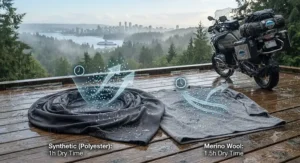
On raw moisture-handling mechanics, the two fabrics work in fundamentally different ways. Polyester is hydrophobic — it doesn’t absorb water into the fibre itself, instead pushing moisture along the fabric surface toward the outside where it evaporates quickly. Merino wool is hygroscopic, meaning the fibre actually absorbs moisture into its core — reportedly up to 30% of its own weight — before slowly releasing it, which is why merino feels dry to the touch even when it’s technically holding more water than a “dry-feeling” polyester layer would in the same conditions.
For merino wool vs polyester thermal riding specifically, this translates into two different comfort profiles on a bike. Polyester feels immediately dry and cool during and right after heavy exertion, which suits stop-and-go city riding or off-road work where you’re actively sweating. Merino feels consistently temperate over a longer ride, since it’s slowly managing moisture rather than aggressively pushing it to the surface, which suits steady highway touring where comfort over hours matters more than instant post-exertion dryness. Neither approach is wrong — they’re simply optimized for different riding rhythms, and the honest answer to which one wins depends entirely on whether your typical ride is a 20-minute sprint or a 6-hour haul.
Natural vs Synthetic Thermal Underwear: The Science of Warmth
Stepping back from base layers specifically, it’s worth understanding why natural vs synthetic thermal underwear even generates warmth in the first place, since the mechanism is identical across activities — it’s not unique to riding gear.
Warmth in any thermal layer comes from trapped air, not the fibre itself. As Wikipedia’s overview of the Merino sheep breed notes, the fine, tightly-crimped structure of the breed’s wool is what has made it prized for centuries — that same natural crimp creates tiny air pockets throughout the fabric, and those pockets are what actually insulate. Synthetic fibres achieve a similar effect through engineered structure: brushed interiors, looped knits, or hollow-core fibres that trap air mechanically rather than through natural crimp. What most buyers overlook here is that fibre weight (grams per square metre) matters more for warmth than material type alone — a 320 g/m² merino piece and an equivalently thick synthetic thermal will trap roughly similar amounts of air, even though the fibres feel completely different against skin.
Where the materials diverge meaningfully is behaviour once moisture enters the picture. Merino’s hygroscopic core continues generating some warmth even wet, since the absorption process itself releases a small amount of heat, while synthetic insulation depends entirely on staying relatively dry to keep those air pockets intact. This is the real, physics-backed reason merino gets recommended so consistently for unpredictable, wet, or genuinely cold riding conditions, rather than it simply being a trendier natural-fibre marketing narrative.
Long-Term Cost & Maintenance: Wool vs Synthetic ROI
Sticker price tells an incomplete story, so it’s worth running the numbers on cost-per-wear rather than upfront cost alone.
A premium merino piece like the Smartwool Classic Thermal Merino Crew at roughly C$120-C$150 might look expensive next to a Under Armour ColdGear Armour Fitted Mock at C$45-C$70, but merino’s odour resistance means fewer washes per season, and fewer wash cycles generally means slower fibre breakdown over the garment’s life — provided it’s cared for correctly with cold water and no tumble drying. A budget synthetic, by contrast, needs washing after nearly every ride to avoid odour buildup, and repeated hot-water washing plus machine drying accelerates elastic fatigue and fabric pilling over a season or two.
That said, synthetics generally win on raw abrasion resistance — a base layer that’s constantly rubbing against armour padding will typically show wear faster in a delicate merino weave than in an engineered synthetic built for exactly that stress, like the KLIM Aggressor Shirt 2.0. The realistic total cost of ownership calculation depends on riding frequency: occasional weekend riders will likely get more total value from a premium merino piece that lasts years with light use, while daily commuters putting a base layer through hundreds of wear-and-wash cycles annually may find a mid-tier synthetic a more economical long-term choice, simply because it tolerates the maintenance grind better.
Base Layer Material Comparison for a Motorcyclist: Safety and Regulatory Notes for Canada
Canada’s climate makes this base layer material comparison motorcyclist decision genuinely higher-stakes than it would be in a milder country, and it’s worth grounding the choice in actual Canadian safety context rather than general gear advice.
Environment and Climate Change Canada’s wind chill index exists specifically because moving air dramatically increases how fast the body loses heat, and the agency’s extreme cold safety guidance notes that health risks like windburn and frostbite increase substantially once wind chill values drop below -27 — a threshold that’s genuinely reachable on a highway ride even when the ambient temperature reading is milder than that. Riders in provinces with long, cold shoulder seasons — Alberta, the Prairies, most of Ontario and Quebec outside summer — should treat base layer choice as safety equipment, not comfort equipment, particularly for early morning or late fall rides where temperatures swing widely within a single trip.
There’s also an occupational health angle worth noting: cold-stress guidance used across Canadian jurisdictions recommends scheduled warming breaks once wind chill temperatures reach roughly -7°C for people working continuously in cold conditions, a benchmark that applies reasonably well to riders too, since sitting relatively still on a bike in cold wind resembles low-activity cold exposure more than it resembles active exercise. No provincial law mandates a specific base layer material for motorcyclists — Canada regulates helmets, not underlayers — but treating wind chill thresholds as a personal riding cutoff, and dressing accordingly in a genuine moisture-managing base layer rather than cotton, is a practical safety habit every Canadian rider should build.
Frequently Asked Questions
❓ Is merino wool actually warmer than synthetic for motorcycle riding?
❓ How often should I wash a merino wool base layer?
❓ Can I wear a synthetic base layer under leather riding gear?
❓ What weight of merino wool base layer is best for riders?
❓ Do I need both a merino and a synthetic base layer?
Conclusion
The merino wool vs synthetic base layer motorcycle debate doesn’t really have a single winner — it has a right answer for your specific riding pattern. Merino wool, represented well here by the Icebreaker Merino 200 Oasis Long Sleeve Crewe, Smartwool Classic Thermal Merino Crew, and the budget-friendly Merino.tech Merino Wool Base Layer Set, earns its premium pricing through genuine multi-day odour resistance and warmth-when-wet performance that matters most for touring riders and unpredictable Canadian weather. Synthetic options like the KLIM Aggressor Shirt 2.0, REV’IT! Airborne 2 Base Layer, Under Armour ColdGear Armour Fitted Mock, and Alpinestars Ride Tech V2 Summer Base Layer earn their place through faster drying, easier care, and — in the case of moto-specific brands — seam construction genuinely engineered for armour compatibility.
If you take one thing from this guide, let it be this: the wrong base layer material doesn’t just mean minor discomfort, it means real heat-loss risk once wind chill enters the equation on a moving motorcycle. Whichever material you land on, treat it as a functional safety layer rather than an optional extra, size it to layer properly under your existing gear, and match the fabric weight to how you actually ride rather than how you wish you rode. Check current pricing and availability before you buy, since both categories span a wide range depending on brand and season.
✨ Don’t Miss These Exclusive Deals!
🔍 Take your cold-weather riding kit to the next level with these carefully researched picks. Click on any highlighted product to check current pricing and availability. The right base layer will help you build a riding wardrobe that actually keeps you comfortable, mile after mile!
Recommended for You
- Merino Wool Base Layer for Motorcycle Riding: 7 Picks (2026)
- Heated Insoles vs Heated Socks for Motorcycle Riding 2026
- Heated Insoles for Motorcycle Boots: 7 Picks That Actually Work (2026)
Disclaimer: This article contains affiliate links. As an Amazon Associate, I earn from qualifying purchases. If you purchase products through these links, we may earn a small commission at no additional cost to you.
✨ Found this helpful? Share it with your friends! 💬🤗
