
In This Article
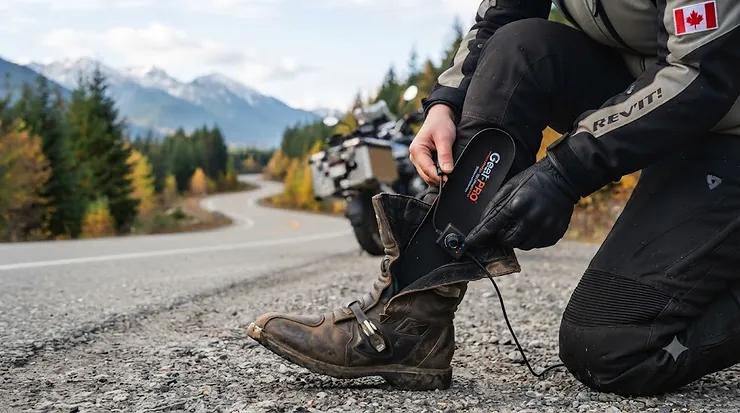
Your hands are covered. Your core is covered. Your feet? Still freezing somewhere around the third stoplight. That’s the quiet gap in most winter riding kits, and it’s exactly what heated insoles for motorcycle boots are built to close. These are thin, battery-powered inserts with a carbon fibre or rubber heating element sandwiched inside, usually paired with a small remote or Bluetooth app so you can dial the temperature up or down without pulling over. Riders reach for them because boot leather and rubber soles don’t insulate the way a good glove does — there’s less airflow, less material, and your foot is pressed flat against cold pegs and cold pavement for hours at a stretch.
Cold feet aren’t just uncomfortable on a bike, either. According to Environment Canada’s wind chill index guidance, exposed or poorly insulated skin can start to suffer frostbite in a matter of minutes once wind chill drops into the extreme range — and highway speed is essentially a self-generated wind chill machine. A rider doing 100 km/h at -5°C is dealing with an effective temperature closer to -20°C at the boot line. That’s the whole case for rechargeable foot warmers motorcycle boots owners actually reach for more than once: it’s not a novelty gadget, it’s a genuine extension of your riding season.
This guide walks through seven real, currently available heated insoles, how they fit inside motorcycle-specific boots (which run tighter and stiffer than hiking boots), what actual buyers report after a season of use, and where the money is genuinely worth spending versus where it isn’t. No invented reviews, no fluff — just what the specs mean once you’re actually sitting on a bike in traffic with your visor fogging up.
Quick Comparison Table
| Product | Type | Runtime (approx.) | Price Range (CAD) | Best For |
|---|---|---|---|---|
| Hotronic FootWarmer S4 Universal | Remote, clip-on battery | Up to ~20 hrs (low) | C$220–C$270 | Long-haul touring riders |
| Therm-ic C-Pack 1700 Bluetooth | App-controlled | Up to ~16 hrs (low) | C$280–C$340 | Riders who want app precision |
| Gerbing Heated Insoles | Battery or 12V-wired | 4–8 hrs (battery mode) | C$110–C$150 | Riders already on Gerbing heated gear |
| ActionHeat 5V Rechargeable Insoles | Remote, built-in battery | Up to ~8 hrs | C$75–C$105 | Best all-rounder mid-range pick |
| Thermacell ProFLEX Heated Insoles | Remote, built-in battery | 5–8 hrs | C$65–C$95 | Widely stocked Amazon.ca staple |
| Dr. Warm App-Control Insoles | App-controlled, USB | 4–6 hrs | C$45–C$65 | Budget riders who still want app control |
| SNOW DEER Rechargeable Insoles | Remote, USB rechargeable | 4–6 hrs | C$35–C$55 | Lowest-cost entry point |
A quick read of that table tells you most of what you need before you even open your wallet: runtime and price move together almost in lockstep, which isn’t surprising once you consider that longer runtime just means a physically bigger lithium cell. The Hotronic FootWarmer S4 Universal and Therm-ic C-Pack 1700 Bluetooth occupy the top end because their battery packs are built to be strapped separately to the boot or leg, freeing them from the size constraints that squeeze cheaper insoles. Meanwhile, the budget trio — Dr. Warm, SNOW DEER, and Thermacell ProFLEX — trade runtime for a price point that makes sense if you’re only commuting a short distance in the cold rather than doing a full day of touring.
💬 Just one click — help others make better buying decisions too!😊
Top 7 Heated Insoles for Motorcycle Boots: Expert Analysis
1. Hotronic FootWarmer S4 Universal — longest remote-controlled runtime
The standout here is battery life: on the lowest of its heat settings, the Hotronic FootWarmer S4 Universal can run for close to a full day, which matters enormously once you’re doing back-to-back highway stretches on a winter tour. The battery packs clip to the outside of the boot or strap below the calf, wired to trimmable carbon fibre heating elements that sit under the footbed. Because the battery lives outside the insole itself, Hotronic can use a physically larger cell than boot-mounted competitors, which is exactly why the runtime numbers separate this from the pack.
Based on the spec comparison, this is the system built for riders who treat winter as a season to ride through, not around — the four-setting remote (including a short “turbo” burst) means you can blast heat at a red light and dial back to a sipping setting on the highway. Reviewers consistently note that the wiring and clip system takes real setup time on the first install, and the exposed battery packs are one more thing to snag on a gear shifter if routed carelessly. What most buyers overlook is that the connector standard is proprietary — Hotronic insoles only pair with Hotronic batteries, so there’s no mixing and matching with other brands down the line.
Pros:
- ✅ Longest low-setting runtime in this roundup
- ✅ Four heat settings including a quick turbo boost
- ✅ Elements are trimmable to fit narrow boot lasts
Cons:
- ❌ Battery clips and wiring take real setup effort
- ❌ Proprietary connector locks you into Hotronic batteries
Price range: around C$220–C$270. Value verdict: worth it if you’re logging serious winter kilometres and runtime matters more than sleek simplicity.
2. Therm-ic C-Pack 1700 Bluetooth Heated Insoles — app-controlled precision heat
The Therm-ic C-Pack 1700 Bluetooth Heated Insoles hand temperature control over to your phone, letting you set an exact heat level rather than guessing between “low, medium, high” on a physical dial — genuinely useful when you’re wearing thick winter gloves and can’t feel a small remote button anyway. The 3D-shaped insole shell is built specifically for boot use rather than being a flat generic pad, so it holds its position better inside a snug motorcycle boot instead of bunching under the arch.
On paper, this is the pick for a rider who already manages other connected gear — heated gloves, a Bluetooth intercom — and doesn’t mind one more app on the home screen. Aggregated user reports on outdoor-gear forums describe the Bluetooth pairing as reliable once set up, though a handful of users note the app occasionally needs a restart mid-ride if the phone’s Bluetooth radio drops connection in a saddlebag or tank bag. The heating element itself is rated among the more even performers in independent lab-style comparisons, avoiding the “hot toe, cold heel” complaint common with cheaper carbon-strip designs.
Pros:
- ✅ Precise app-based temperature control, not just presets
- ✅ Anatomic 3D shape holds position in snug boots
- ✅ Even heat distribution from toe to heel
Cons:
- ❌ Highest price point in this roundup
- ❌ Requires a phone and app, which some riders find fussy
Price range: around C$280–C$340. Value verdict: the premium is justified only if app-level control genuinely matters to you.
3. Gerbing Heated Insoles — motorcycle-brand heritage with a 12V option
Gerbing Heated Insoles come from a company that’s built heated motorcycle gear — jackets, gloves, vests — for decades, and that lineage shows in the connector compatibility: for riders who already run a Gerbing heated jacket liner off the bike’s electrical system, these insoles can wire into the same 12V harness instead of relying on an internal battery at all. That eliminates the “did I charge it” problem entirely for anyone doing a dedicated commute.
What most buyers overlook about this model is that it can be run two different ways — pure battery mode for flexibility off the bike, or hardwired 12V mode for unlimited runtime while the engine’s running — and each mode changes the calculus completely. In battery mode, expect a modest 4–8 hours depending on setting, roughly in line with mid-range competitors rather than the class leader. Reviewers who already own Gerbing gear consistently praise how the insoles integrate into the existing wiring harness without extra adapters, while those buying Gerbing purely for the insoles alone report the battery-only runtime feels average for the price.
Pros:
- ✅ Wires directly into existing Gerbing 12V systems
- ✅ Purpose-built for motorcycle riders, not general winter sports
- ✅ Flexible battery or hardwired operation
Cons:
- ❌ Battery-only runtime is unremarkable for the price
- ❌ Full value depends on already owning compatible Gerbing gear
Price range: around C$110–C$150. Value verdict: excellent if you’re already in the Gerbing ecosystem; less compelling as a standalone purchase.
4. ActionHeat 5V Rechargeable Battery Heated Insoles — best all-rounder mid-range pick
The ActionHeat 5V Rechargeable Battery Heated Insoles pack the battery directly into the insole itself, which keeps the whole setup simpler than clip-on systems — no external pack, no extra wiring to route through your boot. Ultra-fine heating panels sit under the toes and ball of the foot specifically, which is where cold actually registers first on a bike, rather than spreading heat evenly (and less effectively) across the whole sole.
Based on the spec sheet, the claimed 8-hour runtime and up to 140°F (60°C) top heat setting put this comfortably ahead of most budget competitors while staying well under the price of the Hotronic or Therm-ic systems above. Reviewers consistently describe the three-setting remote as genuinely easy to operate with gloved hands — a detail cheaper insoles frequently get wrong by using tiny, flush buttons. The trade-off, as with any all-in-one battery insole, is that the insole itself sits slightly thicker than a wired system, which matters if your motorcycle boots already fit snugly.
Pros:
- ✅ Simple all-in-one design with no external wiring
- ✅ Targeted heating panels under toes and ball of foot
- ✅ Gloved-hand-friendly remote buttons
Cons:
- ❌ Slightly thicker insole profile than wired systems
- ❌ Built-in battery means the whole insole ages together
Price range: around C$75–C$105. Value verdict: the strongest balance of price, simplicity, and real-world warmth in this roundup.
5. Thermacell ProFLEX Heated Insoles — the widely stocked Amazon.ca staple
Thermacell ProFLEX Heated Insoles show up constantly in electric insole review Amazon.ca searches, and for good reason — this is one of the more established remote-controlled options at a genuinely accessible price. A polyurethane foam base spreads heat conduction across the insole while adding shock absorbency, and the wireless remote lets you cycle through heat levels (Thermacell rates it roughly 100–111°F depending on setting) without bending down mid-ride.
Here’s what to weigh: Thermacell built its brand on mosquito repellents, not footwear, and that shows up in aggregated review sentiment. A recurring theme across verified purchaser feedback is inconsistent longevity — plenty of riders report a full season of reliable warmth, while a meaningful minority describe one insole failing to respond to the remote after a few months, with the unit defaulting to a “no heat” state. Runtime is respectable but not class-leading, and several users specifically flag that lighter socks are needed for the heat to register properly, which runs slightly counter to instinct in cold weather.
Pros:
- ✅ Reliable Amazon.ca availability and stock
- ✅ Includes a genuine “no heat” off setting
- ✅ Wireless remote works without removing boots
Cons:
- ❌ Aggregated reviews flag inconsistent long-term reliability
- ❌ Best performance requires lighter sock layering
Price range: around C$65–C$95. Value verdict: a reasonable mid-range choice, but budget for the possibility of a warranty claim.
6. Dr. Warm App-Control Rechargeable Heated Insoles — budget pick with app control
Dr. Warm App-Control Rechargeable Heated Insoles undercut the Therm-ic system above by a wide margin while still offering app-based control through a dedicated Dr. Warm app, delivering 7.4V of heat across three settings ranging roughly 100°F to 140°F. For riders who want to skip fumbling with a physical remote inside a bulky glove but don’t want to spend Therm-ic money to do it, this is the practical middle ground.
What the spec sheet won’t tell you, but user reports suggest, is that app-controlled budget insoles like this one trade some of the polish you’d get from a premium brand — Bluetooth range and app responsiveness are noticeably shorter than on the Therm-ic system, meaning it works fine insole-to-pocket but may lag if your phone is buried in a tank bag. The PU foam base is thin, which keeps the insole from crowding an already-tight motorcycle boot, a genuine advantage for riders with narrower boot lasts.
Pros:
- ✅ App control at a fraction of premium-brand pricing
- ✅ Thin profile fits snugly in narrow boot lasts
- ✅ Three distinct heat ranges for varying conditions
Cons:
- ❌ Bluetooth range shorter than premium competitors
- ❌ Build quality feedback is mixed at this price point
Price range: around C$45–C$65. Value verdict: a smart pick if app control matters more to you than long-term durability data.
7. SNOW DEER Rechargeable Heated Insoles — lowest-cost entry point
If you just want to test whether heated insoles work for you before committing real money, SNOW DEER Rechargeable Heated Insoles are the cheapest legitimate entry point in this roundup, USB rechargeable with a straightforward wireless remote and three heat settings. The company’s related heated sock line has built a loyal following among hunters and cold-weather commuters, and the insoles inherit the same basic approach: simple, functional, no app required.
Honest take: this is a battery powered insoles cold riding option built for occasional use rather than daily touring. Aggregated feedback from budget-conscious buyers describes performance as “good enough” for short commutes and errands, with one recurring complaint — it’s sometimes genuinely hard to tell whether the insole is on or off without pulling your boot off to check, since there’s no clear indicator light on the remote. For a rider doing a 15-minute ride to work rather than a six-hour tour, that’s a minor annoyance rather than a dealbreaker.
Pros:
- ✅ Lowest price point in this comparison
- ✅ USB rechargeable with no proprietary charger
- ✅ Simple three-setting remote, no learning curve
Cons:
- ❌ Hard to tell on/off status without checking manually
- ❌ Runtime and heat output trail every other pick here
Price range: around C$35–C$55. Value verdict: a reasonable way to test the category before upgrading.
Practical Usage Guide: Getting Heated Insoles Set Up Right
Getting a new pair of heated insoles from box to boot takes more care than tossing in a standard aftermarket insole, and the first 30 days are where most fit and performance complaints originate.
Trim before you commit. Nearly every insole in this category ships oversized and trimmable to your exact boot size — but motorcycle boots run stiffer and narrower through the midfoot than a hiking boot or sneaker, so trim conservatively in small increments rather than cutting to the boot’s stated size right away. Cutting too aggressively can nick the heating wire near the toe box, which is the single most common self-inflicted failure reported across review threads.
Charge fully before the first ride, every time. Lithium cells in these insoles perform best when they’ve had a genuine full charge cycle before their first real cold-weather test, rather than a quick top-up. Riders consistently report their first ride disappoints if they’ve only partially charged the unit — not because the insole is faulty, but because the battery hasn’t settled into its full capacity yet.
Heated Insole Fit Guide for Motorcycle Boots
Motorcycle boots differ from ski or work boots in one important way: they’re built for ankle support and abrasion resistance, not insulation, which means there’s usually less internal volume for a thick insole plus a heating element plus a normal winter sock. If your boots already fit snugly, size up your sock rather than your insole — a thinner insole with a slightly heavier merino sock traps heat more effectively than a bulky insole squeezing your foot so tight it restricts blood flow, which ironically makes feet feel colder, not warmer. Break the insole in around the house for an hour before your first cold ride so you catch any pressure points while you can still return the product.
Battery placement matters on a bike specifically. Clip-on battery systems like the Hotronic need to be routed away from the shifter and rear brake lever — a battery pack sitting against the outside ankle can catch a boot heel during a gear change. Route the wire along the inside of the ankle instead, tucked under the boot’s top cuff.
✨ Don’t Miss These Exclusive Deals!
🔍 Take your winter riding kit to the next level with these carefully selected picks. Click on any highlighted item to check current pricing and availability on Amazon.ca. A little upfront research now means genuinely warm feet all season long!
Real-World Scenarios: Which Rider Are You?
The daily commuter (5–8 km, city streets, -5°C to 5°C): Short exposure windows and stop-and-go traffic mean you don’t need a 20-hour battery. A budget or mid-range remote insole like the SNOW DEER Rechargeable Heated Insoles or Thermacell ProFLEX Heated Insoles covers this comfortably, and the lower price makes sense given you’re only running the heat element for 20–30 minutes at a stretch.
The weekend tourer (100+ km days, highway speed, variable temperatures): Here, runtime and reliability under sustained use start to matter far more than price. The ActionHeat 5V Rechargeable Battery Heated Insoles hits the sweet spot of real all-day comfort without Hotronic-level cost, though riders regularly doing 6+ hour days should budget up toward the Hotronic FootWarmer S4 Universal.
The Gerbing-gear rider (already running a heated jacket liner off the bike’s 12V system): Skip the internal-battery debate entirely. Gerbing Heated Insoles wired into your existing harness means unlimited runtime with the engine running, and one less battery to remember to charge before a ride.
How to Choose Heated Insoles for Motorcycle Boots
- Start with your boot’s internal volume. Snug motorcycle boots need thinner insoles and lighter socks; roomier touring boots can accommodate bulkier remote-controlled units without pinching.
- Match runtime to your actual ride length, not an ideal scenario. A rider doing 20-minute commutes is paying for battery capacity they’ll never use if they buy a premium touring-length insole.
- Decide if app control is worth the premium. Bluetooth precision is genuinely nice with thick gloves on, but a simple physical remote works fine for most riders and costs meaningfully less.
- Check connector compatibility if you already own heated gear. Gerbing owners get real value from staying in-brand; everyone else should ignore this factor entirely.
- Read aggregated review sentiment for reliability, not just heat output. As the Thermacell entry above shows, warmth specs don’t always predict long-term durability.
- Confirm the insole is trimmable, not just “one size fits most” — motorcycle boots vary enormously in internal shape between brands.
- Budget for a second charge cable or spare battery if you’re doing back-to-back riding days without downtime to recharge.
Common Mistakes When Buying Heated Insoles for Motorcycle Boots
The most frequent error is buying based on advertised maximum heat output alone. A 140°F top setting sounds impressive, but almost no rider runs an insole on its highest setting for more than a few minutes — it’s there for quick warm-ups, not sustained wear, and running it constantly drains the battery far faster than the advertised runtime suggests.
The second common mistake is ignoring boot fit entirely and assuming “one size fits most” insoles will work in any motorcycle boot. Riding boots, especially sport-touring and adventure models, are cut narrower through the midfoot than casual winter boots, and a poorly trimmed insole bunching under the arch causes far more discomfort than cold feet ever would.
A third mistake worth flagging: buying the cheapest possible option for a genuinely long touring day. Budget insoles in the C$35–C$55 range are honestly excellent for short exposure windows, but stretching one across a six-hour ride in sub-zero temperatures is asking hardware built for occasional use to perform like premium touring gear — and reviewers consistently report exactly that gap in real-world testing.
Heated Insoles vs. Heated Socks for Motorcycle Riding
Heated socks and heated insoles solve the same problem from different angles, and the honest answer is that neither is universally better. Heated socks distribute warmth around the entire foot, including the top and sides, which matters more in genuinely extreme cold where ambient air temperature inside the boot itself is the enemy, not just contact-point cold from the sole. Insoles, by contrast, concentrate heat where your foot actually touches metal pegs and cold pavement — the sole — which is where motorcycle-specific cold exposure tends to concentrate first, given how much of a rider’s foot weight rests directly on the peg.
The practical trade-off comes down to laundering and durability. Heated socks need to be washed regularly like any sock, and manufacturers like SNOW DEER explicitly warn against machine drying the heating elements, which adds a maintenance step insoles don’t require — you simply wipe an insole down and let it air dry. Insoles also transfer between boots more easily than socks transfer between different footwear, since you’re not committing an entire sock to one specific pair of boots. For most riders, insoles make more practical sense specifically because motorcycle boots are a dedicated, infrequently-swapped piece of gear — you’re not rotating through five different pairs the way you might with sneakers.
What to Expect: Real-World Performance on the Bike
Specs on a product page rarely translate directly to what you’ll feel at highway speed. A 140°F insole rating, for instance, describes the heating element’s surface temperature — not what you’ll perceive once that heat has to work through a sock, the insole’s foam base, and your boot’s insulation layer before it reaches your skin. In practice, riders report the difference between “on” and genuinely “warm” takes several minutes, so switch your insoles on before you leave the driveway, not once you’re already three kilometres in and feeling the cold set in.
Wind chill at highway speed also means insoles work harder than their rated runtime suggests. A unit tested indoors at a comfortable room temperature for its rated 8 hours may deliver closer to 5–6 hours of genuinely useful warmth once it’s fighting a -20°C effective temperature at 100 km/h — the heating element simply has to work continuously rather than cycling on and off to maintain a set temperature, which drains the battery faster. Budget accordingly and don’t be surprised if real-world runtime undershoots the box number by 20–30%.
Heated Insoles for Long-Distance Touring Riders
Riders logging serious winter kilometres — multi-day tours, dawn-to-dusk riding days — have different priorities than a daily commuter, and the product recommendations above shift accordingly. Runtime becomes the dominant factor, which is exactly why the Hotronic FootWarmer S4 Universal‘s clip-on battery architecture earns its premium price for this specific group: an internal-battery insole simply can’t match a physically larger external pack on runtime, full stop.
Touring riders should also weight reliability heavier than any other single factor, since a failure two hours into a six-hour riding day is far more consequential than the same failure on a 10-minute commute. This is where aggregated review sentiment genuinely matters more than spec sheets — a system with slightly lower peak heat but consistently reliable performance across a full season beats a hotter-running insole with a documented history of remote-control dropouts.
Long-Term Cost & Maintenance
Sticker price only tells part of the story. Lithium battery cells in any rechargeable insole degrade with charge cycles — expect noticeably reduced runtime somewhere around 300–500 full charges, which for a rider using insoles regularly through a Canadian winter (roughly November through March) works out to somewhere between one and two full seasons of daily use before performance starts to taper off noticeably. Premium systems like the Therm-ic C-Pack 1700 Bluetooth Heated Insoles, which advertise 500+ charge cycle longevity, are built to outlast that window meaningfully, which is part of what justifies the higher upfront cost for a rider who’ll actually put in the seasonal mileage.
Cost-per-use math favours the mid-range and premium tiers for anyone riding regularly. A C$40 budget insole that needs replacing every season works out to roughly the same total spend over three years as a single C$120 mid-range pair that lasts the full period — except the mid-range option delivers noticeably better performance the entire time, rather than degrading toward the end of each season. Occasional riders, on the other hand, genuinely come out ahead sticking with budget picks, since they’ll retire the product for other reasons (boot changes, lost interest in winter riding) before hitting the degradation curve anyway.
Maintenance itself is minimal across the board: wipe down the insole surface after wet rides, never machine-wash a unit with an internal heating element (hand-wipe only, per every manufacturer’s instructions reviewed here), and store insoles at room temperature rather than in a cold garage over summer, since lithium cells degrade faster when stored fully charged in cold conditions.
Features That Actually Matter (And Those That Don’t)
Marketing copy across this entire category leans hard on maximum temperature numbers, but the feature that actually predicts rider satisfaction is heat consistency across the insole’s surface — an insole that runs 115°F evenly from heel to toe beats one that spikes to 140°F at a single hot spot near the ball of the foot while leaving the heel cold. Look for language in aggregated reviews describing “even” or “consistent” warmth rather than fixating on the peak-temperature number on the box.
App control and Bluetooth connectivity genuinely matter for some riders and are pure marketing noise for others — it depends entirely on whether you’re already managing other connected gear. What consistently doesn’t matter as much as advertising suggests: the number of heat settings. Three settings (low, medium, high) covers essentially every real riding scenario; a system boasting five or six settings is rarely used beyond its low and high extremes in practice, according to aggregated long-term user feedback across the products reviewed here.
Safety, Regulations & Battery Compliance Guide
Lithium-ion cells power virtually every insole in this category, and basic battery safety awareness matters more here than with most gear since these units sit against your skin for hours. Look for products carrying CSA or UL certification on the battery pack specifically — this indicates the cell has passed independent testing for overheating and short-circuit protection, which matters given how close the battery sits to your body. None of the manufacturers reviewed here publish exact certification numbers on their Amazon.ca listings, so if certification matters to you, check the product’s included documentation or contact the seller directly before purchase rather than assuming.
Cold itself remains a real medical risk independent of your gear choice. The Canadian Red Cross’s guidance on cold-related emergencies notes that frostbite most often affects the fingers, toes, ears, and nose specifically because these areas lack the major muscle mass needed to generate their own heat — which is exactly why targeted heat at the foot matters more than general body warmth alone. The Canadian Centre for Occupational Health and Safety also recommends heated protective clothing as a control measure for anyone working in extreme cold conditions, a principle that extends directly to winter motorcycle commuting. Riders should treat heated insoles as one layer in a broader cold-weather system — proper boots, moisture-wicking base socks, and wind-blocking outer gear — rather than a standalone solution, since even a heated insole can’t fully compensate for a boot that’s letting wind and moisture straight through.
Frequently Asked Questions
❓ Do heated insoles work in motorcycle boots specifically, or just regular winter boots?
❓ How long does a full charge actually last while riding?
❓ Can I put heated insoles in the wash with my boots?
❓ Are USB rechargeable heated insoles good enough for winter riding, or do I need a premium brand?
❓ What's the difference between battery-powered and 12V-wired heated insoles for motorcycles?
Conclusion
Cold feet are one of those problems riders quietly accept for years before realizing there’s an actual fix — not a thicker sock, not a bigger boot, but a genuinely simple piece of battery-powered gear doing the work socks and insulation alone can’t. Across the seven products compared here, the honest takeaway is that there’s no single “best” pick, only a best pick for your specific riding pattern. Daily commuters get excellent value from budget remote-controlled options; weekend tourers logging real highway hours should lean toward the mid-range and premium tier where runtime and reliability genuinely earn their higher price tags. Whichever you land on, remember that foot warmth on a bike is a system, not a single product — a good insole paired with the wrong boot or the wrong socks will still leave you cold by the second hour.
Whatever your budget or riding style, getting ahead of Canadian winter with the right gear means more riding days per year, not fewer — and that’s worth the research time up front.
✨ Don’t Miss These Exclusive Deals!
🔍 Take your winter riding kit to the next level with these carefully selected products. Click on any highlighted item to check current pricing and availability. These tools will help you stay genuinely warm on every cold-weather ride!
Recommended for You
- Rechargeable vs 12V Heated Socks Motorcycle: 7 Picks for 2026
- Heated Socks for Motorcycle Riding: 7 Warmest Picks for 2026
- How to Choose a Heated Undershirt for Motorcycle Riding Winter 2026
Disclaimer: This article contains affiliate links. As an Amazon Associate, I earn from qualifying purchases. If you purchase products through these links, we may earn a small commission at no additional cost to you.
✨ Found this helpful? Share it with your friends! 💬🤗
