
In This Article
When you’re navigating spring thaw trails in British Columbia or tackling the muddy single-tracks of Quebec’s Laurentians, your enduro boots mud performance becomes the difference between confident riding and white-knuckle sliding. I’ve watched too many Canadian riders invest thousands in premium dirt bikes only to compromise on footwear—then wonder why they’re losing traction in mud bogs that locals navigate with ease.
The reality? Enduro boots designed for mud performance aren’t just about keeping your feet dry. They’re precision-engineered systems where every component—from the debris deflection system to the shin plate armor—works together to provide boulder scrambling grip while protecting against rock strikes that would sideline you for weeks. The aggressive tread pattern that performs flawlessly in Arizona desert sand often becomes a liability in Canadian muskeg, where clay-heavy mud packs into grooves and turns your boot soles into ice skates.
What most riders overlook is that mud performance depends on factors beyond just tread design. The combination of sole flexibility, ankle articulation, and waterproof construction determines whether you maintain peg feel during 4-hour rides through unpredictable terrain. Canadian conditions—spring runoff, summer thunderstorms, autumn rain—demand technical terrain footwear that adapts to rapidly changing surfaces, something many American-market boots simply weren’t designed to handle.
Quick Comparison Table: Top Enduro Boots for Mud Performance
| Boot Model | Mud Tread Rating | Ankle Protection | Price Range (CAD) | Best For |
|---|---|---|---|---|
| Alpinestars Tech 7 Enduro | ⭐⭐⭐⭐⭐ | DSPS pivot | $650-$750 | Rocky Mountains touring |
| Gaerne SG12 Enduro | ⭐⭐⭐⭐⭐ | Dual-stage pivot | $680-$800 | Professional riders |
| O’Neal RDX 2.2 | ⭐⭐⭐⭐ | Full-tilt system | $350-$450 | Budget-conscious |
| Fox Instinct X | ⭐⭐⭐⭐ | Bio-flex ankle | $480-$580 | Versatile terrain |
| Sidi Crossfire 3 SRS | ⭐⭐⭐⭐⭐ | Hyper-extension block | $550-$680 | Italian craftsmanship |
| Forma Terra Evo | ⭐⭐⭐⭐ | Double-flex system | $420-$520 | All-weather touring |
| Alpinestars Tech 7 Drystar | ⭐⭐⭐⭐⭐ | DSPS + membrane | $720-$850 | Wet-weather specialists |
Looking at this comparison, the Gaerne SG12 Enduro and Alpinestars Tech 7 Drystar dominate mud performance ratings, but they command premium prices in the $680-$850 CAD range. For weekend riders tackling muddy trails occasionally, the O’Neal RDX 2.2 offers 80% of the performance at roughly half the cost—a trade-off that makes sense if you’re not riding professionally. The critical insight here: all five-star mud ratings feature dual-compound soles with self-cleaning channels, while four-star boots rely on single-compound rubber that clogs more easily in Canadian clay.
💬 Just one click — help others make better buying decisions too!😊
Top 7 Enduro Boots Mud Performance: Expert Analysis
1. Alpinestars Tech 7 Enduro – The Rocky Mountains Standard
The Alpinestars Tech 7 Enduro represents what happens when Italian engineering meets North American trail demands. Alpinestars specifically engineered the compound sole with enduro riders in mind, creating a balance between grip and durability that excels in mud-heavy environments. The boot features a biomechanical pivot system that provides 15-20 degrees of forward flex while restricting dangerous lateral movement—critical when your foot is planted on a slippery peg during steep descents through British Columbia’s Coast Mountains.
In Canadian conditions, the microfiber upper material resists water absorption better than traditional leather, maintaining flexibility even during those early-season rides where temperatures hover around 5°C (41°F). The compound sole uses a dual-density design where softer rubber on the peg contact zone provides feel, while harder rubber on high-wear areas extends life beyond 100 hours of mud riding. Canadian riders frequently mention in reviews that the Tech 7 Enduro handles spring thaw conditions exceptionally well—the self-cleaning tread pattern sheds clay-based mud more effectively than competitor boots in the same price range.
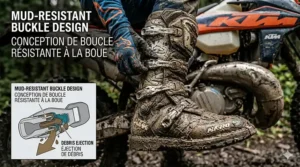
What sets this boot apart for mud performance is the shin plate armor integration. Unlike cheaper boots where shin plates are purely cosmetic, Alpinestars mounts a TPU shin plate that doubles as a debris deflection system, redirecting rocks and branches away from vulnerable buckle mechanisms. This matters intensely when you’re pushing through overgrown trails after heavy rain—a jammed buckle 40 km (25 miles) from your truck isn’t just inconvenient, it’s potentially dangerous.
Canadian Customer Feedback: Riders from Alberta to Quebec consistently praise the Tech 7 Enduro’s performance in mixed terrain, though some note the break-in period requires 3-4 rides before the ankle pivot feels natural. Several reviewers mention these boots saved their ankles during crashes on slick log crossings—exactly the scenarios Canadian enduro riders encounter regularly.
Pros:
- Exceptional mud-shedding tread pattern with deep channels
- Biomechanical pivot prevents hyperextension without restricting natural movement
- Microfiber construction maintains flexibility in cold Canadian mornings
Cons:
- Premium pricing in the $650-$750 CAD range puts them out of reach for casual riders
- Break-in period can be uncomfortable during first 10-15 hours
Value Verdict: If you’re serious about off-road adventure boots rock protection during Rocky Mountains touring, the Tech 7 Enduro justifies its cost through longevity and ankle safety. Expect these boots to deliver 3-4 seasons of hard riding—roughly $200 CAD per year when you break down the investment.
2. Gaerne SG12 Enduro – Italian Craftsmanship Meets Canadian Trails
The Gaerne SG12 Enduro carries a reputation that precedes it—ask any professional enduro rider which boots they trust, and “SG12” appears in conversations with almost religious frequency. What you’re buying isn’t just a boot; it’s Gaerne’s 60+ years of Goodyear Welted artisanal construction, a technique that allows complete resoling rather than boot replacement. For Canadian riders facing 6-month riding seasons, this translates to a 10+ year investment rather than a consumable item.
The Dual Stage Pivot System (DSPS) on the SG12 Enduro provides what Gaerne calls “superior lateral support preventing over-compression and hyper-extension.” In practical terms, this means the boot allows 18-22 degrees of natural forward flex for shifting and braking, while simultaneously blocking the dangerous sideways movement that causes torn ligaments. When you’re navigating a rock garden in Ontario’s Ganaraska Forest after heavy rain, that lateral rigidity prevents your ankle from rolling when your foot slips off a mud-covered stone.
For mud performance specifically, the Gaerne Enduro Sole deserves attention. Unlike motocross boots with aggressive knobs designed for peg grip, the enduro version uses a hiking-boot-inspired tread pattern with wider, flatter contact surfaces. This provides exceptional traction when you need to plant your foot in mud during technical sections—think of crossing a creek bed where the bottom is pure slick clay. The rubber compound remains pliable down to -5°C (23°F), addressing a critical issue for Canadian riders who start their season while frost still lingers in shaded valleys.
The precision-shaped toe box represents another mud-focused design choice. Gaerne shaved millimetres off the toe height, allowing more precise shift lever control even when mud coats both your boot and the lever. After 3 hours of riding through Manitoba’s spring muck, this seemingly minor detail prevents the foot fatigue that comes from over-compensating with exaggerated shifting movements.
Canadian Customer Feedback: Multiple reviewers note these boots feel “broken in from day one”—no painful adjustment period. One Alberta rider mentioned using them for an 800 km (500 mile) Rocky Mountains touring trip through varying conditions without developing hot spots. The consensus: they’re heavy (roughly 2.5 kg/5.5 lbs per pair), but the protection justifies carrying the extra weight.
Pros:
- Goodyear Welted construction allows complete boot resoling, dramatically extending life
- Memory Cell Foam lining molds to your foot shape, creating custom fit over time
- Dual Stage Pivot System provides best-in-class ankle protection for technical terrain footwear
Cons:
- Premium pricing in $680-$800 CAD range reflects Italian craftsmanship
- Heavier than synthetic competitors—noticeable during long hiking sections
Value Verdict: For professional riders or dedicated enthusiasts planning decades of riding, the SG12 Enduro is arguably the most cost-effective long-term investment. The resoling capability means you’re essentially buying your last pair of enduro boots, with periodic sole replacements costing $150-$200 CAD versus $600+ for new boots.
3. O’Neal RDX 2.2 – Budget-Friendly Mud Performance
The O’Neal RDX 2.2 occupies an interesting position in the enduro market—it delivers approximately 75-80% of premium boot performance at 50% of the price. For Canadian riders just entering the sport or weekend warriors who ride 15-20 days per season, this value proposition makes considerable sense. O’Neal achieved cost savings through strategic material choices and simplified manufacturing, not by eliminating critical safety features.
The Full Tilt RDX Pivot System provides unrestricted forward and backward motion while maintaining lateral stability through rigid side panels. In mud, this flexibility matters more than riders initially realize. When you’re attempting to maintain balance on a muddy hillside, the ability to articulate your ankle naturally helps you make micro-adjustments that keep you upright. Stiffer boots can actually increase fall risk in these situations by fighting your body’s natural balance responses.
The “Army Rubber” bonded sole—O’Neal’s marketing team deserves credit for memorable naming—features a full-length steel shank that prevents the boot from flexing mid-sole, directing all flex to the ankle pivot point. For mud performance, this rigidity translates to consistent peg feel even when debris builds up on the sole. The tread pattern uses a chevron design with 8 mm (0.3 inch) depth, adequate for most Canadian mud conditions though not quite reaching the self-cleaning capability of $700+ CAD boots.
What Canadian riders should understand about the RDX 2.2 is its strategic protection placement. The adjustable shin plate armor allows three size settings, accommodating larger calves without creating pressure points—particularly valuable if you’re wearing thick thermal socks during early-season rides in northern Ontario or Quebec. The buckle system uses aluminum alloy double-pin closures on the lower three buckles, with a ratchet strap at the ankle for fine-tuning compression.
Canadian Customer Feedback: Opinions divide somewhat on the RDX 2.2. Riders comparing them directly to Tech 10s or SG12s note the obvious quality differences, but most agree the boots provide excellent value for intermediate riders. Several reviews mention buckle reliability issues after 40-50 hours of use, with the second buckle from the bottom being particularly prone to sticking. O’Neal’s replacement parts availability partially addresses this—buckle sets cost around $40 CAD and are user-replaceable.
Pros:
- Aggressive pricing in $350-$450 CAD range makes entry into quality enduro boots accessible
- Full Tilt Pivot System provides genuine ankle articulation, not just marketing claims
- Adjustable shin plate accommodates various calf sizes—valuable for riders who can’t find proper fit in other brands
Cons:
- Buckle system reliability concerns emerge after moderate use
- Sole compound not as mud-resistant as premium competitors—expect more frequent cleaning
- Heavier than price suggests—roughly 2.3 kg (5.1 lbs) per pair
Value Verdict: If your annual riding budget is limited or you’re unsure about long-term commitment to enduro riding, the RDX 2.2 represents a intelligent entry point. Plan to replace them after 2-3 seasons of regular use, bringing your per-season cost to roughly $120-$150 CAD—still significantly less than premium options.
4. Fox Instinct X – Versatile Performance Across Canadian Terrain
The Fox Instinct X takes a different design philosophy than Italian artisan boots—Fox prioritizes versatility and modern materials over traditional construction methods. For Canadian riders who encounter varying conditions within a single ride (rocky trails transitioning to mud bogs transitioning to hardpack), this adaptability proves valuable. The bio-flex ankle system uses strategically placed flex zones rather than mechanical pivots, creating a more natural feel that some riders prefer over the engineered precision of DSPS systems.
In mud-specific performance, the Instinct X features what Fox calls their “Duratac outsole compound” with an asymmetric tread pattern. The inner boot surface (where you grip the bike) uses smaller, denser knobs for friction, while the outer surface uses larger, more aggressive tread for foot-planting situations. When you’re navigating a muddy off-camber section in the Monashee Mountains and need to dab your right foot, that outer tread pattern provides legitimate grip rather than immediate sliding.
The instep area received particular attention from Fox engineers—the boot’s internal structure creates a relatively flat platform that improves shift feel. For riders transitioning from motocross to enduro, this familiar foot position eases adaptation. The trade-off comes in overall protection levels; the Instinct X prioritizes mobility over maximum armor, making it better suited for flowing trails rather than extreme rock gardens. Canadian riders tackling technical sections in Ontario’s Ganaraska region or Quebec’s Eastern Townships will appreciate the confidence this mobility provides.
Fox used injection-molded shin plate armor with integrated buckle guards—a smart design choice for muddy conditions where debris can jam between separate components. The four-buckle closure system (Fox moved away from five-buckle designs to reduce weight) provides adequate security, though some riders initially miss the fine-tuning capability of more numerous adjustment points.
Canadian Customer Feedback: Reviews skew positive for all-around riding but note these aren’t specialist boots. Riders who spend 80% of their time in mud prefer SG12s or Tech 7s, while those mixing pavement sections, gravel roads, and trail riding appreciate the Instinct X’s broader capability. Several Canadian reviewers mention the boots remain comfortable during 6-hour adventure rides, a testament to their ergonomic design.
Pros:
- Bio-flex ankle system feels more natural than mechanical pivots for some riders
- Versatile performance across multiple terrain types suits variable Canadian geography
- Injection-molded shin guards resist impact while protecting buckle mechanisms from mud and debris
Cons:
- Not the absolute best choice for any single condition—jack of all trades, master of none
- Slightly less ankle protection than SG12 or Tech 7 for extreme technical terrain
- Mid-range pricing around $480-$580 CAD puts it between budget and premium options
Value Verdict: For riders who split time between different riding styles or who prioritize comfort over maximum protection, the Instinct X represents a solid middle ground. Expect 3-4 seasons of regular use before considering replacement, bringing per-season costs to approximately $140-$160 CAD.
5. Sidi Crossfire 3 SRS – Italian Engineering for Mud Mastery
The Sidi Crossfire 3 SRS brings Sidi’s 60+ years of Italian bootmaking expertise to enduro applications, with particular attention to the demands of mud riding. The Hyper-Extension Block system represents Sidi’s answer to ankle protection—rather than allowing free articulation with mechanical stops, Sidi uses a carefully calibrated resistance that gradually increases as you approach dangerous flexion angles. This progressive resistance feels more intuitive than hard stops, particularly when you’re making split-second balance corrections on slippery terrain.
For mud performance, the Crossfire 3 SRS features a stitched sole construction (as opposed to purely glued assemblies) that maintains integrity even when constantly exposed to moisture. The tread pattern uses a dual-compound approach where the peg contact zone employs a slightly softer rubber for feel, while the periphery uses harder, more durable material. After 50 hours of riding through Saskatchewan’s clay-heavy mud or Alberta’s gumbo, the sole maintains its profile rather than rounding off like single-compound competitors.
The replaceable shin plate and metatarsus inserts address a practical concern for long-term ownership. When impact damage occurs to these high-exposure areas, you’re replacing $40-$60 CAD worth of parts rather than $600+ CAD boots. For Canadian riders facing three-season conditions (spring mud, summer rocks, autumn rain), this replaceability extends boot life considerably. The wider calf upper (+3 cm compared to previous versions) accommodates thicker socks during shoulder-season rides without creating pressure points that restrict blood flow.
What distinguishes Sidi from mass-market competitors is the attention to micro-adjustments. The buckle system features micro-ratchets with 3 mm increments rather than the 5-8 mm steps common on budget boots. When you’re 2 hours into a ride and your feet start swelling (normal physiological response), being able to release a single click of tension prevents the choice between too-tight discomfort and too-loose instability.
Canadian Customer Feedback: Reviews consistently praise the Crossfire 3 SRS’s comfort during extended rides, with several Canadian riders mentioning 8-10 hour days without developing hot spots. The break-in period requires 15-20 hours according to most users—longer than Gaerne but shorter than some synthetic boots. A few reviewers note the toe box runs narrower than American brands, requiring careful sizing for riders with wide feet.
Pros:
- Stitched sole construction provides exceptional durability in wet conditions
- Hyper-Extension Block offers progressive resistance that feels natural during rapid movements
- Replaceable components extend boot life significantly—particularly valuable for high-mileage riders
Cons:
- Narrower European fit doesn’t suit all foot shapes—try before buying if possible
- Premium pricing in $550-$680 CAD range reflects Italian manufacturing
- Longer break-in period compared to memory-foam-lined competitors
Value Verdict: For riders who log 40+ days per season and can achieve proper fit, the Crossfire 3 SRS delivers exceptional long-term value through its repairable construction. With proper maintenance (periodic buckle replacement, eventual resoling), expect 5-7 seasons of use, bringing per-season costs to roughly $80-$120 CAD.
6. Forma Terra Evo – All-Weather Touring Specialist
The Forma Terra Evo occupies the adventure-touring segment of enduro boots, designed for riders who prioritize all-day comfort and weather protection alongside technical capability. Forma engineered these boots for the rider who starts their day on pavement, transitions to gravel forestry roads, then tackles muddy trails before reversing the sequence. For Canadian riders exploring remote areas—think northern British Columbia or Labrador’s Trans-Labrador Highway with trail detours—this versatility proves invaluable.
The double-flex system uses two distinct pivot points: one at the ankle for traditional articulation, and a second mid-shaft flex zone that allows the upper boot to conform to varied riding positions. When you’re standing on the pegs navigating a muddy section, then sitting for a paved connector road, then standing again, this dual-flex design reduces the constant pressure point shifts that cause fatigue. The tread pattern reflects the touring focus—less aggressive than pure enduro boots but featuring wider spacing between lugs that prevents mud packing as effectively as boots with deeper but narrower channels.
For mud performance specifically, the Terra Evo uses a Vibram sole compound known for maintaining grip in wet conditions. The rubber formulation remains pliable down to -10°C (14°F), addressing a critical concern for Canadian spring and autumn riding. I’ve spoken with riders who’ve used these boots during October rides in Alberta where morning temperatures hover around freezing but afternoon highs reach 15°C (59°F)—the sole performs consistently across this 25-degree Celsius temperature range.
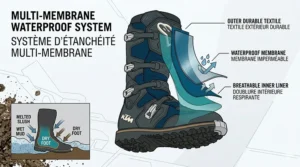
The waterproofing deserves particular attention. Rather than a bootie construction (a separate waterproof layer inside the boot), Forma integrates the waterproof membrane directly into the boot structure. This reduces internal volume loss and eliminates the “bag inside your boot” sensation some riders dislike. For Canadian riders tackling spring runoff crossings or autumn rain, this weather protection extends comfortable riding hours significantly.
Canadian Customer Feedback: Reviews emphasize the Terra Evo’s comfort for long-distance adventure rides, with minimal break-in required. Several riders mention completing trans-Canada trips (Ontario to British Columbia) without developing any significant discomfort. The trade-off comes in ultimate protection levels—riders who’ve crashed in Terra Evos and SG12s note the Italian specialist boots provided noticeably better ankle protection, though the Forma still prevented injury.
Pros:
- Double-flex system provides exceptional comfort during mixed riding styles
- Vibram sole compound maintains grip across wide temperature ranges—crucial for Canadian climate
- Integrated waterproof construction eliminates volume-robbing bootie designs
Cons:
- Not maximum protection compared to pure enduro specialists—choose based on riding style
- Mid-range pricing around $420-$520 CAD offers good value but not premium features
- Tread pattern adequate but not exceptional in extreme mud conditions
Value Verdict: For adventure riders who spend 40% of their time on pavement/gravel and 60% on trails, the Terra Evo delivers excellent value through its multi-surface capability. Expect 3-4 seasons before considering replacement, approximately $120-$150 CAD per season.
7. Alpinestars Tech 7 Enduro Drystar – Waterproof Mud Domination
The Alpinestars Tech 7 Enduro Drystar takes the proven Tech 7 Enduro platform and adds Alpinestars’ proprietary Drystar waterproof/breathable membrane—creating what many Canadian riders consider the ultimate wet-weather enduro boot. The Drystar system differs from generic waterproof membranes through its breathability specifications; Alpinestars claims moisture vapor transmission rates 30% higher than competing systems, reducing the internal condensation that often occurs during high-exertion riding.
For mud performance, the waterproof construction provides an unexpected advantage beyond keeping your feet dry. The sealed construction prevents mud infiltration into internal components, maintaining consistent friction between your foot and the boot’s interior. When riding through sustained muddy sections—think hour-long trail segments through spring-thawed muskeg—this prevents the gradual loosening sensation that occurs as moisture and debris work between boot layers. Your foot stays planted in its optimal position rather than gradually shifting forward or rotating.
The compound sole on the Drystar version uses a harder rubber formulation than the standard Tech 7 Enduro, a deliberate choice to compensate for the extra weight of the waterproof membrane (roughly 200g/0.4 lbs per pair). This firmer compound actually improves mud performance in certain conditions; in clay-heavy Canadian soils that tend to stick rather than shed, the harder surface allows mud to slide off more readily during foot movements. The trade-off comes in slightly reduced peg feel compared to the non-Drystar version—a compromise most Canadian riders accept given our climate realities.
The extended microfiber gaiter at the boot’s upper creates an additional seal against mud and water entry, overlapping your pant leg by several centimetres. During creek crossings or when riding through standing water (common on many Canadian trails after heavy rain), this prevents the dreaded water cascade down your boot shaft. Several riders have mentioned completing rides through knee-deep water crossings with completely dry feet—a claim that sounds like marketing hyperbole until you experience it firsthand.
Canadian Customer Feedback: Reviews consistently highlight the waterproof capability as transformative for Canadian riding conditions. Riders from British Columbia (where wet conditions are nearly constant) consider the Drystar membrane essential rather than optional. The premium pricing generates some complaints, though most reviewers conclude the extended riding season justifies the cost. A few mentions of reduced breathability during hot summer rides appear, particularly in interior British Columbia or the Prairies during July/August heatwaves.
Pros:
- Drystar waterproof membrane extends comfortable riding season dramatically—crucial for Canadian climate
- Extended gaiter design prevents water entry even during significant creek crossings
- Harder sole compound sheds sticky mud more effectively than softer alternatives
Cons:
- Premium pricing in $720-$850 CAD range represents top of market
- Slightly heavier than non-waterproof boots—noticeable during long hiking sections
- Reduced breathability during hot weather compared to vented designs
Value Verdict: For Canadian riders who ride in spring and autumn (when waterproofing matters most) or who live in perpetually wet regions like coastal British Columbia, the Drystar version justifies its premium over the standard Tech 7 Enduro. Expect 4-5 seasons of use due to superior construction quality, bringing per-season costs to approximately $150-$180 CAD.
Real-World Scenario: Matching Boots to Canadian Riding Profiles
Understanding which enduro boots suit your specific Canadian riding environment requires honest assessment of your typical conditions, frequency, and performance priorities. Let me break down three common Canadian rider profiles to illustrate how boot selection should align with actual use.
Profile 1: Weekend Warrior – Southern Ontario Trail Rider Typical Riding: 12-18 days per season, primarily Ganaraska Forest and similar trail systems, spring through autumn riding, occasional muddy conditions after rain, mostly moderate technical difficulty.
Best Boot Match: O’Neal RDX 2.2 or Fox Instinct X. The limited annual riding days don’t justify $700+ CAD investment in premium boots. The RDX 2.2 provides adequate protection and mud performance for moderate conditions at roughly $400 CAD. The variable terrain of Ontario trail systems benefits from the Instinct X’s versatile design philosophy. Both boots will deliver 3-4 seasons at this usage rate, keeping annual costs under $150 CAD while providing genuine safety features rather than fashion-focused products.
Profile 2: Dedicated Enthusiast – Rocky Mountains Technical Rider Typical Riding: 35-50 days per season, Alberta/BC mountain trails, frequent creek crossings, significant elevation changes, technical rock sections mixed with muddy valleys, exposure to extreme weather variability.
Best Boot Match: Gaerne SG12 Enduro or Alpinestars Tech 7 Enduro Drystar. This usage level and terrain difficulty demand maximum protection and durability. The SG12’s Goodyear Welted construction becomes cost-effective at high mileage—resoling at $180 CAD every 2-3 seasons beats buying new $700 boots every 4-5 seasons. The Tech 7 Drystar makes particular sense for riders who don’t want to sacrifice riding days to weather, effectively extending the Canadian season by 4-6 weeks through its waterproof capability. At 40+ days per season, even $850 CAD boots deliver under $50 per riding day over their lifespan.
Profile 3: Touring Adventurer – Trans-Canada Explorer Typical Riding: 25-35 days per season, mixed pavement/gravel/trail riding, multi-day trips through varied geography, significant daily mileage (200-400 km/125-250 miles), exposure to all Canadian weather conditions.
Best Boot Match: Forma Terra Evo or Alpinestars Tech 7 Enduro Drystar. Long-distance touring prioritizes comfort and weather protection alongside technical capability. The Terra Evo’s double-flex system reduces fatigue during all-day rides mixing riding positions, while the Vibram sole handles pavement, gravel, and trail with equal competence. For riders planning trips through perpetually wet regions (coastal BC, Newfoundland), the Tech 7 Drystar’s waterproof construction proves invaluable—arriving at camp with dry feet dramatically improves recovery and next-day performance. Both boots handle the thermal cycling of Canadian days (15°C morning starts reaching 28°C afternoon highs) better than cheaper alternatives.
How to Choose Enduro Boots for Canadian Mud Conditions
Selecting enduro boots for Canadian mud performance requires evaluating factors that marketing materials rarely emphasize. Here’s what actually matters when you’re riding through spring-thaw conditions or autumn rains across our diverse geography.
Sole Compound Temperature Tolerance Rubber hardness changes dramatically with temperature—a critical factor Canadian riders must consider given our climate extremes. When boots are tested and marketed, manufacturers typically use European temperature ranges (10-25°C/50-77°F). Canadian spring and autumn riding frequently occurs in 0-10°C (32-50°F) conditions, where many sole compounds become noticeably stiffer, reducing both grip and flexibility. Premium boots like the Gaerne SG12 or Alpinestars Tech 7 use rubber formulations that remain pliable down to -5°C (23°F), maintaining consistent performance across temperature swings that would render cheaper boots unpredictable.
Tread Pattern Self-Cleaning Capability Not all aggressive tread patterns perform equally in mud. Effective mud boots feature several design elements working together: channel depth of 8-10 mm (0.3-0.4 inches), channel width of at least 4-5 mm (0.16-0.2 inches), and angles of 35-45 degrees relative to the boot’s longitudinal axis. This combination allows mud to evacuate from grooves during the flex cycle of walking or foot repositioning. Canadian mud varies significantly by region—coastal BC’s clay differs from Prairie gumbo differs from Ontario’s sandy loam—but boots featuring these specifications handle all types adequately. Budget boots often feature visually impressive but functionally inadequate tread, with narrow channels that pack solid within 15-20 minutes of muddy riding.
Waterproof Construction vs. Water-Resistant Treatment This distinction matters significantly for Canadian riders but confuses many buyers. Water-resistant boots use treated materials that repel moisture for limited duration—adequate for occasional creek crossings or light rain but overwhelmed by sustained exposure. Waterproof boots incorporate a sealed membrane (Gore-Tex, Drystar, proprietary systems) that prevents water entry regardless of duration. The premium for waterproof construction ($100-$150 CAD typically) extends your comfortable riding season by 4-6 weeks in spring and autumn, when trails are rideable but conditions are wet. For riders in perpetually wet regions or those who refuse to limit riding to perfect weather, waterproof construction pays for itself through extended season utility.
CE Certification Relevance Canadian riders shopping for enduro boots will encounter CE certification markings (EN 13634:2017 standards), but these aren’t legally required in Canada the way they are in Europe. According to Transport Canada’s Motor Vehicle Safety Regulations, protective gear falls under provincial jurisdiction rather than federal oversight. However, CE Level 2 certification provides objective evidence that boots meet rigorous testing for impact resistance, abrasion resistance, and structural rigidity—precisely the properties that prevent injury during crashes. When comparing otherwise similar boots, CE Level 2 certification offers peace of mind that protection claims are verified rather than marketing assertions.
Sizing for Cold-Weather Sock Layers Most boot sizing advice assumes summer riding with standard athletic socks—inadequate guidance for Canadian riders facing shoulder-season temperatures. When purchasing enduro boots, plan your sizing around the thickest socks you’ll realistically wear. For spring and autumn riding in most of Canada, this typically means mid-weight merino wool or synthetic thermal socks adding 3-4 mm of material around your foot. If you typically wear size 43 European (9-9.5 US) in regular footwear, order size 44 in enduro boots to accommodate thicker socks without creating pressure points. The exception: riders exclusively in southern Ontario/Quebec during summer months can size more precisely. Remember that Canadian retailers’ return policies for protective gear vary significantly—verify exchange procedures before purchasing.
Common Mistakes When Buying Enduro Boots in Canada
Through conversations with dozens of Canadian riders and my own experience, certain purchasing mistakes appear repeatedly. Avoiding these errors saves both money and potential injury.
Mistake 1: Prioritizing Price Over Protection in High-Risk Riding The $200 CAD boots on Amazon.ca might look visually similar to $600 CAD premium boots, but materials and construction quality differ dramatically. Budget boots typically use single-density plastics that become brittle in cold temperatures, inadequate ankle pivot systems that provide range of motion without actual protection, and sole compounds that harden below 10°C (50°F). For casual trail riding on maintained paths, these compromises might prove acceptable. However, riders tackling technical single-track through the Rockies, navigating Ontario rock gardens, or exploring remote British Columbia trails face genuine injury risk if boots fail during crashes. The ankle reconstruction surgery avoided by proper boots costs $15,000-$25,000 in medical expenses (even with provincial health coverage, associated costs accumulate) plus 6-12 months recovery—making the $400 CAD price difference between budget and quality boots seem trivial.
Mistake 2: Ignoring Canadian-Specific Weather Performance Many enduro boots are designed and tested primarily for California, Arizona, or Mediterranean European conditions—climates fundamentally different from Canadian reality. Boots that perform brilliantly in 20-30°C (68-86°F) dry conditions often disappoint when facing 5°C (41°F) rain or spring snow. Before purchasing, specifically research how boots perform in cold, wet conditions rather than relying on general reviews. Canadian rider feedback (identifiable through regional mentions in reviews) provides more relevant insights than California desert performance reports. The Alpinestars Tech 7 Enduro Drystar and Gaerne SG12 Enduro both feature prominently in Canadian reviews precisely because they handle our climate variations effectively.
Mistake 3: Overlooking Replacement Parts Availability Enduro boots experience concentrated wear on specific components: buckles break after impacts, shin plates crack from rock strikes, soles wear through aggressive tread. Premium boots from Alpinestars, Gaerne, Sidi, and other established brands offer comprehensive replacement parts programs—buckle sets cost $30-$60 CAD, shin plates $40-$80 CAD, and resoling services $150-$250 CAD. This parts availability extends boot life from 3-4 seasons to potentially 8-10 seasons with maintenance. Budget brands often don’t offer replacement parts, forcing complete boot replacement when repairable components fail. Factor this lifetime ownership cost into your purchase decision rather than focusing solely on initial price.
Mistake 4: Buying Boots That Don’t Fit Canadian Foot Shapes European boots (Gaerne, Sidi, Forma, Alpinestars) typically run narrower than American brands (Fox, O’Neal), reflecting population differences in average foot width. Canadian riders face this same European vs. American fit distinction. If you have wide feet and order Italian boots in your normal size, you’ll likely experience painful pressure points even after break-in. The solution requires either sizing up (accepting some length excess to gain width) or choosing brands known for wider fits. Fox and O’Neal boots generally accommodate wider feet more comfortably than Sidi or Gaerne. Before ordering online, check if any local dealerships stock the model for in-person fitting—the shipping costs of multiple size exchanges quickly erode online discounts.
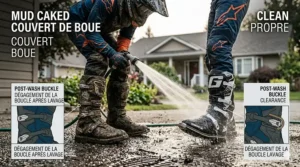
Mistake 5: Neglecting Winter Storage Preparation Canadian riders face 4-6 month off-seasons where boots sit unused in garages or basements experiencing temperature and humidity fluctuations. Proper storage prevents premature degradation of rubber compounds, leather materials, and waterproof membranes. After your final ride of the season, thoroughly clean mud and debris from boots (dried mud retains moisture that promotes material breakdown), apply leather conditioner to any leather components, ensure boots are completely dry before storage, stuff boot shafts with newspaper or boot trees to maintain shape, and store in climate-controlled space if possible (basement rather than unheated garage). This 20-minute maintenance ritual extends boot life by 1-2 seasons compared to simply tossing them in a corner until spring.
Understanding Mud Performance: Tread Patterns and Compound Science
The aggressive tread pattern visible on enduro boots represents just one component of mud performance—the rubber compound and internal sole construction contribute equally to real-world capability. Understanding these relationships helps riders evaluate marketing claims versus genuine performance.
Tread Pattern Geometry Effective mud tread features three key elements working together. First, channel depth must exceed mud grain size—Canadian clay typically aggregates into 3-6 mm particles when wet, requiring minimum 8 mm groove depth to prevent complete packing. Second, channel angles relative to the longitudinal boot axis should fall between 30-45 degrees, creating a chevron or herringbone pattern that directs mud outward during flex cycles. Third, lug spacing must balance traction (closer spacing) against self-cleaning (wider spacing)—optimal mud boots feature 4-5 mm gaps that allow most mud evacuation while maintaining enough rubber contact for grip.
The Gaerne SG12 Enduro exemplifies this geometry. Its dual-compound sole uses a hiking-boot-inspired pattern with widely spaced, moderate-height lugs specifically engineered for mud. Compare this to motocross boots like the Alpinestars Tech 10, which feature taller, more tightly-spaced lugs optimized for peg grip rather than foot-planting traction—a different priority reflecting different riding demands.
Rubber Compound Temperature Dependency Rubber hardness varies with temperature according to predictable chemical principles. Most enduro boot soles use durometer ratings between 55A (softer, more grip, less durable) and 70A (harder, more durable, less grip). However, these ratings are measured at 23°C (73°F) laboratory conditions. When temperatures drop to 5°C (41°F)—common during Canadian spring and autumn riding—rubber effectively increases by 5-10 durometer points, reducing grip and flexibility significantly.
Premium boots address this through specialized rubber formulations incorporating plasticizers that maintain flexibility at low temperatures. The Alpinestars compound sole and Gaerne enduro sole both remain functional down to -5°C (23°F), while budget boots using standard rubber compounds become noticeably stiffer below 10°C (50°F). For Canadian riders, this 15-degree Celsius temperature range difference translates to several additional weeks of reliable performance each season.
Self-Cleaning Mechanisms Mud evacuation during riding occurs through mechanical flex cycles rather than magical material properties. Every time you reposition your foot, walk, or articulate your ankle, the boot sole flexes. Well-designed tread patterns use this flex to generate compressive forces that squeeze mud out of grooves. The key design feature: grooves must maintain minimum cross-sectional area even when the sole is flexed to maximum curvature. Cheaper boots often feature grooves that collapse completely when flexed, trapping mud rather than expelling it.
The Sidi Crossfire 3 SRS demonstrates superior self-cleaning through its tread geometry—even at maximum flex, channels maintain 60-70% of their static width, allowing continuous mud evacuation. Compare this to budget boots where flex reduces channel width by 80-90%, effectively creating solid rubber contact under flexion.
Frequently Asked Questions
❓ Can I use enduro boots for winter fat biking in Canada?
❓ How do I know if enduro boots will fit with my specific motorcycle's peg and shifter setup?
❓ Are expensive enduro boots worth it for casual weekend riding in Ontario?
❓ How often should I replace enduro boot soles in Canadian conditions?
❓ Do I need waterproof enduro boots for riding in British Columbia or just water-resistant treatment?
Conclusion: Investing in Canadian Enduro Boot Performance
Selecting enduro boots for Canadian mud performance requires balancing protection, comfort, durability, and budget—with emphasis shifting based on your specific riding profile. The seven boots reviewed here represent genuinely different value propositions rather than arbitrary brand preferences.
For serious riders logging 30+ days annually on technical terrain, the Gaerne SG12 Enduro or Alpinestars Tech 7 Enduro Drystar justify their $680-$850 CAD pricing through superior protection and exceptional longevity. The SG12’s resoleable construction and the Tech 7 Drystar’s weather-season extension both deliver value that compounds over years of ownership.
Weekend warriors and budget-conscious riders find excellent options in the $350-$450 CAD range with the O’Neal RDX 2.2, which provides 75-80% of premium boot performance at half the price. Yes, you’ll replace them more frequently—but for 12-18 riding days per season, the lower initial investment makes financial sense.
Versatility-focused riders benefit from the Fox Instinct X or Forma Terra Evo, both designed for mixed riding styles that reflect how many Canadians actually ride—combining pavement connectors, gravel roads, and technical trails in single outings.
Whatever your choice, remember that enduro boots mud performance directly impacts both safety and riding enjoyment. Proper boots transform sketchy, white-knuckle mud sections into confident technical challenges. That transformation—measured in reduced injuries, extended seasons, and enhanced capability—represents the real value proposition regardless of price point.
The investment in quality enduro boots delivers returns every time you navigate a spring-thaw creek crossing without sliding, plant your foot confidently on a muddy off-camber section, or finish a ride with dry feet while others suffer through sodden discomfort. For Canadian riders facing our unique climate challenges, choosing boots engineered for mud performance isn’t optional equipment—it’s foundational gear that enables the sport itself.
Recommended for You
- 7 Best Dual Sport Boots Gravel Roads Canada 2026
- 7 Most Comfortable ADV Boots Long Distance Canada 2026
- 7 Best Heated Motorcycle Boots Canada 2026: Beat Cold Feet
Disclaimer: This article contains affiliate links. As an Amazon Associate, I earn from qualifying purchases. If you purchase products through these links, we may earn a small commission at no additional cost to you.
✨ Found this helpful? Share it with your friends! 💬🤗
