
In This Article
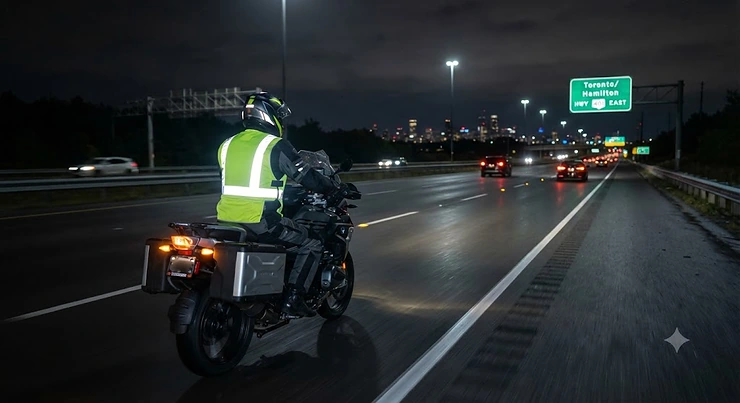
Here’s an uncomfortable truth: your motorcycle could be the most brilliant shade of red on the lot, and a distracted driver still might not clock you until it’s almost too late. That’s not a scare tactic — it’s physics. Motorcycles present a fraction of the visual footprint of a car, and against a cluttered background of guardrails, mailboxes, and other traffic, a rider in dark gear can genuinely disappear into the visual noise. A reflective vest for motorcycle riders solves a problem your jacket, no matter how expensive, usually can’t: it puts a wall of retroreflective material exactly where oncoming headlights and side-mirror glances are most likely to land.
This guide skips the marketing fluff and gets into the specifics. We researched seven real, currently available vests spanning budget hook-and-loop mesh options to premium touring-ready designs, and we’re going to walk through what the specs actually mean for you on a Tuesday commute or a weekend run up the Sea-to-Sky. You’ll get honest analysis grounded in real product data and aggregated review patterns — not invented testimonials, because nobody here is pretending to have logged 10,000 km in each vest personally. According to a widely cited 2004 study on rider conspicuity, wearing reflective or fluorescent clothing correlated with a 37 percent lower risk of a rider sustaining a crash-related injury — this isn’t a nice-to-have accessory — it’s one of the cheapest safety upgrades a rider can make. We’ll also dig into sizing, how these vests actually fit over a jacket, and build you a proper gear checklist before you throw a leg over the seat again.
Quick Comparison Table
If you’re short on time (or reading this at a red light — please don’t), here’s the fast version. Every vest below meets some form of recognized high-visibility standard, and all are genuinely available through Amazon.ca listings as of this writing.
| Vest | Closure Style | Pockets | Best For |
|---|---|---|---|
| Oxford Bright Vest | Hook & loop | None | Budget backup / glovebox stash |
| Ergodyne GloWear 8210HL | Hook & loop | 2 | Cheapest fit-over-jacket option |
| JKSafety JK150 Hi-Vis Vest | Zipper + hook & loop | 9 | Commuters who carry gear |
| Ergodyne GloWear 8220Z | Zipper | 3 | Balanced mid-range daily wear |
| Badass Moto Hi-Vis Vest | Zipper | 1 | Motorcycle-specific styling |
| Oxford Utility Bright Top | Zipper + elastic panels | 4 | Touring over full gear |
| Ergodyne GloWear 8245PSV | Hook & loop, expandable | 2 | Bulky jackets and layered winter riding |
Looking at the spread, there’s a clear budget-to-premium gradient here, and it roughly tracks with how much adjustability and storage you get. The Oxford Bright Vest and Ergodyne GloWear 8210HL are built for simplicity — grab-and-go visibility with no frills — while the Oxford Utility Bright Top and Ergodyne GloWear 8245PSV are engineered to sit comfortably over bulky riding jackets without choking your range of motion. If you carry a phone, wallet, or toll transponder on you, the pocket count matters more than most riders realize until they’re patting themselves down at a gas station.
💬 Just one click — help others make better buying decisions too!😊
Top 7 Reflective Vests for Motorcycle Riders: Expert Analysis
We picked these seven to cover the realistic range of what Canadian riders actually buy: dirt-cheap emergency backups, mid-range daily options, and the kind of gear a serious tourer keeps rolled up in a saddlebag. Every product below is a real, currently listed item — no invented brands, no fictional model numbers.
1. Oxford Bright Vest — cheapest way to meet EN ISO 20471
Oxford Products has been making motorcycle-specific gear for decades, and this vest is the no-nonsense entry point into their high-vis lineup. It’s a certified fluorescent vest that conforms to the EN ISO 20471 visibility standard, which is the European benchmark most closely aligned with what Canadian CSA Z96 apparel is designed to match. In practice, that certification means the fluorescent base fabric and reflective banding have been independently tested for area coverage and retroreflectivity — not just “looks bright in the store.” The construction is deliberately minimal: a fluorescent yellow shell, horizontal reflective bands front and back, and a hook-and-loop front closure that goes on over a jacket in about four seconds flat.
Who should buy this? Honestly, almost everyone — as a backup. Based on the spec comparison against pricier options, what you’re sacrificing here is storage and structure, not visibility performance; the reflective coverage itself is genuinely compliant-grade. Reviewers consistently note that it packs down small enough to live under a seat or in a tank bag, which matters more than people expect on the one commute a month when the sky suddenly opens up. It won’t win style points next to a fitted riding jacket, but that was never the job.
Pros:
- ✅ EN ISO 20471 certified reflective coverage
- ✅ Packs flat for under-seat or tank bag storage
- ✅ Extremely simple to put on over any jacket
Cons:
- ❌ No pockets or storage of any kind
- ❌ Basic hook-and-loop closure can loosen on rough roads
Priced under C$30 at the time of research, this is the cheapest legitimate way to add certified visibility to any kit you already own — check current price and availability before you buy, since Amazon listings shift stock regularly.
2. Ergodyne GloWear 8210HL — best budget fit-over-jacket option
Ergodyne’s GloWear line is a workwear-safety staple, and the 8210HL brings that industrial pedigree to a price point riders will appreciate. It’s built from lightweight 3.3oz polyester mesh, rated Type R, Class 2 under ANSI/ISEA 107-2020 — the American standard that CSA Z96 is designed in technical harmony with, per CSA Group’s own documentation. The dual-sizing design is the real story here: it’s cut generously so it comfortably layers over a bulky riding jacket rather than squeezing your shoulders like some novelty vests do.
Where this one earns its keep is the hook-and-loop closure paired with a lower interior pocket and single exterior pocket — enough to stash a phone or a folded toll receipt, though not much more. What most buyers overlook about mesh-construction vests like this is that the open weave isn’t just about airflow; it also means the vest dries almost instantly after a rain shower, which matters if you’re stuffing it wet into a pannier. Reviewers of the GloWear line broadly describe the fabric as holding its reflective tape well through repeated machine washing, consistent with Ergodyne’s stated 25-wash durability claim.
Pros:
- ✅ Roomy dual-sizing fits easily over jackets
- ✅ Mesh fabric dries fast after wet rides
- ✅ ANSI/ISEA 107-2020 Type R Class 2 compliant
Cons:
- ❌ Only two pockets, both fairly shallow
- ❌ Hook-and-loop sides can flap at highway speed
In the C$15-C$25 range, this is arguably the best value fit-over-jacket vest on this list — check current price, as it fluctuates with Amazon promotions.
3. JKSafety JK150 Hi-Vis Vest — motorcycle hi-vis vest with pockets, done right
If you’ve ever cursed a vest for having zero place to put your phone, this is the one built for you. The JK150 comes loaded with nine separate pockets and compartments, including a two-tier pocket with a clear ID window and two large expandable utility pockets near the waist. It’s a genuinely functional motorcycle hi-vis vest with pockets, not just a hi-vis vest that happens to have a pocket bolted on as an afterthought. Four 2-inch reflective strips cover the shoulders, chest, and waist for 360-degree visibility, and the zipper-plus-hook-and-loop combination keeps the front secure even with pockets loaded.
Here’s what the spec sheet won’t tell you, but the applications list quietly confirms: JKSafety explicitly markets this line for “motor riding” alongside its usual construction and surveying crowd, and the pocket layout reflects that crossover thinking — you get a dedicated slot roughly sized for a smartphone plus separate small pouches for keys or a multitool. For a rider who wants one vest that covers commuting, quick errands, and the odd job-site visit without changing gear, that flexibility is a genuine selling point rather than marketing filler. Aggregated reviews describe the mesh as breathable in warm weather while noting the vest runs slightly generous, so sizing down a notch is a common suggestion.
Pros:
- ✅ Nine pockets for phone, keys, and tools
- ✅ 360-degree reflective strip coverage
- ✅ ID window pocket for visible identification
Cons:
- ❌ Runs large — consider ordering one size down
- ❌ Bulkier profile than minimalist alternatives
Expect to pay in the C$25-C$40 range depending on colour and size; prices may vary, so check current listings before adding to cart.
4. Ergodyne GloWear 8220Z — best balanced mid-range daily wear
The 8220Z sits right in the middle of Ergodyne’s lineup, and that middle-ground positioning is exactly what makes it a strong daily-wear pick. It upgrades from the 8210HL’s hook-and-loop closure to a proper front zipper, which stays put far better once you’re leaned over in a corner or hunched into a headwind. Construction is the same durable 3.3oz polyester mesh, still Type R Class 2 compliant, but now with three pockets total — one interior, two exterior — plus a single radio mic tab that riders sometimes repurpose for clipping a lanyard or small light.
Based on the spec comparison with the cheaper 8210HL, the C$10-15 price jump buys you a fundamentally more secure closure system, and that’s not a trivial upgrade for anyone commuting at highway speeds. Here’s what most buyers overlook about zipper vests generally: a zipper keeps the fluorescent panel taut against your torso, which actually improves how well the retroreflective tape catches headlights compared to a loosely flapping hook-and-loop front. Reviewers describe the zipper as smooth-running out of the box and note the machine-washable fabric holds its shape through repeated laundering, matching Ergodyne’s published 25-wash durability standard.
Pros:
- ✅ Zipper closure stays secure at speed
- ✅ Three pockets balance storage and weight
- ✅ Meets ANSI/ISEA 107-2020 Class 2 standard
Cons:
- ❌ Sizing runs true, less forgiving over bulky jackets
- ❌ No dedicated phone pocket sizing
Sitting around C$35-C$50, this is the vest we’d point most daily commuters toward first — check current price for your size and colour combination.
5. Badass Moto Hi-Vis Vest — best motorcycle-specific styling
Most hi-vis vests are dressed-up construction gear. This one was actually built by a motorcycle-focused, family-run company from the ground up, and it shows in small but meaningful ways. The bold orange colourway is deliberately styled to read as “biker gear” rather than “road crew,” with a zipper front, a single pocket sized for a smartphone or keys, and a mesh cooling liner that Ergodyne-style industrial vests generally skip. It’s adjustable on both sides, letting a Medium comfortably expand to fit over a Medium-to-Large jacket — genuinely useful if your riding jacket varies by season.
What stands out on paper is the padded neck detail, a small comfort feature aimed squarely at long stretches in traffic rather than an eight-hour construction shift. Aggregated customer feedback for this line consistently praises the visibility of the reflective striping specifically when illuminated by headlights at night, which lines up with its marketed “ultra-bright” reflective tape claim. On the flip side, with only one pocket, it’s not going to replace the JK150 if you’re someone who carries a lot on your person.
Pros:
- ✅ Purpose-built styling for motorcycle riders
- ✅ Mesh cooling liner improves hot-weather comfort
- ✅ Adjustable sides fit multiple jacket sizes
Cons:
- ❌ Only one usable storage pocket
- ❌ Sizing runs specific to jacket-size pairing, not body size
Typically priced in the C$35-C$55 range, this is the pick for riders who want their safety gear to actually look like motorcycle gear rather than a detour sign.
6. Oxford Utility Bright Top — best reflective vest for touring motorcyclists
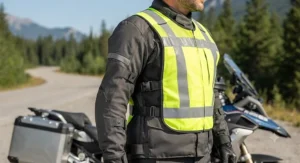
This is Oxford’s step-up model, and it’s specifically engineered with intelligent sizing to fit over a jacket — Oxford’s own guidance is to size the vest to your jacket size, not your body size, which is a detail a lot of buyers miss on their first order. Certified to the EN 1150 high-visibility standard (a European standard specifically for non-professional/leisure use, distinct from the occupational EN ISO 20471 rating on the entry-level Oxford Bright Vest), it’s built with a clear ID pocket, a zippered chest pocket, two front box pockets, and a rear box pocket — four functional storage points total. Elasticated binding and targeted stretch panels keep it snug against the body even at highway speed, addressing the flapping problem that plagues cheaper hook-and-loop vests.
For a reflective vest for touring motorcyclists specifically, this is the strongest candidate on this list. Multi-day trips mean packing a phone, a wallet, spare earplugs, and sometimes a paper map or hotel confirmation — and the Utility Bright Top’s four pockets are actually distributed sensibly across chest and lower back rather than clustered in one spot. Reviewers of Oxford’s Bright range broadly describe the reflective heat-transfer branding and 360-degree reflective coverage as noticeably brighter under direct headlight illumination compared to cheaper printed reflective tape, consistent with the brand’s reputation in the UK and Canadian touring community.
Pros:
- ✅ Sized specifically to fit over riding jackets
- ✅ Four pockets distributed front and back
- ✅ EN 1150 certified 360-degree reflective coverage
Cons:
- ❌ Higher price point than basic mesh vests
- ❌ Bulkier profile not ideal for minimalist commuting
Expect a price range of roughly C$55-C$80 at the time of research — a reasonable premium for gear built specifically around multi-day riding.
7. Ergodyne GloWear 8245PSV — best high-visibility vest fit over jacket for bulky winter gear
Originally engineered for public safety workers who need visibility over body armour, radios, and turnout gear, the 8245PSV’s expandable design translates surprisingly well to winter riders layering a heated liner under a heavy touring jacket. It uses 3M Scotchlite reflective material — a genuinely premium retroreflective compound — set against a 4.5-inch contrasting colour background, a two-tone configuration Ergodyne specifically designs to make the reflective tape stand out under more lighting conditions than a single-tone strip. The hook-and-loop closure and expandable panel construction mean it accommodates significantly more bulk under the vest than any other option here, without pulling tight across the shoulders or restricting arm movement on the bars.
This is the answer if you’ve ever tried to zip a “one-size” hi-vis vest over a winter jacket and physically couldn’t close it. Breakaway shoulder and side seams — a public-safety feature meant to release if snagged on machinery — double as a practical safety margin if a strap ever catches on a mirror or luggage rack while you’re getting on or off the bike. Based on the spec sheet, this is overkill for a summer commuter in a mesh jacket, but for anyone riding through a Canadian shoulder season in a heavily insulated jacket, it may be the only vest on this list that actually fits.
Pros:
- ✅ Expandable design fits over bulky winter jackets
- ✅ 3M Scotchlite two-tone reflective material
- ✅ Breakaway seams reduce snag risk
Cons:
- ❌ Overbuilt and bulky for warm-weather riding
- ❌ Premium price relative to basic mesh vests
Sitting in the C$45-C$70 range, it’s a niche but genuinely smart pick for layered cold-weather riders — check current price before ordering, as public-safety-grade gear occasionally runs limited stock.
Practical Usage Guide: Getting the Most From Your Hi-Vis Vest
Buying the vest is the easy part. Getting real value out of it takes a few habits most listings never mention. First, don’t leave it crumpled at the bottom of a saddlebag between rides — reflective tape that’s been folded sharply for weeks can develop creases that scatter light instead of bouncing it straight back at a driver’s headlights, quietly reducing the exact performance you paid for. Roll it loosely instead of folding on hard lines.
Second, build a simple maintenance habit: wash mesh vests like the Ergodyne GloWear 8210HL or Ergodyne GloWear 8220Z in cold water on a gentle cycle, and skip the dryer — heat degrades the adhesive backing on reflective tape faster than sunlight does. Ergodyne’s own documentation notes their GloWear fabric is rated to hold shape through roughly 25 washes, which is a useful mental benchmark for retiring a vest once the tape starts looking dull or cracked rather than bright and glassy.
Third, in your first 30 days, resist the urge to over-tighten adjustable sides on vests like the Badass Moto Hi-Vis Vest — a vest cinched too tight compresses the reflective panel’s shape and can actually reduce the flat surface area facing traffic. A common first-time mistake is treating the vest like a snug base layer instead of a loose outer shell; loose and flat beats tight and wrinkled every time for retroreflectivity.
Real-World Scenarios: Which Rider Are You?
Picture three riders standing in the same gear shop, each walking out with a completely different vest, and each one making the right call for their situation.
Meera commutes 14 km each way through city traffic in a light textile jacket, mostly during shoulder-season daylight with the occasional evening ride home. For her, the Ergodyne GloWear 8220Z makes sense — zipper security for stop-and-go traffic, enough pocket space for a phone and transit card, and a price point that doesn’t sting if it gets left on a bike rack in the rain once.
Devon is doing a two-week cross-Canada tour, camping most nights, and needs gear that survives being packed and unpacked daily while still carrying essentials during long highway stretches. The Oxford Utility Bright Top fits that brief precisely — sized to layer over a full touring jacket, four pockets to distribute weight, and a certification level built around exactly this kind of extended, non-occupational riding.
Priya rides year-round, including through late-fall temperatures that push her into a heavily insulated winter jacket with a thermal liner. Standard vests simply won’t zip over that bulk. The Ergodyne GloWear 8245PSV, with its expandable panels originally designed for gear-laden public safety workers, is the only realistic option among these seven that comfortably wraps around her winter setup without cutting off shoulder mobility.
Your Complete Motorcycle Safety Gear Checklist
A reflective vest is one piece of a bigger safety puzzle, and treating it as the whole solution is a mistake worth avoiding. Before your next ride, run through this motorcycle safety gear checklist:
- Helmet — government-approved and properly fastened, full-face for maximum protection.
- Eye protection — a face shield or riding glasses, since debris at speed is a real hazard even on short trips.
- Reflective vest or hi-vis outer layer — one of the seven above, sized to fit over your actual riding jacket.
- Abrasion-resistant jacket and pants — leather or reinforced textile, covering torso, arms, and legs completely.
- Gloves — full-coverage, ideally with knuckle protection.
- Over-the-ankle boots — non-flapping laces, sturdy sole.
- Reflective tape on the bike itself — wheel rims and the rearmost surfaces catch headlights independently of what you’re wearing.
- Earplugs — reduces fatigue on longer highway stretches, which indirectly supports alertness and visibility awareness.
Provincial road safety bodies consistently echo a version of this list; Alberta’s own guidance recommends wearing reflective tape and bright safety gear as core visibility steps for every rider, regardless of what province you’re actually riding in.
Reflective Vest Sizing: How to Get the Right Fit
Vest sizing trips up more first-time buyers than any other single factor on this list, mostly because the sizing logic is backwards from what people expect. With a jacket, you size to your body. With a reflective vest meant to be worn over a jacket, you size to your jacket — not your bare chest measurement. Oxford explicitly states this for the Oxford Utility Bright Top: if you wear a large jacket, order the large vest, even if your body measurements alone would suggest a medium.
Dual-sized vests like the Ergodyne GloWear 8210HL solve some of this ambiguity by covering a wider size range per unit — a single “M/L” designation, for example, might comfortably span jacket sizes that would otherwise need two separate vest sizes. Adjustable-side designs, like the Badass Moto Hi-Vis Vest, add a second layer of flexibility: even within a labelled size, the hook-and-loop side straps let you fine-tune the fit around whatever you’re wearing that day, whether that’s a light mesh jacket in July or a slightly heavier layer in September. The safest approach if you’re between sizes: size up. A vest that’s a touch loose still drapes flat and reflects properly; one that’s too tight distorts the reflective panel and restricts the shoulder movement you need for shoulder checks and signalling.
How a High-Visibility Vest Fits Over Your Jacket
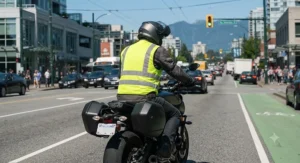
The whole premise of a reflective riding vest is that it goes on top of existing gear, but “fits over a jacket” means different things depending on construction. Simple hook-and-loop vests, like the Oxford Bright Vest, rely on generous overall cut and side straps that cinch to whatever girth is underneath — quick to adjust, but with a practical ceiling on how much bulk they can accommodate before the straps run out of range.
Expandable designs solve that ceiling problem directly. The Ergodyne GloWear 8245PSV was engineered for public safety workers wearing body armour and radios, so its expandable panel construction has substantially more range than a standard vest — which is exactly why it’s the strongest choice here for riders layering a heavy winter jacket or a heated vest liner underneath. Zippered vests sit in between: the Ergodyne GloWear 8220Z and JKSafety JK150 Hi-Vis Vest both zip closed, which gives a cleaner, more secure fit than hook-and-loop, but that same zipper means less forgiveness if you’re right at the edge of a size range. As a rule of thumb, match closure type to how much your under-layer bulk changes across seasons: if you ride the same jacket year-round, a snug zippered vest works fine; if your jacket thickness swings seasonally, prioritize an expandable or generously dual-sized option instead.
How to Choose a Reflective Vest for Motorcycle Riders
Cutting through the marketing noise, here’s the actual decision process worth following, step by step.
- Start with certification, not colour. Look for ANSI/ISEA 107, EN ISO 20471, or EN 1150 labelling — these indicate independently tested reflective coverage, not just a bright paint job.
- Match closure type to your riding pattern. Zippers for daily commuting security; hook-and-loop or expandable panels for seasonal flexibility.
- Count the pockets you’ll actually use. An adjustable reflective riding vest with too few pockets forces you to carry a separate bag; too many adds bulk you don’t need.
- Size to your jacket, not your torso, as covered above — this single step prevents most return requests.
- Consider your typical light conditions. Riders doing mostly dusk or night commutes benefit more from denser reflective tape coverage, like the 3M Scotchlite on the Ergodyne GloWear 8245PSV, than daytime-only riders.
- Factor in climate. Mesh breathes better for summer; solid-panel or expandable vests handle layered cold-weather riding without restricting movement.
- Set a realistic budget band, and remember that price ranges shift constantly on Amazon — check current pricing rather than anchoring to a number you saw last month.
Common Mistakes When Buying Motorcycle Hi-Vis Gear
The single most common mistake is buying based on body measurements alone and ignoring what’s supposed to go underneath the vest — a rookie error that leads directly to returns and exchanges. A close second is assuming any bright colour equals real visibility; an uncertified neon shirt from a big-box store simply hasn’t been tested for retroreflective performance the way a CSA Z96-aligned or ANSI/ISEA 107 vest has been. Riders also frequently underestimate how quickly reflective tape degrades with dryer heat, then wonder a year later why the vest looks duller under headlights than it did new. Finally, plenty of buyers pick a minimalist, pocket-free vest like the base Oxford Bright Vest and then get frustrated they have nowhere to put a phone — a mismatch between product and use case that a five-minute pocket-count check would have avoided entirely.
Reflective Vests vs Hi-Vis Jackets: Which Wins for Riders?
A dedicated hi-vis riding jacket bakes reflective material directly into the garment, which sounds appealing until you consider the total cost and flexibility trade-off. A hi-vis jacket typically runs several times the price of even the priciest vest here, like the Oxford Utility Bright Top, and it locks you into wearing that specific jacket every time you want visibility — no mixing and matching with your existing gear collection. A vest, by contrast, layers over whatever jacket you already own, which means one C$40 purchase like the Ergodyne GloWear 8220Z extends visibility coverage across your entire jacket wardrobe rather than just one garment.
Where a dedicated jacket wins is integration: no extra layer to put on or take off, no separate item to forget on a shelf. For most riders, though, the vest’s flexibility and dramatically lower upfront cost make it the more practical choice, especially for anyone who already owns a perfectly good non-hi-vis jacket and simply wants a visibility boost for occasional dusk or highway riding rather than a full gear replacement.
What to Expect: Real-World Performance in Rain, Night, and Highway Riding
Specs on a page and specs in a rainstorm are two different experiences, so here’s the translation. In daylight, the fluorescent base fabric on any of these seven vests does most of the visibility work — it’s the colour saturation, not the reflective tape, that catches a driver’s peripheral vision at a distance. Reflective tape only activates its full potential once direct light hits it, meaning its real job starts at dusk and continues through full darkness, exactly when a rider’s silhouette blends most easily into background clutter.
In rain, mesh-construction vests like the JKSafety JK150 Hi-Vis Vest genuinely shine, since water beads and drains through the open weave rather than pooling and darkening the fluorescent panel the way a solid-fabric vest can. At highway speed, closure type becomes the dominant factor in real-world performance: a loosely cinched hook-and-loop vest will billow and flap, distorting the flat reflective surface a following driver relies on, while a zippered or tightly elasticated design like the Oxford Utility Bright Top stays flush against the torso and keeps its reflective geometry consistent mile after mile.
Long-Term Cost & Maintenance of Reflective Riding Gear
Total cost of ownership for a reflective vest is refreshingly simple compared to most riding gear, but it’s not zero. Beyond the initial purchase price, factor in an eventual replacement cycle — Ergodyne’s own washability rating of roughly 25 washes for their GloWear line is a reasonable proxy across most mesh vests, meaning a rider washing their vest monthly might realistically expect two to three years of reliable retroreflective performance before the tape’s brightness noticeably drops.
Cost-per-use math favours the cheaper options for occasional riders: an Oxford Bright Vest purchased for under C$30 and worn a dozen times a year works out to pennies per ride over its lifespan. For daily commuters logging hundreds of rides annually, though, investing in a more durable zippered option like the Ergodyne GloWear 8220Z or Oxford Utility Bright Top often makes more sense long-term, since the sturdier closure and construction tend to hold up to daily on-off cycling better than a budget hook-and-loop design. Either way, the maintenance cost is trivial — cold water, gentle cycle, air dry — which keeps the total ownership cost of any vest on this list well below almost any other category of protective riding gear.
Safety, Regulations & Compliance Guide for Canadian Riders
Canada doesn’t currently have a single nationwide law mandating hi-vis gear for motorcyclists the way helmets are mandated, but the regulatory groundwork for high-visibility apparel is well established through CSA Z96, the Canadian Standards Association’s standard for high-visibility safety apparel. This standard is explicitly designed in technical harmony with the American ANSI/ISEA 107 rating referenced throughout this guide, and it’s treated as best practice — and a hard requirement in some workplace contexts — across several provinces.
The stakes behind that framework are significant. According to Statistics Canada’s National Collision Database analysis, motorcyclists accounted for 12 percent of vulnerable road user collision fatalities in a recent reporting year, despite representing a small fraction of registered vehicles on the road. Provincial motorcycle safety programs consistently point back to visibility as a controllable variable in that risk equation, which is exactly the gap a certified reflective vest is designed to close — it won’t prevent every close call, but it measurably shifts the odds of being seen before a mirror-check gets missed.
Frequently Asked Questions
❓ Do I legally need to wear a reflective vest on a motorcycle in Canada?
❓ What size reflective vest should I buy for my motorcycle jacket?
❓ Can I wear a reflective vest over a leather motorcycle jacket?
❓ How often should I replace a motorcycle hi-vis vest?
❓ Are reflective vests with pockets worth the extra cost?
Conclusion
Visibility isn’t glamorous gear talk, but it might be the single highest-value, lowest-cost upgrade available to any rider in Canada right now. Whether you land on the barebones Oxford Bright Vest for glovebox-emergency duty, the pocket-loaded JKSafety JK150 Hi-Vis Vest for daily commuting, or the expandable Ergodyne GloWear 8245PSV for layered winter rides, the underlying logic stays the same: make yourself impossible to miss, and let the physics of retroreflection do the work your riding skill alone can’t. None of these seven vests will replace a properly fitted helmet or abrasion-resistant jacket, but stacked on top of that foundation, a well-chosen reflective vest closes one of the most preventable gaps in a rider’s overall safety picture.
✨ Don’t Miss These Exclusive Deals!
🔍 Take your riding visibility to the next level with these carefully researched picks. Click on any highlighted vest above to check current pricing and availability on Amazon.ca. A few extra dollars now could mean being seen exactly when it matters most.
Recommended for You
- Hi-Vis Vest vs Reflective Vest for Motorcyclists: 7 Picks (2026)
- Reflective Safety Tape Roll: 7 Top Picks for Canadian Nights (2026)
- Reflective Helmet Decals: 7 Best Picks for Canada in 2026
Disclaimer: This article contains affiliate links. As an Amazon Associate, I earn from qualifying purchases. If you purchase products through these links, we may earn a small commission at no additional cost to you.
✨ Found this helpful? Share it with your friends! 💬🤗
