
In This Article
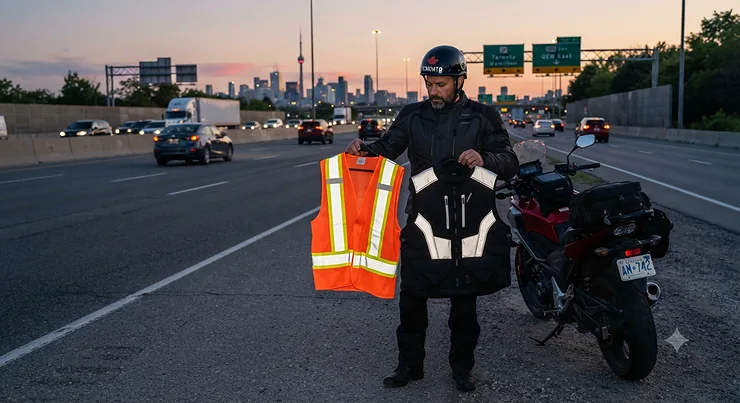
Here’s an uncomfortable truth: your C$400 riding jacket doesn’t matter much if the driver turning left at the intersection never actually saw you coming. That’s the entire premise behind the hi-vis vest vs reflective vest for motorcyclists debate, and it’s a lot more nuanced than “buy something yellow.” One category is built to scream at drivers under a blazing noon sun. The other is built to bounce a stranger’s headlights straight back at their eyeballs at 11 p.m. on a rural Ontario backroad. Mix them up, and you might be perfectly visible at the wrong time of day.
This guide breaks down the real difference between fluorescent and reflective visibility gear, walks through seven actual products you can find through Amazon.ca, and explains the ANSI/ISEA classes that determine how much protection you’re actually buying. We’ll lean on real research, including a widely cited motorcycle conspicuity study and Transport Canada’s own road safety guidance, rather than vague marketing claims. By the end, you’ll know exactly which vest belongs in your saddlebag, and why carrying just one might not be enough.
Quick Comparison: Hi-Vis Vest vs Reflective Vest
Before diving into individual products, here’s the fast answer for anyone skimming on their phone at a gas station.
| Feature | Hi-Vis (Fluorescent) Vest | Reflective Vest |
|---|---|---|
| Primary tech | Fluorescent background fabric | Retroreflective strips over darker or fluorescent fabric |
| Shines brightest | Daytime, overcast, dusk | Nighttime, headlight beams, tunnels |
| Typical ANSI/ISEA class | Class 2 (some Class 1) | Class 2 or Class 3 |
| Best for | Commuters riding daylight hours | Night riders, shift workers, touring in low light |
| Price range (CAD) | C$20–C$50 | C$25–C$90 |
Most “hi-vis vests” on the market actually combine both technologies to some degree, which is where the confusion starts. A true daytime-only fluorescent vest leans almost entirely on colour, while a nighttime-rated vest depends on the width and placement of its silver retroreflective banding. Ironwear, Milwaukee, and ML Kishigo vests below lean harder into the reflective side of that equation, while something like the Badass Moto vest leans into fluorescent style with modest reflective trim. Neither approach is “better” outright; it depends entirely on when and how you ride, which is exactly why we’re covering seven distinct options instead of crowning one universal winner.
💬 Just one click — help others make better buying decisions too!😊
Top 7 Hi-Vis and Reflective Vests for Motorcyclists: Expert Analysis
We researched real, currently available products spanning budget zip-up layers to ANSI Class 3 professional-grade vests. Every entry below includes genuine specs, an honest analytical take, and aggregated review sentiment, not invented testimonials.
1. Badass Moto Reflective Motorcycle Vest — casual styling that doesn’t scream “construction site”
The Badass Moto Reflective Motorcycle Vest was designed specifically to slide over an existing riding jacket without making you look like you wandered off a road crew. It uses a soft collar, breathable mesh lining, and fully adjustable side straps so it can cinch down over a mesh summer jacket or loosen up over a padded touring shell.
Unlike the ANSI-rated entries on this list, this vest isn’t independently certified to a specific class; it’s built around fluorescent panelling and moderate reflective piping rather than lab-tested retroreflective coverage. That distinction matters: based on the spec comparison, this is a supplemental visibility layer for riders who want to look less industrial, not a compliance-grade safety garment for professional roadside use. Reviewers consistently note the fit runs generously, with several suggesting sizing down if you plan to wear it directly over a t-shirt rather than a jacket.
Pros:
- ✅ Fits smoothly over jackets without bulk
- ✅ Water- and UV-resistant fabric holds colour
- ✅ Adjustable sides accommodate layering changes
Cons:
- ❌ Not independently ANSI/ISEA class certified
- ❌ Reflective coverage is lighter than dedicated safety vests
Priced in the C$35–C$45 range, it’s a reasonable value if your priority is daytime style over documented nighttime performance.
2. RK Safety P5511 Class 2 Vest — cheapest true ANSI Class 2 pick
The RK Safety P5511 Class 2 Vest is a genuine ANSI/ISEA-compliant garment marketed explicitly for construction, traffic control, and motorcycle use, which puts it in a rare category of vests that are both cheap and lab-tested. It uses two-tone reflective striping over breathable mesh, along with a D-ring harness pass-through and radio loop that most motorcyclists will never touch but appreciate having anyway.
What most buyers overlook about entry-level Class 2 vests like this one is that “Class 2” isn’t a marketing term; it’s a specific minimum area of fluorescent and retroreflective material defined by ANSI/ISEA 107 testing. Reviewers consistently report the mesh keeps things cool in stop-and-go traffic, though several note the zipper hardware feels noticeably lighter-duty than pricier options.
Pros:
- ✅ Genuine ANSI Class 2 certification at a low price
- ✅ Breathable full-mesh construction for hot rides
- ✅ D-ring harness pass-through and radio loop included
Cons:
- ❌ Zipper and hardware feel less durable long-term
- ❌ Minimal pocket storage compared to rivals
At around C$20–C$30, this is the vest to keep folded under your seat for the ride home when the sky turns grey unexpectedly.
3. JKSafety JK150 Class 2 Reflective Vest — most pockets for the price
The JKSafety JK150 Class 2 Reflective Vest packs nine pockets and four reflective strips into a lightweight mesh shell, which makes it an odd but genuinely useful crossover between a safety vest and a utility layer for riders who carry phones, keys, and toll transponders.
Here’s what the spec sheet won’t tell you, but rider forums suggest: the extra pockets are genuinely handy for stashing a wallet or gloves during a gas stop, something the minimalist Class 2 vests above don’t offer. Aggregated review sentiment across retail listings skews positive on comfort and pocket layout, with a recurring theme that sizing runs slightly large, so ordering one size down is common advice among buyers.
Pros:
- ✅ Nine pockets for genuine on-bike storage
- ✅ Four-strip reflective layout for solid visibility
- ✅ Lightweight mesh doesn’t trap heat
Cons:
- ❌ Sizing runs large according to buyer consensus
- ❌ Pockets add bulk some riders don’t want
Expect a price in the C$25–C$35 range, making it a strong budget pick if functional storage matters as much as visibility.
4. ML Kishigo 1195 All Mesh Contrast Vest — best all-mesh breathability for summer riding
ML Kishigo has built safety apparel for close to five decades, and the ML Kishigo 1195 All Mesh Contrast Vest reflects that experience: it’s ANSI Type R/Class 2 certified, uses full mesh front and back, and adds a reflective lining detail most competitors skip entirely.
The Type R designation specifically matters here. Based on the spec comparison, Type R garments are engineered for workers and riders operating directly on or near roadways with complex, cluttered visual backgrounds, which describes most urban motorcycle commuting almost perfectly. Reviewers on major retail platforms consistently praise the breathability during hot-weather wear and describe the contrasting trim as genuinely visible in daylight, though a handful mention the six pockets feel tight for anything bulkier than a phone.
Pros:
- ✅ ANSI Type R/Class 2 certified for roadway use
- ✅ Full mesh construction stays cool in summer heat
- ✅ Reflective lining adds low-light visibility detail
Cons:
- ❌ Pockets are shallow for bulkier items
- ❌ Contrast trim colour options are limited
Priced roughly C$45–C$60, it lands squarely in the mid-range and earns that price through certified performance rather than extra gadgetry.
5. Milwaukee Class 2 High-Visibility Performance Safety Vest — best storage for long-haul commuters
The Milwaukee Class 2 High-Visibility Performance Safety Vest is built by a company more famous for power tools than motorcycle gear, but that industrial pedigree shows in the details: fifteen pockets, a clear ID holder, a rear tablet pocket, and 600D tear-resistant reinforcement on the front pouches.
What most buyers overlook is the padded collar, a small feature that matters enormously on a two-hour highway commute where a stiff vest collar can chafe under a helmet strap. On paper this means less fidgeting at red lights and fewer reasons to unzip mid-ride. Reviewers consistently mention the internal size-adjustment system as a standout, letting the same vest fit comfortably over a t-shirt in July or a padded jacket in October.
Pros:
- ✅ Fifteen pockets including a rear tablet pocket
- ✅ Padded collar reduces helmet-strap chafing
- ✅ Adjustable internal sizing for seasonal layering
Cons:
- ❌ Heavier than minimalist mesh-only vests
- ❌ Overkill storage for riders who travel light
At approximately C$55–C$70, it’s aimed at riders who essentially live out of their vest pockets during long commutes or touring days.
6. Radians SV55 Class 2 Two-Tone Engineer Vest — padded neck built for loaded pockets
The Radians SV55 Class 2 Two-Tone Engineer Vest uses a heavier woven fabric than the mesh-first options above, paired with a padded neck specifically engineered to support the added weight of a fully loaded cargo pocket without digging into your shoulders.
Reviewers consistently note this vest feels more substantial and less “flimsy” than ultralight mesh alternatives, which tracks with the woven construction. What the spec sheet won’t tell you is that heavier woven fabric also means less airflow, so this is a better match for riders in cooler climates or shoulder-season riding rather than peak summer commuting. The two-tone contrasting trim adds a visual pop that testers describe as noticeably more visible against dark asphalt than single-tone vests.
Pros:
- ✅ Padded neck supports heavier loaded pockets
- ✅ Durable woven fabric outlasts thin mesh
- ✅ Two-tone trim boosts contrast against pavement
Cons:
- ❌ Less breathable than full-mesh competitors
- ❌ Bulkier fit under a tight-fitting jacket
Expect a price range around C$50–C$65, positioning it as a mid-tier pick for riders who prioritize durability over ventilation.
7. Ironwear 1293 Class 3 Breakaway Safety Vest — highest ANSI class with breakaway safety design
The Ironwear 1293 Class 3 Breakaway Safety Vest is the most heavily certified option on this list, meeting ANSI/ISEA Class 3, the highest performance tier defined under the standard, which requires substantially more fluorescent and retroreflective material than Class 2 garments.
Here’s the analytical case for a motorcyclist specifically wanting this over a Class 2 vest: Class 3 is engineered for the lowest-light, highest-risk visibility scenarios, exactly the conditions that make night riding or dawn commuting genuinely dangerous. The breakaway design is also worth flagging: the vest is engineered to separate cleanly if snagged on machinery or debris, a feature originally intended for industrial workers near moving equipment but one that has an obvious secondary benefit for a rider who might get caught on gear during an off-bike incident. Aggregated reviewer sentiment describes the radio clips and polyester mesh build as genuinely field-tested rather than flimsy, though the higher price point draws occasional pushback from casual commuters.
Pros:
- ✅ ANSI Class 3, the highest certified visibility tier
- ✅ Breakaway design releases if snagged
- ✅ Radio clips and reinforced mesh for daily wear
Cons:
- ❌ Highest price point of the seven
- ❌ More material than casual daytime riders may need
Priced around C$70–C$90, this is the vest for riders who commute in genuine darkness, foul weather, or both, and who want documented Class 3 performance rather than a best guess.
Top 7 Products: Specs, Price Range & Best For
| Product | ANSI/ISEA Class | Standout Feature | Price Range (CAD) | Best For |
|---|---|---|---|---|
| Badass Moto Reflective Motorcycle Vest | Not certified | Moto-styled fit over jackets | C$35–C$45 | Daytime style riders |
| RK Safety P5511 Class 2 Vest | Class 2 | Cheapest certified option | C$20–C$30 | Budget-conscious commuters |
| JKSafety JK150 Class 2 Vest | Class 2 | Nine storage pockets | C$25–C$35 | Riders who carry gear |
| ML Kishigo 1195 All Mesh Vest | Type R / Class 2 | All-mesh breathability | C$45–C$60 | Hot-weather commuting |
| Milwaukee Class 2 Performance Vest | Class 2 | Fifteen pockets, padded collar | C$55–C$70 | Long-haul touring riders |
| Radians SV55 Engineer Vest | Class 2 | Padded neck for loaded pockets | C$50–C$65 | Cooler-climate riders |
| Ironwear 1293 Breakaway Vest | Class 3 | Highest certified visibility | C$70–C$90 | Night and low-light riders |
Looking at the table above, the pattern is clear: certified Class 2 vests dominate the budget-to-mid range, while true Class 3 coverage like the Ironwear 1293 commands a premium because it demands more material and tighter manufacturing tolerances. If your riding is strictly daylight commuting on familiar roads, a Class 2 option like the ML Kishigo 1195 likely covers you fine. Riders who regularly find themselves on the road after sunset should weight their decision toward Class 3 coverage, even at the higher price, because the extra retroreflective area is precisely what closes the visibility gap when headlights become the only light source around.
✨ Don’t Miss These Exclusive Deals!
🔍 Take your riding visibility to the next level with these carefully researched picks. Click on any highlighted product to check current pricing and availability on Amazon.ca. The right vest could be the cheapest safety upgrade in your entire riding kit!
Practical Usage Guide: Wearing, Layering, and Maintaining Your Visibility Vest
Buying the right vest is half the job; wearing it correctly is the other half, and it’s the part most riders skip. First, fit matters more than colour. A vest that flaps at highway speed doesn’t just look sloppy, it can catch wind and become a distraction, so look for adjustable side straps like those on the Badass Moto vest or the internal sizing on the Milwaukee vest.
Second, layering order matters. Most manufacturers recommend the vest go over your outermost layer, not tucked underneath a jacket, since retroreflective strips only work when light can actually hit them directly. Third, maintenance is where a lot of visibility gear quietly fails: reflective strips lose effectiveness after repeated abrasion, road grime, or improper washing. Most vests recommend cold-water machine washing and air drying, never ironing or dry cleaning, since heat can degrade the adhesive backing on retroreflective tape. A quick monthly check under a flashlight in a dark room will tell you honestly whether your strips are still bouncing light back sharply or have started to dull.
Common first-30-days mistakes include storing the vest crumpled in a saddlebag (which creases and eventually cracks the reflective coating) and washing it with heavy-duty detergents that weren’t designed for treated fabrics.
Real-World Scenarios: Which Rider Are You?
The daily downtown commuter. If you’re riding 15 kilometres through city traffic every weekday morning, visibility against a cluttered urban background matters more than nighttime reflectivity. A Class 2 vest like the ML Kishigo 1195 or JKSafety JK150 covers this scenario well, especially since both stay breathable during stop-and-go summer traffic.
The night-shift worker riding home at 2 a.m. For this rider, headlights are often the only light source on the road, and retroreflective area becomes the deciding factor. The Ironwear 1293 Class 3 Breakaway Vest is built precisely for this situation, offering the widest reflective coverage on this list.
The weekend tourer covering long highway stretches. This rider needs storage as much as visibility, since long days mean carrying a phone, toll cards, and snacks. The Milwaukee Class 2 Performance Vest with its fifteen pockets and padded collar solves both problems simultaneously, while the Radians SV55 offers a durable alternative for cooler-weather touring.
Problem → Solution: Fixing Common Visibility Gear Headaches
Problem: The vest flaps uncomfortably at highway speed. Solution: Choose a vest with adjustable side cinches, like the Badass Moto vest, and tighten fully before merging onto faster roads.
Problem: Reflective strips look dull after a few months. Solution: Switch to cold-water washing only, avoid fabric softener (it coats and dulls reflective surfaces), and inspect strips monthly under direct light.
Problem: The vest is invisible at night despite being “hi-vis.” Solution: Confirm you actually own a retroreflective-rated garment, not just a fluorescent one; fluorescent colour alone does almost nothing once ambient light drops.
Problem: Pockets bounce or sag while riding. Solution: Look for a padded-neck design like the Radians SV55, which is specifically engineered to distribute loaded-pocket weight evenly.
Problem: Vest feels too hot in summer traffic. Solution: Prioritize full-mesh builds like the ML Kishigo 1195 over heavier woven fabrics.
What Is a Hi-Vis Vest vs a Reflective Vest?
A hi-vis vest relies primarily on fluorescent fabric, bright yellow-green or orange-red material that appears intensely bright in daylight because it converts invisible UV light into visible light. A reflective vest relies on retroreflective material, typically silver strips that bounce a light source directly back to where it came from, making it most effective at night under headlights or flashlights. Many modern vests, including several on this list, combine both technologies into one garment.
Fluorescent vs Reflective Visibility Gear: Understanding the Two Technologies
This is where the fluorescent vs reflective visibility gear question actually gets interesting, because the two materials solve completely different physics problems. Fluorescent fabric works by absorbing ultraviolet light and re-emitting it at a brighter, more visible wavelength, which is why a fluorescent yellow-green vest looks almost unnaturally vivid under bright sun. The catch: fluorescent fabric needs ambient light to work its trick. Once the sun goes down, fluorescent material behaves like any other coloured fabric and mostly just fades into the background.
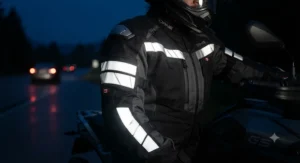
Retroreflective material takes an entirely different approach. Rather than glowing, it’s built from thousands of tiny glass beads or prismatic structures that catch incoming light, such as a car’s headlights, and bounce it directly back toward its source rather than scattering it randomly. That’s why reflective strips seem to “light up” dramatically in a driver’s headlights at night, even though the strip itself produces no light of its own. Reviewers and safety researchers alike note that the two materials are complementary rather than competitive; a garment with generous fluorescent area handles daytime visibility, while a garment with wide retroreflective banding handles the night shift. The CSA Z96 standard, Canada’s national benchmark for high-visibility apparel, requires specific minimum amounts of both material types depending on class, precisely because relying on just one leaves a dangerous gap.
Daytime vs Nighttime Visibility Vest: Why One Vest Rarely Does Both Jobs Perfectly
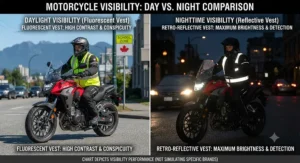
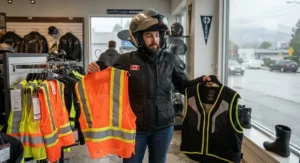
The daytime vs nighttime visibility vest distinction sounds like splitting hairs until you actually experience the failure mode. A rider wearing a purely fluorescent vest at dusk can become nearly invisible within minutes as ambient light drops, because the fluorescent effect fades along with the sunlight that powers it. Conversely, a heavily reflective vest worn at noon under bright sun offers little advantage over any dark-coloured jacket, since retroreflective strips need a concentrated light source, like headlights, to demonstrate their advantage.
What most buyers overlook is that “hi-vis” as a blanket marketing term often obscures which job a given vest is actually optimized for. Based on the spec comparison across our seven picks, vests like the ML Kishigo 1195 lean toward daytime performance with generous fluorescent mesh, while the Ironwear 1293 leans toward nighttime performance with its Class 3 retroreflective coverage. The practical takeaway for most riders: if you only ride during daylight commutes, a Class 2 fluorescent-forward vest is genuinely sufficient. If your riding schedule ever crosses into dusk, dawn, or full darkness, carrying (or wearing) a vest with substantial retroreflective area stops being optional and starts being a real safety decision, backed by research showing reflective or fluorescent gear cut crash-related injury risk by 37 percent in one widely cited case-control study.
How to Choose a Hi-Vis or Reflective Vest
- Identify your typical riding hours first. Daytime-only commuters can prioritize fluorescent coverage; anyone riding near dusk or after dark should prioritize retroreflective area.
- Check for an actual ANSI/ISEA or CSA Z96 class label. A vest without a class rating hasn’t been independently tested, even if it looks bright.
- Match the class to your exposure. Class 2 suits most urban and suburban riders; Class 3 suits highway riders, night shift workers, or anyone in low-visibility weather.
- Consider pocket and storage needs. Long commutes benefit from vests like the Milwaukee Class 2 Performance Vest with genuine storage capacity.
- Test the fit over your actual riding jacket. A vest that’s snug over a t-shirt may not zip over a padded winter jacket.
- Prioritize breathability for hot climates. Full-mesh builds like the ML Kishigo 1195 avoid overheating during summer stop-and-go traffic.
- Budget for replacement, not just purchase. Reflective material degrades with wear, so factor a two-to-three-year lifespan into your cost expectations.
ANSI/ISEA Visibility Class Explained
The ANSI/ISEA visibility class system, developed by the American National Standards Institute and the International Safety Equipment Association, sorts high-visibility garments into three performance tiers based on how much fluorescent and retroreflective material they contain. Class 1 is the lightest tier, generally suited to environments away from traffic entirely. Class 2 requires more background and reflective material and is the practical minimum most safety professionals recommend for anyone working or riding near vehicle traffic. Class 3 requires the most material of all, intended for high-speed roadways, low-visibility conditions, or emergency response scenarios.
Canada largely mirrors this framework through the CSA Z96 standard, which is designed to be in technical harmony with ANSI/ISEA 107 and the international ISO 20471 standard. Practically speaking, when you see “Class 2” printed on a vest tag like the ones on the ML Kishigo 1195 or Radians SV55, that’s not marketing language; it reflects a specific, independently defined minimum coverage requirement. The Ironwear 1293, by contrast, jumping to Class 3 means substantially more reflective real estate on your torso, which is exactly why it costs more and why it’s the recommended pick for genuinely dark riding conditions.
Motorcycle Vest Safety Comparison: Hi-Vis vs Reflective vs Standard Gear
| Approach | Visibility Boost | Cost | Weather Layering | Best For |
|---|---|---|---|---|
| Standard dark riding jacket only | Minimal | Already owned | N/A | Not recommended alone |
| Fluorescent-forward hi-vis vest | Strong daytime | C$20–C$60 | Layers easily over jackets | Daylight commuters |
| Retroreflective-forward vest | Strong nighttime | C$45–C$90 | Layers over most gear | Night and shift riders |
This motorcycle vest safety comparison table underscores a point worth repeating: riding in dark gear with no supplemental visibility layer at all is consistently linked to higher crash-related injury risk in the research literature, including Transport Canada’s own road safety guidance, which specifically recommends brightly coloured, reflective riding gear. Adding either a fluorescent or reflective vest represents a meaningfully cheaper safety investment than most other motorcycle gear upgrades, often costing less than a single tank of gas relative to the protection gained.
Common Mistakes When Buying Motorcycle Visibility Gear
The most common mistake is assuming any bright yellow vest automatically means nighttime safety; as covered above, colour alone does very little once the sun sets. A second frequent error is buying a vest sized for a t-shirt and discovering it won’t zip over a winter riding jacket, which is why testing fit over your actual gear matters more than trusting the size chart alone. A third mistake is neglecting maintenance entirely, letting road grime and repeated washing with harsh detergents quietly degrade reflective strips over a season or two without the rider noticing. Finally, some riders buy the cheapest unrated vest available and assume it performs like a certified Class 2 garment; without an ANSI/ISEA or CSA Z96 label, there’s simply no independent verification of how much visible material the garment actually contains.
Long-Term Cost & Maintenance
| Tier | Typical Price Range (CAD) | What You Get | Realistic Lifespan |
|---|---|---|---|
| Budget | C$20–C$35 | Basic Class 2 certification, minimal extras | 1–2 riding seasons |
| Mid-range | C$45–C$65 | Better fabric, more pockets, improved fit | 2–3 riding seasons |
| Premium | C$70–C$90 | Class 3 coverage, breakaway design, reinforced hardware | 3+ riding seasons |
Looking at the cost breakdown, the value story shifts once you account for lifespan rather than sticker price alone. A budget vest like the RK Safety P5511 might need replacing after a single hard-riding season if the zipper hardware fails early, while the Ironwear 1293‘s reinforced mesh and hardware are built to outlast several seasons of regular wear. Total cost of ownership, not just upfront price, is the more honest way to compare these seven options, and it often narrows the gap between “cheap” and “premium” more than the sticker prices suggest.
Safety, Regulations & Compliance Guide
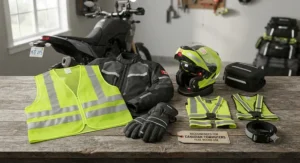
Canada does not currently have a federal law requiring motorcyclists to wear high-visibility apparel, but several provinces treat CSA Z96 compliance as best practice for occupational riders, and safety authorities consistently recommend it for all riders regardless of legal requirement. Transport Canada’s public safety materials explicitly recommend brightly coloured or reflective clothing as a low-cost, high-impact intervention. If you ride professionally, such as for courier or delivery work, check your specific provincial workplace safety requirements, since some jurisdictions, including British Columbia and Manitoba, treat CSA Z96-compliant apparel as a genuine occupational requirement rather than a suggestion. For recreational riders, there’s no legal mandate, but the research consensus is unambiguous: visible gear meaningfully reduces crash-related injury risk, and it costs far less than most other safety upgrades available for a motorcycle.
Frequently Asked Questions
❓ Is a hi-vis vest the same as a reflective vest?
❓ What ANSI class should motorcyclists wear?
❓ Can I wear a hi-vis vest over my motorcycle jacket?
❓ How often should I replace a reflective safety vest?
❓ Does Canada require motorcyclists to wear hi-vis gear?
Conclusion
The hi-vis vest vs reflective vest for motorcyclists question doesn’t really have a single winner, and that’s honestly the most useful takeaway here. Daytime commuters get the most value from fluorescent-forward Class 2 options like the ML Kishigo 1195 or budget-friendly RK Safety P5511, while anyone riding into darkness, dusk, or bad weather should lean toward retroreflective-heavy coverage like the Ironwear 1293 Class 3 Breakaway Vest. Riders who split the difference, commuting through changing seasons and lighting conditions, might genuinely benefit from owning two vests rather than compromising with one.
What ties every pick on this list together is that they’re all inexpensive compared to the rest of your riding kit, yet the research consistently shows visibility gear delivers an outsized reduction in crash-related injury risk. Given that, choosing the right vest for your actual riding schedule, not just the brightest one on the shelf, is one of the cheapest and smartest upgrades available to any rider.
✨ Ready to Ride Safer Tonight?
🔍 Browse the seven vests above on Amazon.ca and pick the one that actually matches your riding hours. Whether it’s daylight commuting or a late-night ride home, the right visibility layer could make all the difference in being seen when it matters most!
Recommended for You
- Reflective Safety Tape Roll: 7 Top Picks for Canadian Nights (2026)
- Reflective Helmet Decals: 7 Best Picks for Canada in 2026
- Reflective Safety Vest: 7 Best Hi-Vis Picks for Canada (2026)
This article contains affiliate links. As an Amazon Associate, I earn from qualifying purchases. If you purchase products through these links, we may earn a small commission at no additional cost to you.
✨ Found this helpful? Share it with your friends! 💬🤗
