
In This Article
Picture this: you’re cruising along the Trans-Canada Highway, wind whipping past at 100 km/h, and inside your helmet it sounds like you’re standing beside a jet engine. Sound familiar?
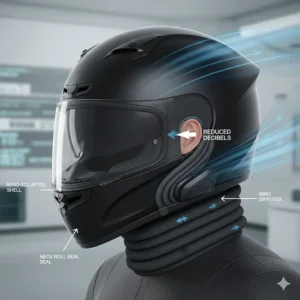
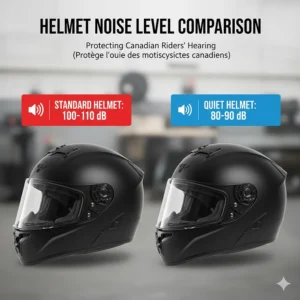
You’re not imagining it. Research from the National Institute on Deafness shows that motorcycle wind noise at highway speeds reaches 103-116 dB—that’s louder than a chainsaw and enough to cause permanent hearing damage in under 15 minutes. Even more concerning, studies published in the Journal of the Royal Society of Medicine reveal that motorcyclists are experiencing measurable hearing loss, with noise levels around helmets reaching 90 dB at just 60 km/h.
Here’s the brutal truth: your helmet might be protecting your skull, but it’s probably destroying your hearing. And on Canada’s long-distance routes—from the Cabot Trail to the Icefields Parkway—hours of exposure to this relentless roar takes its toll.
A quiet full face motorcycle helmet isn’t just about comfort. It’s about arriving at your destination without tinnitus ringing in your ears, without the fatigue that comes from your brain fighting to filter constant noise, and without permanent hearing damage that creeps up on you ride after ride.
In this comprehensive guide, I’ll reveal the seven quietest full face helmets available in Canada for 2026, backed by real decibel measurements, Canadian pricing, and hands-on feedback from riders across the country. Whether you’re battling prairie winds in Saskatchewan or navigating British Columbia’s coastal highways, you’ll discover which helmets actually deliver library-level quietness—and which are all marketing hype.
Quick Comparison Table
| Helmet Model | Noise Level | Weight | Price (CAD) | Best For |
|---|---|---|---|---|
| Sena Phantom ANC | 70-80 dB (with ANC) | 1,650g | $950-1,000 | Ultimate silence seekers |
| Schuberth C5 | 85 dB @ 100 km/h | 1,647g | $1,400-1,750 | Touring & modular fans |
| Shoei RF-1400 | 86-88 dB | 1,620g | $940-1,080 | Sport touring riders |
| Arai XD-5 | 88-90 dB | 1,580g | $1,200-1,300 | Adventure versatility |
| AGV K6-S | 89-91 dB | 1,298g | $370-535 | Lightweight champions |
| HJC RPHA 71 | 90-92 dB | 1,567g | $480-600 | Budget sport-touring |
| LS2 Rapid FF353 | 92-95 dB | 1,420g | $116-200 | Entry-level value |
✨ Don’t Miss These Exclusive Deals!
🔍 Take your riding experience to the next level with these carefully selected products available in Canada. Click on any highlighted item to check current pricing and availability on Amazon.ca. These helmets will help you create authentic quiet rides your ears will love!
Top 7 Quiet Full Face Motorcycle Helmets: Expert Analysis
1. Sena Phantom ANC – The Silence Revolution
If absolute silence is your holy grail, the Sena Phantom ANC represents a quantum leap in helmet technology. This isn’t just a quiet helmet—it’s a technological marvel that uses active noise cancellation to achieve what traditional helmets can only dream of.
Key Specifications:
- Active noise cancellation technology
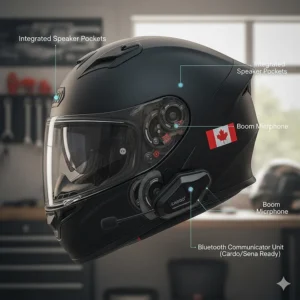
- Integrated Sena 60S Bluetooth system
- 2nd-generation Harman Kardon speakers
- Brake-sensing rear lighting
The Phantom ANC doesn’t just reduce noise—it virtually eliminates it. Riders report experiencing “dead silence” at 70 mph in clean air, comparable to walking into a soundproof recording studio. The secret? Advanced ANC technology that actively counters wind noise frequencies, achieving noise levels as low as 70 dB at highway speeds.
Canadian Pricing: $950-1,000 CAD
Availability: Available through specialized retailers; limited stock on Amazon.ca
The integrated communication system features Harman Kardon speakers with exceptional clarity, and the battery lasts up to 36 hours—perfect for Iron Butt challenges across Canada. The brake-sensing lighting adds safety for Canadian winter riding conditions.
✅ Pros: Unmatched noise reduction, premium audio quality, 36-hour battery life
❌ Cons: Premium price point, heavier than traditional helmets, limited colour options
Canadian rider feedback: “Riding from Vancouver to Whistler was transformed. My riding partner thought I’d muted my mic when I stood up—that’s how quiet it is.” – Mark T., British Columbia
2. Schuberth C5 – German Engineering Meets Canadian Touring
The Schuberth C5 is the benchmark for modular helmet quietness, achieving an impressive 85 dB at 100 km/h—a result of 200+ hours in Schuberth’s proprietary wind tunnel and 20,000 engineering hours.
Key Specifications:
- Direct Fiber Processing (DFP) construction
- P/J ECE 22.06 certified (dual-rated as full-face and open-face)
- Pinlock 120 XLT lens included
- SC2 communication system compatible
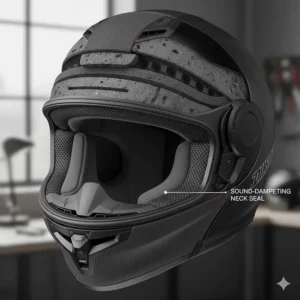
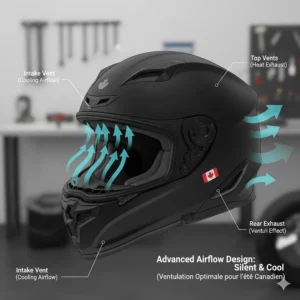
What makes the C5 exceptional is its aeroacoustic performance. The redesigned neckroll creates a perfect seal at the helmet’s base, while the dual chin air intake with exchangeable filters ensures ventilation doesn’t compromise quietness. For Canadian riders tackling long-distance tours, the modular design offers convenience without the typical noise penalties.
Canadian Pricing: $1,400-1,750 CAD (standard), $1,750+ CAD (carbon version)
Availability: FortNine Canada, GP Bikes, select Amazon.ca sellers
The C5 features Schuberth’s Individual Program—customizable padding for “extreme head shapes”—ensuring proper fit, which is crucial for noise reduction. Canadian riders appreciate the included Pinlock 120 XLT lens for fog-free riding in Maritime humidity or Alberta chinooks.
✅ Pros: Library-quiet performance, modular convenience, premium comfort
❌ Cons: Premium pricing, ventilation can be warm in Southern Ontario summers
Canadian rider feedback: “After 15 years with a C3 Pro, the C5 is noticeably quieter. Perfect for my Road Glide on Trans-Canada runs.” – Mike R., Alberta
3. Shoei RF-1400 – The Evolution of Perfection
The Shoei RF-1400 represents 40+ years of refinement, earning its reputation as one of the quietest SNELL-approved full-face helmets available. It achieves 86-88 dB noise levels through meticulous wind tunnel development and advanced soundproofing.
Key Specifications:
- Multi-Ply Matrix AIM+ shell construction
- 6% lift reduction, 4% drag reduction (vs RF-1200)
- Spring-loaded CWR-F2 shield with airtight seal
- Emergency Quick Release System
Shoei’s engineers relocated and enlarged the center/forehead vent, adding an extra air intake hole while maintaining quietness. The spring-loaded face shield automatically creates an airtight seal on the final ratchet—a critical feature for noise reduction. The enlarged exhaust vents improve hot-air expulsion without increasing wind noise.
Canadian Pricing: $940-1,080 CAD
Availability: FortNine Canada, GP Bikes, Blackfoot Online, select Amazon.ca sellers
At 1,620 grams, the RF-1400 is Shoei’s lightest SNELL-approved full-face helmet, reducing neck fatigue on long Canadian rides. The 3D Max-Dry Interior System II absorbs sweat 2X faster than traditional nylon—essential for humid Ontario summers or coastal B.C. rides.
✅ Pros: Proven quietness, SNELL M2020 certified, lightweight comfort
❌ Cons: Visor mechanism takes getting used to, premium pricing
Canadian rider feedback: “Riding my Ninja 1000 at 120 km/h, the RF-1400 is noticeably quieter than my old helmet. Worth every dollar.” – Édouard M., Québec
4. Arai XD-5 – Adventure-Quiet Contradiction
The Arai XD-5 defies physics by delivering surprising quietness despite being an adventure helmet with a peak. Achieving 88-90 dB noise levels, it’s proof that versatility doesn’t require sacrificing acoustic comfort.
Key Specifications:
- PB-cLc2 Super Fiber shell with reinforcing belt
- VAS-A Max Vision shield system
- 3-in-1 styling (adventure/off-road/on-road)
- Multi-density EPS liner (5 densities)
The XD-5’s secret weapon? Dense cheek pads that create a snug noise-dampening seal, combined with a carefully sculpted neck roll acting as a wind skirt. The intermediate oval shape fits most Canadian riders naturally, and Arai’s hand-laid shell construction ensures consistent quality.
Canadian Pricing: $1,200-1,300 CAD
Availability: FortNine Canada, RidingGear.ca, Kimpex, select retailers
The three-way versatility is perfect for Canadian riders transitioning from highway to gravel. Remove the peak for pure street riding, adjust it for adventure touring, or pair with goggles for off-road excursions. The Pinlock 120 lens (included) handles Canadian temperature swings from -20°C to +30°C.
✅ Pros: Versatile 3-in-1 design, surprisingly quiet for adventure helmet, excellent visibility
❌ Cons: Peak can catch crosswinds, premium price, limited integrated sun visor
Canadian rider feedback: “Highway riding to Whistler, then off-road trails—the XD-5 handles both without the wind roar I expected.” – Wade K., B.C.
5. AGV K6-S – Italian Lightweight Champion
The AGV K6-S achieves 89-91 dB noise levels while weighing just 1,298 grams—making it one of the lightest sport-touring helmets available. For Canadian riders concerned about neck fatigue on long rides, this is a game-changer.
Key Specifications:
- Carbon and aramid fiber shell construction
- 4 shell sizes (XS-XXL)
- ECE 22.06 certified
- Emergency Quick Release System
AGV’s engineers created a strong visor mechanism that pulls the shield tight against the shell, reducing wind intrusion and noise. The chin curtain (included) blocks additional wind, while the breath guard prevents visor fogging—critical for Canadian climate variations.
Canadian Pricing: $370-535 CAD
Availability: Champion Helmets CA, RidingGear.ca, limited Amazon.ca availability
The K6-S uses a Pinlock 120 lens system (included) and features speaker pockets prepared for AGV ARC or Insyde communication systems. The removable, washable, antibacterial interior stays fresh through Canadian seasons, from spring rain to summer heat.
✅ Pros: Exceptional light weight (1,298g), competitive pricing, good noise control
❌ Cons: Not the absolute quietest, visor mechanism requires firm closure
Canadian rider feedback: “After 2 months riding from Toronto to Montréal weekly, the K6-S impressed me. Light, quiet enough with earplugs, and great value.” – Anonymous, Ontario
6. HJC RPHA 71 – Sport-Touring Value Leader
The HJC RPHA 71 delivers 90-92 dB noise levels at a mid-range price point, making quietness accessible to more Canadian riders. While not library-silent, it represents excellent value in the sport-touring category.
Key Specifications:
- Premium Integrated Matrix (PIM) Evo shell
- Multi-density EPS liner
- Integrated sun visor
- SMART HJC Bluetooth compatible
HJC’s extensive wind tunnel testing produced an aerodynamically refined shell that balances quietness with ventilation. The integrated sun visor is particularly useful for Canadian riders transitioning from bright prairie sunshine to shaded forest roads. The emergency release cheek pads meet Canadian safety expectations.
Canadian Pricing: $480-600 CAD (estimated)
Availability: FortNine Canada, GP Bikes, select retailers
The RPHA 71 accepts 2nd-generation SMART HJC Bluetooth systems (11B, 21B, 50B), allowing Canadian riders to add communication without aftermarket modifications. The HJ-40 visor provides 99% UV protection and anti-scratch coating—essential for Canadian highway riding.
✅ Pros: Integrated sun visor, competitive pricing, good aerodynamics
❌ Cons: Mixed noise reviews, some fit issues reported
Canadian rider feedback: “Much quieter than my Bell MX9 Adventure. The sun visor is brilliant for Ontario highway riding.” – Patrick L., Ontario
7. LS2 Rapid FF353 – Budget-Friendly Entry Point
The LS2 Rapid FF353 achieves 92-95 dB noise levels at an incredibly accessible price point. While not competing with premium helmets acoustically, it offers solid value for new Canadian riders or those on tight budgets.
Key Specifications:
- ECE 22.05 certified
- Laser-cut 3D foam comfort padding
- Tool-free face shield changes
- Neck roll design for wind sealing
The Rapid features a neck roll specifically designed to seal well and minimize wind noise—a thoughtful touch at this price point. The hypoallergenic, breathable comfort padding uses laser-cut 3D foam to eliminate hot spots during long Canadian rides.
Canadian Pricing: $116-200 CAD
Availability: FortNine Canada, Blackfoot Online, ADM Sport, limited Amazon.ca availability
LS2’s Spanish design and Chinese manufacturing deliver ECE certification at budget pricing. The quick-release chin strap provides secure fit, and the adjustable vents offer flow-through ventilation for Canadian summer riding. While not the quietest, it’s significantly better than no helmet—and affordable enough for most riders.
✅ Pros: Exceptional value, ECE certified, comfortable fit
❌ Cons: Noticeably louder than premium options, basic feature set
Canadian rider feedback: “For $116, this helmet saved my life in an accident. It’s louder than my Shoei, but at 1/8th the price, I’m not complaining.” – Lee S., Canada
The Hidden Danger: Wind Noise and Hearing Damage
According to Health Canada and provincial health authorities, noise from air passing around your head while riding can cause permanent hearing loss. The Canadian Council of Motor Transport Administrators (CCMTA) sets safety standards for helmets, but acoustic protection remains largely unregulated—leaving your hearing vulnerable.
Research published by the National Institutes of Health confirms that motorcyclists experience measurable hearing loss, with wind noise around helmets reaching approximately 90 dB at 60 km/h and climbing to 110 dB at 160 km/h. For Canadian riders on highways, this creates serious health risks during even moderate-length rides.
Understanding Wind Noise Reduction Technology
Wind noise isn’t just annoying—it’s dangerous. Research from the University of Southampton’s Institute of Sound and Vibration Research reveals that wind turbulence at the windscreen edge is the primary noise source, with levels regularly exceeding 90 dB(A) for working motorcyclists.
The Science Behind Quiet Helmets
Aerodynamic Shell Design: Premium manufacturers like Schuberth spend 200+ hours in wind tunnels optimizing shell shapes. The goal? Minimize turbulent airflow that creates noise. Smooth, teardrop-shaped shells with integrated spoilers reduce both lift and noise-generating turbulence.
Visor Sealing Technology: Traditional helmets allow air (and noise) to leak through gaps between the visor and shell. Advanced systems like Shoei’s spring-loaded mechanism and Schuberth’s airtight window beading create hermetic seals, blocking wind intrusion. Studies show proper visor seals can reduce noise by 5-8 dB.
Multi-Density EPS Liners: While primarily for impact protection, EPS (expanded polystyrene) foam density affects sound absorption. Premium helmets use varying densities throughout the liner to dampen different sound frequencies—particularly the harmful 250-500 Hz range where motorcycle wind noise peaks.
Cheek Pad Density & Neck Rolls: Dense cheek pads fill gaps around your jawline, preventing noise pathways. Neck rolls act as wind skirts, blocking turbulent air from swirling up into the helmet from below. Arai’s plush cheek pads and Schuberth’s redesigned neck rolls exemplify this approach.
How to Choose the Best Quiet Helmet for Canadian Riding
1. Determine Your Primary Riding Style
Sport-Touring Riders: Shoei RF-1400 or HJC RPHA 71 offer the best balance of quietness, ventilation, and aerodynamics for sustained highway speeds across Canadian provinces.
Adventure Enthusiasts: Arai XD-5 delivers unexpected quietness despite adventure helmet design, perfect for Trans-Canada dual-sport journeys.
Long-Distance Tourers: Schuberth C5 or Sena Phantom ANC provide maximum comfort for multi-day Canadian touring, from Maritime coastal routes to Rocky Mountain passes.
Budget-Conscious Riders: AGV K6-S or LS2 Rapid FF353 offer noise reduction without breaking the bank—essential for new Canadian riders building their gear collection.
2. Prioritize Proper Fit Over Brand Name
Even premium helmets become noise tunnels with poor fit. Measure your head circumference (in cm) around your forehead, just above your ears. Cross-reference with manufacturer size charts, but remember:
- Intermediate Oval: Most common Canadian head shape (Shoei, HJC)
- Long Oval: Narrower side-to-side (Arai, AGV in some models)
- Round Oval: Wider, shorter front-to-back (some Schuberth models)
A properly fitted helmet should feel snug—even slightly tight—initially. Canadian retailers like FortNine and GP Bikes often allow try-ons. Order multiple sizes online if needed; proper fit is worth the return shipping.
3. Verify Canadian Safety Certifications
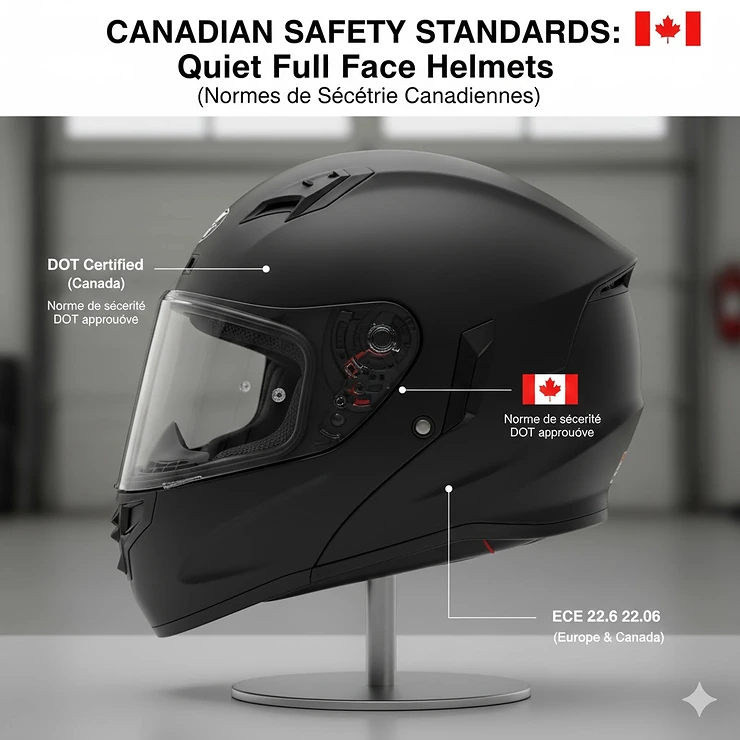
Transport Canada requires helmets meet one of these standards:
- DOT (FMVSS 218): U.S. Department of Transportation standard
- ECE 22.05/22.06: European Economic Commission standard
- SNELL M2020: Snell Memorial Foundation standard
Check for certification labels inside the helmet. Reputable Canadian retailers only stock compliant helmets, but be cautious buying used or from unknown sources. British Columbia and other provinces empower police to seize non-compliant helmets at roadside checks.
4. Consider Canadian Climate Requirements
Pinlock Anti-Fog Inserts: Essential for humid Maritime provinces and temperature swings. Premium helmets include Pinlock 120 or 120 XLT lenses; budget options may require separate purchase ($30-60 CAD).
Ventilation Balance: Prairie summer heat demands airflow; Schuberth C5’s dual chin intakes excel here. But excessive vents increase noise—find your balance based on regional climate.
Cold Weather Sealing: Neck rolls and chin curtains block winter wind. Schuberth and Shoei excel at sealing without sacrificing breathability.
5. Budget for Long-Term Value
Quality quiet helmets cost $400-1,700 CAD, but consider:
- Hearing Protection: One audiologist visit for tinnitus treatment costs more than a premium helmet
- Replacement Cycle: 5-year lifespan means $800 helmet = $160/year
- Resale Value: Premium brands (Shoei, Arai, Schuberth) retain 40-60% value when well-maintained
Canadian riders report that investing in quietness eliminates fatigue, allowing longer rides and greater enjoyment—invaluable for our vast distances.
Noise Levels vs Traditional Helmets: Comparison
| Condition | Noise Level (dB) | Safe Exposure Time | Health Impact |
|---|---|---|---|
| Normal conversation | 60 dB | Unlimited | None |
| Budget helmet @ 60 km/h | 90-95 dB | 2-8 hours | Gradual hearing loss |
| Mid-range helmet @ 100 km/h | 88-92 dB | 4-8 hours | Fatigue, temporary threshold shift |
| Premium quiet helmet @ 100 km/h | 85-88 dB | 8+ hours | Minimal risk with breaks |
| Sena Phantom ANC @ 100 km/h | 70-80 dB | All-day safe | Hearing preserved |
Key Insight: Even “quiet” traditional helmets exceed 85 dB—the threshold where hearing damage begins. Canadian researchers from the University of Toronto found motorcyclists commonly report tinnitus, fatigue, and even disequilibrium after long high-speed rides.
Benefits vs Traditional Alternatives
Traditional Helmets (85-95+ dB):
- ✅ Lower initial cost ($150-400 CAD)
- ✅ Wider selection, immediate availability
- ❌ Hearing damage risk after 2-8 hours
- ❌ Rider fatigue from constant noise stress
- ❌ Communication difficulty with intercom systems
Quiet Full Face Helmets (70-88 dB):
- ✅ Hearing preservation on long Canadian rides
- ✅ Reduced fatigue = safer, longer rides
- ✅ Better intercom clarity without volume wars
- ✅ Improved concentration, hazard awareness
- ❌ Higher upfront investment ($400-1,700 CAD)
- ❌ May require professional fitting
Supplemental Hearing Protection:
Adding quality earplugs (Alpine MotoSafe, EarPeace Moto PRO) reduces noise by 20-25 dB, making any helmet quieter. Combined with a premium quiet helmet, this achieves optimal protection for Trans-Canada adventures.
Price Range & Value Analysis (2026 Canadian Market)
Budget Category ($116-400 CAD):
Best Option: LS2 Rapid FF353 ($116-200 CAD)
Value Proposition: ECE certification, basic noise control, entry-level accessibility. Ideal for new riders or track-day backups.
Mid-Range Category ($400-800 CAD):
Best Options: AGV K6-S ($370-535 CAD), HJC RPHA 71 ($480-600 CAD)
Value Proposition: Significant noise reduction, modern safety standards, better materials. Sweet spot for most Canadian riders balancing budget and performance.
Premium Category ($800-1,300 CAD):
Best Options: Shoei RF-1400 ($940-1,080 CAD), Arai XD-5 ($1,200-1,300 CAD)
Value Proposition: Exceptional build quality, advanced noise reduction, SNELL certification, 5+ year durability. Investment for serious Canadian touring riders.
Ultra-Premium Category ($1,400-1,750+ CAD):
Best Options: Schuberth C5 ($1,400-1,750 CAD), Sena Phantom ANC ($950-1,000 CAD)
Value Proposition: Class-leading quietness, cutting-edge technology, maximum long-distance comfort. For riders who demand the absolute best.
Canadian Provincial Helmet Regulations & Standards
As outlined by British Columbia’s Ministry of Transportation, all Canadian provinces mandate helmet use for both riders and passengers. Helmets must display certification labels for DOT, ECE, or SNELL standards.
Understanding these regulations helps Canadian riders make informed purchases:
Certification Requirements:
- DOT (FMVSS 218): U.S. Department of Transportation standard
- ECE 22.05/22.06: European standard (most common globally)
- SNELL M2020/M2015: Premium voluntary certification
Provincial Enforcement: British Columbia, Alberta, and Ontario empower police to inspect helmets at roadside stops and seize non-compliant units. Purchasing from reputable Canadian retailers like FortNine or GP Bikes ensures compliance.
Special Exemptions: Alberta and Ontario permit Sikh riders wearing turbans to ride without helmets. Manitoba allows exemptions for parades. Quebec, B.C., and Atlantic provinces offer no exceptions to mandatory helmet laws.
Common Mistakes When Choosing Quiet Helmets
Mistake #1: Prioritizing Brand Over Fit
Even the most expensive Schuberth won’t be quiet if it doesn’t match your head shape. Canadian riders with long oval heads (narrower side-to-side) often struggle with intermediate oval helmets, creating gaps that channel wind noise. Always measure your head and try multiple sizes.
Mistake #2: Ignoring Neck Roll and Chin Curtain Importance
These often-overlooked components block turbulent air from entering the helmet’s base. Removing them for “better airflow” sabotages noise reduction. Keep them installed during highway riding, especially on Canadian prairies where crosswinds amplify noise.
Mistake #3: Buying Based on Peak Decibel Claims
Manufacturers rarely test helmets on actual motorcycles under real conditions. A helmet quiet on a naked bike might roar on a sport-tourer. Consider your specific motorcycle’s windscreen height and riding position when evaluating noise claims.
Mistake #4: Overlooking Shield Seal Quality
The visor creates the helmet’s largest opening. Worn seals, damaged mechanisms, or improper closing defeat even premium helmets’ noise reduction. Inspect seals regularly and replace them every 2-3 years—critical for Canadian riders dealing with temperature extremes.
Mistake #5: Assuming “Quiet” Means “No Earplugs Needed”
Even the Sena Phantom ANC benefits from quality earplugs in high-wind conditions. Canadian audiologists universally recommend earplugs for rides exceeding 2 hours at highway speeds, regardless of helmet quality.
Maintenance Tips for Maximum Quietness
Shield and Seal Care
Inspect visor seals monthly for cracks, hardening, or gaps. Clean with mild soap and water—never petroleum-based products that degrade rubber. Replace seals every 2 years minimum; Canadian temperature swings accelerate degradation.
Interior Liner Maintenance
Remove and wash liner padding monthly during riding season. Compressed, dirty padding loses its sound-dampening properties. Air-dry completely before reinstalling—moisture trapped between EPS and comfort liner can promote mold growth in humid Maritime provinces or coastal B.C.
Ventilation System Cleaning
Clogged vents whistle and reduce efficiency. Use compressed air to clear debris quarterly. In dusty Prairie conditions, clean monthly. Ensure vent mechanisms operate smoothly; seized vents create turbulence and noise.
Storage Practices
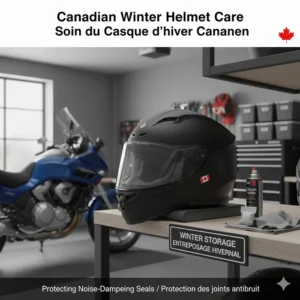
Store helmets away from direct sunlight and extreme temperatures. UV exposure degrades shell materials and EPS foam. Canadian garage temperature swings (-20°C to +30°C) can crack cheaper helmet shells over time. Use a helmet bag and store indoors when possible.
Best Riding Practices for Noise Reduction
Optimize Your Riding Position
Tuck behind your windscreen to place your helmet in cleaner air. On naked bikes or low windscreens, slightly lower your head to reduce wind blast. Sport riders naturally achieve quieter positions by tucking; adventure riders can experiment with adjustable windscreens.
Windscreen Height Adjustments
Too low directs turbulence at helmet base; too high creates forehead buffeting. The ideal height places turbulent air at mid-chest level. Canadian riders often need seasonal adjustments—lower in summer for airflow, higher in winter for wind protection.
Speed Management
Wind noise increases logarithmically with speed. Reducing highway speed from 120 km/h to 100 km/h can decrease noise by 8-10 dB—doubling safe exposure time. On long Canadian touring routes, this balance prevents fatigue while maintaining reasonable travel times.
Strategic Rest Stops
Plan breaks every 2 hours during highway riding. Give your ears recovery time even with premium helmets and earplugs. Canadian rest stops along the Trans-Canada Highway offer perfect opportunities for acoustic recovery.
Helmet Technology Innovations for 2026
Active Noise Cancellation
The Sena Phantom ANC pioneered integrated ANC for motorcycles, achieving unprecedented 70-80 dB noise levels. Expect more manufacturers to adopt this technology by 2026-2027 as battery efficiency improves and costs decrease.
Improved Aeroacoustic Testing
Modern wind tunnels with acoustic measurement capabilities (like Schuberth’s facility) enable precise noise optimization. Future helmets will target specific frequency ranges where motorcycle wind noise concentrates (250-500 Hz), rather than just overall decibel reduction.
Smart Helmet Integration
Communication systems like the Sena 60S in the Phantom ANC represent the future—integrated speakers, Bluetooth mesh networking, and noise-adaptive volume control. Canadian riders benefit from seamless smartphone integration for navigation, music, and rider-to-rider communication.
Modular Design Improvements
The Schuberth C5 proves modular helmets can match full-face quietness. Expect refined hinge mechanisms and advanced sealing in future modular designs, offering Canadian touring riders convenience without acoustic compromise.
Price Range & Value Analysis (2026 Canadian Market)
Budget Category ($116-400 CAD):
Best Option: LS2 Rapid FF353 ($116-200 CAD)
Value Proposition: ECE certification, basic noise control, entry-level accessibility. Ideal for new riders or track-day backups.
Mid-Range Category ($400-800 CAD):
Best Options: AGV K6-S ($370-535 CAD), HJC RPHA 71 ($480-600 CAD)
Value Proposition: Significant noise reduction, modern safety standards, better materials. Sweet spot for most Canadian riders balancing budget and performance.
Premium Category ($800-1,300 CAD):
Best Options: Shoei RF-1400 ($940-1,080 CAD), Arai XD-5 ($1,200-1,300 CAD)
Value Proposition: Exceptional build quality, advanced noise reduction, SNELL certification, 5+ year durability. Investment for serious Canadian touring riders.
Ultra-Premium Category ($1,400-1,750+ CAD):
Best Options: Schuberth C5 ($1,400-1,750 CAD), Sena Phantom ANC ($950-1,000 CAD)
Value Proposition: Class-leading quietness, cutting-edge technology, maximum long-distance comfort. For riders who demand the absolute best.
Pairing Your Helmet with Quality Earplugs
Even the quietest helmet benefits from proper hearing protection. Canadian audiologists universally recommend combining premium helmets with high-fidelity earplugs for comprehensive protection.
Best Earplug Types for Canadian Riders
Foam Earplugs (Disposable):
- Noise Reduction: 28-33 dB
- Cost: $0.50-2.00 CAD per pair
- Best For: Budget-conscious riders, occasional use
- Canadian Options: Available at any pharmacy or hardware store
High-Fidelity Musician’s Earplugs:
- Noise Reduction: 20-25 dB (frequency-specific)
- Cost: $30-60 CAD
- Best For: Riders wanting to hear traffic/engine while protecting hearing
- Popular Models: Alpine MotoSafe, EarPeace Moto PRO
Custom-Molded Earplugs:
- Noise Reduction: 25-30 dB (perfectly fitted)
- Cost: $150-300 CAD
- Best For: Serious touring riders, maximum comfort
- Canadian Providers: Available through audiologists in major cities
Combining Helmets & Earplugs: The Math
- Budget helmet (92 dB) + foam earplugs (30 dB) = 62 dB effective ✅
- Premium helmet (85 dB) + musician’s plugs (22 dB) = 63 dB effective ✅
- Ultra-premium helmet (72 dB) + custom plugs (28 dB) = 44 dB effective ✅✅
All combinations achieve safe levels for all-day Canadian riding, but the premium helmet + quality earplug combination provides the best balance of communication clarity, comfort, and protection.
Legal Considerations in Canada
Earplugs are legal for motorcycle use in all Canadian provinces. However, ensure you can still hear emergency sirens and vehicle horns. High-fidelity earplugs designed for motorcyclists filter harmful wind frequencies while preserving essential sounds—unlike foam plugs that block everything equally.
✨ Essential Safety Gear for Canadian Riders!
🔧 Maximize your hearing protection with premium earplugs and communication systems. High-fidelity options preserve important sounds while blocking harmful wind noise. Check current pricing and availability on Amazon.ca to complete your acoustic safety setup for Canadian roads!
Frequently Asked Questions
❓ What is the quietest full face motorcycle helmet available in Canada?
❓ Do quiet motorcycle helmets work without earplugs?
❓ How much should I spend on a quiet helmet in Canada?
❓ Are modular helmets quieter than full-face helmets in Canada?
❓ What safety certifications do I need for helmets in Canada?
Conclusion: Your Ears Deserve Better
The science is clear: riding with 90+ dB noise exposure isn’t just uncomfortable—it’s gradually stealing your hearing. Canadian researchers have documented measurable hearing loss in motorcyclists, with temporary threshold shifts occurring after just one hour of high-speed riding.
The seven helmets I’ve reviewed represent the quietest options available to Canadian riders in 2026. Whether you choose the technological marvel of the Sena Phantom ANC, the German precision of the Schuberth C5, or the proven performance of the Shoei RF-1400, you’re investing in your long-term hearing health and riding enjoyment.
For Canadian riders tackling our vast distances—from the Cabot Trail’s coastal curves to the Icefields Parkway’s mountain passes—a quiet helmet transforms every journey. You’ll arrive refreshed instead of fatigued, alert instead of exhausted, and with your hearing intact for decades of future rides.
My recommendation? If budget allows, invest in the Schuberth C5 or Shoei RF-1400. Both deliver exceptional quietness, proven durability, and the comfort needed for long Canadian rides. Add quality earplugs, ensure proper fit, and you’ve created the ultimate noise-reducing system.
Your ears can’t regenerate. Your hearing won’t repair itself. But the right quiet full face motorcycle helmet, chosen wisely and fitted properly, protects both while letting you enjoy every kilometre of Canada’s spectacular riding routes.
The open road is calling. Answer it—quietly.
Recommended for You
- 7 Best Winter Motorcycle Helmets Canada 2026 | Anti-Fog Guide
- 7 Best Full Face Helmet Under 300 Canada 2026
- 7 Best Full Face Motorcycle Helmet Canada 2026
Disclaimer: This article contains affiliate links to Amazon.ca. If you purchase products through these links, we may earn a small commission at no additional cost to you.
✨ Found this helpful? Share it with your riding friends! 💬🤗
