
In This Article
Somewhere around the third red light of a -12°C commute, your face starts negotiating with you. It wants to go home. Your helmet, meanwhile, is doing its structural job beautifully and not one thing more — it was never designed to keep your jaw warm. That gap between “helmet as safety device” and “helmet as winter coat for your head” is exactly where the balaclava vs neck gaiter for motorcycle riding winter question lives, and it’s a more consequential decision than most riders give it credit for. Choose wrong and you’re peeling off at every gas station to rewrap a scarf that’s slipped down your neck again. Choose right and cold-weather riding stops feeling like an endurance test.
This guide breaks down exactly how a balaclava and a neck gaiter differ in real winter riding conditions across Canada — from a damp, 2°C Vancouver morning to a bone-dry -25°C prairie afternoon — and walks through seven real, currently available products spanning fleece, merino wool, and technical windproof builds. You’ll get honest analysis grounded in actual specs and aggregated review sentiment, not marketing copy dressed up as advice. By the end, you’ll know which category fits your riding style, and which specific product in that category is worth your money.
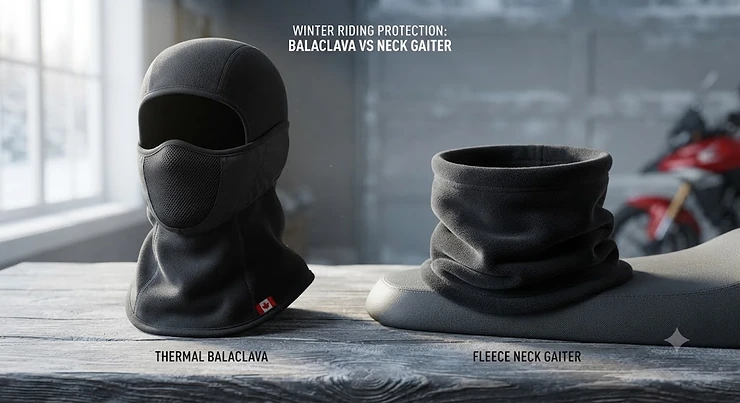
Balaclava vs Neck Gaiter for Motorcycle Riding Winter: Quick Comparison
| Feature | Balaclava | Neck Gaiter (Tube/Fleece) |
|---|---|---|
| Face coverage | Full face, head, and neck | Neck and lower face only (pull up) |
| Best for | Sub-zero, exposed highway riding | Mild-to-moderate cold, stop-and-go city riding |
| Helmet fit impact | Can add bulk under tight full-face helmets | Minimal — sits mostly below the helmet shell |
| Versatility | Single-purpose winter layer | 12+ wearing styles (headband, hood, mask) |
| Typical price range (CAD) | C$35-C$140 | C$20-C$70 |
| Best For | Riders facing -10°C and below, long highway stints | Riders in 0°C to -8°C, frequent helmet removal |
A balaclava earns its keep the moment temperatures drop into truly punishing territory — think a Klim Balaclava shielding your entire head and neck on a -15°C prairie run — because full coverage matters more than convenience when exposed skin is genuinely at risk. A neck gaiter, on the other hand, rewards the rider who’s constantly flipping their helmet up at drive-thrus and delivery stops, since a BUFF Original EcoStretch Neck Gaiter slides on and off in two seconds without disturbing your hair or helmet liner. If you’re riding somewhere that swings between both extremes in the same week — hello, most of Canada — owning one of each isn’t overkill, it’s just realistic layering.
💬 Just one click — help others make better buying decisions too!😊
What Is a Motorcycle Balaclava?
A motorcycle balaclava is a fitted hood that covers the head, face, and neck in one piece, leaving only an opening for the eyes (and sometimes nose and mouth), designed to sit under a helmet as a windproof, moisture-wicking thermal layer. Unlike ski balaclavas, motorcycle versions are cut lower-profile to avoid bulking out a helmet’s internal padding.
The core job of any balaclava is sealing gaps — around the jaw, behind the ears, at the base of the skull — where cold air sneaks in at highway speed. Wind chill is brutal on a moving motorcycle even when the ambient temperature seems tolerable; at 100 km/h, still-air cold that feels like a light jacket day on foot can feel closer to a genuine winter storm against exposed skin. Transport Canada’s winter driving guidance reinforces just how quickly cold-weather conditions can turn genuinely hazardous for anyone on the road, motorcyclists very much included. That’s the physics a well-built balaclava is fighting.
Top 7 Balaclavas and Neck Gaiters for Motorcycle Riding Winter: Expert Analysis
1. Klim Balaclava — Gore-Tex Infinium windstopper panel at neck and chest
The Klim Balaclava is built around a simple idea: keep the head breathable and keep the neck and chest sealed dead against wind. That split-fabric approach is the whole story here, and it’s a smart one for anyone who overheats easily but still needs real cold protection where it counts.
Its Coolmax fabric covers the top of the head and ears for moisture-wicking breathability, while Gore-Tex Infinium with Windstopper technology covers the neck and upper chest — the zones that actually leak cold air into a jacket collar at speed. Silicone grip pads along the neckline keep the fabric tucked into your riding jacket instead of riding up over the hours.
Based on the spec comparison, this design makes the most sense for riders doing longer highway stints rather than short urban hops, since the breathable head zone prevents the clammy, overheated feeling that a fully windproof balaclava can cause once you’re stopped at a light. What most buyers overlook about this model is that the extended torso length is a genuine upgrade over older balaclava designs — it stays put under a jacket instead of working its way up and exposing the collarbone area, which is a common complaint with cheaper, shorter balaclavas.
Reviewers consistently report that the fit runs true to “one size fits most” for average adult head sizes, with several noting the neoprene-adjacent nose bridge helps control fogging on cold mornings, though a handful mention the head area alone isn’t quite warm enough for extreme prairie cold without an added liner.
Pros:
- ✅ Windproof neck and chest zone blocks highway wind chill
- ✅ Breathable head area prevents overheating at stops
- ✅ Extended torso length stays tucked under jackets
Cons:
- ❌ Head zone alone isn’t enough insulation below -20°C
- ❌ Premium price point compared to fleece alternatives
Expect a price in the C$60-C$85 range at the time of research, and given the Gore-Tex Infinium component alone, that sits as solid value for riders who log real winter mileage rather than the occasional cold-snap commute.
2. BUFF Merino Wool Midweight Neck Gaiter — natural odour control from 100% merino fibre
The BUFF Merino Wool Midweight Neck Gaiter swaps synthetic fleece for 100% merino wool, and that single material change ripples through nearly every other spec on this product.
Merino wool naturally regulates temperature better than most synthetics of comparable thickness, wicking moisture away from skin while resisting the odour buildup that plagues polyester tubes after several rides in a row. The midweight construction sits heavier than BUFF’s lightweight merino line, making it genuinely viable down to around -5°C to -8°C before you’d want to layer it under something else.
Here’s what to weigh: merino is a premium material for a reason, and that shows up in both comfort and price. The fibre is naturally soft against skin (none of the itch associated with cheaper wool blends), and it performs across a wider temperature band than a single-purpose fleece gaiter, which matters if your commute spans a shoulder-season morning at 4°C and a deep-winter afternoon at -12°C on the same bike.
Reviewers consistently note the odour resistance as the standout real-world benefit — riders who wear it multiple days between washes report it staying noticeably fresher than synthetic equivalents. A common complaint in user reviews is that merino wool requires gentler hand-washing care and shouldn’t go in a dryer, which is a bit more maintenance than a toss-in-the-wash fleece tube.
Pros:
- ✅ Naturally odour-resistant across multiple wears
- ✅ Wide comfortable temperature range for shoulder seasons
- ✅ Soft against skin with no synthetic itch
Cons:
- ❌ Requires hand-washing and air-drying, not machine care
- ❌ Higher price than comparable synthetic fleece gaiters
Pricing typically lands in the C$35-C$50 range, and for a rider who wants one gaiter that handles fall, early winter, and spring without swapping gear, the merino wool premium is arguably justified by sheer versatility.
3. Alpinestars Touring Winter Balaclava — waterproof neck skirt seals the jacket collar
The Alpinestars Touring Winter Balaclava takes a different approach than most: rather than just insulating, it adds a waterproof and windproof neck skirt specifically designed to overlap and seal against your jacket collar, cutting off one of the sneakiest cold-air entry points on a moving bike.
Flat-lock seam construction reduces chafing under a tight-fitting helmet, while double-sided Lycra panels and a microfiber inner lining add warmth without excessive bulk. The neck skirt is the genuinely clever part of this design — on paper this means less gap-related heat loss than a balaclava that simply tucks into a collar and relies on friction to stay put.
What most buyers overlook is that this neck-skirt approach solves a problem specific to touring riders: the constant micro-adjustments needed to keep a regular balaclava sealed against a jacket as you shift position over a long ride. Reviewers consistently point to the flat-lock seams as noticeably more comfortable than bulkier stitched alternatives, particularly for riders wearing full-face helmets with snug internal padding.
A recurring theme in aggregated feedback is that the “one size” fit runs slightly large for smaller head shapes, so it benefits from being paired with a snugger base layer for a fully sealed fit in extreme cold.
Pros:
- ✅ Waterproof neck skirt seals against jacket collar
- ✅ Flat-lock seams reduce chafing under tight helmets
- ✅ Double-sided Lycra panels balance warmth and mobility
Cons:
- ❌ Runs slightly large for smaller head shapes
- ❌ Bulkier neck skirt than minimalist tube gaiters
Expect this one in the C$45-C$65 range, which is competitive for a touring-specific design with genuine engineering behind the neck-seal feature rather than a simple thermal tube.
4. BUFF Polar Fleece Neck Warmer — double-layer fleece with tube-scarf versatility
The BUFF Polar Fleece Neck Warmer pairs BUFF’s signature stretch tube shape with a double-layer fleece lining, positioning it squarely as the answer for riders who want gaiter versatility without sacrificing serious warmth.
The fleece backing adds real thermal mass compared to BUFF’s single-layer summer tubes, while the classic seamless tube construction means it can be worn as a neck gaiter, pulled up over the nose as a half-mask, or worn as a simple headband — a fleece neck gaiter motorcycle riders can genuinely reconfigure mid-ride without removing a helmet.
Based on the spec comparison, the double-layer fleece construction puts this gaiter in the “moderate cold” category rather than deep-winter territory — reviewers consistently describe it as ideal for that frustrating 0°C to -8°C band where a balaclava feels like overkill for a 20-minute commute but bare skin genuinely stings. What the spec sheet won’t tell you, but user reports suggest, is that the fleece traps a bit more moisture than merino wool during high-exertion stop-and-go riding, so it benefits from being shaken out and aired between rides rather than immediately stuffed back into a jacket pocket.
Aggregated reviews consistently praise the UPF 50 sun protection as an unexpected bonus for riders who also use it on sunny but cold late-autumn rides, alongside near-universal agreement that the fit is genuinely one-size-fits-most.
Pros:
- ✅ Reconfigurable into headband, mask, or full gaiter
- ✅ Double-layer fleece adds real thermal mass
- ✅ UPF 50 sun protection for bright cold-weather rides
Cons:
- ❌ Traps more moisture than merino during high exertion
- ❌ Not warm enough alone for deep sub-zero riding
At around C$25-C$35, this sits at the accessible end of the lineup and represents strong value for riders who want one flexible piece rather than a dedicated cold-weather balaclava.
5. Minus33 Merino Wool Expedition Balaclava — heavyweight merino built for extreme cold
The Minus33 Merino Wool Expedition Balaclava goes all-in on natural insulation, using a heavyweight 100% merino wool knit rather than a synthetic windproof membrane, aiming at riders who prioritize sustained warmth over ultimate wind-cutting performance.
Heavyweight merino traps significantly more air than lightweight or midweight versions, which translates to noticeably more insulation against still cold — the kind you feel waiting at a rural stop sign rather than screaming down a highway. The knit construction is also naturally more breathable than a laminated windproof fabric, meaning less clamminess on rides that mix hard acceleration with idle traffic stops.
Here’s what to weigh: expedition-grade wool like this is genuinely warmer at rest than most technical synthetic balaclavas, but it lacks a dedicated windproof membrane, so at sustained highway speeds in open, exposed terrain, wind can cut through a pure-knit balaclava faster than one built with Gore-Tex Infinium or a similar laminate. Reviewers consistently frame it as best-in-class for stop-and-go winter commuting and cold-weather touring at moderate speeds, with a common complaint in user reviews being reduced wind-cutting performance specifically at sustained speeds above roughly 100 km/h without an additional wind-blocking layer.
Pros:
- ✅ Heavyweight merino delivers exceptional at-rest warmth
- ✅ Naturally breathable, resists overheating at stops
- ✅ Odour-resistant for multi-day wear between washes
Cons:
- ❌ No dedicated windproof membrane for high-speed exposure
- ❌ Heavier and bulkier under snug full-face helmets
Pricing generally falls in the C$50-C$70 range, positioning it as a strong mid-range pick for commuters and touring riders who spend more time at moderate speeds than flat-out highway runs.
6. Naroo X5S Filtered Balaclava — built-in particulate filter pocket for polluted commutes
The Naroo X5S Filtered Balaclava takes an unusual angle for this category, combining standard cold-weather coverage with a replaceable particulate filter pocket originally designed for urban air quality, which happens to double nicely as extra wind-blocking density across the mouth and nose.
The lightweight synthetic fabric wicks moisture efficiently and dries fast, making this balaclava noticeably less bulky under a helmet than fleece or heavyweight wool options, while the filter insert adds a layer of density precisely where breath condensation and cold air both concentrate. What most buyers overlook about this model is that the filter pocket isn’t just a gimmick for city smog — swapping in a filter also meaningfully cuts wind penetration through the mouth area on cold rides, functioning as an accidental cold-weather upgrade.
On paper this means Naroo’s balaclava suits commuters riding through mixed conditions — cold mornings, exhaust-heavy traffic, occasional rain — better than a single-purpose thermal balaclava built for pure cold alone. Reviewers consistently highlight the lightweight, low-bulk fit as ideal for smaller or snugger helmets where a thick fleece balaclava would create uncomfortable pressure points, though aggregated feedback notes the base fabric alone runs cooler than dedicated winter balaclavas without a filter or added base layer.
Pros:
- ✅ Filter pocket adds wind-blocking density at mouth/nose
- ✅ Low-bulk fit suits snug or smaller helmets
- ✅ Fast-drying fabric resists helmet-liner dampness
Cons:
- ❌ Base fabric alone is thinner than dedicated winter builds
- ❌ Best warmth requires buying replacement filters separately
Typical pricing sits in the C$25-C$40 range including a starter filter, making it a smart pick specifically for city riders layering it under a light base layer rather than relying on it as a standalone deep-winter piece.
7. BUFF Original EcoStretch Neck Gaiter — recycled polyester tube scarf, budget entry point
The BUFF Original EcoStretch Neck Gaiter is the simplest, most affordable entry in this lineup — a seamless stretch tube made from recycled polyester, without fleece lining or a windproof membrane, built for versatility over raw thermal output.
Because it’s a single, lightweight layer, this gaiter functions more like a wind and sun buffer than a true insulator; it blocks direct wind chill across exposed neck skin and can be pulled up over the nose in a pinch, but it won’t hold heat the way a fleece or merino piece will in sustained sub-zero conditions. UPF 50 sun protection is baked in, useful on those bright, cold, low-sun days common across much of Canada in late fall and early spring.
Based on the spec comparison, this is the product to reach for as a starter gaiter or a warm-weather-to-cool-weather crossover piece rather than a dedicated deep-winter solution — What most buyers overlook is that it’s genuinely excellent layered underneath a fleece or merino gaiter on the coldest days, adding a moisture-wicking base layer against skin while the outer piece handles insulation. Reviewers consistently praise the near-weightless feel and the sheer number of ways it can be worn (headband, wristband, hair tie, half-mask), with a recurring theme in feedback being that it’s simply not warm enough on its own once temperatures drop meaningfully below freezing.
Pros:
- ✅ Extremely affordable entry point into the category
- ✅ Lightweight, low-bulk, near-invisible under a helmet
- ✅ Versatile — 12+ wearing styles beyond neck coverage
Cons:
- ❌ Not warm enough alone below roughly -3°C to -5°C
- ❌ No windproof membrane for highway-speed cold
Priced in the C$20-C$28 range, this is the pick for riders testing whether they even need dedicated winter neckwear, or for anyone building a two-piece layering system on a budget.
Top 7 Products Comparison Table
| Product | Type | Warmth Rating | Price Range (CAD) | Best For |
|---|---|---|---|---|
| Klim Balaclava | Balaclava | High (with layering) | C$60-C$85 | Long highway stints, sub-zero |
| BUFF Merino Wool Midweight Neck Gaiter | Gaiter | Moderate-High | C$35-C$50 | Shoulder-season versatility |
| Alpinestars Touring Winter Balaclava | Balaclava | High | C$45-C$65 | Touring riders, jacket-collar seal |
| BUFF Polar Fleece Neck Warmer | Gaiter | Moderate | C$25-C$35 | Stop-and-go city commuting |
| Minus33 Merino Wool Expedition Balaclava | Balaclava | Very High (at rest) | C$50-C$70 | Slower cold-weather touring |
| Naroo X5S Filtered Balaclava | Balaclava | Moderate | C$25-C$40 | Urban commuters, mixed conditions |
| BUFF Original EcoStretch Neck Gaiter | Gaiter | Low-Moderate | C$20-C$28 | Budget starter, layering base |
Looking at the comparison above, the Klim Balaclava and Alpinestars Touring Winter Balaclava justify their higher price with genuine windproof engineering for sustained highway exposure, while the BUFF Original EcoStretch Neck Gaiter delivers the best value for riders who mainly need wind-and-sun coverage rather than deep insulation. Budget-focused riders should note that the Minus33 Merino Wool Expedition Balaclava trades wind-cutting ability for exceptional at-rest warmth, making speed and route exposure the real deciding factor between these two balaclavas rather than price alone.
✨ Don’t Miss These Exclusive Deals!
🔍 Take your cold-weather riding kit to the next level with these carefully selected options. Click through to check current pricing and availability on whichever balaclava or gaiter fits your commute — a small upgrade that pays off every single ride this winter.
Practical Usage Guide: Getting the Most From Under-Helmet Warmth Accessories
Buying the right piece is half the equation — wearing it correctly under a helmet is the other half, and it’s where a lot of riders quietly sabotage a perfectly good balaclava.
Start with fit before you even swing a leg over the bike. A balaclava or gaiter that’s too thick will compress your helmet’s internal padding, which can actually reduce the helmet’s protective fit — not a trade-off worth making for warmth. Try your full helmet-and-neckwear combo on at home first, and if the helmet feels noticeably tighter or your vision through the eye port narrows, size down the fabric bulk before your first cold ride, not during it.
Layering order matters more than most riders realize. Merino or synthetic base layers go directly against skin, with any fleece or windproof piece as the outer layer closest to the helmet’s inner liner — reversing this order traps moisture against your skin instead of wicking it away, which ironically makes you colder over a long ride. For the coldest days, a thin BUFF-style tube gaiter worn underneath a heavier balaclava gives you two moisture-managing layers instead of one thick, damp one.
In the first 30 days of regular winter use, the most common mistake is skipping maintenance. Fleece and merino both lose loft when compressed and unwashed for weeks, and salt-laden road spray (common on Canadian winter roads) speeds up fabric breakdown. A simple gentle hand-wash every one to two weeks of regular riding, followed by full air-drying before the next ride, keeps insulation performing at its rated warmth instead of gradually flattening out. This mirrors what Wikipedia’s overview of cold-weather biking notes about winter gear generally — road salt and slush are consistently cited as the main culprits behind faster wear on any fabric or metal component exposed to them.
One optimization trick that rarely makes it onto a product page: silicone anti-fog wipes or a thin dab of dish soap on your visor’s interior pair extremely well with a balaclava’s nose bridge, since heavy breathing into a sealed lower face zone is one of the fastest ways to fog a visor on a cold morning.
Real-World Scenario: Matching Riders to the Right Pick
Picture three riders, three very different winters, three very different answers.
The daily commuter — rides a 25-minute mixed city-and-highway route in Southern Ontario, temperatures hovering between -2°C and -10°C most of the season, stopping at four or five lights each way. This rider is better served by the BUFF Polar Fleece Neck Warmer or Naroo X5S Filtered Balaclava — both low-bulk enough to not fight a snug commuter helmet, and warm enough for the moderate cold without the overheating risk that a heavyweight balaclava creates during constant stop-and-go.
The weekend tourer — logs 200+ km highway days through the Prairies or the BC interior in late fall, often at -15°C or colder with real wind exposure at speed. This is exactly the profile the Klim Balaclava and Alpinestars Touring Winter Balaclava are built for; both prioritize windproof sealing over sheer thickness, which matters far more than raw insulation once you’re sustaining 100+ km/h for hours.
The budget-conscious new rider — just got their licence, riding short trips in shoulder-season weather (5°C to -3°C), not yet sure how much winter riding they’ll actually do. The BUFF Original EcoStretch Neck Gaiter makes the most sense here: it’s an inexpensive way to test whether dedicated winter neckwear is even worth the investment before committing to a merino or Gore-Tex Infinium piece.
How to Choose a Balaclava or Neck Gaiter for Motorcycle Riding
- Start with your coldest regular ride, not your average one. If you occasionally ride at -18°C even a few times a winter, buy for that day — a balaclava like the Minus33 Merino Wool Expedition Balaclava or Klim Balaclava will feel like overkill in October but essential in January.
- Count your stops. Frequent helmet-off stops (deliveries, city commuting, running errands) favour a neck gaiter’s quick on/off convenience over a balaclava’s full-coverage commitment.
- Check your helmet’s internal fit first. A helmet that already fits snugly leaves less room for thick fleece — lean toward lower-bulk options like the Naroo X5S Filtered Balaclava or a lightweight merino gaiter.
- Weigh windproofing against breathability. Highway riders need a windproof membrane (Gore-Tex Infinium or similar); stop-and-go city riders benefit more from breathable natural fibres that won’t leave them clammy at red lights.
- Factor in maintenance realism. Merino wool performs beautifully but demands hand-washing; if that’s not going to happen regularly, a synthetic fleece gaiter that tolerates a normal wash cycle may serve you better long-term.
- Consider a two-piece system. A thin base gaiter under a heavier balaclava often outperforms one single “do-everything” piece, particularly across a Canadian winter’s full temperature swing.
- Buy the coverage you’ll actually use. A full balaclava that sits unused in a saddlebag because it feels excessive for a five-minute ride to the grocery store isn’t providing value — match the gear to your real riding pattern, not an idealized one.
Common Mistakes When Buying Neck and Face Protection for Cold Riding
The single biggest mistake is buying based on warmth rating alone, ignoring bulk. A balaclava can be objectively warmer on paper and still be the wrong choice if it compresses your helmet’s padding enough to loosen the fit — safety and warmth need to be balanced together, not warmth optimized in isolation.
A close second: assuming one gaiter or balaclava will cover an entire Canadian winter. Riders in most provinces face genuine multi-season swings — a piece that’s perfect in November often falls short by January. Budgeting for a two-piece system from the start, rather than discovering the gap mid-season, saves both money and cold mornings.
Underestimating wind chill at speed is another recurring pitfall. Reviewers across nearly every product in this category mention that gear feels adequately warm standing still in a driveway and inadequate at highway speed — test any new piece on a real ride, in real conditions, before deciding it’s “not warm enough” and buying something heavier than you actually need.
Finally, riders frequently skip checking care instructions before buying. A busy rider who won’t realistically hand-wash merino wool weekly is better served by an easier-care synthetic fleece piece, even if merino tests slightly warmer on paper — gear that degrades from neglect stops performing at its rated warmth regardless of the initial spec sheet.
Neck Gaiter vs Tube Scarf for Motorcyclists: What’s the Real Difference
The terms get used almost interchangeably, and honestly, in casual conversation they mostly are — but there’s a meaningful distinction once you’re comparing actual products. A tube scarf is generally the broader, more general-purpose category: a simple stretch fabric loop, often thin, marketed as much for hiking or general outdoor wear as for motorcycling. A purpose-built motorcycle neck gaiter typically adds features a generic tube scarf skips entirely — UPF sun protection, moisture-wicking treatment specific to sustained sweat exposure, and sizing calibrated to sit comfortably under a helmet’s chin strap without bunching.
Products like the BUFF Polar Fleece Neck Warmer occupy the upper end of this spectrum — genuinely engineered for cold-weather performance with a fleece backing most generic tube scarves skip. A bargain-bin tube scarf, by contrast, might technically cover the same anatomy but lacks the moisture management that keeps sweat from turning into clammy, chilling dampness over a two-hour ride.
For motorcyclists specifically, the practical advice is simple: if a product’s marketing copy leans entirely on “scarf” without mentioning moisture-wicking or a windproof rating, treat it as a fashion accessory rather than genuine winter riding gear. The BUFF Original EcoStretch Neck Gaiter, despite being the most affordable option in this guide, still outperforms a basic tube scarf specifically because of its recycled polyester’s wicking treatment and UPF rating — features a plain scarf simply doesn’t have.
Long-Term Cost and Maintenance: What You’re Actually Paying For
A quick cost-per-use exercise makes the value picture clearer than price tags alone. A C$25 fleece gaiter used twice a week across a five-month Canadian winter season gets roughly 40 uses, working out to well under a dollar per ride — trivial money for meaningfully warmer commutes. A C$75 Gore-Tex Infinium balaclava used at the same frequency runs closer to C$1.90 per use in year one alone, but unlike budget fleece, a well-maintained technical balaclava routinely lasts three to five winters before the windproof laminate degrades, which brings its true cost-per-use down well below the cheaper option over its full lifespan.
Merino wool sits in an interesting middle position: higher upfront cost than synthetic fleece, but merino’s natural odour resistance means fewer washes over a season, and fewer washes generally means slower fabric degradation — hand-washing is gentler than a washing machine’s agitation cycle regardless. Riders who hate laundry day may find the reduced washing frequency alone worth the premium.
The real long-term cost trap isn’t the gear itself — it’s buying the wrong category twice. A rider who buys a lightweight gaiter, discovers it’s inadequate for their coldest rides, and then buys a proper windproof balaclava has effectively paid for two products to solve one problem. Reading your actual riding pattern honestly before that first purchase, using the decision framework above, is the single best way to avoid that double spend.
Buyer’s Decision Framework
If you ride primarily in stop-and-go city traffic above -8°C, choose a fleece or lightweight merino neck gaiter, because the frequent on/off convenience and breathability outweigh the marginal extra warmth a full balaclava would add.
If you regularly sustain highway speeds below -10°C, choose a windproof technical balaclava with a laminated membrane like Gore-Tex Infinium, because wind chill at speed defeats natural-fibre-only insulation far faster than standing-still cold ever will.
If your winter riding is unpredictable — some short trips, some long hauls, temperatures all over the map — choose a two-piece layering system: a thin base gaiter plus a heavier balaclava you deploy only on the coldest days, because flexibility beats any single “perfect” product when conditions genuinely vary week to week.
If budget is the primary constraint, start with an affordable synthetic gaiter like the EcoStretch line, and treat it as a diagnostic purchase — it’ll tell you within one real cold-weather season whether you need to invest further, without over-committing up front.
Safety Considerations for Cold-Weather Riding in Canada
Cold isn’t just an uncomfortable inconvenience on a motorcycle — it’s a genuine safety factor. Reduced dexterity in cold fingers, delayed reaction time from shivering, and the mental fatigue of sustained discomfort all measurably affect rider performance, which is part of why the Government of Canada’s extreme cold guidance points out that cold exposure claims more lives across the country each year than lightning, windstorms, and tornadoes combined. That statistic applies broadly, but it’s a useful reminder that winter riding gear isn’t just about comfort — it’s risk management.
A properly fitted balaclava or gaiter also interacts directly with helmet safety. As Health Canada’s helmet safety resource explains, a well-fitted helmet designed for the activity helps protect the head by absorbing force from a fall or impact, and different helmets are built to handle different types of impact. That’s exactly why bulky, poorly-sized neckwear that compromises your helmet’s internal fit is a genuine trade-off, not a minor styling concern. Always test your winter layering with your actual helmet before relying on it for a real ride, and re-check the fit whenever you switch to a thicker piece for colder days.
Visibility matters more in winter too — shorter daylight hours and grey, overcast skies common across much of Canada reduce how easily other drivers spot motorcyclists, reinforcing the value of reflective or brightly coloured outer gear alongside whatever you’re wearing underneath your helmet.
What to Expect: Real-World Performance in Different Conditions
Specs on a page rarely tell the full story of how gear feels at -12°C with a 15 km/h crosswind, so here’s the translation. A windproof balaclava like the Alpinestars Touring Winter Balaclava, worn correctly with its neck skirt sealed against a jacket collar, effectively eliminates the “cold trickle” sensation riders describe when wind finds a gap at the collarbone — that’s the single biggest comfort difference technical windproofing provides over basic fleece.
A merino gaiter like the BUFF Merino Wool Midweight Neck Gaiter, by contrast, won’t fully stop wind at highway speed the way a laminated membrane does, but it excels at something else entirely: comfort during the temperature swings within a single ride. Leaving home at -6°C and arriving somewhere at 2°C as the sun climbs is common on Canadian shoulder-season mornings, and merino’s natural temperature regulation handles that swing more gracefully than a single-purpose winter piece that’s either too warm or exactly right, with no in-between.
Fog and moisture management is the other real-world factor spec sheets undersell. Breathing hard into a sealed balaclava on a cold morning creates condensation fast, and reviewers across nearly every technical balaclava in this guide mention needing a properly fitted nose bridge or breath deflector to keep that moisture from fogging a visor — worth testing on a short ride before committing to one piece for an entire winter.
Frequently Asked Questions
❓ Is a balaclava warmer than a neck gaiter for motorcycle riding?
❓ Can I wear a neck gaiter under a motorcycle helmet?
❓ What material is best for a motorcycle balaclava in winter?
❓ How do I stop my neck gaiter from sliding down while riding?
❓ Do I need a balaclava for riding above 0°C?
Conclusion
The balaclava vs neck gaiter for motorcycle riding winter decision really comes down to two honest questions: how cold does it actually get on your ride, and how often are you getting on and off the bike. Full coverage from something like the Klim Balaclava or Alpinestars Touring Winter Balaclava earns its bulk on sustained sub-zero highway stretches, while the quick convenience and breathability of a BUFF Polar Fleece Neck Warmer or BUFF Original EcoStretch Neck Gaiter fits stop-and-go city riding far better than a full hood ever would. Merino wool options like the BUFF Merino Wool Midweight Neck Gaiter and Minus33 Merino Wool Expedition Balaclava split the difference nicely for riders who value natural performance and don’t mind a bit of extra laundry care, and the Naroo X5S Filtered Balaclava rounds things out as a clever, low-bulk pick for mixed urban commuting.
There’s no single “best” answer here — only the piece that actually matches your coldest real ride and your actual riding habits. Whichever direction you lean, layering intelligently and checking your helmet fit with the gear on will do more for your winter riding comfort than any single spec on a product page ever could.
✨ Ready to gear up for the season? Check current pricing on the pick that matches your ride, and stop letting cold mornings decide whether you ride at all! 🧣🏍️❄️
Recommended for You
- Balaclava for Motorcycle Riding: 7 Proven Picks for 2026
- Cooling Base Layer for Motorcycle Riding: 7 Picks for 2026
- Moisture Wicking Base Layer for Motorcycle Riding: 7 Picks (2026)
Disclaimer: This article contains affiliate links. As an Amazon Associate, I earn from qualifying purchases. If you purchase products through these links, we may earn a small commission at no additional cost to you.
✨ Found this helpful? Share it with your friends! 💬🤗
