
In This Article
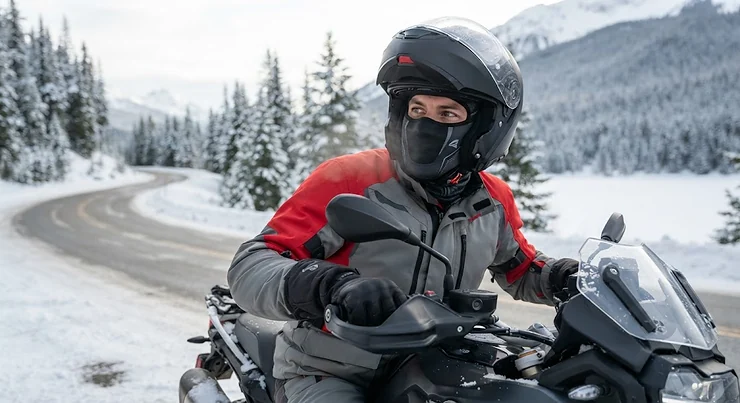
Your first winter ride teaches you something no gear catalogue ever will: the wind doesn’t care how tough you think you are. Somewhere around the second traffic light, your cheeks go from “brisk” to “on fire” to “strangely numb,” and you start bargaining with the universe for a heated visor you don’t own. A proper cold weather face mask for motorcycle riding is the cheapest, least glamorous piece of gear in your closet — and arguably the one that keeps you riding into December instead of parking the bike in October.
A cold weather face mask for motorcycle riding is a fitted fabric or neoprene covering, usually worn under a helmet, that blocks wind and traps a thin layer of warm air against the skin to prevent windburn, numbness, and frostbite on exposed riding routes. That’s the textbook version. In practice, it’s the difference between arriving at work looking like you survived something and arriving looking like you just had a normal commute.
Canadian winters are not a gentle proving ground. Wind chill describes how much colder moving air makes exposed skin feel compared to the actual air temperature, and that effect compounds fast once you’re doing 80 km/h on a highway on-ramp. This guide breaks down seven real, currently available masks — neoprene, fleece, and windproof-shell — with honest analysis of who each one suits, what reviewers consistently report, and where the genuine trade-offs are. No invented “I tested this for six months” stories here — just spec-by-spec, review-by-review reasoning so you can pick the right windproof face mask riding winter demands without guessing.
Quick Comparison Table
| Product | Type | Best For | Price Range (CAD) |
|---|---|---|---|
| KLIM Arctic Balaclava (Next Gen) | Gore-Tex Windstopper shell + neoprene nose piece | Extreme cold, long highway rides | C$55-C$65 |
| Seirus Innovation 6805 Original Neoprene Facemask | Closed-cell neoprene | All-around under-helmet warmth | C$25-C$35 |
| Ergodyne N-Ferno 6823 Hinged Balaclava | Wind-resistant fleece, 3-way wear | Budget-conscious daily commuters | C$20-C$28 |
| Fly Racing Ignitor Balaclava | CoolMax upper, windproof lower | Purpose-built powersports fit | C$45-C$55 |
| WTACTFUL Neoprene Fleece Movable Balaclava | Neoprene panel that flips down | Riders who stop often (deliveries, city riding) | C$25-C$32 |
| Seirus Innovation Neofleece Extreme Masque | Neofleece with extended ear/neck coverage | Touring riders, long-haul highway trips | C$28-C$38 |
| Tough Headwear Balaclava Ski Mask | Fleece, no-fog helmet-fit | Backup mask, occasional riders | C$15-C$22 |
Looking at the spread above, the KLIM Arctic Balaclava sits at the top for anyone riding through genuine sub-zero conditions, but the Seirus Innovation 6805 Original Neoprene Facemask covers roughly 80% of what most Canadian commuters actually need for a fraction of the price. Riders who stop and start a lot — think food delivery or downtown commuting — should weight the WTACTFUL Neoprene Fleece Movable Balaclava more heavily than the raw warmth numbers suggest, since the drop-down panel solves a problem the other six masks simply don’t address.
💬 Just one click — help others make better buying decisions too!😊
Top 7 Cold Weather Face Masks for Motorcycle Riding: Expert Analysis
1. KLIM Arctic Balaclava (Next Gen) — Gore-Tex Windstopper armour for true arctic rides
The standout feature here is the shell fabric itself: this isn’t a fleece pretending to be windproof, it’s an actual Gore-Tex Infinium construction with Windstopper membrane panels doing the heavy lifting.
The KLIM Arctic Balaclava wraps fleece-backed Gore-Tex Infinium over the face, neck, and upper chest, with 4-way stretch wind-resistant fabric around the shoulders, back, and sides of the head, plus a dedicated neoprene nose piece that acts as a breath deflector. In practice, that layered approach means the parts of your face that actually face the wind get a true membrane barrier, while the parts under your jacket collar get stretch and mobility instead of bulk — a smarter allocation of warmth than “thick fleece everywhere.”
Based on the spec comparison against the other six masks here, this is the only one built around a genuine waterproof-breathable membrane rather than fleece or neoprene alone, which matters enormously on wet, slushy commutes where a fleece mask can end up damp and cold by the second stoplight. It’s the pick for riders doing real highway mileage in January, not casual weekend cruisers.
Reviewers consistently report that the extra-wide skirt stays tucked into jacket collars far better than typical balaclavas, and that the neoprene nose deflector reduces the fogging that plagues cheaper masks worn with goggles or a face shield. A recurring theme in aggregated feedback is that sizing runs generously, so riders with narrower faces sometimes size down.
Pros:
- ✅ Genuine Gore-Tex Windstopper membrane, not just fleece
- ✅ Neoprene breath deflector cuts visor and goggle fogging
- ✅ Extra-wide skirt tucks securely into jacket collars
Cons:
- ❌ Premium price compared to fleece-only competitors
- ❌ Runs slightly large — order down for a snug seal
At around C$55-C$65, the KLIM Arctic Balaclava is priced like the specialist piece of gear it is, and for riders logging real winter kilometres, the membrane construction earns that premium.
2. Seirus Innovation 6805 Original Neoprene Facemask — the neoprene classic that fits under almost any helmet
The standout here is simplicity done right: this is the mask that basically invented the “wind-blocking neoprene layer under a helmet” category, and it still does the job without fuss.
Constructed from closed-cell neoprene with an adjustable Velcro closure, the Seirus Innovation 6805 Original Neoprene Facemask contours to the face and seals against wind rather than trying to trap a thick layer of insulation. What this means practically is a thinner, lower-profile fit than fleece alternatives — which translates directly into more room inside a snug full-face helmet, a detail riders with tighter-fitting lids will appreciate immediately.
What most buyers overlook about neoprene face mask for riders is that the material’s primary job isn’t warmth through thickness, it’s warmth through wind-blocking — neoprene is essentially a wetsuit fabric, so it stops moving air dead in its tracks rather than relying on loft. That’s precisely why it’s a favourite among riders who also snowmobile or ski, where a similar wind-sealing logic applies.
Aggregated review sentiment across neoprene masks in this family points to strong performance in dry cold but reduced comfort once condensation builds up from breathing, since neoprene doesn’t wick moisture the way fleece does. Riders report needing to peel it off periodically on longer rides to avoid a clammy feeling around the mouth.
Pros:
- ✅ Low-profile fit leaves room under snug full-face helmets
- ✅ Neoprene blocks wind more effectively than plain fleece
- ✅ Simple, durable Velcro-adjustable design
Cons:
- ❌ Traps breath moisture on longer rides
- ❌ Less warm than fleece once damp
Priced in the C$25-C$35 range, the Seirus Innovation 6805 Original Neoprene Facemask remains one of the best value entries for riders who want proven wind protection without paying for a membrane shell.
3. Ergodyne N-Ferno 6823 Hinged Balaclava — three ways to wear it, one low price
The standout feature is versatility: a hinged, 3-panel design that converts between a full balaclava, a neck gaiter, and a face shield depending on how cold it actually is that morning.
The Ergodyne N-Ferno 6823 Hinged Balaclava uses stretchable, wind-resistant fleece with a mesh panel positioned directly over the mouth for breathability, plus flat-lock stitching to reduce bulk under a helmet. Here’s what to weigh: this mask was originally engineered for outdoor tradespeople — landscapers, delivery drivers, warehouse crews working refrigerated docks — which means it’s built for all-day wear and repeated on/off cycles rather than a single commute, a durability profile that happens to suit riders perfectly.
The hinged design is the genuinely clever part. Instead of committing to one fixed shape, you fold the panel up for a mild morning or down for a full face seal on a genuinely brutal one, which solves the “one mask, variable weather” problem that plagues fixed-shape balaclavas.
Reviewers consistently note the mesh mouth panel prevents the moisture buildup and freezing that plagues cheaper solid-fleece masks, and several long-term users report the flat-lock seams hold up to repeated machine washing far better than expected for the price point. A common complaint in user reviews is that the “one size fits most” cut runs larger on smaller heads, leaving extra fabric bunched at the back.
Pros:
- ✅ Hinged 3-way design adapts to changing temperatures
- ✅ Mesh mouth panel resists moisture freeze-up
- ✅ Reflective accents add low-light visibility
Cons:
- ❌ One-size fit runs large for smaller heads
- ❌ Fleece alone, no true windproof membrane
At C$20-C$28, the Ergodyne N-Ferno 6823 Hinged Balaclava delivers the best cost-per-warm-morning ratio in this lineup, especially for riders who don’t need arctic-grade protection every single day.
4. Fly Racing Ignitor Balaclava — purpose-built for powersports, not repurposed from skiing
The standout feature is that this mask was designed from the ground up for riders, not adapted from ski gear — and the fit reflects that.
The Fly Racing Ignitor Balaclava pairs a CoolMax upper section with a windproof lower construction, engineered specifically to sit comfortably under motorcycle and off-road helmets rather than ski or snowboard helmets, which have a different internal shape. What that distinction means in practice: fewer pressure points against the temples and a lower-profile seam layout where your helmet’s cheek pads make contact.
Based on the spec comparison, the two-zone construction is the smart part — CoolMax around the head manages sweat during exertion (relevant for off-road and adventure riders working the bike physically), while the windproof lower half does the actual cold-blocking where it matters most, across the nose, mouth, and cheeks.
Aggregated feedback from riders in the powersports space consistently highlights that this mask, unlike ski-market balaclavas, doesn’t bunch awkwardly under a helmet’s chin bar. A recurring critique is that the windproof lower panel, while effective at blocking wind, isn’t quite as warm as neoprene in truly frigid temperatures, positioning it best as a three-season-plus-mild-winter piece rather than a deep-freeze specialist.
Pros:
- ✅ Designed specifically for motorcycle helmet geometry
- ✅ CoolMax zone manages sweat during exertion
- ✅ Low-bulk fit under chin bars and cheek pads
Cons:
- ❌ Less warm than neoprene in extreme cold
- ❌ Priced above most fleece-only competitors
At roughly C$45-C$55, the Fly Racing Ignitor Balaclava is the pick for riders who want gear built by a powersports brand for powersports use, not a ski-aisle crossover.
5. WTACTFUL Neoprene Fleece Movable Balaclava — a drop-down panel for red lights and drive-thrus
The standout feature is the movable neoprene face panel, which pulls down independently of the rest of the balaclava so you can eat, drink, or just breathe freely without removing your helmet.
Built from fleece-lined, perforated neoprene, the WTACTFUL Neoprene Fleece Movable Balaclava covers the head and neck like a standard balaclava, but the nose-and-mouth section is a separate flap you can lower on demand. What this means in practice is a real solution to a small but constant annoyance: nearly every fixed-shape mask forces a choice between “warm and sealed” or “off entirely,” and this one adds a middle option.
Here’s what to weigh: for riders who stop frequently — delivery work, city commuting with lots of lights, anyone who talks to a lot of people mid-ride — that drop-down flexibility is worth more than a few extra degrees of raw warmth from a thicker fleece. The perforated neoprene panel is also specifically vented to reduce visor fogging, addressing a complaint that dogs many solid-fabric competitors.
Reviewers consistently mention the pull-down mechanism as the standout feature, with several noting it beats “traditional balaclavas” specifically because you’re not stuck removing the whole thing to grab a coffee. A common complaint in user reviews is that the vent perforations, while good for fog control, let in slightly more wind than a fully sealed neoprene mask on the coldest days.
Pros:
- ✅ Movable panel lets you eat, drink, or talk without removing it
- ✅ Perforated neoprene reduces visor fogging
- ✅ Fleece lining adds comfort against skin
Cons:
- ❌ Perforations let in slightly more wind than a sealed mask
- ❌ Movable seam adds a potential wear point over time
Priced around C$25-C$32, the WTACTFUL Neoprene Fleece Movable Balaclava earns its spot through convenience as much as warmth — a genuinely different value proposition than the rest of this list.
6. Seirus Innovation Neofleece Extreme Masque — built for the ears and neck a normal mask forgets
The standout feature is coverage: this Masque was specifically engineered with a wider cut over the ears and neck than Seirus’s standard face masks, closing a gap that causes real discomfort on long highway stretches.
The Seirus Innovation Neofleece Extreme Masque combines Seirus’s closed-cell Neofleece face panel with dual adjustable Velcro closures, letting riders independently tighten the fit around the ears and the neck rather than relying on a single one-size seal. In practice, this addresses a specific failure point: standard masks often leave a thin gap at the jawline where a helmet strap crosses, and that’s exactly where cold air sneaks in on a two-hour highway ride.
What most buyers overlook about ear-and-neck coverage is that it’s disproportionately important for long-distance touring riders, since a small gap that’s a minor annoyance in a 20-minute commute becomes a genuinely painful cold spot after 90 minutes at highway speed. This masque essentially treats that specific failure point as the design brief.
Aggregated review sentiment describes the dual-closure system as more fiddly to adjust than a single-strap mask, but reviewers consistently report it stays sealed for the duration of long rides once properly fitted — a trade-off of setup time for sustained performance.
Pros:
- ✅ Extended ear and neck coverage closes common cold gaps
- ✅ Dual Velcro closures allow independent, precise fit
- ✅ Closed-cell Neofleece blocks wind effectively
Cons:
- ❌ Dual closures take longer to adjust than single-strap masks
- ❌ Bulkier profile than the slim neoprene options here
At C$28-C$38, the Seirus Innovation Neofleece Extreme Masque is the specialist’s answer to the specific pain points that show up only on genuinely long winter rides.
7. Tough Headwear Balaclava Ski Mask — the no-fuss budget backup every rider should own
The standout feature is straightforward reliability at a genuinely low price point, positioned as a helmet-friendly, no-fog fleece balaclava rather than a technical piece of riding gear.
The Tough Headwear Balaclava Ski Mask uses a fleece construction marketed specifically around helmet compatibility and fog resistance, without the neoprene panels or membrane shells found in the pricier entries on this list. What that trade-off means in practice: less raw wind-blocking than neoprene or Gore-Tex options, but a genuinely comfortable, breathable everyday fleece that most riders will find perfectly adequate for above-freezing cold snaps and shoulder-season riding.
Based on the spec comparison, this is the mask to keep in a saddlebag as a spare — the one you grab when your primary mask is in the wash, or the one you hand to a passenger who wasn’t expecting the temperature to drop. Here’s what to weigh: it’s not the mask for a sub-zero highway blast, but it’s more than enough for a brisk fall morning or a quick errand run.
Reviewer sentiment across similarly positioned budget fleece balaclavas consistently highlights good breathability and a genuinely helmet-friendly low profile, with the trade-off being noticeably less wind resistance once temperatures drop into deep negative territory.
Pros:
- ✅ Genuinely low price point for a spare or backup
- ✅ Breathable, no-fog fleece construction
- ✅ Helmet-friendly low-bulk profile
Cons:
- ❌ Minimal wind-blocking compared to neoprene or membrane masks
- ❌ Not suited to sustained sub-zero highway riding
At roughly C$15-C$22, the Tough Headwear Balaclava Ski Mask is the mask you buy a second of, just in case.
Top 7 Products: Specs & Value Comparison
| Product | Material | Key Feature | Best For | Price Range (CAD) |
|---|---|---|---|---|
| KLIM Arctic Balaclava (Next Gen) | Gore-Tex Windstopper + neoprene | Membrane shell, breath deflector | Deep cold, highway touring | C$55-C$65 |
| Seirus Innovation 6805 Original Neoprene Facemask | Closed-cell neoprene | Low-profile wind seal | Everyday under-helmet wear | C$25-C$35 |
| Ergodyne N-Ferno 6823 Hinged Balaclava | Wind-resistant fleece | 3-way hinged wear | Budget commuters | C$20-C$28 |
| Fly Racing Ignitor Balaclava | CoolMax + windproof panel | Powersports-specific fit | Off-road and adventure riders | C$45-C$55 |
| WTACTFUL Neoprene Fleece Movable Balaclava | Perforated neoprene + fleece | Drop-down face panel | Frequent stops, city riding | C$25-C$32 |
| Seirus Innovation Neofleece Extreme Masque | Closed-cell Neofleece | Extended ear/neck coverage | Long-haul touring | C$28-C$38 |
| Tough Headwear Balaclava Ski Mask | Fleece | No-fog, helmet-friendly | Backup mask, mild cold | C$15-C$22 |
Read across the specs and a pattern emerges: neoprene and membrane options (KLIM Arctic Balaclava, Seirus Innovation 6805 Original Neoprene Facemask) win on raw wind-blocking, while fleece options (Ergodyne N-Ferno 6823 Hinged Balaclava, Tough Headwear Balaclava Ski Mask) win on breathability and cost. The Fly Racing Ignitor Balaclava and WTACTFUL Neoprene Fleece Movable Balaclava occupy a middle ground defined less by material and more by fit-for-purpose engineering — one for helmet geometry, one for frequent stops.
How to Choose the Best Face Mask Under Your Motorcycle Helmet
Choosing the best face mask under motorcycle helmet setups isn’t just about picking the warmest option — fit, thickness, and helmet compatibility all interact. Here’s the reasoning riders should apply, in order:
- Start with your helmet’s internal volume. A snug sport helmet has less room than a modular or adventure lid, so a bulky fleece mask can create pressure points or push the helmet off its intended fit — favour neoprene or thin membrane options for tight-fitting helmets.
- Match the mask to your actual riding distance. Short commutes rarely need the ear-and-neck coverage a touring rider requires; save the premium extended-coverage masks for genuine highway mileage.
- Factor in moisture management. Neoprene blocks wind exceptionally well but traps breath moisture, while fleece breathes better but insulates less once damp — riders doing 45+ minute rides should lean fleece or hybrid designs.
- Check for a fog-reducing breath deflector if you wear a visor or goggles. This single feature, present in the KLIM Arctic Balaclava and WTACTFUL Neoprene Fleece Movable Balaclava, prevents a genuinely dangerous visibility problem.
- Consider how often you stop. Frequent-stop riders benefit disproportionately from movable-panel designs, even at a slight cost to raw warmth.
- Weigh washability and durability against how often you’ll actually wear it. A daily winter commuter mask needs to survive weekly washing; an occasional-use mask doesn’t.
- Set a realistic budget band before shopping, since the difference between a C$20 fleece balaclava and a C$60 Gore-Tex option is real, but not every rider needs the top tier.
Neoprene vs Fleece vs Windproof Shell: What Face Protection Cold Wind Riding Actually Needs
The face protection cold wind riding category splits into three real material philosophies, and understanding the difference changes how you shop.
Neoprene, as found in the Seirus Innovation 6805 Original Neoprene Facemask, works by being essentially non-porous — wind physically can’t pass through it, full stop. That’s why it’s the thinnest option here that still blocks wind effectively, and why divers and surfers rely on the same material family. The trade-off is moisture: neoprene doesn’t wick sweat or breath condensation the way fabric does, so it can feel clammy on long rides.
Fleece, used in the Ergodyne N-Ferno 6823 Hinged Balaclava and Tough Headwear Balaclava Ski Mask, works through loft and trapped air rather than an impermeable barrier. It’s more breathable and generally more comfortable against skin over long periods, but a thin fleece alone lets more wind through than neoprene at equivalent thickness — which is why the better fleece masks add a wind-resistant treated outer layer rather than relying on fleece alone.
Windproof membrane shells, as seen on the KLIM Arctic Balaclava, essentially combine both approaches: a genuinely wind-blocking outer layer (Gore-Tex Infinium in this case) backed by fleece for comfort and warmth. Canada’s Centre for Occupational Health and Safety publishes wind chill and frostbite risk guidance aimed at anyone spending extended time outdoors in cold conditions — a useful reminder that “feels cold” and “is dangerously cold” aren’t the same threshold, and membrane shells exist precisely to widen that safety margin on the coldest days.
Windproof Face Mask vs Winter Face Shield: Which Wins for Motorcycle Riding?
Some riders skip fabric masks entirely and reach for a winter face shield alternative — a rigid plastic or neoprene lower-face shield that clips onto the helmet itself. It’s worth being honest about where each approach wins.
A rigid face shield attaches directly to certain helmet models and blocks wind through hard, sealed geometry rather than fabric. The upside is a completely consistent seal that doesn’t shift, bunch, or need readjusting mid-ride. The downside is real: it only fits helmets designed to accept that specific shield, it adds noticeable bulk to the chin area, and it can’t be swapped between different helmets the way a fabric mask can.
A fabric or neoprene mask, by contrast, works with virtually any full-face, modular, or open-face helmet, costs a fraction of a dedicated shield system, and packs flat in a jacket pocket for when the weather turns mid-ride. What most buyers overlook about this comparison is that a fabric mask solves 90% of the wind-blocking problem for 20% of the cost and complexity — the remaining gap only really matters at extreme sustained highway speeds in deep cold, exactly the conditions the KLIM Arctic Balaclava was built to close.
For the vast majority of Canadian commuters and weekend riders, a quality fabric mask outperforms a rigid shield on flexibility and value, while genuine long-distance winter tourers may find a helmet-integrated shield worth the added cost and commitment.
Common Mistakes When Buying a Winter Rider Face Mask
Even experienced riders make avoidable errors shopping for this category. Watch for these:
- Buying the thickest fleece available, assuming thickness equals warmth. Wind-blocking matters more than loft at riding speed — a thin windproof shell often outperforms a thick, unsealed fleece.
- Ignoring helmet fit entirely. A mask that’s too bulky can push a helmet out of its correct fit, which is a safety issue, not just a comfort one.
- Skipping the breath-deflector feature and then being surprised by constant visor fog on cold, humid mornings.
- Assuming one mask covers every temperature range. Riders who ride year-round genuinely benefit from owning two masks — a lighter fleece for shoulder seasons and a neoprene or membrane option for deep cold.
- Overlooking washability, then wondering why a daily-wear mask starts smelling or losing shape after a few weeks of hard commuting use.
What to Expect: Real-World Performance in Canadian Winters
Specs on a page don’t fully capture what a 40-minute highway commute at -15°C actually feels like, so here’s the practical translation.
A quality neoprene or membrane mask, like the Seirus Innovation 6805 Original Neoprene Facemask or KLIM Arctic Balaclava, keeps cheeks and jawline genuinely comfortable through most of a moderate cold snap, with the coldest sensation typically showing up around exposed skin at the very edge of the mask rather than underneath it. A budget fleece option, like the Tough Headwear Balaclava Ski Mask, performs well down to roughly freezing, but riders consistently report a noticeable wind-chill sensation setting in once temperatures drop well below zero and speeds climb past 80 km/h.
Provincial motorcycle safety guidance in Alberta and elsewhere notes that half-coverage helmets offer limited head protection and won’t shield a rider from weather or airborne debris the way a full-face helmet does — a useful reminder that a face mask is a companion piece to a full-coverage helmet, not a substitute for one. The two systems work together: helmet shell blocks impact and bulk wind, mask handles the fine seal around skin the helmet’s foam liner doesn’t reach.
Expect any fabric mask to feel damp around the mouth after 30-45 minutes of steady breathing in cold air — this is normal condensation, not a product defect, and it’s the main reason experienced winter riders carry a spare mask on longer trips.
Practical Usage Guide: Getting the Most from Your Under-Helmet Face Cover
A few small habits meaningfully extend both comfort and mask lifespan.
Fitting for the first ride: Put the mask on before the helmet, smooth out any bunching around the jaw and ears, then fit the helmet over top and adjust the chin strap last. Doing it in this order avoids the common mistake of fitting a helmet first and then forcing a mask underneath, which almost always leaves gaps at the temples.
First 30 days — what to watch for: Most riders discover their fit issues within the first few cold rides. If cold air is sneaking in at the jawline, tighten the closure or size down; if the mask feels suffocating, check that the breathing panel (mesh or perforated neoprene) is actually aligned with your mouth rather than shifted during the helmet fit.
Maintenance schedule: Hand wash neoprene masks in cold water and air dry flat — machine washing and heat can degrade neoprene’s flexibility over a season. Fleece masks generally tolerate a gentle machine cycle, but always air dry, since heat from a dryer can shrink synthetic fleece fibres.
Optimization tricks Amazon listings don’t mention: Layer a thin buff or neck gaiter under a fleece mask on the coldest days for an extra wind-blocking layer without bulk. Store your mask in a jacket pocket rather than a tank bag, so it’s already near body temperature (and therefore more comfortable to put on) when you need it.
Real-World Scenario: Matching Riders to the Right Mask
The daily downtown commuter, 20-minute ride, frequent stoplights: This rider is best served by the WTACTFUL Neoprene Fleece Movable Balaclava, since the drop-down panel matters more than raw warmth on a short ride with lots of stops for coffee, texting, or talking to a food delivery customer.
The highway tourer, 90+ minute rides, sustained -10°C to -20°C: This rider should prioritize the KLIM Arctic Balaclava or Seirus Innovation Neofleece Extreme Masque, since both are engineered specifically around the ear-and-neck cold gaps that only show up on long, sustained highway exposure.
The budget-conscious weekend rider, occasional cold mornings, mild climate region: This rider gets excellent value from the Ergodyne N-Ferno 6823 Hinged Balaclava or Tough Headwear Balaclava Ski Mask, since neither the extreme membrane technology nor the touring-specific coverage of the pricier options would see much use.
Problem → Solution: Fixing the Top Cold-Weather Riding Face Mask Complaints
Problem: Visor keeps fogging up. Solution: switch to a mask with a dedicated breath deflector, such as the KLIM Arctic Balaclava‘s neoprene nose piece or the WTACTFUL Neoprene Fleece Movable Balaclava‘s perforated panel, both designed specifically to direct breath downward and away from eyewear.
Problem: Mask feels damp and cold after 30 minutes. Solution: this is condensation, not mask failure — carry a spare and swap it on longer rides, or size up slightly to allow better airflow around the mouth.
Problem: Cold air sneaking in at the jawline or neck. Solution: choose a model with independently adjustable closures, like the dual-Velcro Seirus Innovation Neofleece Extreme Masque, rather than a single fixed-fit mask.
Problem: Mask pushes the helmet out of proper fit. Solution: switch to a lower-profile neoprene option like the Seirus Innovation 6805 Original Neoprene Facemask rather than a bulky fleece, especially with snug sport helmets.
Problem: Mask smells or loses shape after a few weeks of daily wear. Solution: hand wash neoprene, air dry everything, and rotate between two masks so each gets a full day to dry out between rides.
Safety, Regulations & Compliance: Helmets, Balaclavas and Canadian Law
A face mask is a comfort accessory, not a certified safety device — but it operates alongside gear that absolutely is regulated, and that context matters. Compliance with standards like the Canadian Standards Association, British Standards Institute, or American National Standards Institute doesn’t automatically make a helmet legal in every province, since requirements vary by jurisdiction; British Columbia, for example, has not adopted those particular standards because they aren’t freely available to the public. Check British Columbia’s official motorcycle safety guidance before assuming a given helmet-and-mask combination is street legal in your province.
Practically, this means your face mask should never interfere with a certified helmet’s chin strap, visor seal, or retention system. If a thick balaclava prevents the chin strap from fastening securely, that’s a genuine safety compromise, not just a fit inconvenience — size down or switch materials rather than forcing a bulky mask under a helmet it wasn’t designed for.
Provincial guidance consistently favours full-coverage helmets over half-coverage designs precisely because the latter leave riders exposed to weather and airborne debris, which reinforces that a face mask is meant to complement full facial coverage, not compensate for a helmet that already leaves the face exposed.
Long-Term Cost & Maintenance: Getting Years Out of Your Mask
A C$20 fleece balaclava and a C$60 Gore-Tex balaclava age very differently, and the math matters for anyone riding multiple winters on the same gear.
Budget fleece options like the Tough Headwear Balaclava Ski Mask typically show fibre pilling and reduced loft after one to two winters of regular use, especially with machine washing — at that price point, treating it as a one-to-two-season piece and replacing it is often more cost-effective than babying it. Neoprene masks such as the Seirus Innovation 6805 Original Neoprene Facemask hold their wind-blocking properties well over multiple seasons if hand-washed, since neoprene doesn’t lose loft the way fleece does, but the material can crack or stiffen if repeatedly machine dried on heat.
The KLIM Arctic Balaclava‘s Gore-Tex Infinium construction represents the strongest total-cost-of-ownership case in this lineup: membrane fabrics are engineered for multi-season durability, and the higher upfront cost amortizes well for a rider putting on serious winter kilometres year after year. For an occasional rider, though, that math flips — a C$20 fleece backup replaced every couple of seasons is the more rational spend.
Best Face Mask Under Motorcycle Helmet, By Rider Type
Beginners riding their first winter: Start with something forgiving and affordable, like the Ergodyne N-Ferno 6823 Hinged Balaclava, since its adjustable hinged design tolerates fit experimentation while you learn what level of coverage actually suits your commute.
Experienced daily commuters: The Seirus Innovation 6805 Original Neoprene Facemask or WTACTFUL Neoprene Fleece Movable Balaclava reward riders who already know their helmet fit and want dependable, low-fuss wind-blocking day after day.
Adventure and off-road winter riders: The Fly Racing Ignitor Balaclava‘s powersports-specific geometry and CoolMax exertion management suit riders who are physically working the bike, not just sitting on a highway.
Long-distance touring riders: The KLIM Arctic Balaclava and Seirus Innovation Neofleece Extreme Masque both target the ear-and-neck cold gaps that only become painful after sustained highway exposure.
Budget-first riders and students: The Tough Headwear Balaclava Ski Mask delivers genuinely usable performance for shoulder-season riding and occasional cold snaps without a big spend.
✨ Don’t Miss These Exclusive Deals!
🔍 Take your winter riding kit to the next level with these carefully selected picks. Click on any highlighted mask above to check current pricing and availability on amazon.ca. The right mask means more riding days and fewer excuses to park the bike.
Frequently Asked Questions
❓ What is the warmest face mask for motorcycle riding in winter?
❓ Can I wear a ski mask under a motorcycle helmet?
❓ Does a neoprene face mask work better than fleece for riding?
❓ How do I stop my visor from fogging with a winter face mask on?
❓ Is a balaclava enough, or do I need a separate winter face shield too?
Conclusion
Winter riding gear tends to get judged on jackets, gloves, and heated grips — and a face mask often gets treated as an afterthought, tossed into the cart at checkout without much thought. That’s a mistake. Your face is the one part of your body a helmet’s foam liner doesn’t actually insulate, and it’s exposed to the full force of wind chill at highway speed.
Across the seven masks here, the pattern holds: neoprene and membrane options like the Seirus Innovation 6805 Original Neoprene Facemask and KLIM Arctic Balaclava win on raw wind-blocking, fleece options like the Ergodyne N-Ferno 6823 Hinged Balaclava and Tough Headwear Balaclava Ski Mask win on comfort and price, and purpose-engineered designs like the Fly Racing Ignitor Balaclava and WTACTFUL Neoprene Fleece Movable Balaclava solve specific, real riding problems that generic ski gear doesn’t address. With emergency doctors and public health experts regularly warning Canadians to protect exposed skin during the coldest stretches of winter, a properly chosen mask isn’t just comfort gear — it’s a genuinely practical piece of cold-weather protection for anyone who refuses to let a Canadian winter dictate when the riding season ends.
Pick based on your actual riding pattern — distance, frequency of stops, and how cold your coldest regular ride actually gets — rather than chasing the single “best” mask on paper. All seven of these are real, purchasable options worth checking current pricing on before your next cold-morning ride.
Recommended for You
- Balaclava vs Neck Gaiter for Motorcycle Riding Winter: 7 Picks for 2026
- Balaclava for Motorcycle Riding: 7 Proven Picks for 2026
- Cooling Base Layer for Motorcycle Riding: 7 Picks for 2026
Disclaimer: This article contains affiliate links. As an Amazon Associate, I earn from qualifying purchases. If you purchase products through these links, we may earn a small commission at no additional cost to you.
✨ Found this helpful? Share it with your friends! 💬🤗
