
In This Article
Your hands get gloves. Your core gets a heated vest. Your feet? They get whatever’s left over — usually a pair of cotton socks and a prayer. If you’ve ever pulled into a gas station on a January commute and had to stomp around like a confused flamingo just to feel your toes again, you already know why the debate over heated insoles vs heated socks for motorcycle riding matters so much to Canadian riders. Both promise warmth. Neither is automatically the right answer for your boots, your bike, or your commute.

Heated insoles are thin, cut-to-fit inserts with heating panels near the toes, usually swapped into your existing boots. Heated socks wrap the whole foot — sole, top, sometimes the ankle — in a heating layer built into the sock itself. The difference sounds small until you’re at -15°C on the 401 and one option is keeping your toes functional while the other has already tapped out. This guide breaks down seven real products from both categories, backed by aggregated review data and spec analysis, so you can figure out which approach actually suits your ride.
We’ll also dig into the secondary questions that matter just as much as the headline comparison: battery life you can actually count on, whether your specific motorcycle boots will even accommodate a heated insole, and which accessories turn a decent product into a genuinely reliable one. Metric temperatures throughout, CAD pricing in ranges (never exact figures, since Amazon pricing shifts constantly), and zero fabricated customer quotes — just honest analysis grounded in real specs and real aggregated review sentiment.
Quick Comparison: Heated Insoles vs Heated Socks at a Glance
| Product | Type | Power Source | Runtime (High Setting) | Price Range (CAD) | Best For |
|---|---|---|---|---|---|
| ActionHeat 3.7V Rechargeable Insoles | Insole | Battery (rechargeable) | ~3 hrs | C$60-C$85 | Budget riders wanting quick swaps |
| Gerbing 12V Heated Insoles | Insole | Bike-wired | Unlimited (while riding) | C$110-C$150 | Long-haul touring riders |
| Keis S102 Heated Insoles | Insole | Bike-wired or battery | Unlimited (bike) / ~4 hrs (battery) | C$130-C$170 | Riders layering a full heated suit |
| ORORO Heated Socks (Tahoe/Mojave) | Sock | Battery (rechargeable) | ~2-3 hrs high, 11 hrs low | C$130-C$175 | All-day comfort off and on the bike |
| Gerbing 7V Heated Sock Liners | Sock | Battery (rechargeable) | ~2.5-5 hrs | C$150-C$190 | Riders who already own Gerbing gear |
| SNOW DEER 7.4V Heated Socks | Sock | Battery (rechargeable) | ~2 hrs high, 3.5 hrs medium | C$55-C$80 | Budget-conscious winter commuters |
| Savior Heat Heated Socks | Sock | Battery (rechargeable) | ~2.5-4 hrs | C$70-C$100 | Riders who want carbon-fibre toe focus |
Looking at the spread above, the split isn’t really budget-vs-premium — it’s wired-vs-battery. The two Gerbing products and the Keis S102 tap into your bike’s electrical system (or a shared battery pack) for essentially unlimited runtime, while everything else runs on its own rechargeable cell with a hard ceiling on high-heat time. If your rides regularly exceed three hours in serious cold, that distinction matters more than the price tag does.
💬 Just one click — help others make better buying decisions too!😊
Top 7 Heated Insoles and Socks for Motorcycle Riding: Expert Analysis
1. ActionHeat 3.7V Rechargeable Heated Insoles — cut-to-fit budget entry point
The standout here is simplicity: no wiring harness, no bike modification, just insoles you charge overnight and drop into your boots. The ActionHeat 3.7V Rechargeable Heated Insoles use a built-in 3.7V battery per insole with heating panels concentrated under the toes, controlled by a small wireless remote with three settings. On paper, that means roughly 140°F (60°C) on high for 3+ hours, dropping to a more modest 100°F (38°C) for a claimed 8+ hours on low — numbers that track with how most rechargeable insole batteries behave once cold temperatures start eating into cell capacity. Based on the spec comparison with pricier insoles, this is the entry point for riders who want to test whether heated footwear even suits them before committing to a bike-wired system.
These are best suited to short-to-medium commutes and riders who don’t want to touch their bike’s wiring at all. Aggregated review sentiment across retailers consistently flags the cut-to-fit sizing as forgiving and the remote as genuinely useful for adjusting warmth without stopping, though a recurring complaint is that battery life on high shrinks noticeably once temperatures drop below freezing — a known characteristic of small lithium cells, not a defect specific to this product.
Pros:
- ✅ No bike wiring or harness required to use
- ✅ Remote control lets you adjust heat mid-ride
- ✅ Cut-to-fit sizing works across most boot styles
Cons:
- ❌ Runtime on high drops fast in sub-zero cold
- ❌ Separate battery per foot means separate charging habits
Priced in the C$60-C$85 range at the time of research, the ActionHeat 3.7V Rechargeable Heated Insoles deliver solid value for riders easing into heated gear without a full system commitment.

2. Gerbing 12V Heated Insoles — unlimited runtime wired to your bike
Gerbing 12V Heated Insoles use the brand’s patented Microwire heating technology, which reaches full temperature within seconds of connection rather than the slow creep typical of resistive-wire insoles. What most buyers overlook about a bike-wired insole is that “unlimited runtime” only holds true once you’ve bought the harness, Y-connector, and temperature controller separately — none of which ship in the box. Once wired into a full 12V system alongside a heated jacket or pant liner, though, you get warmth that never runs out for as long as your engine is charging the circuit.
This is squarely a touring rider’s product, not a commuter’s convenience item. Reviewers and forum threads consistently note that Gerbing’s Microwire tech survives years of vibration and flexing far better than cheaper woven-wire alternatives, and the company backs that with a documented warranty. The tradeoff is setup complexity: you’re drilling into your electrical system, not just charging a battery overnight.
Pros:
- ✅ Effectively unlimited heat while the engine runs
- ✅ Microwire tech heats up within seconds
- ✅ Integrates with the full Gerbing 12V ecosystem
Cons:
- ❌ Harness, Y-cable, and controller sold separately
- ❌ Requires permanent wiring modification to the bike
Expect to pay in the C$110-C$150 range for the insoles alone, with accessories adding to the total — a worthwhile investment if you’re already building a wired heated suit.
3. Keis S102 Heated Insoles — the layering specialist’s choice
The Keis S102 Heated Insoles were built around one core idea: they’re designed to slot into an existing Keis heated-gear ecosystem rather than function as a standalone product. They connect either directly to bike power or to Keis’s shared rechargeable battery pack, and use the brand’s Micro Alloy Element technology for even heat distribution across the sole rather than a single hot spot under the toes. Here’s what to weigh: independent testing from UK motorcycle publications gave these a cautious recommendation, flagging some comfort and heat-control quirks, while still finding them genuinely valuable for year-round commuting once integrated with a controller.
Who should care about this one? Riders already running Keis jackets, gloves, or trousers who want their entire kit sharing one battery and one controller. Trying to run these in isolation, without the rest of the Keis system, is where most of the reported frustration originates — the insoles are a component, not a solution on their own.
Pros:
- ✅ Even heat distribution across the whole sole
- ✅ Shares a battery and controller with other Keis gear
- ✅ Suits riders building a full heated-suit ecosystem
Cons:
- ❌ Some reviewers report inconsistent heat-control at low settings
- ❌ Best value only realized alongside other Keis products
At the time of research, expect a C$130-C$170 range for the insoles, climbing higher once you factor in the shared battery pack if you don’t already own one.
4. ORORO Heated Socks (Tahoe / Mojave Point 4.0) — best all-rounder for off-bike comfort too
Unlike insoles, the ORORO Heated Socks heat the entire sole and toe box within the sock’s own knit, not through a separate insert. The standout feature is ORORO’s 3D flex-stitch construction, which embeds the heating element into the fabric without sacrificing the sock’s natural stretch — a common complaint with older heated-sock designs that felt stiff and wire-like underfoot. Powered by a 7.4V battery pocketed near the ankle, ORORO’s current lineup claims up to 11 hours of runtime on low and roughly 2-3 hours on high, a wide spread that reflects how dramatically heat output scales battery drain.
The real-world meaning here is versatility: because the heating lives in the sock rather than an insole, these work whether you’re wearing motorcycle boots, hiking boots, or just sitting at a cold bus stop before your ride starts. Aggregated customer sentiment is mixed on battery capacity claims — some buyers report the “11 hours” figure only applies on the lowest, barely-perceptible setting — but consistently positive on comfort and the coolmax fabric’s moisture control.
Pros:
- ✅ Full-sole heating built into a genuinely wearable sock
- ✅ COOLMAX fabric manages sweat far better than cotton
- ✅ Works across multiple boot types, not just motorcycle-specific
Cons:
- ❌ High-heat runtime is short relative to advertised total hours
- ❌ Charger sometimes sold separately from the socks
Priced around the C$130-C$175 range, the ORORO Heated Socks earn their spot as the pick for riders who want warmth that doesn’t stop the moment they park the bike.
5. Gerbing 7V Heated Sock Liners — premium battery socks for Gerbing loyalists
Where the ORORO pair is a standalone consumer product, Gerbing 7V Heated Sock Liners are engineered as sock liners — thin layers meant to sit under your regular riding socks, inside your boots. Gerbing’s 7V battery platform pushes more voltage than most 3.7V rechargeable competitors, which on the spec sheet translates to faster preheating and generally more stable output as the battery discharges, rather than the gradual dimming some lower-voltage insoles exhibit. Based on the spec comparison with the brand’s own 12V wired system, these liners exist for exactly one situation: riders who want Gerbing-grade heat without committing to permanent bike wiring.
Reviewers who already own other Gerbing gear tend to rate these highly for consistency and build quality, echoing the brand’s decades-long reputation in heated apparel. Riders new to the brand should note the price reflects that reputation — this is not a budget pick, and the battery-only runtime, while solid, still caps out well short of a wired system’s unlimited heat.
Pros:
- ✅ 7V platform preheats faster than typical 3.7V insoles
- ✅ Consistent output as the battery discharges
- ✅ Backed by Gerbing’s established warranty and reputation
Cons:
- ❌ Premium price relative to battery-only competitors
- ❌ Runtime still capped, unlike the brand’s 12V wired line
Sitting in the C$150-C$190 range, these make the most sense as an add-on for riders already invested in the Gerbing ecosystem rather than a first heated-footwear purchase.
6. SNOW DEER 7.4V Heated Socks — budget motorcycle-specific pick
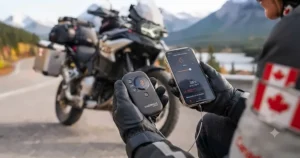
SNOW DEER Heated Socks are marketed explicitly at motorcyclists, hunters, and winter commuters, and the spec sheet backs that positioning up reasonably well for the price. A 7.4V, 2200mAh lithium-polymer battery pack feeds far-infrared heating elements across the whole toe and forefoot area, with three heat settings indicated by LED colour (red for high, around 45-55°C for roughly two hours; white for medium; blue for low, stretching toward 3.5+ hours). What most buyers overlook about budget heated socks in this tier is that the touch-button controller and moisture-wicking CoolMax-blend fabric are genuinely competitive features rarely found at this price point.
The honest tradeoff is battery chemistry: at 7.4V rather than the 3.7V used in cheaper competitors, SNOW DEER’s runtime is more stable through a ride, but the smaller mAh rating compared to premium socks means high-heat sessions stay shorter. Reviewers consistently flag these as good value for occasional cold-weather riding rather than daily sub-zero commuting.
Pros:
- ✅ Purpose-marketed and specced for motorcycle riders
- ✅ 7.4V battery gives steadier output than 3.7V rivals
- ✅ Touch-button controller is unusually refined for this price
Cons:
- ❌ High-setting runtime trails premium sock competitors
- ❌ Battery packs are proprietary, so spares aren’t universal
In the C$55-C$80 range, this is the pick for riders who want a genuinely motorcycle-oriented heated sock without the premium-brand price tag.
7. Savior Heat Heated Socks — carbon-fibre toe focus for cold-sensitive riders
The Savior Heat Heated Socks lean into a specific problem: for many riders, it’s the toes — not the whole foot — that go numb first. Savior Heat concentrates its carbon-fibre heating elements at the toe box, paired with a 7.4V, 2200mAh rechargeable battery rated for a fast heat-up. Here’s what the spec sheet won’t tell you directly: carbon-fibre heating elements tend to distribute heat more evenly across a concentrated zone than the flat resistive-wire elements found in cheaper socks, which is exactly why toe-focused designs like this one get singled out by cold-weather athletes as well as riders.
For anyone whose main complaint on cold rides is specifically numb toes rather than a generally cold foot, this targeted approach can outperform full-sole heating socks that spread the same battery capacity across a larger area. The compromise is less warmth felt through the arch and heel compared to full-sole designs like ORORO’s.
Pros:
- ✅ Toe-concentrated heat targets the coldest part of the foot first
- ✅ Fast heat-up time from the 7.4V battery
- ✅ Good middle-ground price between budget and premium socks
Cons:
- ❌ Less heat felt through the arch and heel
- ❌ Not ideal if your main discomfort is a cold sole, not toes
Expect a C$70-C$100 range, positioning the Savior Heat Heated Socks as a smart pick for riders whose cold-weather problem is specifically toe numbness rather than whole-foot chill.
Winter Riding Foot Comfort: Your Practical Setup & Maintenance Guide
Getting heated footwear right isn’t just about picking a product — it’s about setting it up so it actually performs when you need it. Start by charging any battery-powered insole or sock fully before its first ride, and cycle the battery through a full charge-and-drain once before relying on it; lithium cells often ship at a partial charge and the first cycle helps the controller calibrate remaining-time estimates accurately.
Fit matters more than most riders expect. Heated insoles need to sit flat against your boot’s factory insole (or replace it entirely) without bunching, since folded fabric creates hot spots and uneven heat distribution. Heated socks should be worn under a thin liner sock rather than against bare skin, both for hygiene and because a barrier layer reduces the chance of low-grade skin irritation from hours of contact heat. In the first 30 days, the most common mistake is running new heated gear on the highest setting immediately — start on medium for the first few rides to gauge how your specific boots trap or vent heat, since boot insulation dramatically changes how hot a “high” setting actually feels.
Maintenance is minimal but non-negotiable: wipe down battery contacts before storage to prevent corrosion, never store lithium batteries at full charge through the off-season (partial charge, around 40-60%, is better for long-term cell health), and inspect wiring on bike-powered insoles annually for chafe points near boot flex zones. A five-minute pre-season check saves you from discovering a dead connection at -10°C on your first ride back.
Real Riders, Real Choices: Matching Gear to Your Commute
Consider three riders with genuinely different needs. The first is a downtown commuter doing 20-minute rides to work in a mid-sized Canadian city where temperatures hover around -5°C to -10°C most winter mornings. For this rider, a battery-powered insole like the ActionHeat 3.7V Rechargeable Heated Insoles or a budget sock like the SNOW DEER 7.4V Heated Socks makes more sense than a wired system — the ride is short enough that battery runtime is never a limiting factor, and there’s no need to modify the bike for a twice-a-day commute.
The second is a weekend tourer who regularly logs 3-5 hour highway stretches into late fall and early spring, chasing the last rideable weekends of the season. This rider’s real constraint is runtime, not comfort features, which is exactly the scenario the Gerbing 12V Heated Insoles or the Keis S102 were built for — wired systems that don’t care how long the ride runs, as long as the engine keeps charging.
The third is a rider based somewhere genuinely cold — think the Prairies or northern Ontario — who rides year-round out of necessity or dedication rather than convenience. For this profile, layering matters more than any single product: a full-sole heated sock like ORORO Heated Socks under insulated boots, paired with a windproof outer shell, addresses the reality that no single heating element beats a genuinely cold commute alone.
Best Heated Insoles for Winter Motorcycle Riding, by Scenario
Use this simple framework instead of guessing: if your rides are under 45 minutes and you don’t want to touch your bike’s wiring, choose a rechargeable battery insole or sock — runtime limitations won’t matter at that duration. If your rides regularly exceed two hours in genuinely cold weather, choose a bike-wired system, because no rechargeable battery in this category comfortably clears that runtime on a meaningful heat setting. If your discomfort is specifically toe numbness rather than whole-foot chill, prioritize a toe-concentrated design over a full-sole one — you’ll get more heat where you actually need it from the same battery capacity.
If you’re already running other heated gear from one brand, matching insoles or socks from that same ecosystem (Gerbing to Gerbing, Keis to Keis) avoids the hassle of juggling multiple chargers, controllers, and connector types on a single ride. And if you’re testing whether heated footwear is worth the investment at all before committing to a premium wired setup, start with a budget rechargeable option — the honest truth is that even the cheapest insoles in this roundup outperform an unheated boot by a wide margin.
✨ Ready to shortlist your pick? Scroll back up to the comparison table and match your ride length to the runtime column.
How to Choose Between Heated Insoles and Heated Socks for Motorcycle Riding
- Match power source to ride length. Bike-wired insoles win for long tours; rechargeable batteries are fine for commutes under an hour or two.
- Check your boot’s internal volume. Heated socks add bulk that thin insoles don’t — a snug motorcycle boot may not have room for both a heated sock and its usual sock layer.
- Decide between full-sole and toe-focused heat. Full-sole designs suit riders with generally cold feet; toe-focused designs suit riders whose numbness starts and stays at the toes.
- Factor in off-bike use. Heated socks work standing in line at a gas station; wired insoles only heat while connected to a running bike.
- Budget for accessories, not just the headline price. Wired systems need harnesses and controllers sold separately; battery systems need spare batteries if you want backup runtime.
- Read the battery voltage, not just the mAh rating. Higher-voltage systems (7V, 7.4V, 12V) tend to hold output more consistently as they discharge than lower-voltage 3.7V units.
- Weigh brand ecosystem fit. If you already own heated gear from one manufacturer, staying within that ecosystem usually beats mixing brands and connector types.
Insole Warmth vs Sock Warmth: The Real-World Difference
| Factor | Heated Insoles | Heated Socks |
|---|---|---|
| Heat coverage | Concentrated under toes/forefoot | Full sole, sometimes ankle |
| Boot fit impact | Minimal — replaces existing insole | Adds bulk — may need larger boot size |
| Off-bike use | None (insole stays in boot) | Full function anywhere |
| Typical runtime (battery) | 2-8 hrs depending on setting | 2-11 hrs depending on setting |
| Best for | Riders prioritizing minimal bulk | Riders prioritizing whole-foot comfort |
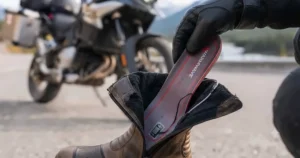
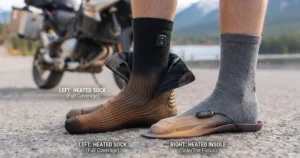
The practical difference comes down to where the heat actually reaches your foot. Insoles sit against the sole, so warmth radiates upward through the bottom of your foot but rarely touches your toes’ upper surface or the sides — which is exactly why so many insole reviews mention warm soles paired with still-cold toe tips. Socks wrap the foot more completely, which is why full-sole designs like ORORO Heated Socks tend to score better on total foot-warmth in aggregated reviews, even when their battery specs look similar to competing insoles on paper.
That coverage advantage comes at a cost, though: heated socks add fabric bulk that a snug-fitting motorcycle boot may not accommodate without sizing up, while a thin insole rarely changes how your boot fits at all.
Battery Life Reality Check: What Heated Insoles Actually Deliver
Manufacturer runtime claims are measured under lab conditions rarely replicated at highway speed in genuine winter cold. Real-world battery life for heated insoles and socks depends on three factors the spec sheet glosses over: ambient temperature (cold itself reduces usable lithium battery capacity by a meaningful margin), heat setting (the jump from medium to high roughly halves runtime across every product in this roundup), and how well-insulated your boot already is (a well-insulated boot needs less heater output to feel warm, stretching effective battery life).
What most buyers overlook is that the “high setting for 3+ hours” claim on a product like the ActionHeat insoles assumes a controlled indoor test, not -15°C highway wind chill. Reviewers consistently report actual cold-weather runtime running 20-30% shorter than advertised once temperatures drop meaningfully below freezing — plan around that gap rather than the number on the box, and carry a spare charged battery if your ride will outlast your gear’s realistic runtime.
Heated Footwear for Different Types of Winter Riders
Commuters riding short, predictable routes benefit most from convenience over raw power — a rechargeable insole or budget sock that charges overnight and requires zero bike modification fits that lifestyle. Long-distance tourers, by contrast, should weight bike-wired systems heavily, since the unpredictability of weather and distance on a multi-day trip makes finite battery runtime a real liability rather than a minor inconvenience.
Riders with boots that already run snug — many sport-touring and race-replica boots are cut narrow through the forefoot — should lean toward thin insoles over bulkier heated socks, since forcing a swollen foot into an already-tight boot restricts circulation and actually worsens cold sensitivity, undermining the entire point of the heating gear. Riders in wider adventure or touring boots have more room to work with a full heated sock without sacrificing fit.
This is also where motorcycle boot insole compatibility becomes the deciding factor rather than an afterthought. Cut-to-fit insoles like the ActionHeat pair generally adapt to most boot shapes since you trim them to size, while bike-wired insoles like the Gerbing 12V and Keis S102 models require enough internal boot volume to route a connector cable out through the top of the boot without pinching — worth test-fitting before you commit to drilling into your bike’s wiring harness.
Heated Footwear Accessories Worth Adding to Your Kit
A handful of accessories separate a merely functional heated-footwear setup from a genuinely reliable one. Spare batteries are the single highest-value add-on for any rechargeable system — swapping a depleted battery for a charged one mid-ride costs seconds and effectively doubles your usable runtime without waiting for a recharge. A dedicated temperature controller, required for most bike-wired Gerbing and Keis insoles, is not optional despite sometimes being sold separately; running wired heating elements without one risks uneven heat and, per manufacturer warnings, potential discomfort or burns at full output.
Y-harnesses and splitter cables let a single battery or bike connection power both a heated jacket and heated footwear simultaneously, which matters if you’re building toward a full heated riding suit rather than footwear alone. Thin liner socks, worn under any heated sock or against bare skin inside a heated insole boot, improve hygiene and reduce moisture buildup — a genuinely underrated accessory given how much aggregated review feedback centres on sweat and odour management during long heated-gear use.
Common Mistakes When Buying Heated Footwear for Motorcycle Riding
The most frequent mistake is buying based on top-line runtime numbers without checking what heat setting they apply to — an “11-hour battery” claim usually refers to the lowest, barely-warm setting, not the output you’ll actually want at -15°C. A close second is ignoring boot fit entirely: a heated sock that fits comfortably in a roomy touring boot may crush your toes in a narrow sport boot, actively worsening circulation and cold sensitivity.
Riders also commonly underestimate accessory costs on wired systems, budgeting only for the insoles themselves and getting surprised by the added price of a harness and controller. And a genuinely common oversight: buying insoles or socks without confirming the connector type matches other heated gear you already own, resulting in a drawer of incompatible heated accessories from different brands that can’t share a battery or controller.
Safety, Batteries, and Canadian Regulations: What Riders Need to Know
Every product in this roundup runs on lithium-based rechargeable cells, and Canadian regulators treat those batteries seriously for good reason. Transport Canada’s guidance on lithium batteries recommends keeping devices and spare batteries in carry-on rather than checked luggage when travelling, since damaged or improperly stored cells carry a documented fire risk during transport. That same caution applies at home: never charge heated insoles or socks unattended overnight on a flammable surface, and stop using any battery that feels unusually warm, swollen, or slow to charge.
Cold itself is the other safety factor worth understanding properly. Environment and Climate Change Canada’s wind chill guidance shows that frostbite risk accelerates sharply once wind chill drops below roughly -27°C, which is a genuinely common wind chill value on Canadian highways in January even when the ambient air temperature reads far milder. Heated footwear reduces frostbite risk by keeping skin temperature elevated, but it isn’t a substitute for weather judgment — riders should still avoid extended highway exposure in extreme wind chill regardless of how well-heated their boots are, and CSA-certified riding boots with proper insulation remain the baseline layer heated inserts build on top of, not a replacement for.
✨ Don’t Miss These Exclusive Deals!
🔍 Take your winter riding kit to the next level with these carefully selected heated insoles and socks. Click on any highlighted product to check current pricing and availability. The right setup turns a dreaded cold commute into just another ride.
Frequently Asked Questions
❓ Are heated insoles better than heated socks for motorcycle riding?
❓ How long do heated insoles last on a motorcycle ride?
❓ Can heated socks fit inside tight motorcycle boots?
❓ Do heated insoles work without a battery pack?
❓ Are heated insoles or socks safe to use every ride?
Conclusion
The heated insoles vs heated socks for motorcycle riding decision really comes down to two questions: how long are your rides, and how tight are your boots? Short commutes in roomy boots lean toward the flexibility of a rechargeable insole like the ActionHeat 3.7V Rechargeable Heated Insoles; long tours in wider boots lean toward the unlimited runtime of a wired system like the Gerbing 12V Heated Insoles; and riders chasing whole-foot comfort both on and off the bike will likely land on a sock like the ORORO Heated Socks. None of these seven picks is a bad choice on its own merits — the mismatch happens when the product doesn’t fit your specific riding pattern, not when the gear itself is flawed.
Whatever you choose, treat it as one layer in a broader winter setup, not a silver bullet. Pair heated footwear with genuinely insulated, wind-resistant boots, respect the wind chill numbers on genuinely cold mornings, and keep a spare charged battery in your jacket pocket on any ride longer than your gear’s realistic runtime. Canadian winters aren’t going anywhere, but neither does your enthusiasm for riding through them — the right heated footwear just makes that combination a lot more comfortable.
Recommended for You
- Heated Insoles for Motorcycle Boots: 7 Picks That Actually Work (2026)
- Rechargeable vs 12V Heated Socks Motorcycle: 7 Picks for 2026
- Heated Socks for Motorcycle Riding: 7 Warmest Picks for 2026
Disclaimer: This article contains affiliate links. As an Amazon Associate, I earn from qualifying purchases. If you purchase products through these links, we may earn a small commission at no additional cost to you.
✨ Found this helpful? Share it with your friends! 💬🤗
