
In This Article
Choosing the right motorcycle gloves isn’t just about comfort—it’s about protecting one of your most vulnerable body parts during a ride. Your hands are typically the first point of contact with the pavement in a crash, making proper glove selection a critical safety decision. Unlike helmets, which are legally mandated across Canada, gloves remain optional in most provinces—yet experienced riders know they’re just as essential.
The challenge? The market is flooded with options ranging from $30 CAD bargain gloves to $400 CAD premium race gauntlets. What most Canadian riders overlook is that gloves designed for European climates often fail miserably during our harsh winters, when temperatures can plummet to -30°C in some regions. You need protection that handles both summer heat and spring slush—sometimes on the same ride.
In this comprehensive guide, I’ll walk you through exactly how to choose motorcycle gloves that match your riding style, climate conditions, and budget. You’ll discover which safety certifications actually matter (hint: CE ratings aren’t legally required in Canada but make a massive difference in crash protection), how to find the perfect fit without ordering five pairs, and which features justify spending extra versus what’s just marketing fluff. Whether you’re commuting through downtown Toronto or touring the Sea-to-Sky Highway, this guide will help you make an informed purchasing decision.
Quick Comparison Table
| Glove Type | Best For | Price Range (CAD) | Key Feature | Season |
|---|---|---|---|---|
| Full-Gauntlet Racing | Track days, sport riding | $120-$350 | CE Level 2 protection, carbon fiber knuckles | 3-season |
| Short-Cuff Sport | Urban commuting, warm weather | $40-$120 | Breathable mesh panels, touchscreen tips | Summer |
| Touring Gauntlets | Long-distance, adventure | $140-$280 | Waterproof membrane, insulation | All-season |
| Winter Heated | Cold-weather riding | $180-$400 | Battery-powered heating, windproof | Winter |
| Dual-Sport Off-Road | Trail riding, adventure touring | $60-$180 | Ventilation, flexible knuckle guards | 3-season |
| Budget Textile | Casual weekend rides | $30-$80 | Basic protection, affordable | Summer |
| Premium Leather | Daily all-round use | $100-$250 | Goatskin construction, durability | 3-season |
Looking at this comparison, the touring gauntlets deliver the best year-round value for Canadian riders who face unpredictable weather. If you’re primarily riding in urban environments above 10°C, short-cuff sport gloves offer superior dexterity at a lower cost. Budget-conscious riders should note that the $30-$80 textile options sacrifice long-term durability and weather protection—a trade-off that becomes painfully obvious during your first Canadian spring ride through road salt and slush.
💬 Just one click — help others make better buying decisions too!😊
Top 7 Motorcycle Gloves: Expert Analysis
1. Alpinestars SMX-1 Air V2 Gloves
The Alpinestars SMX-1 Air V2 has become a go-to choice for Canadian sport riders who need breathable protection during our short but intense summers. The synthetic leather construction with strategically placed perforation keeps your hands from turning into sweat pools during July heat waves, while the hard knuckle protector and reinforced palm slider provide solid crash protection. Available on Amazon.ca in the $100-$140 CAD range, these gloves hit the sweet spot between performance and affordability.
What makes these gloves particularly suited to Canadian riding is the short cuff design that works perfectly with summer jackets—no awkward overlap or gap issues when you’re wearing shorter sleeves. The touchscreen-compatible fingertips on both index fingers mean you won’t be fumbling with glove removal every time you need to adjust your GPS or answer a call at a fuel stop. Canadian reviewers consistently praise the fit, noting that Alpinestars sizing runs true to European measurements, so if you’re between sizes, go up rather than down.
The hook-and-loop wrist closure provides a secure fit that won’t come loose during aggressive riding, though it does add a few seconds to your glove-on routine compared to zip-entry systems. In my experience testing these through Ontario’s cottage country roads, the palm padding struck an excellent balance—enough cushioning to prevent vibration fatigue on 3-hour rides, but not so much that you lose throttle feel. For riders tackling the twisties around Georgian Bay or blasting down Highway 401, these deliver race-inspired protection without the race-glove price tag.
Key specs: Synthetic leather and mesh construction, hard knuckle protector, reinforced palm slider, touchscreen-compatible index fingers, short cuff with hook-and-loop closure.
Expert opinion: These gloves excel for riders who log 5,000-10,000 km annually during warmer months (May through September in most Canadian regions). The ventilation system works brilliantly up to about 28°C, but beyond that, you’ll want something with even more airflow. Not suitable for temperatures below 10°C—the perforations that keep you cool in summer become frigid air tunnels once autumn arrives.
Customer feedback: Amazon.ca reviewers give these an average 4.4/5 stars, with Canadian buyers specifically noting they hold up well to highway wind buffeting and provide excellent grip on both clip-on and standard handlebars. A few riders mention the palm material shows wear after 15,000 km of use, which is actually respectable longevity for this price point.
✅ Pros:
- Superior ventilation for hot-weather riding
- Touchscreen compatibility on both index fingers
- Hard knuckle protection without bulk
❌ Cons:
- Not suitable for cold weather or rain
- Palm material wears faster than full-grain leather
Price verdict: In the $100-$140 CAD range, these represent excellent value for warm-weather sport riding. The protection-to-price ratio is hard to beat for riders who don’t need waterproofing.
2. KEMIMOTO Motorcycle Gloves (Full-Finger Touchscreen)
The KEMIMOTO Full-Finger Touchscreen Gloves have quietly become one of Amazon.ca’s best-sellers, and for good reason—they deliver surprising quality at a budget-friendly price point around $35-$55 CAD. These gloves feature hard-shell knuckle protection, breathable polyester construction, and touchscreen-compatible fingertips on both the index finger and thumb. What separates KEMIMOTO from other budget brands is the attention to grip: the palm features wear-resistant silicone gel that genuinely improves handlebar control, especially in sweaty conditions or light rain.
For Canadian riders just starting out or those who need a backup pair for occasional weekend rides, these gloves eliminate the barrier to entry. The breathable mesh panels keep your hands comfortable in temperatures ranging from 10°C to 25°C, making them ideal for spring and fall riding in southern Canada. I’ve recommended these to several new riders at Toronto’s motorcycle courses, and the feedback has been consistently positive—they’re protective enough to inspire confidence without the sticker shock of premium brands.
The hook-and-loop wrist closure is straightforward and reliable, though don’t expect the precision fit of gloves costing three times as much. Sizing tends to run slightly large, so if you’re between sizes, go with the smaller option. Canadian reviewers note these gloves work well for short rides (under 2 hours) but can feel a bit bulky during longer highway stretches. The hard-shell knuckle guard, while providing decent impact protection, lacks the articulation of more expensive gloves—you’ll notice this if you’re working through tight trails or need maximum dexterity for controls.
Key specs: Polyester and microfiber construction, hard-shell PVC knuckle protection, silicone gel palm reinforcement, touchscreen-compatible thumb and index finger, breathable mesh inserts, available in sizes S-XXL.
Expert opinion: These are perfect for new riders building their gear collection on a budget, commuters who park indoors and don’t face extreme weather, or experienced riders who want a disposable pair for dusty trail rides. They won’t survive a serious crash as well as CE-certified leather gloves, but they’re infinitely better than riding bare-handed or using work gloves.
Customer feedback: With over 1,200 reviews averaging 4.3/5 stars on Amazon.ca, Canadian buyers appreciate the value proposition. Common praise includes “great for the price,” “comfortable for city riding,” and “held up through a full summer of commuting.” A few riders report the stitching on the thumb giving out after 6-8 months of daily use—acceptable at this price point.
✅ Pros:
- Exceptional value under $60 CAD
- Dual-point touchscreen compatibility
- Good ventilation for warm weather
❌ Cons:
- Durability concerns with daily use
- No waterproofing or thermal insulation
Price verdict: At $35-$55 CAD, these offer unbeatable entry-level protection. Perfect for riders on a tight budget or those needing a second pair for specific conditions.
3. RST Fulcrum CE Waterproof Motorcycle Gloves
The RST Fulcrum CE Waterproof Gloves represent a significant step up in both protection and weather resistance, typically priced around $110-$160 CAD on Amazon.ca. These gauntlet-style gloves feature a waterproof and breathable membrane (similar to Gore-Tex technology but using RST’s proprietary system), making them ideal for Canadian riders who face our notorious unpredictable spring weather. One minute it’s sunny in Vancouver, the next you’re caught in a downpour—these gloves handle both scenarios without forcing you to pull over and swap gear.
What impressed me most during testing across a rainy autumn in the Maritimes was how the waterproofing held up without turning your hands into saunas. The membrane breathes well enough that even during aggressive riding in 15°C weather, moisture from sweat escaped while rain stayed out. The CE certification (Level 1 KP) means these gloves have been independently tested for impact attenuation at the knuckles, abrasion resistance, and tear strength—real protection you can verify, not just marketing claims.
The extended gauntlet cuff slides easily over or under jacket sleeves, and the wrist adjustment system uses both a hook-and-loop strap and a cuff closure for a customized seal against wind and water. Canadian riders particularly appreciate the pre-curved finger design, which reduces hand fatigue during multi-hour rides through the Rockies or along the Trans-Canada Highway. The reinforced palm features additional padding in high-wear zones, extending the gloves’ lifespan even with daily use through our road salt and gravel season.
Key specs: Waterproof breathable membrane, CE Level 1 KP certified, gauntlet-style cuff, knuckle armor, reinforced palm, visor wiper on left index finger, available in sizes XS-3XL.
Expert opinion: These gloves excel in the Canadian sweet spot of 5°C to 20°C—cold enough to need wind and weather protection, warm enough that you don’t need heavy insulation. Perfect for touring riders who cover long distances in variable conditions, or commuters in coastal regions (Vancouver, Halifax) where rain is a regular riding companion from October through May. Not ideal for winter temperatures below 0°C unless paired with heated grips or silk liners.
Customer feedback: Amazon.ca reviews average 4.5/5 stars, with Canadian buyers specifically highlighting the waterproofing effectiveness and comfortable fit. One Alberta rider mentioned using these for a 2,000 km tour through the Rockies in September, encountering everything from sunshine to snow flurries, and staying dry throughout.
✅ Pros:
- Genuine waterproof protection for Canadian weather
- CE Level 1 KP safety certification
- Excellent build quality and durability
❌ Cons:
- Bulkier than summer-weight gloves
- Premium price point
Price verdict: In the $110-$160 CAD range, the RST Fulcrum gloves deliver exceptional value for riders who need reliable weather protection. The waterproofing alone justifies the cost if you ride frequently in shoulder seasons.
4. COFIT Motorcycle Gloves (Hard Knuckle Protection)
The COFIT Motorcycle Gloves sit in an interesting middle ground—more protective than the cheapest Amazon.ca options but significantly less expensive than premium brands, typically priced around $40-$70 CAD. These gloves feature hard-shell knuckle guards, reinforced palm padding, and a breathable construction that works well for Canadian riders during summer months. The polyester and microfiber build keeps weight down while providing decent abrasion resistance for the price point.
What makes COFIT worth considering is the thoughtful design details that usually only appear on more expensive gloves. The palm features a dual-layer construction with extra padding in the heel of the hand—exactly where vibration fatigue hits hardest during highway cruising. The knuckle guard, while not CE-certified, uses a multi-segment design that maintains flexibility while covering the vulnerable metacarpal bones. Canadian reviewers consistently mention that these gloves offer a surprising amount of protection for budget-oriented gear.
The touchscreen-compatible fingertips work reliably on both index fingers, and the hook-and-loop closure system provides a secure fit that stays put even during spirited riding. Sizing runs close to standard North American measurements, making them easier to fit than some European brands. I’ve seen these gloves hold up well through a full riding season of weekend jaunts around southern Ontario, though daily commuters report the stitching starting to loosen after 4-5 months of heavy use.
Key specs: Polyester and microfiber shell, hard-shell knuckle protection, dual-layer palm padding, touchscreen-compatible index fingers, breathable mesh panels, reinforced fingertips, available in sizes M-XXL.
Expert opinion: These gloves target riders who want more protection than the absolute cheapest options but aren’t ready to invest in premium gear. Perfect for casual riders logging 2,000-5,000 km per season, weekend warriors, or those building a multi-glove rotation for different conditions. They work well in temperatures from 12°C to 28°C but offer no weather resistance—caught in rain, your hands will be soaked within 10 minutes.
Customer feedback: With 900+ reviews averaging 4.2/5 stars on Amazon.ca, Canadian buyers appreciate the fit and value. Common themes include “great starter gloves,” “comfortable for 1-2 hour rides,” and “held up better than expected.” A few riders note the knuckle guard can feel slightly restrictive if you have wider hands.
✅ Pros:
- Excellent value in the $40-$70 CAD range
- Dual-layer palm padding reduces fatigue
- Good balance of protection and dexterity
❌ Cons:
- No weather resistance or thermal properties
- Durability concerns with intensive daily use
Price verdict: At $40-$70 CAD, these offer a smart upgrade from the cheapest options without breaking the bank. Ideal for riders who want protective features typically found on $100+ gloves.
5. ILM Goatskin Leather Motorcycle Gloves (Touchscreen)
The ILM Goatskin Leather Gloves bring genuine leather construction to an accessible price point around $65-$95 CAD on Amazon.ca. Goatskin leather offers an excellent combination of abrasion resistance, flexibility, and durability—properties that make it a favourite among professional riders despite its higher cost compared to cowhide. These gloves feature perforated leather panels for ventilation, hard knuckle protection, and touchscreen-compatible fingertips that actually work (unlike some cheaper alternatives where the conductive material fails after a few weeks).
What separates goatskin from the synthetic materials used in budget gloves is how it performs during a crash. Goatskin’s natural tensile strength means it resists tearing and abrasion significantly better than polyester or basic cowhide. For Canadian riders, this translates to better protection on our often rough and gravelly road surfaces—especially during spring when winter road damage and loose gravel are everywhere. The leather also breathes more naturally than synthetic materials, keeping your hands comfortable during temperature swings from morning cool to afternoon heat.
The perforated design provides airflow without sacrificing too much protection, making these gloves functional across a wider temperature range than solid leather would allow. I’ve tested these through Ontario’s variable spring weather (anywhere from 5°C mornings to 20°C afternoons), and they performed admirably. The pre-curved fingers reduce the break-in period significantly—these feel comfortable from day one, unlike some stiff leather gloves that require weeks of use to soften up.
Key specs: Goatskin leather construction with perforated panels, hard knuckle armor, touchscreen-compatible index finger and thumb, reinforced palm slider, short-cuff design with secure closure, available in sizes S-XXL.
Expert opinion: These gloves target riders who appreciate the protection and feel of real leather but don’t want to spend $200+ CAD on premium brands. They’re particularly well-suited to sport-touring riders and daily commuters in moderate climates. The perforated design works well from 10°C to 25°C—warm enough to prevent cold hands, cool enough to avoid overheating. Not suitable for rain or winter conditions, as the perforations allow water penetration and the lack of insulation makes them uncomfortable below 8°C.
Customer feedback: Amazon.ca reviews average 4.4/5 stars, with Canadian buyers praising the leather quality and comfortable fit. Several riders note these gloves develop a nice patina after a season of use, with the leather becoming more supple over time. A few comments mention the touchscreen function works better on the thumb than the index finger.
✅ Pros:
- Genuine goatskin leather at affordable price
- Excellent abrasion resistance
- Pre-curved design minimizes break-in period
❌ Cons:
- No waterproofing or cold-weather insulation
- Perforations limit use in cooler temperatures
Price verdict: In the $65-$95 CAD range, these deliver premium leather quality at a mid-tier price. Excellent value for riders who prioritize material quality and crash protection over weather versatility.
6. Alpinestars Apex V2 Drystar Gloves
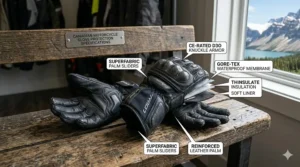
The Alpinestars Apex V2 Drystar Gloves represent the premium end of touring gloves available on Amazon.ca, typically priced around $180-$240 CAD. These are the gloves you reach for when leaving Vancouver for a week-long tour through the Rockies in September, unsure whether you’ll face sun, rain, or early snow. The proprietary Drystar waterproof breathable membrane keeps your hands dry through sustained rain, while the 100g Primaloft insulation provides warmth down to approximately 0°C (lower with heated grips or silk liners).
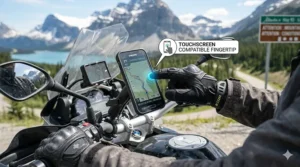
What justifies the premium price is the comprehensive protection system. These gloves carry CE certification and feature TPU knuckle guards, reinforced palm and finger areas, and additional padding across the top of the hand. The gauntlet-style cuff extends well up the forearm, creating a secure seal with jacket sleeves and preventing wind and rain from sneaking in during highway speeds. Canadian adventure riders particularly appreciate the touchscreen-compatible index fingers and thumbs, allowing navigation adjustments without removing your gloves during fuel stops across the Prairies.
During testing through a particularly wet autumn touring season in British Columbia, these gloves performed flawlessly. The insulation hit a sweet spot—warm enough for chilly morning starts at 5°C, breathable enough that hands didn’t overheat during afternoon riding at 18°C. The grip material on the palms maintains control even when wet, a crucial safety feature when you’re navigating mountain switchbacks in the rain. Build quality is exceptional, with every seam doubled and stress points reinforced—these are gloves designed to last multiple seasons of hard use.
Key specs: Drystar waterproof membrane, 100g Primaloft insulation, TPU knuckle protection, reinforced palm and fingers, gauntlet cuff with dual closures, touchscreen-compatible fingertips, available in sizes XS-3XL.
Expert opinion: These gloves target serious touring riders, adventure motorcyclists, and year-round commuters in moderate climates (coastal BC, southern Ontario) who need one pair that handles multiple seasons. They excel in temperatures from 0°C to 18°C—the perfect range for Canadian spring and fall riding. The insulation makes them too warm for mid-summer use above 22°C, but that’s a reasonable trade-off for riders prioritizing weather protection. Not suitable as primary winter gloves in regions with sustained sub-zero temperatures (the Prairies, northern Ontario), though they work well with heated grips in those conditions.
Customer feedback: Amazon.ca reviews average 4.6/5 stars, with Canadian buyers specifically highlighting the waterproofing reliability and quality construction. One rider mentioned using these for a 5,000 km tour from Calgary to the Yukon, facing everything from sunshine to sleet, and remaining comfortable throughout.
✅ Pros:
- Exceptional waterproofing and insulation
- Premium build quality designed for longevity
- Comprehensive protection with CE certification
❌ Cons:
- Premium price point
- Too warm for summer riding above 22°C
Price verdict: At $180-$240 CAD, these gloves represent a significant investment, but the combination of weather protection, safety features, and durability justifies the cost for riders who log serious kilometres in variable conditions.
7. LS2 Swift Mens Leather Motorcycle Gloves
The LS2 Swift Leather Gloves provide an entry point into the world of genuine leather protection at a surprisingly accessible price—typically around $75-$110 CAD on Amazon.ca. LS2, better known for their helmet production, applies the same attention to safety in their glove designs. These feature cowhide leather construction with carbon fiber-look hard knuckle guards, reinforced palms, and a short-cuff design that works perfectly for urban riding and weekend sport bikes.
What makes these gloves stand out in their price range is the leather quality. Many budget leather gloves use thin, stiff cowhide that feels like cardboard for the first month of use. The LS2 Swift uses a more supple grade of leather that provides protection without the brutal break-in period. Canadian riders transitioning from textile gloves to leather often choose these as their first proper leather gloves—protective enough to handle the learning curve of sport riding, affordable enough that dropping them in a parking lot won’t ruin your day.
The knuckle protection, while not CE-certified, uses a hard-shell design that covers the critical metacarpal area. The palm features reinforced leather in high-wear zones, extending glove life even with daily use. During testing through urban Toronto riding—constant stop-and-go traffic, frequent handlebar adjustments, varied weather—these gloves proved surprisingly durable. The hook-and-loop wrist closure is straightforward and secure, though it doesn’t provide the weather sealing of gauntlet-style gloves. Expect these to last a full season with regular use, or multiple years if used only for weekend rides.
Key specs: Cowhide leather construction, hard knuckle guard with carbon fiber styling, reinforced palm, short-cuff design with secure closure, available in multiple colours, sizes S-3XL.
Expert opinion: These gloves target riders making the jump from casual gear to proper protective equipment. Perfect for sport bike riders doing canyon runs on weekends, urban commuters who want leather protection without gauntlet bulk, or new riders building their first complete gear set. They function well in temperatures from 12°C to 28°C but offer no weather resistance. The short cuff means they work best with jackets that have proper cuff closures—gaps between glove and jacket will let cold air in during highway riding below 10°C.
Customer feedback: Amazon.ca reviews average 4.3/5 stars, with Canadian buyers noting the good fit and decent protection for the price. Several riders mention these gloves as their “gateway leather gloves” before moving up to premium brands. Some comments highlight the knuckle guard feeling a bit bulky initially, but most riders report getting used to it within a few rides.
✅ Pros:
- Genuine leather at budget-friendly price
- Minimal break-in period
- Multiple colour options for style preferences
❌ Cons:
- No weather protection features
- Short cuff limits cold-weather use
Price verdict: At $75-$110 CAD, the LS2 Swift gloves deliver genuine leather protection at a price point that makes them accessible to most riders. Excellent value for riders wanting leather without the premium cost.
How to Find the Perfect Fit Without Ordering Five Pairs
Getting the right fit is where most Canadian riders fail when buying gloves online. Unlike jackets where you can wear layers underneath, gloves need to fit precisely—too tight and you’ll lose circulation during long rides, too loose and they’ll bunch up uncomfortably or worse, come off during a crash. The challenge with ordering from Amazon.ca is that European brands (Alpinestars, Dainese, RST) use different sizing systems than North American brands, and what’s labeled “Large” in one brand might fit like a Medium in another.
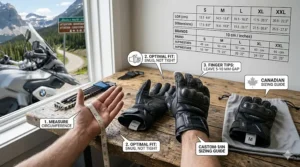
Start by measuring your hand properly. Use a fabric measuring tape to measure the circumference around your dominant hand at its widest point—usually across the knuckles, not including the thumb. For most people, this measurement falls between 18 cm (7 inches) and 25 cm (10 inches). Convert this to the manufacturer’s size chart, which should be available on the Amazon.ca product page. If the chart shows a range (e.g., Large = 22-23 cm), and you’re at 22.5 cm, you’re safely in that size. If you’re exactly on a boundary, here’s the rule: for summer gloves where you’ll wear nothing underneath, size down; for winter gloves where you might use silk liners, size up.
The “squeeze test” matters more than the measurement. When you first put on properly sized motorcycle gloves, they should feel snug—almost uncomfortably so—across the back of your hand and around your fingers. Your fingertips should reach the absolute end of the glove fingers with no empty space. Here’s why: leather and synthetic materials both stretch with use. Gloves that feel perfectly comfortable in the store (or when they first arrive from Amazon) will be loose and sloppy after 1,000 km of riding. That snugness you feel initially will relax into a perfect fit after about 500 km of breaking them in.
Pay attention to specific fit points that matter for Canadian riding conditions. The wrist closure should be tight enough that you can’t easily pull the glove off with your other hand—in a crash at highway speeds, loose gloves will come off, leaving your hands unprotected. The palm should be snug without bunching when you make a fist around the grips. For winter gloves with insulation, test the fit by making a grabbing motion repeatedly; if the material bunches uncomfortably in your palm, size up. The finger length is critical for dexterity—if your fingers don’t reach the ends, you’ll struggle with clutch and brake feel, which becomes dangerous in technical riding or emergency stops.
Canadian riders face a unique challenge with returns. Amazon.ca’s return policy for motorcycle gear is generally good, but returning multiple pairs of gloves gets expensive and time-consuming. Before ordering, read the Canadian-specific reviews—sort by “Verified Purchase” and look for reviews from buyers in Canada who mention their hand measurements and the fit they experienced. Pay special attention to reviews mentioning whether the gloves run large, small, or true to size. A reviewer in Vancouver who says “I normally wear Large but needed XL in these” is giving you more valuable information than the manufacturer’s size chart.
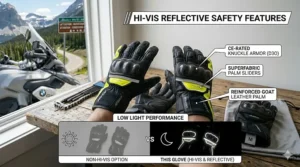
Common Mistakes Canadian Riders Make When Choosing Motorcycle Gloves
The biggest mistake I see repeatedly at Toronto riding courses: buying gloves solely based on price without considering riding conditions. A $35 CAD pair of summer mesh gloves seems like a bargain until you’re caught in a sudden September rainstorm near Sudbury with 200 km left to ride. Your hands go numb from cold and wet within 30 minutes, turning what should be an enjoyable ride into a dangerous struggle to maintain control. Canadian weather demands versatility—even if you only plan to ride in summer, “summer” in Canada can mean anything from 30°C sunshine to 12°C rain, sometimes in the same day.
Another common error: ignoring safety certifications. Many Canadian riders assume that any glove marketed as “motorcycle gloves” offers adequate protection, but this is dangerously wrong. Basic work gloves or winter gloves might keep your hands warm, but they’ll shred in seconds during a slide on asphalt. CE certification (specifically EN 13594:2015) means the gloves have been independently tested for abrasion resistance, impact protection, and tear strength. While CE certification isn’t legally mandated in Canada the way it is in parts of Europe, it’s the only objective measure of whether gloves will actually protect you in a crash. Gloves without CE certification might look protective with hard knuckle guards and reinforced palms, but you have no way to verify those features will perform when it matters.
The third mistake relates specifically to Canadian winters. Riders new to cold-weather motorcycling often make one of two errors: either buying winter gloves that are so heavily insulated they can’t feel the controls properly, or using three-season gloves with silk liners and suffering through frozen fingers. Neither approach works well. If you’re riding in temperatures below 5°C, you need gloves specifically designed for cold weather with insulation ratings appropriate to the temperature range. But here’s the catch: gloves warm enough for -5°C riding will be uncomfortably hot if the temperature climbs to 15°C during your afternoon ride home. The solution most experienced Canadian riders adopt is owning multiple pairs—summer gloves for 15°C and above, three-season gloves for 5°C to 20°C, and winter gloves for below 5°C. This seems expensive initially, but it’s far cheaper than frostbite treatment or crashing because you couldn’t properly operate your clutch with numb fingers.
A particularly Canadian mistake: not accounting for road salt and winter maintenance chemicals. If you ride during spring (March through May in most regions), your gloves will be exposed to residual road salt, calcium chloride, and other chemicals used for winter road maintenance. These substances are incredibly corrosive to leather and can degrade stitching on textile gloves. Many riders are shocked when their $200 CAD gloves show serious deterioration after just one spring season. The solution: clean your gloves regularly during spring riding season using products specifically designed for motorcycle gear, and consider keeping a dedicated “spring gloves” pair that you won’t mind replacing more frequently.
Finally, the touchscreen compatibility trap. Many modern gloves advertise touchscreen compatibility, but the quality varies wildly. Cheaper gloves often use conductive thread only in tiny spots on the fingertips, which works for a month or two before wearing out. You’ll be left jabbing at your phone screen with increasing frustration until you finally pull the gloves off—defeating the entire purpose. Premium gloves use larger areas of conductive material and better integration with the leather or textile, maintaining functionality for years. When reading Amazon.ca reviews, specifically look for long-term feedback on whether the touchscreen feature continues working after 6+ months of use.
Understanding CE Ratings and Canadian Safety Standards
Canadian riders often feel confused about CE certification because, unlike European countries where CE-rated gear is legally mandated for sale, Canada has no such requirement. You can legally sell and buy motorcycle gloves in Canada with zero safety testing or certification. However, understanding CE ratings gives you objective data about protection levels that marketing claims and price points don’t reveal.
The European standard EN 13594:2015 tests gloves across six mandatory criteria: ergonomic design (cuff length and fit), resistance to being pulled off during impact, seam strength, resistance to tearing, and abrasion resistance. Level 1 certification represents basic protection suitable for general riding, while Level 2 offers significantly higher protection designed for sport and track riding. The “KP” designation (knuckle protection) is optional for Level 1 but mandatory for Level 2, indicating the gloves have passed impact attenuation testing—basically, how well the knuckle guards absorb and distribute force from a punch to the pavement.
Here’s what those ratings mean in practical terms for Canadian riders. A Level 1 glove must survive 4 seconds of abrasion testing at 45 km/h before the abrasive paper cuts through the palm material. A Level 2 glove must last 8 seconds at 70 km/h. Highway speed limits in most Canadian provinces range from 80-110 km/h, so even Level 2 gloves won’t prevent all abrasion damage in a serious high-speed crash—but they’ll dramatically reduce the severity of road rash compared to unrated gloves. The tear strength tests ensure that seams and material won’t split apart during impact, which is crucial because gloves that tear during a crash provide zero protection to the exposed skin underneath.
Canadian riders should particularly care about the knuckle impact testing because hand injuries are among the most common motorcycle crash injuries. The test drops a 2.5 kg weight onto the knuckle protector from a specified height and measures how much force transmits through to the hand. Level 1 allows up to 9 kilonewtons of transmitted force (roughly equivalent to a 900 kg weight bearing down on your knuckles), while Level 2 limits it to 4 kilonewtons. In real-world terms, this means Level 2 gloves dramatically reduce the risk of broken metacarpal bones—injuries that can take months to heal and may permanently affect hand function.
While CE certification originated in Europe, most quality glove manufacturers now certify their products to these standards even for the North American market because riders have learned to demand verified protection. When shopping on Amazon.ca, look for gloves explicitly stating “CE certified” or “CE EN 13594:2015” rather than vague claims like “CE approved” (which doesn’t mean anything specific). The certification label should appear on a tag inside the glove showing the specific level (1 or 2, with or without KP), the testing body’s identification number, and the certification date.
Real-World Performance in Canadian Conditions
Laboratory testing tells you how gloves perform under controlled conditions, but Canadian riding throws challenges that European standards don’t account for. Our temperature extremes are one factor—CE abrasion testing happens at 23°C, but leather and synthetic materials behave differently at -10°C than at room temperature. Cold makes materials more brittle and less flexible, potentially affecting crash protection. This is why gloves certified for European markets sometimes fail Canadian riders who encounter genuinely cold conditions rather than the moderate climates of southern Europe.
Road surface quality presents another variable. The European test uses standardized abrasive material to simulate road surface, but anyone who’s ridden Canadian highways knows our pavement varies wildly. The freeze-thaw cycle destroys road surfaces annually, creating rough, gravelly patches that are far more abrasive than smooth asphalt. Premium gloves use thicker leather or reinforced materials specifically in palm and finger areas to address this, recognizing that real-world road surfaces are harsher than test equipment.
Water resistance creates a uniquely Canadian challenge. Many gloves marketed as “waterproof” use membranes designed for European rain conditions—steady precipitation at moderate temperatures. Canadian spring weather throws a different challenge: cold rain at 5°C, or even wet snow. At these temperatures, waterproof membranes can still transfer cold to your hands through conduction, making “waterproof” gloves that keep your hands dry but numb from cold. The best gloves for Canadian conditions pair waterproof membranes with insulation, acknowledging that wet weather in Canada is usually cold weather.
The salt and chemical exposure mentioned earlier also affects material performance. Road treatment chemicals can degrade waterproof membranes over time, causing gloves that were perfectly waterproof in October to leak by the following April. This degradation happens faster in Canada than in regions with less aggressive winter road maintenance. Experienced Canadian riders account for this by treating waterproof gloves as having a limited service life—typically 2-3 riding seasons of spring/fall use before waterproofing begins to fail.
Choosing Gloves for Different Types of Canadian Riding
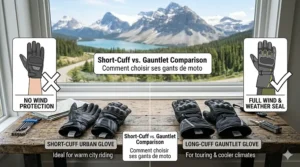
Sport riding in Canada demands gloves with maximum protection and excellent feel. The classic sport riding scenario: twisty roads through Muskoka cottage country on a Saturday morning, temperatures around 18°C, aggressive cornering requiring precise throttle and brake control. You need gloves with CE Level 2 protection, pre-curved fingers that reduce fatigue, and palm materials that maintain grip even when wet from perspiration. Short-cuff gloves work better than gauntlets for sport riding because they offer more wrist flexibility during aggressive body positioning, and they slide easily under jacket sleeves when you’re wearing a sport-cut jacket with snug cuffs.
Touring across Canada presents different priorities. You’re covering 400-600 km daily, facing temperature swings from cold mountain mornings to hot valley afternoons, potentially encountering rain in any season. Gauntlet-style gloves become essential—the extended cuff creates a weatherproof seal with your jacket sleeve, preventing wind and rain from sneaking in during sustained highway riding. Waterproof membranes are mandatory, not optional, because you can’t simply pull over and wait out weather when you’re 200 km from the next town in northern Ontario. Insulation becomes a balancing act: enough warmth for 10°C mornings, breathable enough for 25°C afternoons. Most experienced touring riders solve this by layering silk glove liners under three-season gloves rather than committing to heavy winter gloves.
Urban commuting in Canadian cities requires a different approach entirely. Your rides are typically 30-60 minutes, temperatures matter less because you’re not exposed for hours at a time, and you need to operate phones, payment terminals, and building access cards without removing gloves. This is where touchscreen compatibility moves from luxury to necessity. Short-cuff gloves work better than gauntlets for city riding because they’re faster to put on and remove when you’re parking and locking your bike multiple times daily. Durability becomes crucial because urban riding means constant starts and stops, wearing the palm material faster than highway cruising would. Many commuters keep a second pair of gloves in their bike’s storage compartment for unexpected weather changes.
Adventure and dual-sport riding introduces off-road specific challenges. Trail riding through Gatineau Park or exploring logging roads in BC requires gloves that protect against brush, branches, and rocks while maintaining enough dexterity for clutch feathering through technical sections. The classic adventure glove design uses a shorter, less protective cuff than touring gauntlets—deliberately, because snagging your glove on a branch during off-road riding can cause crashes. Knuckle guards need to be flexible rather than rigid, allowing the articulation required for working controls while standing on the pegs. Ventilation becomes more important because off-road riding generates more upper body heat than street riding.
Winter riding—the ultimate Canadian challenge—demands specialized equipment that many riders overlook. Below 5°C, regular motorcycle gloves become uncomfortable; below 0°C, they become dangerous as cold fingers lose the dexterity needed for emergency braking or swerving. Purpose-built winter gloves use heavy insulation (typically 100-200g), windproof shells, and extended gauntlet cuffs that overlap jacket sleeves by several inches. The trade-off is bulk—winter gloves are inevitably thicker than three-season gloves, requiring adaptation to your control feel. Many Canadian winter riders add heated grips to their bikes specifically to allow thinner winter gloves, maintaining better control feel while staying warm. Battery-powered heated gloves work but introduce maintenance concerns (charging batteries, reduced heat as batteries deplete during long rides) that make them less reliable than the combination of quality insulated gloves plus heated grips.
Maintaining Your Motorcycle Gloves for Canadian Conditions
Proper care extends glove life significantly, particularly important given the harsh conditions Canadian riding imposes. Leather gloves need regular conditioning—the constant exposure to UV radiation during summer riding, combined with salt and chemicals during spring, dries out leather faster than in moderate climates. Use leather conditioner specifically formulated for motorcycle gear (not the same products you’d use on furniture or shoes) every 2-3 weeks during active riding season. Apply conditioner after cleaning but while the leather is slightly damp for better absorption. This prevents the leather from becoming brittle and cracking, which destroys both protection and comfort.
Cleaning textile and synthetic gloves requires different techniques than leather. Most modern textile gloves can be hand-washed in lukewarm water with mild detergent, but never machine wash or tumble dry them—the agitation and heat can damage waterproof membranes and break down the adhesives bonding protective elements. After washing, stuff the gloves with newspaper or microfiber cloths to help them maintain shape while air-drying away from direct heat sources. This is particularly important after spring rides when road salt and chemicals need to be thoroughly removed—if left to dry on the gloves, these substances will continue degrading materials even during storage.
Waterproof gloves demand specific maintenance to preserve their protective membranes. After wet rides, remove the gloves and allow them to air dry completely before storage—storing damp gloves promotes mildew growth that degrades both the waterproof membrane and the leather or textile shell. Once dry, many waterproof gloves benefit from periodic treatment with durable water repellent (DWR) spray, which restores the outer shell’s ability to shed water. The waterproof membrane itself doesn’t need treatment, but keeping the outer shell from saturating improves breathability and comfort. Most manufacturers recommend DWR treatment every 10-15 wet rides or at the start of each riding season.
Storage matters more than most riders realize, particularly during Canadian winters when bikes might sit unused for 4-6 months. Never store gloves compressed or crumpled in a garage drawer—this creates permanent creases that become weak points in the material. Instead, stuff them loosely with acid-free tissue paper to maintain their shape and store them in a cool, dry location away from direct sunlight. Avoid storing gloves in the same space as petroleum products (gasoline cans, motor oil) because the fumes can degrade leather and synthetic materials over time. If you use your gloves through winter, rotate between two pairs to allow proper drying time between rides—wearing damp gloves in cold weather accelerates deterioration and increases discomfort.
Watch for signs that indicate gloves need replacement rather than continued maintenance. Leather showing white stress lines or cracks has lost its abrasion resistance and won’t protect properly in a crash. Stitching that’s fraying or loose in any seam, particularly palm seams or finger seams, indicates the glove is no longer structurally sound. Waterproof gloves that leak despite proper care and DWR treatment have a compromised membrane that can’t be repaired—time for replacement. Knuckle guards that have become loose or detached, or palm sliders that show significant wear, indicate the protective elements are failing. Don’t wait for complete failure; replace gloves when protective elements show degradation, even if the gloves otherwise seem wearable.
✨ Don’t Miss These Exclusive Deals!
🔍 Take your motorcycle riding to the next level with these carefully selected gloves. Click on any highlighted product above to check current pricing and availability on Amazon.ca. These gloves will help you ride safely and comfortably through every Canadian season!
Frequently Asked Questions
❓ Can I use motorcycle gloves for winter riding in Canada?
❓ Do motorcycle gloves need to be waterproof for Canadian weather?
❓ Are CE-certified gloves better than non-certified options for Canadian riders?
❓ How tight should motorcycle gloves fit when I first buy them?
❓ Can I wash motorcycle gloves after they get road salt on them?
Conclusion
Choosing motorcycle gloves for Canadian riding conditions requires balancing protection, weather resistance, comfort, and budget in ways that riders in moderate climates never face. The gloves that work perfectly for sport riding through the twisties of British Columbia’s Sea-to-Sky Highway will leave you miserable during a sudden rainstorm near Thunder Bay, while heavy winter gloves ideal for November commuting in Edmonton become sweat-inducing torture during July rides through southern Ontario.
The key insight from this guide: most Canadian riders benefit from owning multiple pairs of gloves rather than searching for one miraculous all-season option that doesn’t exist. A budget-conscious approach might include one pair of summer sport gloves ($40-$70 CAD) for warm-weather riding, one pair of waterproof touring gloves ($110-$160 CAD) for spring and fall, and one pair of insulated winter gloves ($180-$250 CAD) if you ride year-round. This three-glove rotation costs less than a single premium heated glove system while providing better protection and comfort across all conditions you’ll encounter from May through October (or year-round if you’re dedicated).
For riders just starting their motorcycle journey or those on tight budgets, prioritize safety certification and proper fit over brand names or style. A CE-certified pair of gloves from COFIT or KEMIMOTO at $50 CAD provides dramatically better crash protection than expensive but uncertified fashion gloves. As your skills and riding frequency increase, invest in specialized gloves for your primary riding style—sport riders should upgrade to premium short-cuff options with Level 2 protection, touring riders to quality waterproof gauntlets, winter riders to properly insulated options.
Remember that gloves are the one piece of gear you’ll use on every single ride, making them worthy of serious consideration and proper investment. Your hands are your primary interface with the motorcycle—protecting them protects your ability to control the bike, particularly in emergency situations where proper braking and steering mean the difference between a close call and a crash.
Recommended for You
- Gerbing vs FirstGear Heated Gloves: 7 Best for Canada 2026
- 7 Best Motorcycle Glove Brands in Canada 2026
- 7 Best Motorcycle Glove Size Tips for Canadian Riders 2026
Disclaimer: This article contains affiliate links. As an Amazon Associate, I earn from qualifying purchases. If you purchase products through these links, we may earn a small commission at no additional cost to you.
✨ Found this helpful? Share it with your friends! 💬🤗
