
In This Article
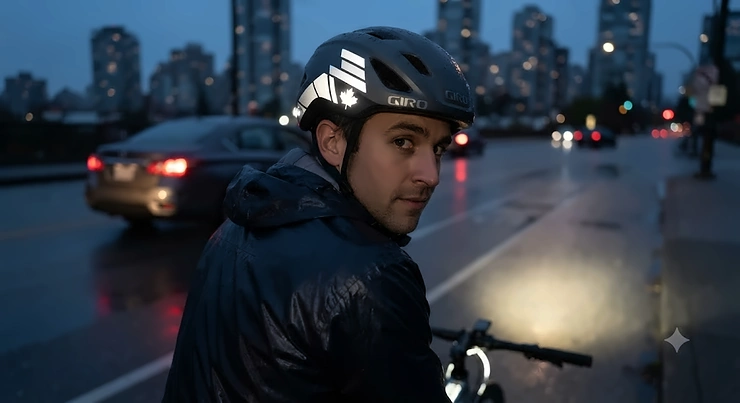
Picture this: it’s 9:40 p.m. on a two-lane road outside Kamloops, the sun’s long gone, and a driver making a left turn simply doesn’t see the motorcycle coming. That single split-second of “I didn’t see them” is exactly what reflective tape for motorcycle helmets is built to prevent. So what is it, exactly? Reflective tape for motorcycle helmets is a thin, adhesive-backed film — usually 3M Scotchlite or Diamond Grade material — that bounces headlight beams straight back toward the driver’s eyes, turning your helmet into a bright, unmistakable beacon the instant a light source hits it. Unlike paint or fluorescent stickers, it does almost nothing in daylight and everything after dark, which is precisely when Canadian riders need the extra edge. According to CCOHS’s breakdown of retroreflective materials, retroreflective products are specifically engineered to be most effective under low-light conditions — exactly the scenario where a helmet becomes hardest to spot. We spent our research digging into seven real, currently available products so you can skip the guesswork and pick the one that actually fits your helmet’s curves, your riding style, and your budget.

Quick Comparison Table
Before the deep dive, here’s the short version for anyone in a hurry.
| Category | Product | Best For |
|---|---|---|
| Best Overall | MotoEquip 3M Scotchlite Computer-Cut Helmet Tape Kit | Factory-fit precision with styling |
| Best Budget Pick | PHIXBEAR Reflective Stickers (3M 823i) | Accenting vents and chin bars cheaply |
| Best Stealth Option | Elos Reflective Gear 3M Reflective Black Stickers | Blacked-out helmets that stay black by day |
| Best Multi-Use Pack | Byllstore 3M Diamond Grade Reflective Safety Tape | Outfitting helmet, jacket, and gear together |
Looking at this snapshot, the pattern that jumps out is that no single product wins on every metric — the MotoEquip 3M Scotchlite Computer-Cut Helmet Tape Kit trades flexibility for a tidy factory-look fit, while the PHIXBEAR pack trades polish for sheer reach-your-budget value. If you ride a matte or gloss-black lid and don’t want daytime sparkle, the Elos Reflective Gear stickers solve a problem the others don’t even attempt to solve.
💬 Just one click — help others make better buying decisions too!😊
Top 7 Reflective Tape for Motorcycle Helmets: Expert Analysis
We shortlisted these seven based on real 3M film grades, genuine buyer feedback patterns, and actual curved-surface performance — not marketing copy. Here’s the spec-level breakdown.
| # | Product | Film / Grade | Price Range (CAD) | Best For |
|---|---|---|---|---|
| 1 | 3M Scotchlite 680CR Black Reflective Vinyl Tape | Engineer-grade 3M Scotchlite, 7 mil | C$15-C$25 | DIY riders covering helmet + panniers |
| 2 | VFLUO Retro-Reflective Stripes Kit | 3M reflective film, pre-shaped | C$18-C$28 | Minimalist four-point legal-style layout |
| 3 | Bright Knight Decals 3M Reflective Helmet Stickers | 7-mil multi-layer 3M vinyl | C$10-C$18 | First-time installers |
| 4 | Byllstore 3M Diamond Grade Reflective Safety Tape | 3M Diamond Grade | C$12-C$20 | Multi-item budget outfitting |
| 5 | Elos Reflective Gear 3M Reflective Black Stickers | 3M reflective film, black | C$14-C$22 | Stealth/blacked-out helmets |
| 6 | PHIXBEAR Reflective Stickers (3M 823i) | 3M 823i film | C$9-C$15 | Small curved zones, vents, chin bar |
| 7 | MotoEquip 3M Scotchlite Computer-Cut Kit | Engineer-grade 3M Scotchlite, 7 mil | C$20-C$32 | Styled, precision-fit patterns |
A quick read of the table: Diamond Grade material (row 4) sits meaningfully above standard engineer-grade film (rows 1, 3, 7) on raw brightness, but engineer-grade still meets ASTM D4956 Type I performance and costs less per square inch. If your riding is mostly urban with streetlights nearby, engineer-grade is plenty; if you’re on unlit rural highways, the jump to Diamond Grade material earns its extra dollars.
1. 3M Scotchlite 680CR Black Reflective Vinyl Tape — genuine engineer-grade film sold by the roll
The standout here is that you’re buying actual 3M Scotchlite film rather than a generic “reflective-style” knockoff, which matters more than it sounds. This particular roll measures roughly 3.5 inches by 30 inches, runs about 7 mil (0.007 inches) thick, and includes air-release adhesive channels that let trapped air escape during application instead of forming bubbles under your fingers.
Based on the spec sheet, this is a black film by daylight that flips to a bright reflective white the instant a headlight hits it — a trick that lets you keep a clean, blacked-out helmet look during the day while still getting full night-time conspicuity. It’s aimed squarely at riders comfortable with scissors and a heat gun, since you’re cutting your own shapes rather than peeling pre-cut pieces. Reviewers of similar roll-format 3M kits consistently report that the air-release channels genuinely reduce bubbling versus older reflective vinyls, though several also note that a steady hand and some patience with curved chin bars go a long way.
Pros:
- ✅ Genuine 3M Scotchlite film, not a generic imitation
- ✅ Air-release channels cut down on bubbling during install
- ✅ Enough material on one roll for helmet plus saddlebags
Cons:
- ❌ Black tape adds zero daytime visibility benefit
- ❌ Requires cutting your own shapes — no pre-cut pieces included
At around C$15-C$25 for the roll, the value case is strongest for riders who also want to wrap hard cases or panniers, since a single roll stretches across multiple surfaces rather than just the helmet.
2. VFLUO Retro-Reflective Stripes Kit — pre-shaped for the four mandated helmet zones
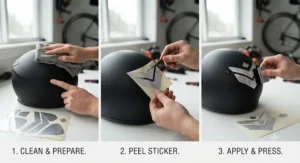
What sets this kit apart is that it isn’t a random sheet you cut yourself — the four stripes are pre-shaped to match a real legal placement standard (originally built around French road-law requirements for motorcyclists, which mandate one reflective sticker each on the front, rear, and both sides of the helmet).
Each strip uses 3M reflective technology and a deliberately low-profile “discreet” design, meaning it reads as a subtle stripe rather than a chunky patch during daylight. What most buyers overlook about a kit like this is that it solves the placement question for you — instead of guessing where reflective coverage matters most on a helmet’s curvature, the four-point layout targets the zones a driver is statistically most likely to be looking from (head-on, from behind, and from either side at an intersection). Aggregated buyer sentiment on comparable European-market helmet stripe kits points to strong praise for the “barely visible in daylight, very visible at night” effect, with the main friction point being that the pre-cut shapes assume a certain helmet silhouette.
Pros:
- ✅ Pre-shaped for the four zones drivers actually scan
- ✅ Low-profile look blends into most helmet graphics
- ✅ Based on a real legal placement standard, not guesswork
Cons:
- ❌ Shapes assume a European-style helmet curve
- ❌ Four small stripes cover less total area than a full sheet
Priced around C$18-C$28, this is best for riders who want the psychological confidence of a “regulation-inspired” layout without covering half the shell in film.
3. Bright Knight Decals 3M Reflective Helmet Stickers — pre-cut shapes built for beginners
The advantage baked right into this product is the pre-cutting: instead of a flat sheet you have to trim, you get computer-designed shapes (hexagons, chevrons, and similar patterns) ready to peel and place.
The material itself is a 7-mil, multi-layered 3M reflective vinyl rated to conform to curved surfaces and hold up outdoors for roughly seven years, with an adhesive that can be removed later using heat around 165°F (about 74°C) without leaving much residue behind. On paper, that heat-release detail is the quiet hero of this listing — it means a first-time installer who botches placement isn’t stuck living with it, which lowers the stakes of trying reflective tape for motorcycle helmets in the first place. Aggregated reviews for this style of pre-cut 3M decal consistently mention how much easier the shaped pieces are to align on a curved shell compared with cutting your own, though a few buyers note that a full 5×30 sheet is more material than a single helmet actually needs.
Pros:
- ✅ Pre-cut shapes remove the guesswork for beginners
- ✅ Heat-removable adhesive forgives placement mistakes
- ✅ Rated for roughly seven years of outdoor use
Cons:
- ❌ Fixed shapes limit custom pattern options
- ❌ One sheet is more material than most single helmets need
At C$10-C$18, this is the pick we’d point a nervous first-timer toward — low financial risk, low installation risk.
4. Byllstore 3M Diamond Grade Reflective Safety Tape Stickers — top-tier brightness in a multi-piece pack
Here’s what the spec sheet won’t spell out plainly: “Diamond Grade” isn’t marketing fluff, it’s a specific, higher-performing tier of 3M reflective sheeting that sits above the more common “engineer grade” film most competitors use.
Each strip measures 1.2 by 3.15 inches, and the pack ships as 20 pieces in mixed colours, which functionally turns one purchase into enough material for your helmet, your jacket’s shoulder panels, and maybe your pannier edges too. Based on the spec comparison against engineer-grade options elsewhere on this list, Diamond Grade throws back noticeably more light at a wider range of approach angles — useful when a car is turning across your path rather than driving straight at you, since the reflective angle isn’t head-on. Reviewers of Diamond Grade helmet and gear tape commonly describe the reflected brightness as “startling” compared with cheaper reflective vinyl, while a smaller number mention wishing they could buy a single colour in bulk instead of a mixed pack.
Pros:
- ✅ Diamond Grade sits above standard engineer-grade brightness
- ✅ 20-piece pack stretches across helmet and other gear
- ✅ Colour variety works with or against helmet graphics
Cons:
- ❌ Individual strips are small, so full coverage needs several
- ❌ Can’t select 20 pieces of a single colour
Running C$12-C$20, this is the strongest per-dollar brightness pick on this list if you’re outfitting more than just a helmet.
5. Elos Reflective Gear 3M Reflective Black Stickers — stays black by day, glows white by night
The hook is right there in the branding: “discreet black until light hits it.” For riders who spent real money on a matte-black or gloss-black lid, this solves the one objection that usually kills interest in reflective tape for motorcycle helmets — nobody wants a helmet that looks like a safety vest at noon.
Listed durability sits around nine years, longer than most competing engineer-grade films on this list, and the tape is waterproof, which matters given how often Canadian riding season includes rain. What most buyers overlook here is that black reflective film performs identically to white or silver film once a headlight actually hits it — the colour only affects how the tape looks in ambient daylight, not its retroreflective brightness rating at night. Aggregated review sentiment for this “discreet black” style of product highlights genuine surprise at how invisible the tape looks in sunlight paired with how bright it reads in a phone flashlight test, with the included tutorial video getting specific credit for smoothing out first-time application.
Pros:
- ✅ Invisible in daylight on black helmets, bright at night
- ✅ Nine-year listed durability outpaces several competitors
- ✅ Waterproof rating suits wet Canadian riding seasons
Cons:
- ❌ No daytime colour-contrast visibility benefit at all
- ❌ Jumbo sizing may need trimming on smaller panels
At C$14-C$22, this is the clear choice for anyone whose main objection to reflective tape has always been “but I don’t want it to look reflective.”
6. PHIXBEAR Reflective Stickers (3M 823i) — small strips for tight, curved zones
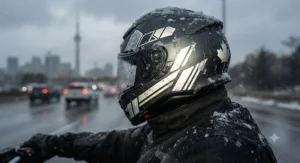
The standout advantage is size: at 3.15 by 1.18 inches per strip, these pieces are small enough to wrap cleanly around vents, chin bars, and other tightly curved sections of a helmet shell where larger sheets tend to crease or lift at the edges.
Built from 3M 823i reflective film and sold as a 20-piece pack, the strips are waterproof and marketed across several surface types — helmets, bicycles, mailboxes, and cars. Here’s what the smaller footprint actually means in practice: rather than one big reflective patch, you can lay down thin accent lines along a helmet’s natural ridges and vents, which both improves helmet curvature adhesion (less surface tension fighting the film) and creates a more deliberate, styled look than a slapped-on rectangle. Reviewers who’ve used similarly sized 3M strip packs on curved gear commonly report that the smaller pieces genuinely resist lifting on tight curves better than oversized sheets, though a few point out that covering a whole helmet with 1-inch strips takes more pieces — and more patience — than a single larger kit.
Pros:
- ✅ Small strip size hugs tight curves without creasing
- ✅ 20-pack allows accent-line styling, not just one big patch
- ✅ Waterproof rating holds up in wet-season riding
Cons:
- ❌ Smaller total reflective surface area than sheet-style kits
- ❌ Generic multi-surface marketing suggests less helmet-specific engineering
At C$9-C$15, this is the budget-friendly answer specifically for chin bars, vents, and other curved trouble spots the bigger kits struggle with.
7. MotoEquip 3M Scotchlite Computer-Cut Helmet Tape Kit — precision patterns, factory-look finish
The differentiator is precision: this kit uses 3M Scotchlite vinyl exclusively, in the same 7-mil, seven-year-rated engineer-grade spec as the roll-format option earlier on this list, but computer-cut into patterns like checkered stripes or “speed diamond” shapes designed to match specific helmet silhouettes.
That computer-cutting step is doing more work than it appears to on the surface — it means the pattern is pre-registered to typical helmet curvature, so installation lands closer to a factory decal than a DIY sticker job. Based on the spec comparison with the flat-roll option (product #1), you’re paying a premium here for design and fit precision rather than for a fundamentally different film. Aggregated feedback on computer-cut 3M helmet kits in this style consistently praises the “like it came from the factory” finish, while noting that pattern-matched kits are less forgiving if your specific helmet shape or size doesn’t line up with the cut template.
Pros:
- ✅ Computer-cut precision reduces trimming and guesswork
- ✅ Checkered and diamond patterns double as a styling upgrade
- ✅ Same 7-mil, 7-year 3M Scotchlite film as premium roll options
Cons:
- ❌ Pattern fit varies more by helmet shape than flat sheets
- ❌ Decorative patterns limit custom layout flexibility
At C$20-C$32, this is the pick for riders who want the safety benefit to double as a visible style upgrade rather than an obvious add-on.
Practical Usage Guide: Applying Reflective Tape to a Curved Motorcycle Helmet
Getting a clean result on a curved shell is less about the tape and more about the prep work. Start by washing the target area with mild soap and water, then wiping it down with isopropyl alcohol — any residual wax, road grime, or silicone-based cleaner will sabotage adhesion no matter how good the tape is. Work in a room between roughly 18°C and 30°C (65°F-85°F); most 3M adhesives are engineered to bond within that range, and cold garages are a common reason installs fail within weeks. Apply small, curved-friendly pieces first, starting from the centre of each shape and pressing outward to push air toward the edges rather than trapping it in the middle — this is exactly where tape flexibility becomes the deciding factor between a smooth finish and a bubbled mess. For larger flat sections, a heat gun on low, held about 15 cm away, softens the adhesive just enough to help the film settle into subtle shell curvature without stretching or tearing the material. Give the adhesive 24 hours to fully cure before running the helmet through rain or a car wash — most bond failures reported in early reviews trace back to riders testing durability too soon after application, not to the tape itself.
Real-World Scenario: Which Rider Are You?
If you’re a college student commuting 8 kilometres into a city core on unlit residential streets, a full-coverage kit like the Byllstore 3M Diamond Grade Reflective Safety Tape makes sense — you’re stretching one purchase across a helmet and a backpack, and Diamond Grade’s wider reflective angle helps at the cross-street intersections where most urban night collisions actually happen. If you’re a weekend rider on a blacked-out cruiser who refuses to compromise the aesthetic, the Elos Reflective Gear 3M Reflective Black Stickers solve your actual problem — the stealth-by-day, bright-by-night effect means the safety upgrade never shows up in your daytime photos. And if you’re commuting home from shift work on rural highways outside town, where oncoming headlights are the primary — sometimes only — light source for long stretches, the higher raw brightness of a Diamond Grade or premium engineer-grade kit like the MotoEquip 3M Scotchlite Computer-Cut Helmet Tape Kit earns its higher price simply because there’s more darkness for it to cut through.
Buyer’s Decision Framework
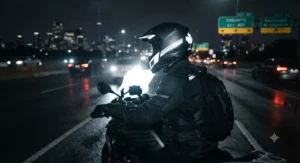
Use this as a quick mental checklist rather than a rigid formula. If your top priority is keeping a blacked-out aesthetic, choose a black reflective film because colour has no effect on night-time brightness. If your top priority is maximum raw brightness on rural, unlit roads, choose Diamond Grade material because it reflects more light across more approach angles than standard engineer-grade film. If your top priority is a fast, foolproof first install, choose a pre-cut sticker kit because it removes the cutting and alignment steps that trip up beginners. If your top priority is covering odd-shaped zones like vents or a chin bar, choose smaller strip-format tape because it resists lifting on tight curves better than large single sheets. And if your top priority is a styled, finished look rather than an obvious safety add-on, choose a computer-cut pattern kit because it’s pre-registered to typical helmet curvature.
Problem → Solution: Fixing Common Reflective Tape Issues
Problem: the tape lifts at the edges within a week. This is almost always an adhesion issue, not a product defect — go back over the edges with isopropyl alcohol prep and reapply with firmer, centre-outward pressure, ideally in warmer ambient temperatures.
Problem: bubbles appear under a larger flat piece. Use a pin to prick the bubble at its edge, then press the air out toward that puncture point; kits with air-release channels, like the 3M Scotchlite 680CR Black Reflective Vinyl Tape, are specifically designed to avoid this altogether.
Problem: the tape looks dull rather than mirror-bright under headlights. Road grime and dust dramatically reduce retroreflective brightness rating performance over time — a simple wipe-down with a damp microfibre cloth every few weeks restores most of the lost brightness.
Problem: you’re unsure the placement actually helps visibility. Have a friend shine a phone flashlight or car headlight at the helmet from roughly 30 metres away at night — genuine 3M film should read as a distinct, bright flash rather than a faint glimmer.
Problem: the shape doesn’t sit flat on a curved panel. Smaller strip-format products, like PHIXBEAR Reflective Stickers (3M 823i), handle tight curves far better than large single sheets and are the easier fix rather than forcing a big piece to conform.
How to Choose Reflective Tape for Motorcycle Helmets
Picking the right product comes down to a handful of practical checks rather than brand loyalty.
- Confirm the film grade. Engineer-grade 3M Scotchlite meets solid baseline brightness; Diamond Grade sits noticeably higher and is worth the upgrade for rural or highway riders.
- Check the size format. Full sheets and rolls suit flat panels; small strips suit curved zones like vents and chin bars.
- Match the colour to your daytime priorities. Black film stays invisible in sunlight; white, silver, or bright colours add a small daytime visibility benefit too.
- Look for a stated durability rating. Seven-year and nine-year ratings both show up in this category — longer isn’t always necessary if you replace gear helmets every few seasons anyway.
- Consider your own installation confidence. Pre-cut kits favour beginners; flat rolls favour riders comfortable trimming their own shapes.
- Weigh the total surface you’re covering. A single helmet needs less material than a helmet-plus-jacket-plus-panniers project, which should steer you toward multi-piece packs.
- Verify it won’t void your helmet’s certification. Reputable manufacturers like FortNine note that helmet certification in Canada — as detailed in their breakdown of DOT, Snell, and ECE ratings — depends on shell integrity, not surface decoration, but it’s still worth avoiding tape that requires aggressive solvents or heat near vents and seams.
Common Mistakes When Buying Reflective Tape for Motorcycle Helmets
The single most common mistake is buying generic “reflective vinyl” intended for signage rather than genuine 3M-grade film — signage vinyl is rigid, cracks on curved surfaces, and loses reflectivity far faster outdoors. A close second is skipping surface prep entirely; even premium film fails early if applied over old wax or grime. Riders also frequently underestimate how much material a full helmet actually needs, buying a single small pack and running out mid-installation, which forces mismatched leftover pieces into visible gaps. Another recurring pitfall is choosing a colour purely for looks without checking that it still reads as a strong retroreflective brightness rating at night — some bright daytime colours are, counterintuitively, weaker performers after dark than a properly rated black or silver film. Finally, some buyers assume all “helmet-safe” claims are equal, when in reality adhesive strength, removability, and helmet curvature adhesion vary meaningfully between products, and skipping that comparison is how people end up with tape that either won’t stick or won’t come off cleanly later.
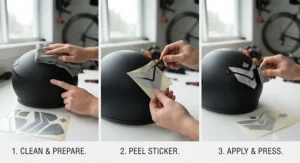
Helmet-Safe Reflective Tape vs Ordinary Automotive Reflective Tape
It’s tempting to grab whatever reflective tape is already in the garage — the leftover roll bought for a trailer fender or mailbox post — but helmet-safe reflective tape and ordinary automotive reflective tape aren’t interchangeable, even when both are made by 3M.
| Factor | Helmet-Safe Reflective Tape | Ordinary Automotive Reflective Tape |
|---|---|---|
| Film flexibility | Engineered thin (around 7 mil) to flex over tight curves | Often thicker, built for flat panels |
| Curvature adhesion | Formulated for compound curves without lifting | Prone to lifting on rounded shell surfaces |
| Adhesive removability | Frequently heat-removable, residue-light | Often a permanent, harder-to-remove bond |
| Typical use case | Helmets, small curved panels | Trailers, bumpers, flat body panels |
| Weight added | Negligible | Also negligible, but not curve-tested |
Looking at this comparison, the meaningful gap isn’t reflectivity — a 3M film is a 3M film — it’s how the adhesive and backing behave once you introduce a compound curve like a helmet shell. Automotive-grade tape not designed with helmet curvature adhesion in mind is more likely to lift at the edges within weeks, undoing the brightness advantage entirely. If you already own a roll of automotive tape, it’s not unsafe to try, but budget-conscious riders are better served buying a purpose-made helmet product the first time rather than troubleshooting lifted edges later.
Curved Surface Reflective Strips and Helmet Curvature Adhesion
Helmet shells aren’t flat, and that single fact explains most of the differences between products on this list. Curved surface reflective strips work by using a thinner, more pliable film backing paired with a pressure-sensitive adhesive that stays tacky enough to reshape slightly as it’s pressed — rather than a rigid backing that fights the curve and eventually springs back, peeling at the edges. Products built specifically with helmet curvature adhesion in mind, like the VFLUO Retro-Reflective Stripes Kit and PHIXBEAR Reflective Stickers (3M 823i), use smaller piece sizes precisely because smaller pieces have less surface area fighting the curve at any given point. Reviewers who’ve tried both large sheets and smaller strip formats on the same curved helmet consistently note that the strips hold their edges longer, even if it takes more individual pieces to achieve full coverage. The practical takeaway: match your product’s format to your helmet’s actual shape rather than defaulting to whichever kit looks like it covers the most area on paper.
Retroreflective Brightness Rating: What the Numbers Actually Mean
“Brightness” in this category isn’t marketing fluff — it’s a measurable property governed by standards like ASTM D4956, which grades retroreflective sheeting by how much light it returns to its source at various angles. Engineer-grade film, used in products like the 3M Scotchlite 680CR Black Reflective Vinyl Tape and the MotoEquip 3M Scotchlite Computer-Cut Helmet Tape Kit, is the baseline commercial-grade tier and comfortably meets standard nighttime visibility needs. Diamond Grade material, as used in the Byllstore 3M Diamond Grade Reflective Safety Tape, sits meaningfully higher on that same brightness scale and, critically, holds its reflectivity across a wider range of approach angles — meaning it still reads bright even when a car’s headlights hit it from the side rather than dead-on. For most urban commuters riding under streetlights, engineer-grade film is genuinely sufficient. For riders spending real time on unlit rural highways, the angle-performance advantage of Diamond Grade is the difference that actually shows up when it matters.
| Grade | Relative Brightness | Best Use Case |
|---|---|---|
| Engineer Grade (7 mil) | Baseline, ASTM D4956 compliant | Urban/streetlit riding |
| Diamond Grade | Noticeably higher, wider angle performance | Rural/highway, unlit roads |
| Generic reflective vinyl | Inconsistent, degrades faster | Not recommended for helmets |
The takeaway from this table is straightforward: don’t assume all “reflective” tape performs the same just because it looks similar in a listing photo — the grade behind the film matters more than the price tag on its own.
Tape Flexibility and Long-Term Durability: What to Expect
On paper, most listed durability ratings in this category cluster around seven to nine years, but real-world performance depends heavily on climate exposure rather than the sticker on the packaging. Canadian winters introduce a specific stress test — freeze-thaw cycling, road salt, and UV exposure off snow all accelerate adhesive breakdown faster than a mild, dry climate would. Tape flexibility plays a direct role here: a film that stays pliable in cold weather resists the micro-cracking that eventually dulls a reflective surface, while a stiffer film can develop hairline fractures that scatter light unpredictably instead of bouncing it cleanly back. Riders who store their motorcycle outdoors through winter should expect the lower end of any stated durability range, while garage-kept helmets used only seasonally will likely land closer to the higher end. A simple twice-yearly inspection — checking for lifted edges, cracking, or dulled brightness under a flashlight — catches degradation early enough to patch a section rather than replace the whole application.
Motorcycle Helmet Night Visibility Tape and Canadian Safety Regulations
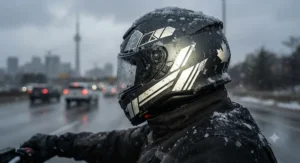
Reflective tape is an add-on for visibility, not a substitute for a properly certified helmet, and it’s worth being clear on where the line sits. In Canada, helmet legality is governed provincially, but as Alberta’s motorcycle safety guidance explains, riders need a helmet bearing a recognized certification mark — CSA, DOT, BSI, Snell, or ECE — regardless of any reflective tape applied afterward. None of the products on this list affect that certification, since they’re surface-applied and don’t alter the shell’s structural impact performance. Where motorcycle helmet night visibility tape genuinely earns its keep is in the gap between “legally compliant” and “actually seen” — a certified helmet protects you in a collision, but reflective tape helps prevent the collision from happening in the first place by making you visible to drivers scanning the road at dusk or after dark. Treat it as a complement to good helmet certification, high-visibility riding gear, and functioning motorcycle lighting, not a replacement for any of them.
✨ Ready to add real nighttime visibility to your ride? Check current prices on today’s pick before your next night ride!
FAQ
❓
Is reflective tape legal on motorcycle helmets in Canada?
❓ Does reflective tape damage a helmet's paint or certification?
❓ What is the best reflective tape for a curved motorcycle helmet?
❓ How long does reflective tape last on a motorcycle helmet?
❓ Can I put reflective tape over existing helmet stickers or graphics?
Conclusion
Reflective tape for motorcycle helmets is one of the cheapest, fastest upgrades available to any rider serious about being seen after dark, but “cheap and fast” doesn’t mean “one-size-fits-all.” Riders wrapping multiple pieces of gear at once get the most mileage from a multi-piece pack like the Byllstore 3M Diamond Grade Reflective Safety Tape, while anyone protecting a specific aesthetic should look straight at the Elos Reflective Gear 3M Reflective Black Stickers. Beginners nervous about their first install are best served by pre-cut options like the Bright Knight Decals 3M Reflective Helmet Stickers, and riders logging real highway kilometres after dark should lean toward Diamond Grade brightness over standard engineer-grade film. Provincial guidance, including British Columbia’s motorcycle safety resources, is consistent on one point: visibility gear complements a certified helmet, it doesn’t replace one. Whichever product you land on, the fifteen minutes of application time is a small trade for showing up clearly in someone’s headlights on the ride home.
Recommended for You
- 7 Best Reflective Helmet Stickers for Canadian Riders (2026)
- Hi-Vis Rain Jacket for Motorcycle Commuting: 7 Picks (2026)
- 7 Best Reflective Vests for Motorcycle Riders in Canada (2026)
Disclaimer: This article contains affiliate links. As an Amazon Associate, I earn from qualifying purchases. If you purchase products through these links, we may earn a small commission at no additional cost to you.
✨ Found this helpful? Share it with a rider you’d hate to lose sight of on a night ride! 💬
