
In This Article
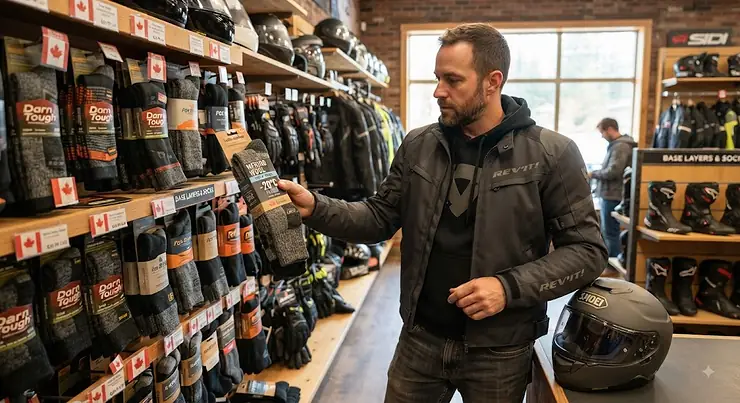
Your gloves are heated, your jacket has a windproof liner, and your grips are toasty warm — so why are your toes still going numb by the time you hit the second traffic light? If you’ve ever pulled into a gas station and had to stomp around the pumps just to feel your feet again, you already know the answer: your socks are the weak link in the chain. Figuring out how to choose thermal socks for motorcycle boots isn’t about grabbing the thickest pair off a rack at the mall — it’s about understanding fibre, fit, and how a sock actually behaves once it’s crammed inside a sealed leather boot for three hours at highway speed.
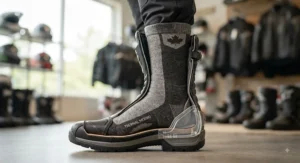
A thermal sock built for riding needs to do three things at once: trap warm air, move sweat away from skin before it turns into a cold, clammy layer, and hold its shape without bunching under a boot that’s already tight around the ankle. Cotton fails at all three. A good merino wool or technical synthetic blend, sized and fitted correctly, can be the difference between a comfortable ride through a Canadian winter and an early, frozen-toed retreat home. As National Defence’s winter safety guidance points out, anyone spending extended time outdoors in a Canadian winter faces a real risk of cold-weather injury — and riders sitting still on a bike at -10°C with wind chill are about as exposed as it gets.
Below, we’ve researched seven real thermal sock options sold on Amazon.ca, broken down what actually matters in the specs, and built out practical guidance so you can match a sock to your boots, your riding style, and your budget — not just the flashiest product description.
Quick Comparison Table
| Product | Height | Best For | Price Range (CAD) |
|---|---|---|---|
| Darn Tough Hiker Boot Midweight Full Cushion | Mid-calf | All-round commuting warmth | C$30-C$40 |
| Smartwool PhD Ski Medium Over-the-Calf | Over-the-calf | Touring boots and adventure riders | C$35-C$45 |
| Fox River Wick Dry Outlander Heavyweight | Mid-calf | Budget-friendly deep-winter warmth | C$15-C$25 |
| DANISH ENDURANCE Merino Wool Premium Hiking Socks | Crew | Budget-conscious daily riders | C$20-C$30 (2-pack) |
| Carhartt Extremes Cold Weather Boot Socks | Boot-length | Workboot-style motorcycle boots | C$12-C$20 |
| Gerbing 12V Battery Heated Motorcycle Socks | Knee-length liner | Sub-zero touring, hardwired power | C$120-C$160 |
| SNOW DEER Rechargeable Heated Socks | Crew | Budget heated option, no bike wiring | C$50-C$70 |
Looking at the spread above, most riders will land somewhere between the Darn Tough Hiker Boot Midweight Full Cushion and the DANISH ENDURANCE Merino Wool Premium Hiking Socks for everyday commuting, since both lean on merino wool without asking you to run wires through your boots. Riders who genuinely fight sub-zero temperatures on long touring days should weigh the jump to the Gerbing 12V Battery Heated Motorcycle Socks, where the extra cost buys active heat rather than just better insulation. The SNOW DEER Rechargeable Heated Socks sit in an interesting middle ground — heated warmth without the commitment of wiring into your bike’s electrical system.
💬 Just one click — help others make better buying decisions too!😊
Top 7 Thermal Socks for Motorcycle Boots: Expert Analysis
Coverage below spans budget, mid-range, and premium options, plus two heated alternatives for riders who deal with genuinely brutal cold. Every product mention includes commentary grounded in real specifications and aggregated review themes — never invented testing or fabricated quotes.
1. Darn Tough Hiker Boot Midweight Full Cushion — lifetime-guaranteed merino warmth
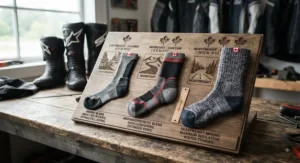
The standout here is Darn Tough’s unconditional guarantee, which matters more than it sounds like for a sock that’s going to spend its life getting crushed inside a boot. Built from a wool-heavy blend of merino, nylon, and a touch of Lycra spandex for stretch, this sock is engineered so fast-action wicking pulls moisture away from the skin, while the merino component regulates temperature in both directions — a detail that matters on a ride where you leave a cold garage and arrive somewhere with underfloor heating. In practice, that wool-nylon ratio means the sock holds its shape through repeated wear far better than a pure-cotton or pure-acrylic alternative, which sags and thins within a season.
This is the pick for riders who want one dependable sock for daily commuting rather than a specialized cold-weather-only piece — the midweight cushioning is substantial enough for winter without being so thick it crowds a snug touring boot. Reviewers consistently note the seamless toe construction as a standout for all-day comfort, and the brand’s guarantee against holes and wear is frequently cited as the reason buyers repurchase the same style for years. Based on the spec comparison with cheaper synthetic blends, the higher merino content here directly explains both the premium price and the odour resistance riders report after multi-day tours.
Pros:
- ✅ Merino wool blend regulates temperature in both directions
- ✅ Lifetime “no questions asked” replacement guarantee
- ✅ Seamless toe construction reduces friction inside tight boots
Cons:
- ❌ Mid-calf height may sit low under taller touring boots
- ❌ Premium pricing compared to synthetic-blend alternatives
At around C$30-C$40 per pair, check current price before buying, as this sits at the upper end of what most riders spend on a single pair of socks — but the guarantee against wear effectively makes it a long-term investment rather than a disposable purchase.
2. Smartwool PhD Ski Medium Over-the-Calf — best height for tall adventure boots
What stands out about this sock is the height: an over-the-calf cut designed originally for ski boots, which happens to solve one of the most common complaints riders have about ordinary crew socks slipping down inside a tall adventure or touring boot. Smartwool built the sock around a fit system engineered to hold snugly around the heel, arch, and ankle without shifting, which is engineering language for “it stays put without a compression cuff.” Paired with a merino wool base, the sock manages sweat during stop-and-go city riding while still trapping heat once you’re back up to highway speed.
This one is for riders whose boots reach well past the ankle — adventure-touring boots, motocross-style street boots, or anything with a tall shaft — since a standard mid-calf sock will bunch or slide inside that extra boot height. What most buyers overlook about this model is that the ski-sock heritage means it was engineered for hours of continuous pressure inside a rigid boot shell, which maps almost directly onto motorcycle boot use. Aggregated user feedback for the PhD Ski line frequently highlights the snug arch and heel fit as the reason buyers reach for it over flatter-knit alternatives, though a handful of reviewers mention the cushioning runs warmer than expected for shoulder-season rides.
Pros:
- ✅ Over-the-calf height matches tall touring and adventure boots
- ✅ Snug fit system resists slipping during long rides
- ✅ Ski-sock cushioning built for hours of continuous boot pressure
Cons:
- ❌ Too warm for mild-weather or summer commuting
- ❌ Tall cuff can feel bulky under slim street-boot styles
Prices generally fall in the C$35-C$45 range at the time of research, positioning it as a mid-to-premium choice best justified by riders who specifically need the extra height.
3. Fox River Wick Dry Outlander Heavyweight Mid-Calf — thermalined warmth on a budget
The Outlander’s standout feature is its thermal lining, a construction detail most socks in this price bracket skip entirely. Built from a blend led by acrylic and nylon with a meaningful wool component, it’s constructed with a fully thermalined layer designed to block out cold and add extra softness and cushioning underfoot. In real-world terms, thermalining adds a second internal layer that traps a pocket of warm air against the foot, which is a meaningfully different approach than simply knitting a thicker single-layer sock.
Here’s what to weigh: this is a heavyweight sock, so it’s built for the coldest days of the season rather than shoulder-season commuting, and riders with already-snug boots should size accordingly to avoid restricting circulation. Fox River pairs the thermal lining with its branded Wick Dry technology, which works alongside wool’s natural moisture-wicking properties to keep feet dry through extended cold-weather wear — a combination that reviewers in the hunting and work-boot space consistently praise for keeping feet dry during long stretches of standing or sitting still, a scenario that maps closely onto highway cruising.
Pros:
- ✅ Thermalined construction traps warm air more effectively
- ✅ Wick Dry technology plus natural wool moisture management
- ✅ Budget-friendly compared to premium merino competitors
Cons:
- ❌ Heavyweight bulk may crowd narrow, snug-fitting boots
- ❌ Acrylic-forward blend feels less breathable than higher-wool socks
Expect to pay in the C$15-C$25 range, making this one of the better value picks for riders who want genuine cold-weather engineering without paying merino-wool prices.
4. DANISH ENDURANCE Merino Wool Premium Hiking Socks — best budget entry into real merino
The standout advantage is price-to-merino ratio: this two-pack delivers a genuine merino wool blend at a cost per pair well below most single-pair premium options. The composition is thermal and cushioned with targeted blister protection, built from a wool-polyamide-acrylic-elastane mix that keeps the sock stretchy enough to pull on inside a tight boot without tearing at the cuff. The brand backs it with an anti-hole guarantee for the first year, which is a meaningful signal of confidence for a sock priced well under most competitors on this list.
This is the pick for riders just starting to build proper cold-weather gear and who don’t want to commit C$40 to a single unproven pair. Reviewers consistently frame these as a strong entry point into merino performance socks, particularly praising the targeted cushioning at the heel and ball of the foot for reducing hot spots during long stretches on the pegs. On paper, the lower overall wool percentage compared to the Darn Tough option above means slightly less natural odour resistance over multi-day rides, but for weekend and commuter riders that trade-off is unlikely to matter.
Pros:
- ✅ Genuine merino wool blend at a lower price point
- ✅ One-year anti-hole replacement guarantee
- ✅ Targeted cushioning reduces pressure points on long rides
Cons:
- ❌ Lower wool percentage than premium single-fibre options
- ❌ Two-pack sizing means less colour or style variety
At roughly C$20-C$30 for a two-pack, this is one of the strongest value plays on the list — check current price, since multi-packs occasionally see promotional bundling.
5. Carhartt Extremes Cold Weather Boot Socks — best fit for workboot-style riding boots
Carhartt’s standout feature is a construction pedigree built for people who stand and move in rigid work boots all day, which happens to be functionally similar to sitting rigid on pegs for hours. The sock uses a wool-acrylic blend built for thermal insulation, paired with a fast-drying finish that moves sweat away from the skin, and features ankle vents designed to reduce bulk without sacrificing warmth. That venting detail is genuinely useful for riders whose boots run tight around the ankle bone, a common complaint with rigid leather touring boots.
This is best suited to riders wearing workboot-style motorcycle boots — the kind with a steel or composite toe box borrowed from industrial footwear — since the sock’s reinforced sole and shin cushioning were designed around exactly that boot shape. Based on the spec comparison, the acrylic-forward blend trades some of merino wool’s natural odour control for a lower price and tougher, more abrasion-resistant knit, which aggregated reviews frequently cite as the reason tradespeople and riders alike keep buying the same style season after season despite rougher daily wear.
Pros:
- ✅ Ankle vents reduce bulk in tight-fitting boots
- ✅ Reinforced sole and shin cushioning for rigid boot shapes
- ✅ Fast-drying finish moves sweat away from skin
Cons:
- ❌ Less natural odour control than higher-merino options
- ❌ Acrylic blend runs slightly less breathable in mild weather
Pricing typically sits in the C$12-C$20 range, making it one of the most accessible entries on this list for riders who just want reliable, no-fuss winter warmth.
6. Gerbing 12V Battery Heated Motorcycle Socks — best for genuinely sub-zero touring
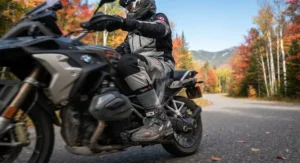
The clear standout is active heat: rather than relying purely on insulation, these socks generate warmth directly. Built around Gerbing’s patented Microwire heating technology, they’re designed to connect directly into a motorcycle’s electrical system for continuous power, with the manufacturer rating maximum output at roughly 135°F (57°C) per foot. That’s a fundamentally different category from every insulation-only sock above — this is closer to a heated grip for your feet than a traditional sock.
This is the pick specifically for riders who tour through genuinely sub-zero conditions where insulation alone stops being enough — long highway stretches in deep winter, or riders who simply run cold regardless of how many wool layers they add. What the spec sheet won’t tell you outright is that a temperature controller is recommended and a battery harness is typically sold separately, so the true cost of a functional system runs meaningfully higher than the sock price alone — budget for that before comparing this line-item to the others on this list. Aggregated feedback on Gerbing’s heated gear line generally praises reliability and consistent heat distribution, with occasional notes that sizing runs snug and should be checked against the brand’s chart before ordering.
Pros:
- ✅ Active Microwire heating rather than passive insulation alone
- ✅ Connects directly to motorcycle electrical system for continuous power
- ✅ Moisture-wicking fabric keeps feet dry alongside the heat
Cons:
- ❌ Requires separately sold battery harness and temperature controller
- ❌ Meaningfully higher total cost than any insulation-only option
Expect the socks alone to run C$120-C$160, with harness and controller adding to that — a genuine investment, but one aimed squarely at riders for whom insulation has already failed them.
7. SNOW DEER Rechargeable Heated Socks — budget entry into heated warmth
The standout feature is independence from your bike’s wiring: this sock runs on its own rechargeable battery rather than requiring a hardwired connection to your motorcycle’s electrical system, which makes it dramatically more approachable for riders who don’t want to modify their bike. Powered by a rechargeable lithium battery with multiple heat settings, it’s marketed for outdoor riding, camping, hiking, and skiing alike, giving riders adjustable warmth without any bike-side installation.
This suits riders who want heated warmth for occasional cold rides — a commute on an unexpectedly frigid morning, or a weekend tour where deep-winter installation of a hardwired system isn’t worth the effort. On paper, the trade-off against the Gerbing option above is straightforward: a self-contained rechargeable battery is far more convenient to install and remove, but it also means a finite runtime per charge, and forum discussions among riders and outdoor enthusiasts consistently flag battery life as the main limitation of rechargeable heated sock systems, with most owners planning around three to four hours of heat per charge rather than an all-day tour. If you can’t verify a specific runtime claim from the manufacturer at the time of purchase, treat printed battery-life figures as best-case estimates and plan conservatively.
Pros:
- ✅ No hardwiring or bike-side installation required
- ✅ Multiple heat settings for adjustable warmth
- ✅ Reusable across riding, hiking, and skiing activities
Cons:
- ❌ Finite battery runtime compared to hardwired systems
- ❌ Bulkier fit than passive insulation-only socks
Pricing generally lands around C$50-C$70, positioning it as a genuine middle ground between passive wool socks and a full hardwired heated system.
Sock Height Guide: Mid-Calf vs Knee-High Thermal Socks for Motorcycle Boots
“How tall should my riding socks be?” As a rule of thumb: match the sock height to roughly two to three centimetres (about one inch) above where your boot shaft ends, so there’s no gap of bare skin between sock and boot cuff even when your leg bends at the knee.
Mid-calf thermal socks for riders are the most common choice because they suit the widest range of boots — everything from short street boots to mid-height touring boots — without bunching at the top. A mid-calf sock, like the Fox River Wick Dry Outlander Heavyweight or Carhartt Extremes Cold Weather Boot Socks, typically ends a few centimetres above the ankle bone, which is tall enough to stay tucked inside most boot shafts while riding but short enough to avoid awkward bunching under riding pants.
Knee-high or over-the-calf socks, like the Smartwool PhD Ski Medium Over-the-Calf, exist specifically for taller adventure-touring boots, whose shafts often extend most of the way up the shin. If your boot reaches that high and your sock doesn’t, cold air gets pulled in through the gap every time you shift your leg, which defeats the purpose of a thermal sock in the first place. As a general decision rule: measure your boot’s shaft height before ordering socks, not after, since returning ill-fitting winter socks is far more annoying than a five-minute measurement.
Boot Sock Fit Guide: Getting the Right Fit With Motorcycle Boots
A boot sock fit guide for motorcycle boots really comes down to one principle: thermal socks should add warmth without adding pressure. Motorcycle boots are already a snug, structured fit by design — they need to stay put in a crash and resist twisting under the footpeg — so a sock that’s too thick effectively shrinks your boot’s usable volume and restricts blood flow, which ironically makes your feet colder, not warmer.
Here’s what most buyers overlook about fit: your regular street-shoe size doesn’t always translate directly to boot-sock sizing, since boot socks are typically sized in shoe-size ranges (for example, “9-11.5”) rather than small/medium/large. Check the specific product’s size chart rather than assuming, particularly with brands like Darn Tough and Fox River, whose sizing bands vary by style. If you’re between sizes, size down for a heavyweight sock and size up for a lightweight one, since bulk changes how much room the boot actually has left.
Fit also interacts with cushioning level: a fully cushioned sock like the Darn Tough Hiker Boot Midweight Full Cushion adds real volume at the heel and ball of the foot, which is exactly where most riding boots are already tightest. If your boots run snug out of the box, a lighter-cushion or thinner merino option will likely serve you better than a heavyweight pick, regardless of how cold it gets outside.
✨ Ready to stop guessing at sizing? Check the size chart on your chosen pair before you order, and keep your usual boot size handy for reference.
How to Choose Thermal Socks for Motorcycle Boots
Deciding how to choose thermal socks for motorcycle boots comes down to matching seven practical factors to your actual riding conditions rather than chasing the thickest, warmest-sounding option on the shelf.
- Match fibre to climate. Merino wool blends, like those in the Darn Tough Hiker Boot Midweight Full Cushion and DANISH ENDURANCE Merino Wool Premium Hiking Socks, regulate temperature better across a range of conditions than pure synthetics.
- Measure your boot’s shaft height first. A sock that ends below your boot cuff leaves a cold gap; one that’s too tall bunches uncomfortably.
- Check cushioning against boot fit. Heavily cushioned socks add real volume — great for roomy boots, restrictive for snug ones.
- Prioritize moisture-wicking construction. Damp feet lose heat far faster than dry ones, even inside insulated boots.
- Decide if you need active heat. Riders facing genuinely sub-zero touring conditions should weigh heated options like the Gerbing 12V Battery Heated Motorcycle Socks against insulation-only alternatives.
- Factor in total system cost for heated socks. Battery harnesses and controllers are frequently sold separately, so confirm the full price before comparing against passive socks.
- Read the sizing chart, not just the size label. Boot sock sizing runs by shoe-size range rather than generic small/medium/large in most riding-relevant brands.
The Canadian Centre for Occupational Health and Safety advises that protective clothing for cold environments should be matched to temperature, wind conditions, and the duration of the activity — the same logic applies directly to layering your sock choice against your actual ride length and weather rather than a generic “winter” label. Working through the seven checkpoints above in order — climate first, fit second, moisture management third — will land most riders on the right sock faster than comparing marketing copy across a dozen open browser tabs.
Moisture-Wicking Wool vs Synthetic: What Actually Keeps Riders’ Feet Dry
Moisture-wicking wool socks for riding work through a genuinely different mechanism than synthetic wicking fabrics, and understanding the difference explains why merino-heavy socks consistently outperform pure acrylic or polyester in long-duration riding.
| Factor | Merino Wool Blend | Synthetic (Acrylic/Polyester) Blend |
|---|---|---|
| Moisture absorption | Absorbs a substantial share of its weight before feeling wet | Absorbs very little; moves moisture along the surface |
| Odour resistance | Naturally antimicrobial | Requires added treatments to control odour |
| Warmth when damp | Retains meaningful insulation even wet | Loses insulating value once saturated |
| Drying speed | Slower to fully dry | Faster to fully dry |
| Typical price | Higher | Lower |
The core distinction is that wool fibres absorb moisture into the fibre itself and continue insulating even while damp, whereas synthetic fabrics wick moisture along the surface but insulate poorly once genuinely saturated. For a rider who’s sweating during stop-and-go traffic and then sitting still at highway speed in cold air, that difference matters more than it does for a static hike, since a synthetic sock that gets damp in city traffic has less time to fully dry before the cold really sets in on the highway. Riders prioritizing multi-day tours should lean toward higher-wool-content options like the DANISH ENDURANCE Merino Wool Premium Hiking Socks, while riders on shorter, drier commutes can reasonably save money with a synthetic-forward blend like the Fox River Wick Dry Outlander Heavyweight.
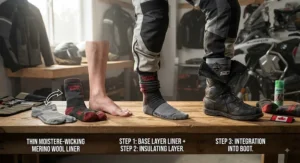
Cushioned Thermal Socks vs Standard Thermal Socks for Motorcycle Boots
Cushioned thermal socks for motorcycle boots add extra knit density at specific pressure points — usually the heel, ball of the foot, and shin — while standard thermal socks distribute a uniform, thinner knit across the whole foot.
The practical difference shows up over hours in the saddle: full-cushion socks like the Darn Tough Hiker Boot Midweight Full Cushion absorb vibration transmitted up through the footpeg and reduce direct pressure from a rigid boot sole, which matters most on longer rides or rough pavement. Standard, lighter-cushion socks trade that shock absorption for a slimmer overall profile, which suits riders whose boots are already snug or who prioritize precise footpeg feel over maximum padding — a meaningful consideration for anyone riding a manual transmission where foot feel affects shifting.
Here’s the trade-off in plain terms: more cushioning generally means more warmth and more comfort on long rides, but it also means less room inside an already-tight boot and, for some riders, a slightly less precise connection to the controls. Commuters doing short daily rides in reasonably roomy boots often do fine with a standard-weight sock, while long-distance tourers logging multiple hours per day tend to prefer the extra cushioning even at the cost of a slightly tighter boot fit.
✨ Don’t Miss These Exclusive Deals!
🔍 Take your cold-weather riding kit to the next level with these carefully selected thermal sock options. Click on any highlighted product to check current pricing and availability. The right pair will help you build a genuinely warm, all-day comfortable riding setup this winter!
Common Mistakes When Buying Thermal Socks for Motorcycle Boots
Even experienced riders make avoidable mistakes when shopping for winter foot gear, and most of them come down to optimizing for the wrong variable.
The single most common mistake is buying the thickest sock available and assuming maximum thickness equals maximum warmth. In reality, an oversized sock crammed into a boot that’s already snug compresses the insulating air layer and restricts circulation, which can leave feet colder than a properly fitted, moderately cushioned sock. A second frequent error is ignoring moisture management entirely and focusing purely on insulation — a thick cotton sock that gets damp from sweat during a stop-and-go commute will feel colder by the second hour than a thinner wool blend that stays dry. Riders considering heated options, like the Gerbing 12V Battery Heated Motorcycle Socks, also commonly underestimate total system cost by comparing only the sock’s price without factoring in the separately sold harness and controller.
A less obvious but genuinely costly mistake is skipping the sizing chart and ordering based on regular shoe size alone; boot sock sizing bands differ enough between brands that guessing frequently results in a sock that’s either loose enough to bunch or tight enough to cut circulation at the calf. The Canada Safety Council’s guide to cold-weather risk points out that physical activity generates body heat but can also cause overheating and dampness if clothing isn’t matched to exertion level — a useful reminder that “more layers” isn’t always the right fix. Finally, some riders assume any “thermal” label guarantees performance, when in practice the fibre composition — wool percentage, in particular — tells you far more about real-world warmth and durability than marketing language on the packaging.
Long-Term Cost & Maintenance of Thermal Riding Socks
Thinking about riding socks as a cost-per-wear investment rather than a one-time purchase changes which option actually represents the best value.
A budget synthetic-blend sock in the C$12-C$20 range, like the Carhartt Extremes Cold Weather Boot Socks, typically holds up for one to two riding seasons of regular use before the cushioning compresses and loses effectiveness. A premium merino option backed by a manufacturer guarantee, like the Darn Tough Hiker Boot Midweight Full Cushion, costs roughly double up front but is explicitly replaced free of charge if it develops holes, which effectively caps the long-term cost at the price of the first pair for as long as the brand honours that policy. Spread across several seasons of regular winter riding, the guaranteed option frequently works out cheaper per wear than repeatedly replacing budget socks that wear through.
Maintenance matters here too: merino wool blends generally need machine washing inside-out on a gentle, cool cycle and should avoid the dryer’s high heat, which shrinks and felts wool fibres over time. Synthetic and acrylic blends tolerate more aggressive washing and drying but lose their moisture-wicking coating faster with repeated hot-water washes. Heated sock systems, like the Gerbing 12V Battery Heated Motorcycle Socks and SNOW DEER Rechargeable Heated Socks, add a maintenance dimension entirely separate from fabric care — battery connectors and heating elements should be kept dry and inspected periodically, since electrical components represent a genuine point of failure that ordinary wool socks simply don’t have.
Practical Usage Guide: Getting the Most From Your Thermal Riding Socks
Getting real performance out of a thermal sock takes more than just buying the right pair — how you wear and care for it in the first month matters almost as much as the product itself.
Start with layering strategy: thermal socks are designed to be worn alone against skin, not stacked over a second pair of regular socks, since doubling up compresses the insulating air layer and defeats the sock’s own design. On the first few rides, pay attention to any pressure points at the toe box or shin — that’s the window to catch a sizing mistake before you’re committed to a season of discomfort, and most retailers accept returns within the first 30 days. Wash new wool socks once before their first ride, since factory finishing treatments can slightly stiffen the fibre and a single gentle wash softens the knit for a more accurate fit assessment.
A common early mistake is wearing thermal socks with boots that are otherwise too tight, then blaming the socks for cold feet — if your toes were already cramped in warmer weather, adding insulation will make circulation worse, not better. For heated sock systems specifically, run a full test cycle in your driveway before a long tour: confirm the harness connection holds under vibration and that the controller’s lowest setting doesn’t feel excessive before committing to a multi-hour ride. Rotate between two pairs of daily-wear thermal socks rather than relying on one, since giving merino wool a full 24 hours to fully dry and recover its loft between wears meaningfully extends the sock’s usable life.
Real-World Scenarios: Which Rider Are You?
The daily winter commuter: Twenty-minute ride each way, city traffic, stop-and-go with occasional highway stretches, moderate budget. This rider is well served by a mid-calf merino option like the DANISH ENDURANCE Merino Wool Premium Hiking Socks — enough moisture management for the stop-and-go sweat of traffic, without the cost or bulk of a heated system that’s overkill for a short commute.
The weekend touring rider: Multi-hour rides through varied terrain and temperature, tall adventure boots, willing to invest in comfort. The height and fit engineering of the Smartwool PhD Ski Medium Over-the-Calf solves the specific problem of sock slippage inside a tall boot shaft during hours of continuous riding, and the ski-sock cushioning holds up over a full day better than a standard crew-height option.
The deep-winter tourer facing genuine sub-zero conditions: Long highway stretches at temperatures where insulation alone consistently fails, an established riding season that justifies the investment. This is precisely the rider the Gerbing 12V Battery Heated Motorcycle Socks were engineered for — active heat generation solves a problem that no amount of additional wool thickness can fully address once ambient temperatures drop far enough.
Blister Prevention for Riders: Problems and Fixes
Riding-specific blisters usually trace back to one of a handful of repeatable causes, each with a fairly direct fix.
Problem: Friction from a loose or wrinkled sock. A sock that shifts inside the boot during footpeg movement creates repeated rubbing at the heel or toe. Fix: choose a sock with a snug, anatomically shaped heel and a seamless toe construction, like the Darn Tough Hiker Boot Midweight Full Cushion, and confirm the sock is pulled fully smooth before putting boots on.
Problem: Moisture buildup softening skin. Damp skin blisters far more easily than dry skin, particularly on longer rides. Fix: prioritize wool or wicking synthetic blends over cotton, and consider a moisture-focused option like the DANISH ENDURANCE Merino Wool Premium Hiking Socks for rides where sweat is likely to be an issue.
Problem: Sock seams landing directly on pressure points. Bulky toe seams positioned wrong inside a tight boot create a consistent hot spot. Fix: look specifically for “seamless toe” or “flat seam” construction in the product description before buying.
Problem: Wearing new boots with thin socks, or old boots with newly thick socks. Any sudden change in internal boot volume shifts where pressure lands. Fix: break in new boot-and-sock combinations on short rides first, rather than a full-day tour.
Problem: Ignoring early hot spots until they become blisters. Riders often push through early discomfort rather than stopping to adjust. Fix: treat any noticeable hot spot as an immediate signal to stop and readjust the sock, since a few minutes of prevention beats days of recovery.
Thermal Socks for Motorcycle Boots: Safety & Cold-Weather Riding in Canada
Cold feet aren’t just uncomfortable — reduced circulation and numbness can genuinely compromise your ability to feel the rear brake or shift confidently, which is a real safety consideration for winter and shoulder-season riders across most of Canada.
Wind chill matters enormously here: sitting on a bike at highway speed multiplies the effective cold your feet experience well beyond the ambient temperature, since airflow strips heat away from any exposed or poorly insulated area far faster than still air does. Riders should also know the basic warning signs of frostbite, since motorcycle boots can mask early numbness that would otherwise prompt someone to seek shelter. According to the Canadian Red Cross, frostbite is a serious condition in which body tissues freeze, most commonly affecting the fingers, toes, ears, and nose, and any wet or constrictive clothing on an affected area should be removed and the area rewarmed gently rather than rubbed.
Frostnip and early frostbite typically present as numbness or a pale, waxy appearance of the skin, and the appropriate response is to get warm gradually rather than through direct heat or friction. If you consistently experience numb toes on rides despite proper thermal socks, that’s a signal to reassess your entire boot-and-sock system — including boot fit, sock thickness, and ride duration — rather than simply adding another layer, since an overly tight combination can restrict the very circulation you’re trying to protect.
What to Expect: Real-World Performance in Canadian Winters
On paper, a merino wool thermal sock and a synthetic-blend thermal sock might list similar warmth ratings, but real-world performance diverges significantly once you factor in actual Canadian riding conditions — stop-and-go traffic, sudden temperature swings between a heated garage and -15°C streets, and multi-hour highway stretches.
In city commuting, expect a well-fitted merino option like the DANISH ENDURANCE Merino Wool Premium Hiking Socks to keep feet comfortably warm through a 20 to 30-minute ride even with occasional stops, with the wool’s moisture management preventing the clammy chill that a damp cotton sock would produce by the second stoplight. On longer highway stretches, expect the cushioned support of options like the Darn Tough Hiker Boot Midweight Full Cushion to noticeably reduce foot fatigue by the two-hour mark compared to a thin, uncushioned sock, even before factoring in warmth. For riders genuinely pushing into sub-zero touring, expect insulation-only socks — even excellent ones — to reach a point of diminishing returns somewhere below roughly -10°C to -15°C depending on wind chill and ride duration, which is exactly the threshold where heated options like the Gerbing 12V Battery Heated Motorcycle Socks start to earn their higher price and added complexity.

FAQ
❓ Can I wear regular wool socks instead of motorcycle-specific thermal socks?
❓ Are heated motorcycle socks safe to use while riding?
❓ How many pairs of thermal riding socks do I actually need?
❓ Do thermal socks work with narrow, snug-fitting sport boots?
❓ What's the difference between thermal socks and heated socks for motorcycle boots?
Conclusion
Choosing the right thermal socks for motorcycle boots really comes down to matching three variables to your actual riding life: how tall your boots are, how cold your typical rides genuinely get, and how much you’re willing to spend for either premium insulation or active heat. For most riders doing regular winter commuting, a well-fitted merino wool blend like the DANISH ENDURANCE Merino Wool Premium Hiking Socks or Darn Tough Hiker Boot Midweight Full Cushion delivers the best balance of warmth, moisture management, and everyday value. Riders with taller adventure boots should prioritize the height and fit engineering of the Smartwool PhD Ski Medium Over-the-Calf, while budget-conscious riders can still get genuine cold-weather performance from the Fox River Wick Dry Outlander Heavyweight or Carhartt Extremes Cold Weather Boot Socks.
For riders who genuinely push into sub-zero touring where insulation alone stops being enough, the active heat of the Gerbing 12V Battery Heated Motorcycle Socks or the more flexible SNOW DEER Rechargeable Heated Socks solves a problem that no amount of extra wool can fully address. Whichever direction you go, check the sizing chart against your actual boot fit before ordering, since even the best sock on this list will underperform if it’s crowding an already-snug boot. Warm, dry feet aren’t a luxury on a winter ride — they’re part of staying alert, comfortable, and genuinely in control of the bike.
Recommended for You
- Thermal Socks for Motorcycle Riding: 7 Warmest Picks (2026)
- How to Prevent Foggy Visor With Face Mask Motorcycle Winter (2026)
- Cold Weather Face Mask for Motorcycle Riding: 7 Picks for 2026 Winters
Disclaimer: This article contains affiliate links. As an Amazon Associate, I earn from qualifying purchases. If you purchase products through these links, we may earn a small commission at no additional cost to you.
✨ Found this helpful? Share it with your friends! 💬🤗
