
In This Article
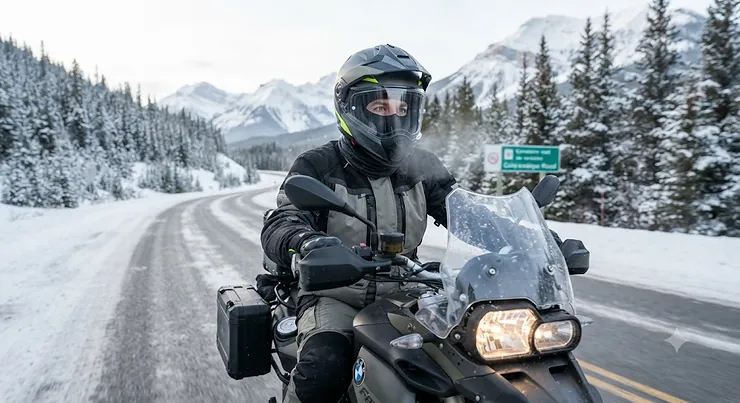
Picture this: it’s minus six, your commute is twenty minutes of frost-rimmed highway, and thirty seconds after you pull away from the driveway your visor turns into a bathroom mirror after a hot shower. You can’t see the car ahead. You can’t see the ice patch. All you can see is your own breath, betraying you in real time. If you’ve ever ridden through a Canadian winter, you already know that learning how to prevent foggy visor with face mask motorcycle winter setups isn’t a nice-to-have skill — it’s the difference between a clear commute and a white-knuckle guess. The good news is that this is a solved problem, and it’s been solved by gear nerds who hate fog even more than you do.
This guide breaks down exactly why your breath fogs the inside of your visor, what a proper cold-weather face mask actually does to stop it, and which real products on amazon.ca are worth your money this season. We’ll walk through seven genuine options spanning budget balaclavas to premium thermal masks, back it with aggregated review sentiment (not invented quotes), and give you the practical setup tricks that actually matter — the stuff the product listing never mentions. Whether you’re chasing a motorcycle face shield fog free cold weather setup for a daily commute or trying to figure out why your thermal face mask motorcyclist review research keeps turning up conflicting advice, you’ll leave this article with a decision you can actually act on.
What is a fog-prevention face mask? A fog-prevention face mask is a lower-face or full-face covering — typically a balaclava or breath deflector — engineered to redirect your exhaled breath downward and away from the inside of your helmet visor, reducing the warm, moist air that condenses into fog on cold glass or polycarbonate. Clear vision matters for more than comfort, too — Canadian eye-protection rules for riders, outlined by Québec’s road safety authority SAAQ, require every rider to use a visor or protective goggles, which only works as intended when that visor stays clear.
Quick Comparison Table
| Product | Type | Fog Control Method | Price Range (CAD) | Best For |
|---|---|---|---|---|
| KLIM Arctic Balaclava | Full balaclava w/ breath deflector | Neoprene nose piece redirects breath down | C$90-C$110 | Serious winter commuters |
| Tough Headwear Fleece Balaclava | Fleece balaclava | Mesh mouth panel disperses breath | Under C$25 | Budget-conscious daily riders |
| WTACTFUL Thermal Balaclava | Thermal balaclava | Multi-zone vents + fleece lining | Under C$20 | Value-focused new riders |
| Klim Covert Balaclava | Mid-weight balaclava | Windproof mouthpiece + wicking fabric | C$60-C$75 | Shoulder-season and moderate cold |
| Forcefield Tornado Advance Balaclava | Technical thermal balaclava | Quick-dry fabric limits moisture buildup | C$45-C$60 | Riders wanting anti-bacterial tech fabric |
| Ergodyne N-Ferno 6823 Balaclava | Hinged fleece balaclava | Convertible neck gaiter reduces breath pooling | C$25-C$35 | Riders who also want a hi-vis/hunting-style option |
| Pinlock 70/120 Insert | Visor insert (not a mask, but pairs with one) | Sealed air-gap + moisture-absorbing lens | C$25-C$45 | Anyone who wants a belt-and-suspenders fix |
Looking at the table, the pattern is pretty clear: the products that actually solve fogging aren’t just “warm cloth for your face” — they physically manage where your breath goes. The KLIM Arctic Balaclava sits at the top of the price range because its neoprene breath deflector is purpose-built engineering, not a marketing afterthought, while the Tough Headwear Fleece Balaclava and WTACTFUL Thermal Balaclava prove you don’t need to spend big to get a mesh panel that does the same basic job. Note that a face mask and a Pinlock 70/120 Insert aren’t competitors — they attack the same problem from two different angles, and pairing a good mask with a Pinlock insert is the closest thing to a guaranteed fix.
💬 Just one click — help others make better buying decisions too!😊
Top 7 Motorcycle Fog-Prevention Face Masks: Expert Analysis
1. KLIM Arctic Balaclava — neoprene breath deflector built specifically to stop fog
The KLIM Arctic Balaclava is the closest thing this category has to purpose-engineered gear, and it shows the moment you look at the nose piece. Rather than relying on generic fleece to trap warmth, KLIM built in a neoprene nose piece that functions as an actual breath deflector, physically routing your exhale downward and away from your visor’s sightline instead of letting it drift straight up into the eye port.
Under the hood, the KLIM Arctic Balaclava pairs fleece-backed GORE-TEX Infinium with WINDSTOPPER panels across the face, neck, and upper chest — meaning wind isn’t just blocked, it’s blocked with a laminate designed to stop air penetration at the fabric level rather than just adding bulk. The silicone grip pad at the collar keeps the mask tucked into your jacket, closing the gap that lets cold air sneak up your neck and undo everything the mask is doing at your chin.
Based on the spec comparison with lighter balaclavas in this guide, this is the pick for riders doing genuine sub-zero commutes rather than occasional cold snaps — the GORE-TEX Infinium construction is overkill for a mild autumn ride but exactly right when your morning commute reads minus fifteen with wind chill. Reviewers consistently report that the breath deflector noticeably reduces fogging compared to standard balaclavas, particularly when paired with a helmet that already has decent chin ventilation.
Pros:
- ✅ Neoprene breath deflector purpose-built to redirect exhale downward
- ✅ GORE-TEX Infinium with WINDSTOPPER blocks wind at the fabric level
- ✅ Silicone grip pad seals the neck gap against draft
Cons:
- ❌ Premium price relative to fleece-only alternatives
- ❌ Warmth level can feel like overkill above freezing
At around C$90-C$110, the KLIM Arctic Balaclava isn’t the cheapest option here, but for riders who genuinely ride through a Canadian winter rather than just tolerate a chilly October, the value case is straightforward: less fog, less draft, fewer cold-weather excuses to park the bike.
2. Tough Headwear Fleece Balaclava — best budget pick with a genuine mesh breathing zone
The Tough Headwear Fleece Balaclava has become something of a default recommendation in budget gear circles, and the reason is simple: it does the fundamentals right without charging a premium for a brand patch. The mouth and nose area uses a breathable mesh panel instead of solid fleece, which matters more than it sounds — solid fabric traps and redirects your breath right back at your face, while mesh lets some of that warm, moist air disperse before it ever reaches your visor.
Constructed from a polar fleece and spandex blend with four-way stretch, the Tough Headwear Fleece Balaclava fits snugly under nearly any full-face helmet without adding the bulk that makes cheaper balaclavas feel like you’re wearing two hats. The flat-lock seams matter for comfort during longer rides — nothing sours a commute faster than a seam digging into your cheek at highway speed.
What most buyers overlook about this model is that its popularity is backed by an unusually large review pool, and the “no more fog” claims in the listing generally track with what aggregated buyer feedback describes: a real, if modest, reduction in fogging versus wearing no mask at all, especially useful for glasses-wearers layering it under a helmet. It’s worth noting some reviewers have reported that pulling the mask fully up over the nose can still push breath toward the visor in very cold conditions — a limitation shared by most mesh-only designs, not a defect unique to this product.
Pros:
- ✅ Mesh mouth panel disperses breath instead of trapping it
- ✅ Four-way stretch fleece fits snugly under full-face helmets
- ✅ Exceptional value at a budget price point
Cons:
- ❌ Less fog control than deflector-style designs in extreme cold
- ❌ Snug fit may not suit riders with larger heads
At under C$25, the Tough Headwear Fleece Balaclava is the pick for riders who want a genuine improvement over bare skin without committing to a premium price — it punches well above its price bracket for everyday shoulder-season and moderate winter riding.
3. WTACTFUL Thermal Balaclava — multi-zone ventilation on a tight budget
The WTACTFUL Thermal Balaclava leans into a strategy you don’t see as often in this category: instead of one big mesh mouth panel, it distributes smaller ventilation zones across the crown, mouth/nose area, and ears. In practice, this spreads airflow out rather than concentrating your breath in one spot, which helps limit the single warm, humid plume that typically fogs a visor.
The fabric is a lightweight stretch knit rather than heavy fleece, so this mask runs cooler and thinner than most entries on this list — great for layering under a snug helmet, less great if you’re expecting deep winter warmth on its own. Reviewers consistently note that the fit works well “as a second skin” under a helmet, and the brand’s own product literature frames this specifically as a design choice to prevent lens fogging by wicking away water vapor and heat rather than trapping it.
Here’s what to weigh: the WTACTFUL Thermal Balaclava genuinely shines in the shoulder seasons — that stretch between “still riding in a hoodie” and “full winter kit” — where you want fog control and wind-cut without roasting under your helmet. For deep-January riding, most buyers layer it under a heavier jacket collar rather than relying on it alone.
Pros:
- ✅ Multi-zone ventilation spreads airflow instead of one hot spot
- ✅ Thin, breathable knit avoids bulk under a snug helmet
- ✅ Very low price point for the ventilation design
Cons:
- ❌ Less insulating than fleece-based options in deep cold
- ❌ Not marketed as waterproof for wet, sleety commutes
Priced under C$20, the WTACTFUL Thermal Balaclava is an easy add-to-cart if you’re not sure how committed you are to winter riding yet — it’s cheap enough to be an experiment and functional enough to become a habit.
4. Klim Covert Balaclava — the moderate-cold middle ground
Where the Arctic model goes all-in on deep winter, the Klim Covert Balaclava is built for the temperature range most Canadian commuters actually spend the most time riding in: cold, but not brutal. It blends windproof, moisture-wicking fabric mapped specifically to zones that need it most, with Coolmax breathable fabric on the head area to prevent overheating once you’re moving and generating body heat.
The redesigned mouthpiece area is worth calling out specifically — KLIM rebuilt this section to improve airflow around the breathing zone, which is a direct, if quieter, answer to the fogging problem than a dedicated deflector. Reviewers consistently describe the fit as close and low-profile, which matters because a baggy balaclava bunching up under your chin bar can itself push breath upward into the visor.
Based on the spec comparison across this list, this is the pick for riders who find the Arctic model too warm for anything above about minus five, but still want KLIM-level fabric engineering rather than a generic fleece tube. What the spec sheet won’t tell you, but buyer patterns suggest, is that this mask tends to become the one people actually reach for daily, while the heavier Arctic model gets saved for the coldest week of the year.
Pros:
- ✅ Redesigned mouthpiece specifically engineered for airflow
- ✅ Mapped windproof fabric only where it’s needed most
- ✅ Low-profile fit reduces bunching under the chin bar
Cons:
- ❌ Not as warm as the Arctic model for extreme cold
- ❌ Mid-range price puts it above generic balaclavas
In the C$60-C$75 range, the Klim Covert Balaclava is the “buy once” pick for riders who commute through a real Canadian shoulder season and want gear that fits the majority of their riding days rather than the coldest outlier.
5. Forcefield Tornado Advance Balaclava — anti-bacterial tech fabric for daily wear
The Forcefield Tornado Advance Balaclava takes a slightly different angle on the fogging problem: rather than a dedicated deflector or ventilation zones, it focuses on a quick-drying, anti-bacterial thermal fabric that limits how much moisture builds up against your face in the first place. Less trapped moisture in the fabric itself means less of it re-evaporating into the air pocket under your visor.
The windproof construction handles the wind-chill side of winter riding competently, and the anti-bacterial treatment is a genuinely practical touch for anyone who rides daily and doesn’t want to hand-wash a balaclava every single night. Reviewers consistently frame it as comfortable for long stretches, with the quick-dry property standing out specifically for riders who get caught in freezing rain or wet snow.
What most buyers overlook about this model is that its warmth-to-bulk ratio is tuned for layering — it’s thin enough to sit comfortably under a heavier scarf or neck warmer on the coldest days, without ever feeling like you’re wearing two masks at once. On paper this means it’s a strong “everyday driver” pick for riders who want one balaclava that handles both damp autumn commutes and moderately cold winter mornings.
Pros:
- ✅ Anti-bacterial fabric practical for daily riders
- ✅ Quick-dry construction handles wet, freezing-rain commutes
- ✅ Thin profile layers well under a scarf or neck warmer
Cons:
- ❌ Not the warmest standalone option for extreme cold
- ❌ Availability can be inconsistent depending on retailer stock
Sitting in the C$45-C$60 range, the Forcefield Tornado Advance Balaclava earns its keep as a daily-wear piece rather than a specialist deep-freeze tool — buy it if your winter riding is mostly “cold and wet” rather than “Arctic and dry.”
6. Ergodyne N-Ferno 6823 Balaclava — hinged design that doubles as a neck gaiter
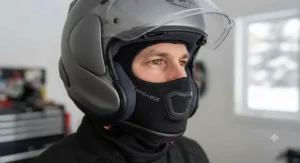
The Ergodyne N-Ferno 6823 Balaclava comes from a brand better known for industrial and construction cold-weather gear, and that heritage shows in the practical, no-nonsense hinged design. The hinge lets you wear it as a full balaclava on the ride out and fold it down into a neck gaiter once you’ve parked and don’t need face coverage anymore — a small feature, but a genuinely useful one for riders who commute into an office and don’t want to walk in wearing a full ski mask.
Wind-resistant construction is the headline feature here rather than a dedicated anti-fog claim, but the mechanism still helps indirectly: by sealing the neck and lower face tightly against draft, it reduces the amount of extra cold air getting pulled up past your chin and mixing with your breath right at the visor’s edge, which is one of the underappreciated causes of fogging that has nothing to do with your breath volume and everything to do with airflow patterns inside the helmet.
Based on the spec comparison, this is the pick for riders who value versatility over specialization — you’re not getting a dedicated breath deflector like the KLIM Arctic, but you are getting a genuinely multi-purpose piece of kit that works equally well off the bike.
Pros:
- ✅ Hinged design converts between balaclava and neck gaiter
- ✅ Wind-resistant seal reduces draft-driven fog at the chin
- ✅ Comes from an established industrial cold-weather brand
Cons:
- ❌ No dedicated breath-deflection feature like specialist masks
- ❌ Camo/workwear styling won’t suit every rider’s taste
In the C$25-C$35 range, the Ergodyne N-Ferno 6823 Balaclava is worth a look for the rider who wants one piece of gear that pulls double duty rather than a single-purpose motorcycle accessory.
7. Pinlock 70/120 Insert — the visor-side fix that pairs with any mask
Every product so far attacks fogging from the “manage your breath” side. The Pinlock 70/120 Insert attacks it from the other direction entirely: instead of a face mask, it’s a secondary lens that clips onto two pins inside a Pinlock-ready visor, creating a sealed air pocket between the insert and the main visor — essentially double-glazing for your helmet.
That air pocket is the key mechanism. It reduces the temperature differential between the cold outer visor and the warmer air inside your helmet, which is the actual physics behind fogging in the first place — condensation forms when warm, humid air meets a cold surface, and the insert’s moisture-absorbing material handles residual humidity on top of insulating against the temperature gap. As explained in this breakdown of how Pinlock inserts prevent fogging, the design essentially works like a double-pane window fitted to the inside of your visor.
Here’s what to weigh: not every helmet is Pinlock-ready out of the box, and genuine Pinlock inserts with a silicone bead seal noticeably outperform cheaper knockoffs with plastic beading, according to detailed comparisons from gear specialists. Insert performance is also tiered — lower numbers suit milder conditions, while the higher tiers are built for serious cold and wet riding, so it’s worth matching the tier to your actual climate rather than defaulting to the cheapest option. For riders who’ve tried a face mask alone and still get fog creeping in on the coldest mornings, pairing a mask with a Pinlock insert is the closest thing this category has to a guaranteed fix, since you’re addressing both sides of the condensation equation at once.
Pros:
- ✅ Directly targets the temperature-differential root cause
- ✅ Works alongside any face mask for a compounded effect
- ✅ Tiered performance levels let you match cost to climate
Cons:
- ❌ Requires a Pinlock-ready visor or drilled retrofit
- ❌ Genuine inserts cost more than generic knockoff versions
At roughly C$25-C$45 depending on the tier, the Pinlock 70/120 Insert isn’t a face mask, but it belongs on this list because the honest answer to “how do I stop visor fog” is very often “mask plus insert,” not one or the other.
Practical Setup & First-Ride Guide
Getting a new anti-fog mask out of the packaging isn’t the finish line — how you wear it on your first few cold rides determines whether it actually works or whether you end up blaming the product for a fitting problem. Start by sizing the mask so the mouth opening sits directly over your lips without slack; a loose mouth panel lets breath escape upward past the fabric edge instead of being redirected, which defeats the purpose of even the best deflector design. Next, always tuck the top edge of the mask under your helmet’s chin bar padding rather than letting it sit on top — this closes the gap where warm air sneaks past the seal and rises straight into your eye port.
In the first thirty days, the most common mistake new cold-weather riders make is treating the mask as “set and forget.” Fabric compresses and stretches with wear, so recheck the fit every few rides, especially after washing — fleece in particular can lose some of its shape. Pair your mask with your helmet’s chin vent open rather than closed if your helmet has one; counterintuitively, a small amount of airflow through the chin vent helps push moist air down and out rather than trapping it, working with your mask instead of against it. Finally, build a simple maintenance habit: hand-wash with a mild detergent every one to two weeks of regular winter use, and let the mask air-dry fully before your next ride, since a damp mask re-introduces moisture right where you don’t want it.
Real-World Scenarios: Which Mask Fits Your Ride
The daily downtown commuter (5-15 km, stop-and-go traffic): If you’re weaving through city traffic where speed rarely climbs high enough for wind to naturally clear a visor, breath management matters more than raw warmth. The Tough Headwear Fleece Balaclava or WTACTFUL Thermal Balaclava make sense here — low-speed riding means less wind-driven fog clearing, so a mesh breathing zone that disperses your breath before it reaches the visor does most of the heavy lifting, and you don’t need heavy-duty wind protection you’ll barely use.
The highway commuter facing sub-zero mornings (30+ km, sustained speed): At highway speed in genuine winter cold, wind chill and sustained exposure change the calculus. This is where the KLIM Arctic Balaclava earns its price tag — the neoprene deflector and GORE-TEX Infinium construction are built for exactly this use case, and pairing it with a Pinlock 70/120 Insert covers both the breath-management and temperature-differential sides of the fog problem simultaneously.
The weekend rider stretching the season (occasional rides, unpredictable temperatures): If you’re not committing to a full winter kit but want to squeeze a few more weekends out of riding season before storage, a mid-weight, versatile piece like the Klim Covert Balaclava or Ergodyne N-Ferno 6823 Balaclava makes more sense than a specialist deep-winter mask — you get meaningful fog reduction and warmth without over-investing in gear you’ll use six times a year.
How to Choose a Fog-Prevention Face Mask
- Match the mask to your actual riding temperature range, not the coldest day of the year. A mask built for minus twenty feels stifling and overheats you on a minus-two commute, which paradoxically increases fogging by raising humidity under your helmet.
- Prioritize breath management over raw warmth. A thin mesh panel that disperses your exhale beats thick fleece that traps it — warmth without airflow control just relocates the fog problem, it doesn’t solve it.
- Check for a deflector or redirect feature if you ride in serious cold. Neoprene nose pieces and structured breathing channels, like the one on the KLIM Arctic Balaclava, physically change where your breath goes rather than just insulating your face.
- Consider pairing with a Pinlock insert if your helmet is compatible. Masks solve the breath side of fogging; inserts solve the temperature-differential side. Together they cover both causes.
- Factor in neck and collar sealing, not just face coverage. A gap at your collar pulls cold air up past your chin, which mixes with your breath and undermines even a well-fitted mask.
- Think about maintenance realistically. If you’re riding daily, a quick-dry, easy-wash fabric like the Forcefield Tornado Advance saves real hassle over a season compared to slow-drying heavy fleece.
- Buy based on your actual commute pattern, not aspirational riding. Stop-and-go city riders and sustained-highway riders have genuinely different fogging conditions, so match your pick to the ride you actually do most days.
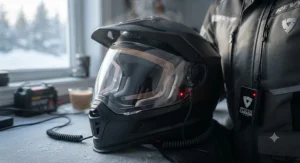
Motorcycle Face Mask vs Pinlock Visor Insert
It’s tempting to think of these as competing solutions, but they solve different halves of the same physics problem, and understanding that difference is the single biggest factor in whether you end up satisfied with your purchase. A face mask manages the source — your breath — by redirecting or dispersing the warm, humid air before it ever reaches the visor’s inner surface. A Pinlock insert manages the destination — the visor itself — by insulating it so there’s no cold surface for that moisture to condense on in the first place, even if some warm breath still reaches it.
The practical implication is straightforward: riders who get fog despite wearing a mask are usually dealing with a temperature-differential problem a mask can’t fix, and riders who get fog despite installing a Pinlock are usually pushing more breath moisture into the helmet than the insert alone can absorb. The insert works by separating the cold outer shield from your warm breath, using a moisture-absorbing material that keeps humidity from condensing in the first place. A mask alone tends to be sufficient for moderate cold and moderate-speed riding; a Pinlock alone tends to be sufficient for riders who don’t breathe heavily inside their helmet at speed. For genuine deep-winter Canadian commuting, most experienced riders end up running both, because neither fully solves the other’s blind spot on its own.
What to Expect: Real-World Performance in Canadian Winter
Specs on a listing page rarely translate cleanly into what you’ll actually feel at minus twelve on the 401 or crossing a bridge in Winnipeg with a crosswind. In practice, even a well-fitted mask with a dedicated breath deflector won’t make your visor bone-dry the instant you pull away from a stop; there’s typically a brief adjustment period in the first thirty to sixty seconds where trapped humidity from standing still needs to clear once you’re moving and airflow picks up. What changes with a proper mask is how quickly that initial haze clears and whether it returns at low speed or in stop-and-go traffic — the difference between a mask that works and one that doesn’t usually shows up at red lights, not on the open highway where wind does most of the clearing for you regardless of what you’re wearing.
Riders switching from no mask to a mesh-panel balaclava typically describe a noticeable reduction rather than a total elimination of fogging, particularly around the lower edge of the visor near the nose. Riders adding a deflector-style mask on top of an already Pinlock-equipped helmet often describe the combination as close to a non-issue even in sustained sub-zero riding, which tracks with the two-sided nature of the fogging problem discussed above.
Common Mistakes When Buying Cold-Weather Riding Masks
One of the most frequent mistakes is buying based on warmth alone and ignoring breathability entirely — a mask that’s technically warmer but traps all your breath against your face can actually make fogging worse, not better, because it raises the humidity concentrated right under your visor. A second common error is ignoring helmet compatibility; a bulky balaclava that doesn’t compress well under a snug sport-helmet chin bar creates gaps at the seal that let cold air in and warm breath escape upward, undermining the mask’s whole purpose. Buyers also frequently skip checking neck coverage, assuming the face portion alone will handle cold — but an exposed neck gap pulls in cold air that mixes with your breath right at your collar, one of the more overlooked causes of persistent low-visor fogging. Finally, some riders buy the cheapest available option sight-unseen and are disappointed when it lacks any dispersal or deflector design at all; at that price point, you’re often just buying a warm cloth tube with no engineering behind the breathing zone, which is fine for standing at a bus stop but doesn’t solve a motorcyclist’s specific fogging problem.
Long-Term Cost & Maintenance
A quality cold-weather mask isn’t a one-season purchase if you take care of it, which changes the real cost-per-use math considerably. A C$20 fleece balaclava washed carelessly and dried on high heat might lose its shape and stretch within a single winter, while the same mask hand-washed and air-dried can reasonably last two to three seasons — effectively cutting its annual cost in half or better. Premium options like the KLIM Arctic Balaclava, built with technical laminates rather than basic fleece, tend to hold their shape and windproofing longer under proper care, which partly justifies the higher upfront price for riders who commute year-round rather than occasionally.
A Pinlock insert has a different cost profile entirely: it’s a wear item that scratches over time, particularly if removed and reinstalled frequently or cleaned with the wrong cloth, and most riders replace an insert every one to three years depending on use. Budgeting a small annual allowance for a fresh insert, alongside occasional mask replacement, is a more realistic total cost of ownership than treating either purchase as a permanent fix-and-forget item.
Cold Air, Breathing, and Why It Matters for Riders
There’s a health dimension to this topic that goes beyond fog and comfort. Cold, dry air is harder on your respiratory system than most riders realize, and Canadian researchers have studied this specifically in the context of high-ventilation winter activity. According to CBC’s coverage of cold-weather lung research from the University of Alberta, people who spend years breathing cold, dry air during intense outdoor activity may become more sensitive to lung irritants over time. While motorcycling isn’t the same intensity as cross-country ski racing, sustained highway riding at sub-zero temperatures does mean breathing cold, dry air for extended periods, and a mask that covers the mouth and nose does double duty here: it fights fogging by managing your breath, and it pre-warms the air you inhale before it reaches your airway.
This is a genuine secondary reason to wear a proper face mask beyond visibility — it’s not just about seeing the road clearly, it’s about not finishing a long cold ride with an unexplained cough or tight chest. If you regularly do long highway stretches through a Canadian winter, treating your mask as respiratory gear as much as anti-fog gear is a reasonable way to think about the purchase.
Safety, Regulations & Visor Compliance in Canada
Fog isn’t just an annoyance — it’s a genuine road-safety issue, which is part of why eye protection and visor condition intersect with Canadian helmet law in the first place. Riders in Canada are required to use eye protection such as a visor, goggles, or glasses, and the Canadian Council of Motor Transport Administrators sets minimum safety standards for motorcycle helmets that cover impact resistance and protection against peripheral vision obstruction. A persistently fogged visor arguably works against that peripheral-vision standard in practice, even if fog itself isn’t explicitly regulated the way helmet construction is.
Provincial rules on required certifications (DOT, ECE, or Snell, depending on where you ride) don’t specifically address anti-fog accessories, but it’s worth knowing that modifying a visor yourself — such as drilling for a non-genuine Pinlock-style insert — can affect a helmet’s certification if done incorrectly. When in doubt, stick to Pinlock-ready helmets that already have factory pins installed, or consult your helmet manufacturer’s documentation before modifying a visor. For full detail on provincial helmet and eye-protection requirements, the Transport Canada road safety research summary is a useful starting point, since standards and enforcement details vary slightly by province.
Features That Actually Matter (And Those That Don’t)
Marketing copy on cold-weather gear loves to pile on buzzwords, so it’s worth separating what genuinely affects fogging from what’s just seasonal dressing. A dedicated breath deflector or structured venting zone matters enormously — this is the single biggest differentiator between masks that meaningfully reduce fog and ones that don’t. Collar and neck sealing matters almost as much, since draft at the collar is an underrated fog contributor. Fabric quick-dry properties matter for daily riders specifically, since a damp mask reintroduces the moisture problem you’re trying to solve.
On the other hand, claimed “UPF50+ sun protection” on a winter balaclava, while not false, is largely irrelevant to the fogging problem and shouldn’t sway a buying decision either way — it’s a leftover spec from masks designed to double as summer gear. Similarly, elaborate camo patterns or tactical styling have zero bearing on anti-fog performance; they’re aesthetic choices riding along on a functional product, not functional features themselves.
Problem → Solution: Common Winter Visor Fogging Issues
Problem: Fog clears at speed but returns every time you stop at a light. This is almost always a low-airflow issue rather than a mask failure — at a standstill, there’s no wind assisting the mask’s dispersal function. Solution: crack your visor slightly at stops if traffic allows, or open a chin vent if your helmet has one, to keep some airflow moving even at zero speed.
Problem: Fog appears specifically at the bottom edge of the visor near your nose. This usually means your mask’s mouth opening sits slightly too low or loose, letting breath escape upward along the chin bar instead of being redirected down and out. Solution: resize or re-tighten the mask’s mouth opening, and confirm it tucks fully under the chin bar rather than resting on top of it.
Problem: Mask works fine at first but gets progressively worse over a 30-minute ride. This points to moisture saturation — the mask fabric itself has absorbed as much breath moisture as it can and started releasing it back into the air pocket under your visor. Solution: switch to a quick-dry fabric like the Forcefield Tornado Advance, or add a Pinlock insert so the visor side of the equation is covered even once the mask’s capacity is maxed out.
Problem: Fine on the ride out, terrible on the ride home after work. Ambient humidity and temperature both shift over a day, and a mask that was matched to morning conditions may be mismatched by evening. Solution: keep a lighter backup mask in your storage compartment for days with a big temperature swing, rather than assuming one mask suits every hour of daylight.
Problem: Persistent fog despite a “no-fog” balaclava. At this point the mask alone likely isn’t enough — you’re dealing with a temperature-differential issue on the visor itself, which no amount of breath management fully solves. Solution: add a genuine Pinlock insert; this is the single most effective upgrade for riders who’ve already tried mask-only fixes without success.
Buyer’s Decision Framework
If you commute short distances in stop-and-go traffic, choose a mesh-panel mask like the Tough Headwear Fleece Balaclava, because low-speed riding needs active breath dispersal more than raw warmth or wind protection. If you ride sustained highway distances in genuine sub-zero cold, choose the KLIM Arctic Balaclava paired with a Pinlock 70/120 Insert, because you need both breath management and temperature-differential control working together. If you’re testing whether winter riding is even for you, choose the WTACTFUL Thermal Balaclava, because the low price limits your risk while still giving you a real functional upgrade over no mask at all. If your commute varies wildly day to day, choose a mid-weight, versatile option like the Klim Covert Balaclava or Ergodyne N-Ferno 6823 Balaclava, because adaptability beats specialization when conditions aren’t predictable.

Frequently Asked Questions
❓ Why does my motorcycle visor fog up even with a face mask on?
❓ Can I use a ski mask instead of a motorcycle-specific balaclava?
❓ Do I need both a face mask and a Pinlock insert?
❓ How often should I wash a winter motorcycle balaclava?
❓ Is a thicker, warmer mask always better for preventing fog?
Conclusion
Winter riding in Canada doesn’t have to mean squinting through a haze of your own breath every time the temperature drops. The physics behind visor fogging is simple once you understand it — warm, moist air meeting a cold surface — and every product in this guide attacks that problem from one angle or another, whether it’s a neoprene deflector on the KLIM Arctic Balaclava, a dispersal mesh on the Tough Headwear Fleece Balaclava, or a sealed air-gap insert like the Pinlock 70/120 Insert. The right pick depends less on which product has the flashiest marketing and more on matching the gear to your actual commute: distance, speed, temperature range, and how often you’re stopping in traffic where wind can’t help clear your visor for you.
If there’s one takeaway to carry forward, it’s that fog prevention is rarely a single-product fix — it’s a system made up of mask fit, collar sealing, helmet ventilation habits, and, for serious winter riders, a visor insert working alongside your mask rather than instead of it. Get those pieces working together and a clear visor stops being something you hope for on a cold morning and starts being something you can just expect.
✨ Don’t Miss These Exclusive Deals!
🔍 Take your winter riding setup to the next level with the picks above. Click through to check current pricing and availability on amazon.ca before you head out on your next cold-weather ride — clear vision starts with the right gear.
Recommended for You
- Cold Weather Face Mask for Motorcycle Riding: 7 Picks for 2026 Winters
- Balaclava vs Neck Gaiter for Motorcycle Riding Winter: 7 Picks for 2026
- Balaclava for Motorcycle Riding: 7 Proven Picks for 2026
Disclaimer: This article contains affiliate links. As an Amazon Associate, I earn from qualifying purchases. If you purchase products through these links, we may earn a small commission at no additional cost to you.
✨ Found this helpful? Share it with your friends! 💬🤗
