
In This Article
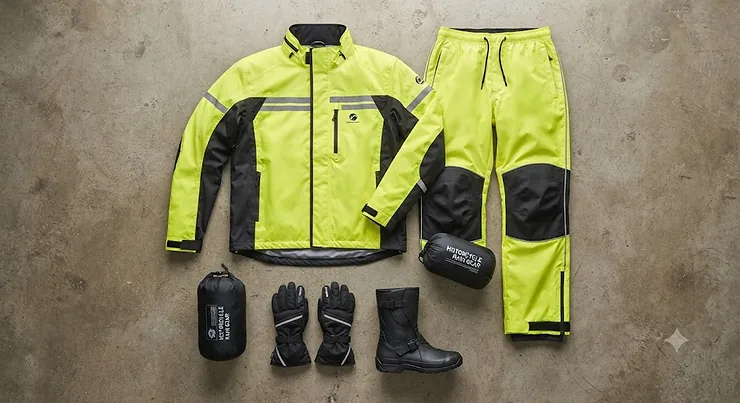
Somewhere around hour six of a soaking, grey Trans-Canada slog, every touring rider has the same thought: why didn’t I pack better rain gear? It’s never the short afternoon shower that breaks you. It’s the fourth day of a trip, the gear that seemed fine in the driveway now clinging to your legs, and a pannier lid that won’t quite latch over a rain suit shaped like a beach ball. Finding genuinely packable rain gear for motorcycle touring isn’t about buying “a raincoat” — it’s about buying a system that survives being crammed into a top box, pulled out at 80 km/h in a highway downpour, and packed away wet the next morning without punishing you for it.
This guide walks through seven real products that Canadian touring riders can actually buy, from ultralight emergency shells you’ll forget are even in your luggage to a Gore-Tex laminate suit that costs as much as a good used bike. Along the way we’ll dig into pannier storage math, weight considerations that actually matter on a loaded touring rig, and how these suits hold up to durability under repeated use — not just one nice weekend, but a full riding season of stuffing and unstuffing.
What is packable rain gear for motorcycle touring? It’s waterproof outerwear engineered to compress small enough for saddlebag or tail-bag storage while still handling highway wind pressure, multi-day exposure, and repeated packing cycles — distinct from bulkier commuter rain suits or one-time-use ponchos. As the Société de l’assurance automobile du Québec notes, wet roads reduce traction and increase braking distance regardless of how good your gear looks, so staying dry is really about staying focused.
Quick Comparison Table
| Product | Type | Pack Size | Best For |
|---|---|---|---|
| Frogg Toggs Pilot II Guide Rain Suit | Two-piece | Fits in a jacket pocket | Emergency backup layer |
| Nelson-Rigg AS-3000 Rain Suit | Two-piece | Small stuff sack | Budget-conscious commuters and tourers |
| REV’IT! Pacific 4 H2O Rain Suit | Two-piece | Included compression sack | Panniers with tight remaining space |
| Rukka Nivala 2.0 | Two-piece, Gore-Tex Pro | Compresses, but not tiny | Serious multi-week touring in any climate |
Even from this shortlist, a pattern shows up fast: the cheapest suits pack the smallest but trade away long-term durability, while the laminated premium suits pack a little bulkier in exchange for genuinely surviving a decade of use. The REV’IT! Pacific 4 H2O Rain Suit sits in the sweet spot most touring riders actually want — small enough to disappear into a pannier, tough enough not to need replacing every season.
💬 Just one click — help others make better buying decisions too!😊
Top 7 Packable Rain Gear Options for Motorcycle Touring: Expert Analysis
Here’s the honest rundown on seven real, currently available options, spanning true budget backup gear through the kind of suit you buy once and never think about again.
1. Frogg Toggs Pilot II Guide Rain Suit — lightest packable emergency layer
The Pilot II’s defining trick is disappearing into almost nothing — this is the suit that lives permanently in your tank bag because you’ll genuinely forget it’s there. Built from a lightweight non-woven polypropylene shell with taped seams, it prioritizes packed volume over long-term toughness, and the jacket alone rolls down to roughly the size of a large water bottle. Reviewers on major retail sites consistently describe it as true-to-size and surprisingly breathable for the price, which matters when you’re wearing it over armoured touring gear on a warm, humid day. This is the right call for riders who want cheap insurance against a surprise shower rather than a primary riding layer — a weekend commuter or occasional tourer who rides in the rain twice a season will get real value here, while someone doing 1,500 km a week through the Rockies will outgrow it fast. Aggregated review sentiment flags the fabric as prone to stretching and seam stress after repeated hard use, which tracks with its budget construction; it’s not designed for daily deployment.
Pros:
- ✅ Packs smaller than almost anything else on this list
- ✅ Breathable fabric avoids the “sauna” feeling in warm rain
- ✅ Genuinely inexpensive backup layer
Cons:
- ❌ Fabric wears and can tear with repeated heavy use
- ❌ Cut is baggy, not tailored for a riding posture
Expect this one to land in the C$120-C$190 range for the two-piece set, and given how disposable the fabric is, treat it as a value backup rather than your only rain layer.
2. Nelson-Rigg AS-3000 Rain Suit — industry-standard reflective two-piece
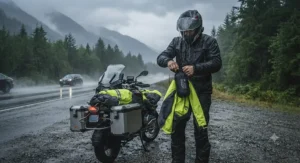
If you’ve ridden with a group of tourers for more than a season, odds are someone in that group owns this suit — it’s become something of a default. The AS-3000 uses a two-layer waterproof shell with sealed seams and reflective piping sized specifically to layer over riding jackets and armoured pants without binding at the shoulders or knees. What most buyers overlook about this model is that the reflective placement is genuinely useful, not decorative — it wraps the arms and legs in a way that shows up in a driver’s headlights during a low-visibility downpour, not just from the rear. Riders consistently praise its true motorcycle-specific fit, and aggregated feedback across retailers repeatedly calls out the elastic waist and ankle cinches as effective at keeping water from creeping in at speed. It suits budget-conscious tourers who want gear built for riding rather than repurposed rain gear from a hardware store.
Pros:
- ✅ Motorcycle-specific cut fits over riding gear cleanly
- ✅ Strong reflective visibility in low light
- ✅ Reliable reputation among long-time tourers
Cons:
- ❌ Less breathable than membrane-based premium suits
- ❌ Bulkier stuff sack than ultralight competitors
Priced around C$110-C$150 for the set, the AS-3000 remains one of the best value-per-dollar picks if you ride in the rain a handful of times per trip rather than every single day.
3. Tour Master Defender 3.0 Rain Suit — breathable step up from PVC
Where classic PVC rain gear turns into a portable greenhouse the moment the sun breaks through, the Defender 3.0’s coated nylon shell is a noticeably more comfortable middle ground. The waterproof-breathable nylon construction and sealed seams give it a lighter feel on the body than old-school vinyl suits, while an under-helmet collar barrier addresses one of the most common failure points in cheaper gear — water sneaking down the back of the neck at highway speed. Based on the spec comparison against entry-level suits, the Defender 3.0 earns its modest price premium through better long-seam construction and a roomier cut designed to move with you when you’re braking, shifting, and shoulder-checking rather than standing still. It’s a strong fit for riders upgrading from a first rain suit who want noticeably better comfort without jumping straight to premium pricing.
Pros:
- ✅ Neck barrier reduces water intrusion at highway speed
- ✅ More breathable than classic PVC-backed suits
- ✅ Roomy fit accommodates full riding gear underneath
Cons:
- ❌ Not as compact packed down as ultralight options
- ❌ Zippers require careful maintenance to keep sealing well
Look for it in the C$150-C$210 range, positioning it as a genuine step up for riders who’ve outgrown emergency-only gear.
4. Oxford Rainseal Pro Suit — hi-vis touring-cut breathability
Oxford built its reputation on motorcycle-specific accessories, and the Rainseal Pro reflects that focus with a cut clearly designed around a riding position rather than a walking one — higher back panel, longer sleeves, and a collar that seals properly under a full-face helmet. The breathable waterproof fabric and taped seams handle sustained highway rain well, and the high-visibility colour options add a genuine safety margin that plain black suits simply can’t match in grey, low-light touring conditions. Here’s what to weigh: this suit earns its reputation with riders who log serious wet-weather mileage rather than occasional showers, since the fabric and stitching are built for repeated flexing rather than a single-season lifespan. Reviewers commonly note the fit runs true to size over medium-weight riding gear, though very bulky armoured jackets may need a size up.
Pros:
- ✅ Touring-specific cut designed for a riding position
- ✅ Strong hi-vis colour options improve visibility
- ✅ Taped seams hold up over repeated wet rides
Cons:
- ❌ Premium pricing versus entry-level competitors
- ❌ Runs snug over heavily armoured jackets
Expect the Rainseal Pro to sit in the C$200-C$260 range, which is reasonable given how much of the price goes into motorcycle-specific tailoring rather than generic rainwear.
5. REV’IT! Pacific 4 H2O Rain Suit — stuff-sack packability for panniers
This is the suit built with pannier storage specifically in mind — it ships with its own compression sack, and the lightweight shell genuinely stuffs down to something you can wedge into a half-full saddlebag without a fight. The waterproof-breathable membrane sacrifices some of the bulk that older PVC-backed suits carry, which is exactly why it manages to be both packable and comfortable over a full day’s ride rather than forcing you to choose one or the other. Our only real knock, echoed across rider write-ups, is that the jacket-to-pants zip stops short of the knee, so stepping into the suit mid-ride on the shoulder takes a bit more coordination than a full-length zip design — doable, just not elegant, especially in boots. For riders whose top priority is minimizing pannier real estate without dropping down to disposable-grade fabric, this is close to the ideal middle-ground pick.
Pros:
- ✅ Included stuff sack maximizes pannier space
- ✅ Genuinely breathable membrane over long days
- ✅ Balanced weight-to-durability ratio for touring
Cons:
- ❌ Knee-height zipper makes on-bike donning awkward
- ❌ Pricier than basic two-layer competitors
Budget roughly C$220-C$280 for the set — solidly mid-range, and arguably the best all-around pick for riders packing light for a multi-day trip.
6. REV’IT! Nitric 3 H2O Rain Suit — tailored stretch fit for long days
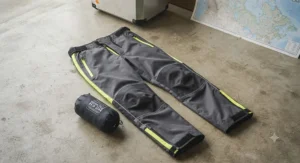
Where a lot of rain gear looks like exactly what it is — a garbage bag with sleeves — the Nitric 3 H2O is cut to actually look and move like real riding gear. Stretch panels at the knees and shoulders let it flex with your body through corners and gear shifts instead of bunching up, and the fully waterproof construction doesn’t compromise that fit to get there. What most buyers overlook about tailored rain suits like this one is that a snug, athletic cut isn’t just about looks — a suit that doesn’t billow at highway speed creates less wind drag and less fabric noise, both of which add up on a long touring day. Reviewers consistently describe the fit as closer to a proper riding jacket than typical rainwear, which explains why it commands a price premium over boxier two-layer suits. It’s the pick for riders who want their rain gear to feel like part of their kit rather than an emergency add-on.
Pros:
- ✅ Athletic, tailored fit reduces wind flap at speed
- ✅ Stretch panels improve comfort over long rides
- ✅ Doesn’t look or feel like disposable rain gear
Cons:
- ❌ Snugger fit means less room for bulky layers underneath
- ❌ Among the pricier two-layer options on this list
Check current pricing, but expect somewhere in the C$240-C$300 range for the jacket-and-pants set.
7. Rukka Nivala 2.0 — Gore-Tex Pro benchmark for serious tourers
If budget genuinely isn’t the deciding factor, this is the suit the rest of the industry gets measured against. The Finnish-engineered shell uses a laminated Gore-Tex Pro membrane bonded directly to the outer fabric rather than floating loose inside it, which — on paper — means there’s no gap for water to pool between layers and breathability stays consistently high even during sustained effort. That construction shows up in real-world reports of multi-hour rides through heavy, sustained rain with the collar, cuffs, and boot-to-ankle transition all staying dry, which is traditionally the hardest zone on any suit to seal properly. The cut is generous enough to layer over full armoured touring gear yet doesn’t billow at highway speed, and the jacket-to-trouser connection zip is secure without being fussy to operate one-handed at a fuel stop. This is a genuine investment piece, not an impulse buy, and it makes the most sense for riders who tour multiple weeks a year or commute through a genuinely wet climate where cheaper suits would need replacing annually anyway.
Pros:
- ✅ Laminated Gore-Tex Pro membrane resists internal pooling
- ✅ Exceptional breathability even during sustained rain
- ✅ Built to layer cleanly over full touring armour
Cons:
- ❌ Premium price puts it out of reach for casual riders
- ❌ Packs down less small than ultralight budget suits
At around C$1,150-C$1,350, it’s the most expensive option here by a wide margin, but for year-round or heavy-mileage touring, the cost-per-wear math often works out favourably against replacing a budget suit every season or two.
How to Pack Your Rain Gear for Pannier Storage on Multi-Day Tours
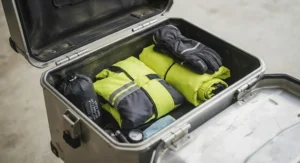
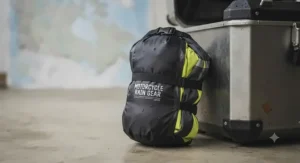
Pannier storage isn’t just “does it fit” — it’s “does it fit and stay dry and stay accessible when you need it in ninety seconds flat.” Start by keeping rain gear in its own dedicated dry bag or the stuff sack it shipped with, separate from clothing, so a leaking pannier seam doesn’t soak your spare socks along with everything else. Position it in the top layer of whichever pannier you can access without unstrapping your whole load, because fumbling through a fully packed bag while the sky opens up is exactly the scenario this gear is meant to prevent. For suits like the REV’IT! Pacific 4 H2O Rain Suit that ship with a compression sack, roll rather than fold the fabric before cinching it down — rolling reduces the sharp creases that eventually crack seam tape over hundreds of pack-unpack cycles. A common mistake in the first month of ownership is packing rain gear wet after a ride and leaving it compressed for days, which invites mildew and breaks down waterproof coatings faster than UV exposure ever will; a five-minute air-out at your next fuel stop pays for itself many times over across a season.
Real-World Scenarios: Matching Rain Gear to Your Touring Style
Picture three riders leaving from the same driveway on the same wet Tuesday morning, and their ideal gear looks completely different by lunchtime. The weekend warrior doing a 400 km loop with mostly clear skies forecast is genuinely well served by something like the Frogg Toggs Pilot II Guide Rain Suit tucked into a tank bag — cheap insurance for a low-probability event, nothing more. The cross-Canada tourer logging 8,000 km over three weeks through the Prairies, the Rockies, and coastal B.C. drizzle is a completely different case; that rider needs something built for daily deployment and packing, which points toward the REV’IT! Pacific 4 H2O Rain Suit or, budget allowing, the Rukka Nivala 2.0 for genuinely miserable, sustained-rain days. Then there’s the year-round commuter-tourer who rides through a wet coastal climate nine months a year and treats rain gear less as backup and more as standard kit — for that rider, upfront cost matters less than long-term durability, making the Gore-Tex laminate construction of the Rukka genuinely pay for itself over several seasons of daily wear. Matching gear to actual riding frequency, not aspirational riding frequency, is the single biggest factor in getting real value out of a purchase.
Weight Considerations: How Much Should Packable Rain Gear Actually Weigh?
Weight matters twice on a touring bike — once when it’s sitting compressed in your pannier taking up payload capacity, and again when you’re wearing it and it either moves with your body or fights you. A realistic packed weight for a genuinely packable two-piece suit runs somewhere between 500 grams for ultralight options like the Frogg Toggs Pilot II up to around 1.2 kilograms for heavier premium laminate suits like the Rukka Nivala 2.0 — the extra mass on the premium end buys you a more durable, better-sealed fabric rather than just marketing weight. On paper this means the ultralight end of the spectrum wins on packed volume, but reviewers consistently note that the lightest fabrics also fatigue and stretch fastest, so a rider chasing minimum weight is often trading long-term durability for grams saved. What most buyers overlook is that on-body weight matters as much as packed weight; a suit that flaps and drags at highway speed creates fatigue over an eight-hour riding day even if it weighs less in the saddlebag. For most multi-day tourers, a suit in the 700-900 gram range hits a sensible balance between genuine packability and a fabric weight that survives repeated wet-weather use without shredding.
How to Choose Touring Rain Gear for Motorcyclists
Touring rain gear for motorcyclists needs to satisfy a different checklist than a commuter raincoat, because the failure modes only show up after hours in the saddle, not minutes. Here’s a practical framework for narrowing the field:
- Confirm it’s motorcycle-specific, not repurposed outdoor gear. A proper riding cut has a longer back panel, higher collar, and gusseted knees that accommodate a seated riding position — generic rainwear rides up and gaps at the waist.
- Check the seam construction, not just the fabric rating. Taped or welded seams matter more than headline waterproof numbers, since seams are where nearly all leaks originate.
- Match pack size to your actual luggage capacity. A suit that doesn’t realistically fit your panniers alongside your other gear will end up strapped to the outside, exposed to road grime and UV.
- Prioritize a collar and cuff seal that works with your helmet and gloves. Test this before a trip, not during one — mismatched seals are the most common source of “waterproof but somehow still wet” complaints.
- Weigh breathability against your climate. A non-breathable shell is fine for a cool coastal tour but miserable in humid summer heat, where trapped moisture soaks you from the inside just as effectively as rain does from outside.
- Consider reflectivity and colour for low-visibility conditions. Rain rides usually mean overcast skies and spray from other vehicles, both of which cut visibility well before dark actually falls.
- Factor in how often you’ll actually use it. Occasional riders can lean budget; daily or multi-week tourers should weight durability and comfort over upfront price.
Durability Under Repeated Use: What Actually Wears Out First
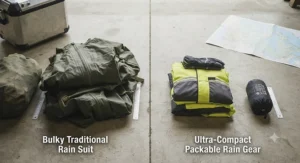
Durability under repeated use is where the real gap between budget and premium rain gear shows up, and it rarely happens the way people expect. The first failure point on cheaper suits is almost always the seam tape at high-stress zones — the crotch, the underarms, and the knee bends — where repeated flexing eventually lifts the adhesive and reopens a pinhole leak. Zippers are the second common failure, particularly on suits packed damp, since trapped moisture accelerates corrosion on cheaper zipper coils; this is one reason the YKK-grade zippers found on mid-range and premium suits are worth the price difference over a multi-season ownership period. Fabric-level wear shows up differently depending on construction: ultralight non-woven shells like the Frogg Toggs Pilot II tend to develop pinholes and small tears at fold lines from repeated compression, while laminated membranes like the Rukka Nivala 2.0’s bonded Gore-Tex Pro resist that specific failure mode because the membrane isn’t relying on a coating that can flake off over time. A common mistake is judging durability from a single trip rather than a full season — a suit can perform flawlessly for three days and still be the one that fails at month four once seam tape starts fatiguing from repeated pack-unpack cycles.
Multi-Day Packable Waterproof Suit vs One-Piece Emergency Shells
A multi-day packable waterproof suit and a one-piece emergency shell solve genuinely different problems, and conflating them is a common buying mistake. One-piece shells — the kind that pull on over your entire riding kit in one motion — prioritize speed of deployment and total coverage, which makes sense for a rider caught in a sudden downpour who needs protection in under a minute. The trade-off is packability and flexibility: a one-piece shell has to be sized for your bulkiest layer underneath, which means it’s oversized and awkward the rest of the time, and there’s no way to shed just the jacket portion during a bathroom or fuel stop without removing the whole thing. Two-piece multi-day suits like the REV’IT! Pacific 4 H2O Rain Suit or Nelson-Rigg AS-3000 Rain Suit solve for exactly the scenario a tourer actually lives with — you can wear just the jacket during a light drizzle, add the pants when it intensifies, and separate the pieces for faster drying and more compact packing between rides. For genuinely multi-day trips where rain gear gets packed, worn, packed again, and worn again across a week or more, the two-piece format wins on almost every practical measure except sheer speed of getting dressed in a parking lot as the first drops hit.
Rain Gear for Long-Distance Riding: What Changes Over 1,000+ Kilometres
Rain gear for long-distance riding has to survive conditions that a single wet commute never tests: temperature swings across a day, multiple pack-unpack cycles, and the cumulative fatigue of hours spent in a suit that either works with your body or against it. What most buyers overlook about long-distance use specifically is thermal regulation — a non-breathable suit that’s perfectly fine for a 40-minute ride home becomes genuinely uncomfortable across six or eight hours, as trapped sweat has nowhere to go and starts soaking you from the inside regardless of how waterproof the shell is from the outside. Based on the spec comparison across this list, breathable membrane suits like the REV’IT! Nitric 3 H2O Rain Suit and Rukka Nivala 2.0 earn their price premium specifically in this scenario, where a full day of riding in changing conditions rewards a fabric that can vent moisture as effectively as it blocks it. Reflective placement also matters more on long-distance routes, since a multi-day tour inevitably includes riding into dusk or through low-visibility fog banks where cheaper suits with minimal reflective trim leave you genuinely harder to spot. Finally, fit consistency across a full riding day — no bunching at the knees during gear shifts, no collar gap opening up as you lean forward on the tank — separates gear designed for touring from gear designed for a five-minute walk to the bus stop.
Common Mistakes When Buying Motorcycle Rain Gear
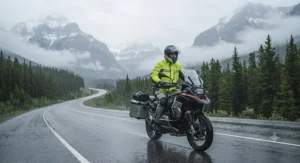
The single most common mistake is sizing rain gear to fit over a t-shirt rather than over your actual riding kit — armoured jacket, pants, and boots — which leaves the suit too tight to move in and, worse, too tight to seal properly at the cuffs and collar. A close second is prioritizing waterproof rating numbers without checking seam construction; a fabric rated at an impressively high hydrostatic head is only as waterproof as its weakest seam, and un-taped or partially taped seams undercut an otherwise strong fabric. Riders also frequently skip the collar-and-helmet compatibility check before buying, only discovering at the first rainy fuel stop that the collar gaps against their specific helmet’s chin bar. Buying based purely on lowest price without accounting for how often you actually ride in the rain is another frequent regret — a rider who commutes through wet weather five days a week needs different durability than someone packing gear “just in case” for one annual trip. Finally, storing rain gear wet and compressed between uses — rather than airing it out before repacking — quietly shortens the lifespan of even premium suits, turning what should be a multi-year investment into a two-season replacement.
Benefits vs Traditional PVC Rain Suits
| Factor | Modern Packable Suits | Traditional PVC Suits |
|---|---|---|
| Pack size | Compresses into a small stuff sack | Bulky, stiff, hard to fold small |
| Breathability | Membrane or coated fabric vents moisture | Traps heat and sweat almost completely |
| Durability | Taped seams, YKK-grade zippers common | Seams and zippers degrade faster with flexing |
| Best For | Multi-day touring, daily commuting | Occasional, short-duration wet rides |
The gap here isn’t subtle — traditional PVC suits still show up on budget shelves because they’re cheap and genuinely waterproof, but the “sauna effect” of a non-breathable shell becomes a real problem on any ride longer than an hour. Modern packable options like the Oxford Rainseal Pro Suit close that gap by using breathable coated fabrics that block rain without trapping body heat, which matters enormously on a multi-hour touring day. For a rider who only pulls rain gear out a handful of times a year, PVC’s low price still makes some sense; for anyone touring seriously, the comfort and packability gains from modern fabrics are worth the price difference.
Long-Term Cost & Maintenance: The Real ROI of Packable Rain Gear
Total cost of ownership tells a different story than sticker price alone. A C$130 budget suit that needs replacing every season because the fabric tears at fold lines works out to roughly the same five-year spend as a single C$250 mid-range suit that lasts four to five seasons with basic care — except the mid-range suit also performs better every single time you wear it. Maintenance is minimal but matters: rinsing off road salt and grit after wet rides, air-drying fully before compressing back into storage, and periodically reapplying a durable water repellent treatment once beading starts to fade all extend fabric life meaningfully. Zippers benefit from an occasional dab of silicone-based lubricant, which prevents the corrosion that’s often the actual cause of a “waterproof” suit suddenly leaking at the closure. For premium laminate suits like the Rukka Nivala 2.0, the higher upfront cost is best thought of as amortized across a decade of expected use rather than compared directly against a budget suit’s one-season price tag — on a genuine cost-per-wear basis, the premium option frequently wins for riders who tour or commute in wet weather regularly.
Safety, Visibility & Canadian Riding Regulations
Rain gear is safety gear, not just comfort gear, and that’s worth taking seriously on Canadian roads specifically. Motorcycles represent a small share of registered vehicles but a disproportionate share of collisions, and Transport Canada data cited by the RCMP attributes much of that gap to visibility issues rather than rider error alone — a gap that reflective and hi-vis rain gear directly addresses during exactly the low-light, low-visibility conditions rain riding creates. Beyond visibility, wet-weather riding itself demands adjusted technique: reduced traction, longer braking distances, and reduced following-driver visibility all compound in the rain, which is why building in extra following distance and smoother inputs matters as much as the gear you’re wearing. Provincial requirements around helmets, protective gear, and equipment vary somewhat across Canada, so it’s worth confirming your province’s specific rules before a cross-border or cross-provincial tour. None of the products in this guide are safety-certified impact gear — they’re waterproof shells meant to layer over CSA-appropriate protective riding gear, not replace it, and that distinction matters when you’re choosing what to pack for a genuinely multi-day trip through unpredictable Canadian weather.
✨ Don’t Miss These Exclusive Deals!
🔍 Take your rain-ready touring kit to the next level with these carefully selected products. Click on any highlighted item to check current pricing and availability. These picks will help you stay dry, comfortable, and confident on every wet-weather ride!
Frequently Asked Questions
❓ What makes rain gear 'packable' for motorcycle touring specifically?
❓ Is a one-piece or two-piece rain suit better for touring?
❓ How much should packable rain gear weigh?
❓ Can I wear rain gear over my regular armoured riding jacket and pants?
❓ How do I stop my rain gear from leaking at the collar and cuffs?
Conclusion
There’s no single “best” packable rain gear for motorcycle touring — there’s only the best match for how you actually ride. A weekend rider chasing occasional showers gets excellent value from something like the Frogg Toggs Pilot II Guide Rain Suit tucked permanently into a tank bag, while a rider logging serious multi-week touring mileage through unpredictable Canadian weather will get far more long-term value out of a durable, breathable mid-range option like the REV’IT! Pacific 4 H2O Rain Suit, or the genuinely best-in-class Rukka Nivala 2.0 if budget allows. What matters across every price point is matching pack size to your actual luggage, checking seam construction rather than trusting a single waterproof number, and treating durability under repeated use — not just one good weekend — as the real test of whether a suit earns its spot in your panniers. Pack smart, check the forecast, but never assume you won’t need it; on a long enough tour, the rain always finds you eventually.
✨ Ready to gear up for your next wet-weather tour? Compare current prices on today’s top pick and pack with confidence before you hit the road! 🏍️💧
Recommended for You
- Rain Jacket And Pants Set vs One-Piece Rain Suit: 7 Top Picks 2026
- 7 Best Packable Rain Suits For Riders in 2026 (Tested)
- Budget Motorcycle Rain Suit: 7 Cheap Picks for Canadian Riders (2026)
Disclaimer: This article contains affiliate links. As an Amazon Associate, I earn from qualifying purchases. If you purchase products through these links, we may earn a small commission at no additional cost to you.
✨ Found this helpful? Share it with your friends! 💬🤗
