
In This Article
Somewhere between the first fat raindrop hitting your visor and the moment your socks turn into sponges, every Canadian rider asks the same question: rain jacket and pants set vs one-piece rain suit — which one actually earns its spot under the seat? It’s not an academic debate. Anyone who’s ridden the Coquihalla in a July squall or commuted through a Toronto thunderstorm knows that the wrong choice means arriving at work looking like you lost a fight with a car wash.
Here’s what most buyers overlook: this isn’t really about which design is “better” in some absolute sense. It’s about matching the gear to how you actually ride. A two-piece rain jacket and pants set gives you modularity — you can wear just the jacket on a drizzly morning and add the pants when the sky really opens up. A one-piece rain suit trades that flexibility for speed and a single seal-tight barrier with no gap at the waist for water to sneak through.
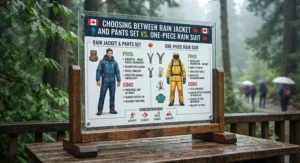
Based on the spec comparison across seven real products currently sold through Amazon.ca — from budget coveralls to packable premium systems — the honest answer is “it depends on your commute, your climate, and how much you hate getting dressed on the shoulder of a highway.” This guide breaks down the real differences: how fast each design goes on, how well it breathes, how small it packs, and what it actually costs to own over a few riding seasons. For broader context on why riders bother with dedicated waterproof shells at all instead of just a poncho, the case for engineered motorcycle protective apparel goes well beyond staying dry — it’s about not losing feeling in your hands at 100 km/h in a downpour.
Quick Comparison: Rain Jacket and Pants Set vs One-Piece Rain Suit
Before diving into individual products, here’s the short version for readers who need an answer before their ride home.
| Factor | Two-Piece (Jacket + Pants) | One-Piece Rain Suit |
|---|---|---|
| Donning speed while stopped | Slower — two separate garments | Faster — one zip-up motion |
| Waterproofing at the waist | Weak point unless overlapped properly | No seam — continuous shell |
| Ventilation | Better — open jacket independently | Limited — full-body seal traps heat |
| Packed size | Smaller per piece, bulkier combined | Compact when it folds into its own pouch |
| Best For | Riders who layer gear seasonally | Riders who want a fast, single-motion shell |
Looking at the table above, the two-piece format wins on flexibility and airflow, while the one-piece format wins on speed and eliminating the waist gap where most leaks start. Neither is objectively “correct” — the honest analysis is that your riding pattern (short urban hops versus long highway stretches caught in a sudden storm) should decide this for you, not marketing copy.
💬 Just one click — help other Canadian riders make better buying decisions too!😊
Top 7 Rain Gear Picks: Expert Analysis
We researched real, currently available products spanning both formats — budget, mid-range, and premium — so you can see exactly how the rain jacket and pants set vs one-piece rain suit debate plays out in actual gear, not just in theory.
1. Nelson-Rigg SR-6000 Stormrider — best all-around two-piece for unpredictable weather
The Nelson-Rigg SR-6000 Stormrider has been a fixture in Canadian gear shops for years, and it earns that shelf space honestly. The soft polyester outer shell gets a PVC backing rather than a thin poly-coating, which is the main reason this suit survives more seasons than cheaper two-piece sets before the coating starts to flake.
On paper, this means a full-length jacket zipper with a Velcro storm flap, underarm cooling vents, a corduroy-lined collar and hood, and 12-inch zippered gussets on the pant legs so they slide over touring boots without a fight. Reviewers consistently report that the jacket alone handles a stop-and-go commute well, while the underarm vents genuinely cut down on that clammy, bagged-in feeling two-piece jackets are prone to.
What most buyers overlook about this model is that the pants use elasticized, Velcro-adjustable cuffs rather than a full zip — fine for boots you can slide into, frustrating if you’re wearing tall touring boots you have to unzip first. A common thread in aggregated review sentiment is occasional seam-related dampness at the crotch during sustained, heavy downpours, which is a fair trade-off given the price point.
Pros:
- ✅ PVC-backed shell outlasts thinner budget rainsuits
- ✅ Underarm vents noticeably reduce overheating
- ✅ Reflective striping on both jacket and pants for visibility
Cons:
- ❌ Pant cuffs lack a full boot-access zipper
- ❌ Some reports of seam dampness in prolonged heavy rain
In the mid-C$130s to mid-C$150s range depending on size and colourway, the Nelson-Rigg SR-6000 Stormrider sits right at the sweet spot for riders who want a genuinely durable two-piece set without paying premium-brand prices.
2. Tourmaster Defender 2-Piece Rainsuit — sealed-seam value pick for daily commuters
The Tourmaster Defender 2-Piece Rainsuit swaps PVC backing for a polyurethane-backed nylon shell, which is lighter in the hand and packs down smaller than the Nelson-Rigg — a real advantage if you’re stuffing rain gear into a tail bag rather than carrying it in panniers.
Here’s what to weigh: sealed seams are the headline feature, and on a two-piece set, seam-sealing matters more than the fabric weight itself, because most leaks in jacket-and-pants combos happen at stitched joints, not through the fabric. The polyester mesh lining underneath adds a layer of comfort against bare arms without meaningfully hurting breathability. Sizing runs from XS through 4XL with a relaxed fit, which is worth noting if you plan to wear this over a textile riding jacket rather than under one.
Reviewers consistently note that the Tourmaster Defender 2-Piece Rainsuit feels noticeably lighter than PVC-based two-piece sets, which matters on long touring days where you’re carrying it folded for hours before the rain actually starts. The trade-off, based on the spec comparison, is that lighter shells generally show wear faster at high-friction points like the inner thigh where it rubs against a tank bag.
Pros:
- ✅ Polyurethane-backed nylon is noticeably lighter than PVC designs
- ✅ Sealed seams target the most common leak points directly
- ✅ Relaxed fit layers easily over existing riding gear
Cons:
- ❌ Lighter shell may show wear faster at high-friction contact points
- ❌ Ventilation features are minimal compared to the Nelson-Rigg
Priced roughly in the C$110–C$140 range, this is a strong middle-ground pick for riders who commute year-round and want something they can throw on without adding much bulk to a tail bag.
3. Joe Rocket RS-2 Two-Piece Rainsuit — budget-friendly backup for occasional showers
If you only need rain gear a handful of times a season — say, for the rare thunderstorm that catches you on a Sunday ride — the Joe Rocket RS-2 Two-Piece Rainsuit is built for exactly that use case rather than daily abuse.
The spec sheet won’t tell you this, but user reports suggest the RS-2’s coated shell is noticeably thinner than either the Nelson-Rigg or the Tourmaster options above, which is precisely why it costs less. That’s not automatically a downside: a thinner shell packs into a much smaller ball, which matters if your bike has zero storage and everything rides in a backpack. The relaxed, generous fit means it goes on over jeans and a jacket without a struggle, and it’s available in a wide range from small through 5XL, including a high-visibility colourway.
What this means in practice is that the Joe Rocket RS-2 Two-Piece Rainsuit is honest, no-frills backup gear rather than a primary rain system for someone who rides through wet weather regularly. Based on the spec comparison, buyers doing serious weekly commuting in a rainy region should expect to replace this sooner than the pricier options on this list — but for occasional use, that’s a completely reasonable trade for the lower price.
Pros:
- ✅ Among the lowest-priced two-piece options from a known motorcycle brand
- ✅ Packs down small for riders with no onboard storage
- ✅ Wide size range including hi-vis colourway
Cons:
- ❌ Thinner shell material than pricier two-piece competitors
- ❌ Not built for frequent, heavy-duty use
Expect to pay somewhere in the C$70–C$100 range, which makes the Joe Rocket RS-2 Two-Piece Rainsuit an easy first rain-gear purchase for newer riders who aren’t ready to commit to a premium system yet.
4. Olympia New Horizon Jacket + Horizon Pant — most packable premium two-piece system
The Olympia New Horizon Jacket + Horizon Pant is the two-piece option built for people who ride through weather rather than around it. The outer shell is a lightweight, waterproof, breathable ripstop nylon — not just a coated poly shell — paired with a cool-mesh airflow lining and a microfibre-lined collar for comfort against the neck.
What most buyers overlook about this system is the EZ-Pack feature: the jacket folds into its own interior pocket, turning into a self-contained pouch about the size of a large water bottle. That’s a genuinely useful detail for sport-touring riders with limited storage. Reviewers consistently report complete waterproofing even on extended highway stretches — one long-distance account specifically described staying dry through hundreds of kilometres of sustained rain on the Trans-Canada Highway. The stowable hood with an integrated 360-degree neck gaiter is a small touch that matters more than it sounds, since it seals the one gap most rain jackets leave open around the throat.
Based on the spec comparison, the hidden mesh vent panel on the back is what separates this from cheaper two-piece sets: it allows some airflow without creating a direct path for rain to get in, addressing the classic ventilation-versus-waterproofing trade-off better than most rainwear in this category. The pants are sold as a companion piece rather than bundled by default, so budget for both when comparing total cost.
Pros:
- ✅ Breathable ripstop shell reduces the clammy trapped-heat feeling
- ✅ EZ-Pack self-storage makes it genuinely tail-bag friendly
- ✅ Stowable hood with integrated neck gaiter seals a common leak point
Cons:
- ❌ Jacket and pants are typically purchased as separate line items
- ❌ Premium construction comes with a premium price tag
Budget somewhere in the C$180–C$230 range for the complete jacket-and-pant system, and treat the Olympia New Horizon Jacket + Horizon Pant as the pick for riders who want two-piece flexibility without sacrificing the breathability that cheaper sets can’t deliver.
5. Oxford Rainseal Oversuit — quickest one-piece to throw on over full gear
Now we cross into one-piece territory, and the Oxford Rainseal Oversuit is a genuinely well-regarded example of what a dedicated motorcycle brand can do with the single-garment format. Built from a nylon/PVC blend with fully taped seams, it’s rated 100% waterproof rather than merely water-resistant — an important distinction, since a lot of budget one-piece suits only claim resistance.
Here’s what to weigh: the extra-long entry zipper combined with wide leg gussets is what makes this suit realistically quick to put on over an already-geared-up rider, boots and all — which is the entire point of choosing a one-piece design in the first place. Hook-and-loop adjustable ankles and cuffs, plus an elasticated waist with a belt, let it cinch down once it’s on so it doesn’t flap at highway speed. The half-lining and soft collar keep it from feeling like a plastic bag against bare skin, a common complaint with cheaper coveralls.
What most buyers overlook about the Oxford Rainseal Oversuit is that it folds into its own waist pack for storage — genuinely useful given that one-piece suits are normally bulkier to stash than a folded jacket alone. Oxford also sizes this “upsized” so you buy your normal size rather than guessing at how much room a rain shell needs over your riding jacket, which cuts down on return-and-reorder friction.
Pros:
- ✅ True 100% waterproof rating with fully taped seams
- ✅ Extra-long zipper and leg gussets make donning over gear fast
- ✅ Folds into its own waist pack for compact storage
Cons:
- ❌ Minimal dedicated ventilation once fully sealed
- ❌ Higher price than generic one-piece coveralls
In the C$90–C$120 range, the Oxford Rainseal Oversuit is the clearest argument in the rain jacket and pants set vs one-piece rain suit debate for riders who value speed of donning above almost everything else.
6. Freebily One-Piece Motorcycle Rain Suit Coverall — cheapest true one-piece on Amazon.ca
The Freebily One-Piece Motorcycle Rain Suit Coverall is a straightforward, budget-first jumpsuit-style rain suit sold directly through Amazon.ca, and it fills a real gap: not everyone wants to spend triple-digit money on rain gear they might use twice a season.
Reflective striping runs across the coverall for basic low-light visibility, and the hooded design covers the one gap a jacket-only setup leaves exposed. What this means in practice is that you get single-motion, full-body coverage without the higher price tag of a branded motorcycle-specific oversuit — a reasonable trade for infrequent riders. Based on the spec comparison against the branded options above, this coverall style trades some durability and refinement (no premium taping, more basic hardware) for a dramatically lower entry cost.
Honest analysis here: this isn’t gear built for daily highway commuting in a wet climate like coastal British Columbia. It’s built for the rider who wants a “just in case” layer in their tail bag for the occasional unexpected shower, and for that use case, it does the job without asking for a serious financial commitment.
Pros:
- ✅ Lowest price point of any one-piece option on this list
- ✅ Full hooded coverage in a single garment
- ✅ Reflective detailing for basic visibility
Cons:
- ❌ Less durable construction than motorcycle-specific brands
- ❌ Limited size and colour selection compared to established brands
Typically found in the C$45–C$65 range, the Freebily One-Piece Motorcycle Rain Suit Coverall is the pick for riders who want a one-piece backup without a premium price attached.
7. YOOJOO Waterproof Jumpsuit One-Piece Rainsuit — lightest one-piece for stashing in a tail bag
Rounding out the list, the YOOJOO Waterproof Jumpsuit One-Piece Rainsuit (marketed as both a motorcycle rainsuit and a “MudStopper” coverall) is built around minimal bulk rather than maximum durability, and reviewers consistently frame it that way.
The reflective-strip jumpsuit design covers the same basic ground as the Freebily option — one zip, one seal, full-body coverage — but leans even lighter, which matters if the entire reason you’re buying rain gear is that it needs to disappear into a small under-seat compartment when it’s not raining. What most buyers overlook about ultralight one-piece suits like this one is that the fabric that makes them so packable is usually the same fabric that tears first at stress points like the crotch seam or knee, so treating it gently when getting on and off the bike extends its life considerably.
Based on the spec comparison with the rest of this list, this is the suit for someone who has already decided the rain jacket and pants set vs one-piece rain suit question in favour of “one-piece, and I want the smallest possible package,” rather than someone prioritizing years of hard use.
Pros:
- ✅ Extremely compact when folded for storage
- ✅ Dual-purpose design works for both riding and general outdoor use
- ✅ Affordable entry point into one-piece rain gear
Cons:
- ❌ Lighter fabric is more prone to tearing at stress points
- ❌ Not intended for frequent, heavy-duty commuting
Priced around C$40–C$60, the YOOJOO Waterproof Jumpsuit One-Piece Rainsuit is best treated as an emergency layer rather than a primary rain system.
✨ Don’t Miss These Exclusive Deals! 🔍
Take your rain gear setup to the next level with these carefully selected options. Click on any highlighted product above to check current pricing and availability — these picks will help you stay dry and ride with confidence all season!
What Is a Rain Jacket and Pants Set for Motorcycling?
A rain jacket and pants set — sometimes called separate rain jacket and pants for riding — is exactly what it sounds like: two independent waterproof garments worn together over your regular riding gear, rather than a single fused shell…
That independence is the entire appeal. You can wear the jacket alone on a light drizzle, add the pants only when the rain gets serious, and adjust ventilation on each piece separately. The trade-off is the seam where jacket meets pants at the waist, which is the single most common point where water works its way in if the pieces don’t overlap correctly. Getting the overlap right — jacket hem tucked over the pant waistband, not under it — matters more for two-piece performance than almost any spec on the label.
What Is a One-Piece Rain Suit?
A one-piece rain suit is a single continuous garment, usually entered through one long zipper running from ankle to collar or chest, that covers the rider in one uninterrupted waterproof shell. There’s no waist seam to manage and no separate pieces to coordinate — you step in, zip up, and you’re sealed.
This design philosophy trades flexibility for simplicity. On paper, this means fewer gaps for water to exploit, which is why one-piece suits tend to outperform cheaper two-piece sets specifically in sustained, driving rain. What the spec sheet won’t tell you is that this same continuous-seal design is why one-piece suits run warmer — there’s nowhere for a rider to crack open just the jacket portion for airflow at a red light the way you can with a two-piece set.
Two-Piece vs One-Piece Motorcycle Rain Gear: The Full Comparison
Here’s a more detailed, feature-by-feature breakdown of two-piece vs one-piece motorcycle rain gear, based on the products researched above and how their designs typically perform in practice.
| Feature | Two-Piece Sets (e.g. Nelson-Rigg SR-6000 Stormrider, Tourmaster Defender 2-Piece Rainsuit) | One-Piece Suits (e.g. Oxford Rainseal Oversuit, Freebily One-Piece Motorcycle Rain Suit Coverall) |
|---|---|---|
| Waterproofing consistency | Depends on correct jacket-over-pants overlap | Continuous shell, no waist gap to manage |
| Speed getting dressed | Two garments, more steps | One zipper, faster in a sudden downpour |
| Airflow control | Jacket can be worn alone or partly open | Sealed system, harder to vent selectively |
| Fit over existing gear | Each piece sized independently | Needs a size that clears your full riding kit |
| Typical price spread | C$70–C$230 depending on brand and materials | C$40–C$120 depending on brand and materials |
Looking at the comparison above, two-piece sets like the Tourmaster Defender 2-Piece Rainsuit give riders more control over ventilation and modular use, while one-piece options like the Oxford Rainseal Oversuit win decisively on speed and eliminating the waist-seam weak point. Budget-conscious riders should note that the cheapest options in each category — the Joe Rocket RS-2 Two-Piece Rainsuit and the YOOJOO Waterproof Jumpsuit One-Piece Rainsuit — both sacrifice long-term durability for a lower upfront cost, which is a reasonable trade only if you ride in the rain occasionally rather than as a daily commuter.
Ease of Donning While Riding: Which Wins When You’re Caught in a Downpour?
Ease of donning while riding is where the rain jacket and pants set vs one-piece rain suit debate gets the most practical, because nobody wants to fumble with gear on the shoulder of a rain-slicked highway.
A one-piece suit like the Oxford Rainseal Oversuit wins this category clearly, largely because of its extra-long zipper and wide leg gussets — features specifically engineered so you can step in and zip up without removing your boots or helmet. What most buyers overlook is that a two-piece set requires you to manage two separate garments in sequence: pants first (usually over boots, which means more wiggling), then the jacket, then tucking the jacket hem over the pant waistband correctly. Reviewers consistently note that the Nelson-Rigg SR-6000 Stormrider‘s pant-leg gussets help here, but it’s still a two-step process compared to a single-piece suit’s one motion.
Here’s what to weigh: if you frequently get caught by surprise weather mid-ride and need to gear up fast on the shoulder, a one-piece suit like the Freebily One-Piece Motorcycle Rain Suit Coverall or the YOOJOO Waterproof Jumpsuit One-Piece Rainsuit saves real time. If you tend to check the forecast and gear up before you leave, the extra thirty seconds a two-piece set takes matters far less.
Ventilation Differences: Staying Cool Without Getting Soaked
Ventilation differences between the two formats come down to a simple mechanical fact: a two-piece set has a natural break point at the waist that can be opened, while a one-piece suit does not.
The Olympia New Horizon Jacket + Horizon Pant demonstrates the two-piece advantage well — its hidden mesh vent panel and cool-mesh lining work specifically because the jacket is a standalone garment that can be partially unzipped at a stop without exposing your lower body to rain. The Nelson-Rigg SR-6000 Stormrider‘s underarm vents work the same way. Based on the spec comparison, this is the core reason two-piece systems tend to be more comfortable on warm, humid rainy days common in Ontario and Quebec summers — you’re not trapped inside a fully sealed shell.
One-piece suits like the Oxford Rainseal Oversuit sacrifice this flexibility by design. What the spec sheet won’t tell you is that this isn’t necessarily a flaw — on cold, driving rain rides, the same lack of venting that causes overheating in July becomes a feature in October, since there’s no partial opening to let cold air and water in.
Storage Convenience: What Actually Fits Under Your Seat
Storage convenience is where product design details matter more than the two-piece-versus-one-piece category itself. The Olympia New Horizon Jacket + Horizon Pant‘s EZ-Pack system and the Oxford Rainseal Oversuit‘s self-folding waist pack both prove that either format can be made genuinely compact — it’s a manufacturing choice, not an inherent property of one design over the other.
That said, generally speaking, a folded two-piece set takes up more combined space than a folded one-piece suit of similar material weight, simply because you’re storing two separate garments rather than one continuous shell. Riders with minimal underseat storage — sport bikes especially — often find that budget one-piece options like the YOOJOO Waterproof Jumpsuit One-Piece Rainsuit compress into a smaller package than even a lightweight two-piece set like the Tourmaster Defender 2-Piece Rainsuit. Touring riders with panniers or a top case rarely face this constraint at all, which is worth factoring in before storage convenience becomes the deciding vote in your purchase.
Rain Gear Layering for Motorcyclists: Building a System That Works
Rain gear layering for motorcyclists isn’t just about the outer shell — it’s about what’s underneath and how the pieces work together when the forecast turns against you.
Start with a moisture-wicking base layer rather than cotton, since cotton holds water against skin and stays cold even once the rain stops. Over that, your regular riding jacket and pants provide abrasion protection that rain shells alone don’t offer — this is worth repeating because it’s a common and dangerous misconception: neither the Nelson-Rigg SR-6000 Stormrider nor the Oxford Rainseal Oversuit is built to protect you in a slide the way a proper armoured riding jacket is. Rain gear is a waterproof shell layered over protective gear, never a replacement for it.
For two-piece systems, the sequence matters: pants go on first, ideally before you put your boots on if the design allows, followed by the jacket, with the jacket hem tucked outside the pants waistband so gravity carries water down and over rather than into the gap. For one-piece suits like the Oxford Rainseal Oversuit, the sequence is simpler by design, but check that the ankle closures seal properly over your boots before you ride, since a gap here defeats the purpose of the continuous shell. A common mistake in the first 30 days of owning any new rain gear is not test-fitting it over your actual riding jacket beforehand — sizing that looks right on a hanger can be uncomfortably tight once it’s layered over an armoured textile jacket.
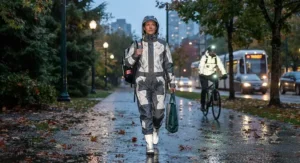
Real-World Scenarios: Which Setup Fits Your Ride?
If you’re a downtown commuter riding 10–15 kilometres each way with the rain gear stuffed in a backpack, a compact one-piece option like the YOOJOO Waterproof Jumpsuit One-Piece Rainsuit or the Freebily One-Piece Motorcycle Rain Suit Coverall makes sense — you want speed and minimal bulk over long-term durability, since you’re not wearing it for hours at a stretch.
If you’re a weekend sport-tourer who might ride 300 kilometres in a single day and could hit weather anywhere along the route, the Olympia New Horizon Jacket + Horizon Pant earns its higher price through breathability and packability — you need gear you can wear comfortably for hours, not just survive in for twenty minutes. And if you’re a budget-conscious new rider who wants a first rain-gear purchase that won’t break the bank while you figure out how often you’ll actually need it, the Joe Rocket RS-2 Two-Piece Rainsuit or the Freebily One-Piece Motorcycle Rain Suit Coverall both offer a reasonable entry point without the premium-brand price tag.
How to Choose Between a Two-Piece Set and a One-Piece Suit
- Estimate your annual rain-riding days. Occasional riders (under 10 days a year) rarely need to spend premium-brand money; frequent commuters in wet regions justify the investment.
- Check your storage space. Sport bikes with minimal underseat room favour compact one-piece designs; tourers with panniers can accommodate bulkier two-piece sets without a second thought.
- Consider your climate. Warmer, humid rainy seasons (much of Ontario and Quebec in summer) favour two-piece ventilation; cold, driving rain (coastal BC, prairie fall storms) favours a sealed one-piece shell.
- Test the donning process before you need it. Practice getting into your gear at home, ideally over your actual riding jacket and boots, so you’re not learning the process for the first time on the shoulder of a highway.
- Prioritize seam construction over fabric weight. Based on the spec comparison across all seven products here, taped or sealed seams matter more to real-world waterproofing than the thickness of the shell material itself.
- Match durability expectations to your budget. Ultralight, budget-friendly options like the YOOJOO Waterproof Jumpsuit One-Piece Rainsuit are honest backup gear, not built for daily abuse — buy accordingly.
Common Mistakes When Buying Motorcycle Rain Gear
A frequent and avoidable error is buying rain gear sized to fit over a T-shirt rather than over your full riding kit — armoured jackets and pants add real bulk, and gear that feels roomy in the store can feel restrictive once layered over them. Another common mistake is assuming “waterproof” and “water-resistant” mean the same thing; water-resistant gear like some entry-level jumpsuits will eventually saturate in sustained heavy rain, while genuinely waterproof, taped-seam products like the Oxford Rainseal Oversuit are built to resist saturation over hours, not minutes.
Riders also frequently skip test-fitting the ankle and cuff closures before their first real ride, only discovering on the highway that water is working its way up a loose pant cuff at speed. Finally, a subtle but costly mistake is buying based on price alone rather than matching gear to riding frequency — spending premium money on gear you’ll use twice a year wastes a budget that could go toward better rain gear used every week, or vice versa.
Long-Term Cost and Maintenance: Which Setup Saves You More?
| Consideration | Two-Piece Sets | One-Piece Suits |
|---|---|---|
| Typical lifespan (regular use) | 2–4 seasons depending on material | 2–3 seasons for budget coveralls; longer for taped-seam brands |
| Repairability | Easier — replace one damaged piece | Harder — full suit replacement if one section fails |
| Storage-related wear | Lower if each piece stored flat | Higher stress at fold lines if compressed tightly and often |
| Cost per wear (occasional use) | Higher unless used frequently | Lower given cheaper entry price |
Looking at the table above, two-piece sets offer a real long-term advantage most buyers overlook: if the jacket wears out first, you replace only the jacket, not the entire system, whereas a damaged one-piece suit like the Freebily One-Piece Motorcycle Rain Suit Coverall generally means buying a whole new suit. That said, riders who only need rain gear a handful of times per year often come out ahead financially with a budget one-piece option, since the total cost of ownership matters less when the item sees minimal wear.
Basic maintenance extends either format’s life meaningfully: rinsing off road salt and grit after wet rides, air-drying fully before folding for storage, and avoiding prolonged storage in direct sunlight (UV exposure breaks down PVC and PU coatings faster than almost anything else) will add real seasons to either a Tourmaster Defender 2-Piece Rainsuit or an Oxford Rainseal Oversuit alike.
Safety and Visibility: What Canadian Riders Should Know
Rain riding isn’t just about staying dry — visibility drops sharply in heavy rain and low light, which is exactly why every product on this list includes reflective detailing as standard rather than an afterthought. According to motorcycle safety guidance from the RCMP, motorcycles make up a disproportionately small share of registered vehicles but account for a much larger share of road fatalities, which is part of why choosing gear with fluorescent material and reflective striping is treated as a genuine safety decision, not a style preference.
Provincial guidance backs this up directly. Quebec’s road safety agency recommends that riders prioritize bright, reflective clothing specifically because a motorcycle’s narrow profile makes riders harder to spot in poor visibility conditions, and Ontario’s own motorcycle handbook advises reducing speed significantly and avoiding sudden braking or lane changes when riding through rain or fog, since both traction and driver sightlines are compromised. None of the seven products here will fix a slippery road on their own, but reflective gear paired with reduced speed genuinely closes part of the visibility gap that makes wet-weather riding riskier than dry-weather riding in the first place.
Frequently Asked Questions
❓ Is a two-piece rain suit or one-piece rain suit better for motorcycles?
❓ Can I wear a rain suit over my regular motorcycle jacket and pants?
❓ How do I stop water getting in at the waist on a two-piece rain suit?
❓ Do one-piece motorcycle rain suits get too hot to wear?
❓ What size should I buy for motorcycle rain gear worn over riding gear?
Conclusion
The rain jacket and pants set vs one-piece rain suit decision ultimately comes down to how you ride, not which format is objectively superior. If you value ventilation, modular wear, and the ability to swap a worn-out piece without replacing the whole system, a two-piece set like the Tourmaster Defender 2-Piece Rainsuit or the premium Olympia New Horizon Jacket + Horizon Pant earns its keep. If speed of donning and a single continuous waterproof seal matter more to you — especially for riders who get caught by surprise weather — a one-piece suit like the Oxford Rainseal Oversuit or a budget coverall like the Freebily One-Piece Motorcycle Rain Suit Coverall makes more practical sense.
Whichever format you land on, the honest takeaway from comparing all seven of these products is that seam construction and fit-over-gear matter more than the marketing on the label, and reflective detailing isn’t optional if you’re riding through reduced-visibility conditions. Check current prices and availability before you decide, since gear and pricing shift throughout the season — but don’t let the rain make that decision for you at the last minute.
✨ Ready to stop dreading the forecast? Compare these seven picks now and gear up before the next Canadian downpour catches you off guard! 🌧️🏍️
Recommended for You
- 7 Best Packable Rain Suits For Riders in 2026 (Tested)
- Budget Motorcycle Rain Suit: 7 Cheap Picks for Canadian Riders (2026)
- Motorcycle Rain Suit: 7 Affordable Picks for Canadian Riders (2026)
Disclaimer: This article contains affiliate links. As an Amazon Associate, I earn from qualifying purchases. If you purchase products through these links, we may earn a small commission at no additional cost to you.
✨ Found this helpful? Share it with your friends! 💬🤗
