
In This Article
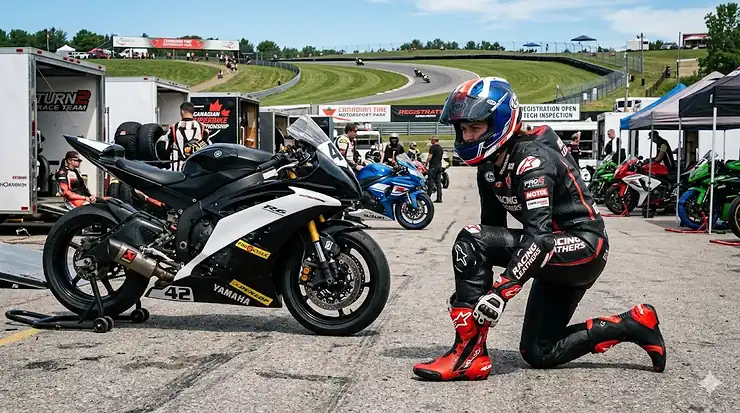
Let me be direct with you: showing up to a Canadian track day in your regular street shoes — or even a pair of casual ankle boots — is a fast track to being turned away at tech inspection. Track day motorcycle boots requirements exist for a very good reason. The human foot and ankle are catastrophically vulnerable at speed. At 100 km/h (62 mph), even a low-side slide can generate enough friction and torsional force to shatter bones, tear ligaments, and grind away skin in under a second.
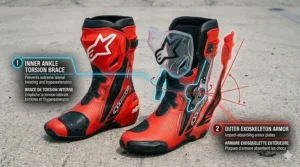
What most Canadian riders don’t realise is that track day boot requirements aren’t just about “wearing something tall.” They’re about specific structural features — torsional rigidity, impact absorption zones, CE certification levels, and ankle retention systems — that ordinary boots simply don’t provide. Understanding these requirements isn’t bureaucratic box-ticking; it’s the difference between walking away from a crash and being stretchered off.
For Canadian riders, this topic carries extra layers. Canada has no federal mandatory standard for motorcycle footwear — unlike Europe, where CE certification under EN 13634:2017 is a legal requirement for boots marketed as protective gear. That gap in Canadian regulation means the responsibility lands entirely on you to understand what protection you actually need. Meanwhile, many Canadian track day organizers — from Shannonville Motorsport Park in Ontario to Mission Raceway in BC — are increasingly aligning their gear requirements with international race standards, demanding CE-certified footwear or boots that meet equivalent structural benchmarks.
In this guide, I’ll break down exactly what track day motorcycle boots requirements look like in 2026, which CE certified racing boots Canada riders can buy on Amazon.ca, how to read those cryptic certification labels, and which boot suits which type of Canadian rider. Whether you’re a first-season novice heading to a FAST track day or an experienced clubracer logging laps at Canadian Tire Motorsport Park, this guide has you covered — completely.
Quick Comparison: Top 7 Track Day Racing Boots for Canadian Riders
| Boot | CE Level | Best For | Price Range (CAD) | Amazon.ca Available |
|---|---|---|---|---|
| Alpinestars Supertech R | Level 2 (2222) | Serious club racers | $850–$960 CAD | ✅ Yes |
| Dainese Axial 2 | Level 2 (2222) | MotoGP-style track riders | $700–$850 CAD | ✅ Yes |
| TCX RT-Race Pro Air | Level 2 (2222) | Hot-weather Canadian summers | $450–$550 CAD | ✅ Yes |
| Alpinestars SMX Plus V2 | Level 2 (2222) | Dual street/track use | $350–$450 CAD | ✅ Yes |
| Gaerne GP-1 Evo | Level 2 (2222) | Budget-conscious club riders | $280–$380 CAD | ✅ Yes |
| Forma Ice Pro Flow | Level 1/2 | Beginner track day riders | $230–$300 CAD | ✅ Yes |
| Sidi Rex Air | Level 2 (2222) | Long-term durability seekers | $500–$620 CAD | ✅ Yes |
Table Analysis: Looking at this comparison, the Alpinestars Supertech R and Dainese Axial 2 sit at the top of the protection pyramid but demand a serious investment — one that’s justified if you’re tracking regularly. Budget-minded Canadian riders will find the Gaerne GP-1 Evo delivers genuine Level 2 protection at a price that doesn’t require a second mortgage. Worth noting: Canadian pricing on all these boots typically runs $50–$120 CAD higher than US equivalents due to import duties and exchange rate differences — but you avoid cross-border shipping hassles, customs delays, and the warranty headaches that come with grey-market gear.
💬 Just one click — help others make better buying decisions too! 😊
✨ Don’t Miss These Exclusive Deals!
🔍 Take your track day safety to the next level with these carefully selected CE-certified racing boots. Click on any highlighted product to check current pricing and availability on Amazon.ca. These boots are engineered to protect you when it matters most!
Top 7 Track Day Racing Boots: Expert Analysis for Canadian Riders
1. Alpinestars Supertech R Boots — The Gold Standard
The Supertech R is what most serious Canadian track day organizers picture when they say “proper racing boots,” and it’s earned that reputation on the back of decades of MotoGP-level development.
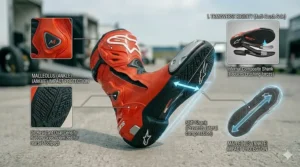
The standout feature here is the Biomechanical Ankle Brace — an internal bootie with two fibreglass-reinforced polyamide braces that act like hinges on each side of the ankle. What this means in practice: your ankle can flex naturally up and down, but is physically prevented from rolling sideways. During a crash, that lateral force is precisely what tears ligaments and shatters the talus bone. The dual-density microfiber upper achieves a Level 2 rating across all four EN 13634 categories (abrasion, impact cutting, transverse rigidity, and height), and replaceable TPU and aluminium toe sliders mean you’re not retiring the boot after your first low-side.
For Canadian riders logging frequent track sessions — think five or more days per season at Shannonville or Calabogie — this boot is the correct investment. Yes, the $850–$960 CAD price tag stings, but consider this: you’re buying a boot engineered alongside Marc Márquez’s race team, and the replaceable components mean you’ll get years of use before the boot is retired.
Customer feedback is overwhelmingly positive, with Canadian buyers frequently noting the fit improvement over previous Supertech generations and praising the slim profile that doesn’t fight against race suit cuffs.
✅ Dual-density construction with fibreglass ankle brace
✅ Replaceable sliders extend boot lifespan significantly
✅ Biomechanical system allows natural flex while blocking lateral roll
❌ Expensive — highest price point in this category on Amazon.ca
❌ Not comfortable for off-bike walking; purely a track tool
Price range: $850–$960 CAD — premium cost, premium protection, justified for regular club racers.
2. Dainese Axial 2 Boots — Italian Race Engineering in Boot Form
Dainese built the Axial 2 as their competition answer to Alpinestars’ Supertech, and the rivalry has produced something remarkable: a boot that MotoGP riders actually wear in World Championship rounds, available to Canadian track day riders on Amazon.ca.
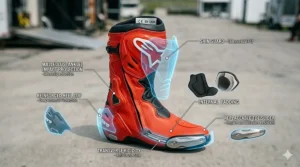
The construction centres on the D-Axial system — a carbon and aramid fibre external structure that prevents foot twisting during crash scenarios. In real terms, this rigid exoskeleton wraps around the outer boot and physically resists the rotational forces that snap ankles during high-side crashes. The D-Stone fabric upper (reinforced with microfiber and cowhide leather inserts) earns a full Level 2 rating, and replaceable magnesium sliders at the toe and heel provide serious abrasion resistance at ground contact points. One unique feature: the mono-boot attachment system, which lets the boot tuck inside your race suit rather than over it — improving aerodynamics and eliminating the gap where wind and debris can enter at speed.
Canadian track day riders who prioritize fit precision and Italian build quality over all else will gravitate toward this boot. The speed-lacing system makes getting the right fit quick and repeatable — useful when you’re rushing between sessions on a hot August day at CTMP.
Reviews from Canadian riders consistently highlight the exceptional fit and the tactile feedback through the sole, which preserves the feel of the pegs and controls even through the boot’s rigid structure.
✅ Carbon/aramid D-Axial torsional protection system
✅ Mono-boot design integrates with race suit for aerodynamic seal
✅ Replaceable magnesium sliders — built for long-term track use
❌ Fit runs narrow — Canadian riders with wide feet should size up
❌ Price-to-protection ratio slightly lower than Alpinestars Supertech R
Price range: $700–$850 CAD — serious racing boot at a serious price, but the Italian pedigree is genuine.
3. TCX RT-Race Pro Air Boots — The Ventilated Sweet Spot
Here’s a confession: most Canadian track day riders spend more time sweating through July and August track days at Shannonville or Calabogie than they do in cold conditions. The TCX RT-Race Pro Air exists specifically for those riders, and it solves a problem that the Alpinestars and Dainese flagships largely ignore — keeping your feet from becoming a sauna while still delivering full Level 2 protection.
The vented construction uses large mesh panels across the instep and ankle areas, combined with a ventilated microfiber upper, to create genuine airflow while maintaining CE Level 2 certification across all four EN 13634 categories. The torsional rigidity is provided by a dual-density injected frame at the ankle — you get the structural resistance to twisting forces without sacrificing the weight savings that come from ventilated construction. The ankle zone features reinforced TPU cups on both sides, and the heel counter is rigid enough to pass transverse rigidity testing with Level 2 results.
What makes this boot ideal for many Canadian riders is the price-to-protection ratio. You get legitimate Level 2 protection at $450–$550 CAD — roughly half the price of the Dainese Axial 2 — with ventilation that makes the Ontario summer season survivable. The compromise? The ventilated panels would let in water during spring or fall wet-track sessions, so if you’re riding in variable Canadian weather, pack a second pair of socks.
Buyers on Amazon.ca consistently rate the TCX RT-Race Pro Air among the best value racing boots currently available, with numerous track day regulars noting the comfortable break-in period versus race-spec boots from Alpinestars or Dainese.
✅ Full CE Level 2 across all four EN 13634 test categories
✅ Ventilated construction — a real advantage for summer Canadian track days
✅ Dual-density injected ankle frame provides solid torsional rigidity
❌ Not suitable for wet conditions; ventilation panels let in water
❌ Durability of mesh panels may be lower than full microfiber competitors
Price range: $450–$550 CAD — exceptional value for full Level 2 protection with ventilation.
4. Alpinestars SMX Plus V2 Boots — The Street-to-Track Bridge
Not every Canadian track day rider owns two pairs of boots. If you’re commuting to the track on your bike — realistic for many riders in Toronto, Vancouver, or Calgary — you need a boot that works on the street and still passes tech inspection. The Alpinestars SMX Plus V2 is that boot.
The SMX Plus V2 achieves CE Level 2 across all categories while maintaining enough walkability to handle parking lots, paddock walks, and the occasional coffee stop without looking absurd. The Multi-Link Control system — essentially a rigid rear internal frame that connects the heel and ankle area — provides meaningful torsional rigidity without the extreme stiffness of pure racing boots. The microfiber upper is thick enough to earn Level 2 abrasion resistance while remaining supple enough for walking. The replaceable TPU toe slider ensures you’re not retiring the boot after a minor tip-over.
For Canadian riders who track occasionally but primarily ride on the road, the SMX Plus V2 is the honest answer. It won’t give you the biomechanical ankle bracing of the Supertech R, but it passes the gear requirements at every Canadian track day I’ve researched, and it protects your feet on the ride home. The $350–$450 CAD price point is also the most accessible Level 2 option in the Alpinestars catalogue.
Canadian buyers frequently highlight the aerodynamic slim profile — the narrow shaft reduces wind drag at highway speeds, which is a genuinely noticeable benefit on longer sport-riding road trips between track days.
✅ CE Level 2 certified — passes track day gear requirements
✅ Practical enough for street use — commutable to the track
✅ Aerodynamic slim profile reduces drag at speed
❌ No dedicated biomechanical ankle brace — less protection than Supertech R
❌ Outsole wears faster than touring-oriented competitors
Price range: $350–$450 CAD — the most versatile option for dual street/track Canadian riders.
5. Gaerne GP-1 Evo Boots — Budget-Conscious Without Compromising Safety
The Gaerne GP-1 Evo proves that “budget” doesn’t have to mean “inadequate.” For Canadian riders entering their first track season without the budget for flagship Italian boots, this is the boot to buy.
The GP-1 Evo uses a full-grain leather upper — less technically advanced than microfiber composites but time-tested for abrasion resistance — combined with injected TPU ankle protectors on both sides and a rigid heel cup. The torsional rigidity comes from a structural backbone that runs the length of the boot and resists sole-to-upper separation under lateral loading. The result is a genuine CE Level 2 rating that satisfies track day boot requirements without demanding $700+ CAD from your riding budget. The Velcro-and-buckle closure system provides a secure fit without the complexity of internal lacing or bio-mechanical braces.
In my view, the GP-1 Evo is the most honest value proposition in track day boot buying. You’re not getting the exotic materials or the MotoGP lineage — but you’re getting certified Level 2 protection at roughly $280–$380 CAD, which means first-time track riders don’t have to choose between safe boots and, say, a proper leather suit.
Canadian customers note excellent durability, with many riders using the same pair for multiple seasons. The full-grain leather also holds up well to the variable spring and fall conditions Canadian riders experience before and after the summer track season.
✅ Full CE Level 2 certification — meets track day requirements
✅ Full-grain leather durability — long lifespan under regular use
✅ Best price-to-protection ratio in this roundup
❌ Heavier than microfiber competitors — noticeable on longer sessions
❌ Leather requires conditioning and maintenance to stay supple
Price range: $280–$380 CAD — the smart choice for new Canadian track day riders.
6. Forma Ice Pro Flow Boots — The Accessible Entry Point
The Forma Ice Pro Flow sits at the entry level of serious track day footwear, and it’s an important option for Canadian riders who are attending their first or second track day and want to meet gear requirements without overcommitting financially.
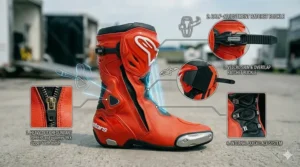
The Ice Pro Flow achieves CE certification with a combination of Level 1 and Level 2 ratings depending on the test category — it earns Level 2 in some areas and Level 1 in others, making it suitable for track days where the requirement is CE certification rather than a specific Level 2 mandate across all categories. The ventilated upper uses Forma’s proprietary Flow construction — large mesh zones bound by rigid TPU overlays — providing airflow while maintaining structural integrity. The ankle area includes reinforced cups and a rigid rear counter, and the sole passes transverse rigidity testing at the Level 1 threshold.
The honest assessment: if your track day organizer specifies “CE-certified over-the-ankle boots,” the Forma Ice Pro Flow qualifies. If the requirement is specifically “CE Level 2 across all categories,” you’ll want to step up to the Gaerne GP-1 Evo or higher. For most amateur track days in Canada — FAST, MRPS, or COMSCC events — the Ice Pro Flow meets the stated requirements and is a legitimate starting point.
Canadian buyers praise the excellent out-of-the-box comfort, noting it’s one of the few racing boots that doesn’t require an extended break-in period.
✅ CE certified — meets most Canadian track day gear requirements
✅ Excellent ventilation via Flow construction
✅ Most comfortable break-in experience in this category
❌ Not full Level 2 across all test categories — check your specific event requirements
❌ Less ankle torsional rigidity than mid-range competitors
Price range: $230–$300 CAD — accessible, CE-certified entry point for new track day riders.
7. Sidi Rex Air Boots — Built to Last a Decade
Sidi has a philosophy that sets them apart from nearly every other racing boot manufacturer: almost every external component on the Rex Air is replaceable. Buckles, sliders, heel cups, ankle protector inserts — all sold separately. For Canadian riders who log serious track time year after year, this means you’re not buying a new boot every two seasons; you’re maintaining the same boot indefinitely.
The Rex Air construction uses Technomicro microfiber — Sidi’s proprietary blend optimized for both abrasion resistance and flexibility — combined with an external ankle support brace on each side and a rigid torsional chassis through the sole. The “Air” version adds ventilation panels across the instep without compromising the Level 2 CE certification across all EN 13634 categories. The closure system uses four adjustable ratchet buckles, which provide a precise, repeatable fit that’s especially important if your foot volume changes slightly between cold-morning sessions and hot-afternoon sessions — a real consideration during Ontario summer track days.
The long-term cost analysis for the Sidi Rex Air is compelling. While the initial purchase in the $500–$620 CAD range is meaningful, the fact that you can replace buckles, sliders, and protectors means the total cost of ownership over five years is often lower than cheaper boots you’d replace twice.
Customer feedback from long-term users specifically calls out the unmatched durability and the satisfaction of maintaining a boot that improves with replacement parts rather than deteriorating to disposal.
✅ Fully replaceable external components — exceptional long-term value
✅ External ankle brace system provides excellent torsional support
✅ Level 2 CE with ventilation — best of both worlds
❌ Ratchet buckle system can require adjustment during initial sessions
❌ Higher upfront cost than mid-range competitors
Price range: $500–$620 CAD — the smartest long-term investment for serious Canadian track day regulars.
Understanding Track Day Motorcycle Boots Requirements: What Canadian Events Actually Demand
This is where most guides leave you hanging, and where I want to give you practical, actionable information.
What Track Day Organizers Actually Check
Canadian track day organizations — FAST (Fast And Safest Track days), MRPS (Mission Raceway Park Sessions), Calabogie Motorsports Park events, and Canadian Tire Motorsport Park track days — each publish gear requirements, and while the specific wording varies, the core expectations are consistent:
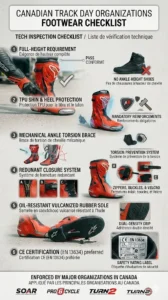
- Over-the-ankle coverage: The boot must extend above the ankle malleolus. This isn’t about the boot being “tall” aesthetically; it’s about the retention system holding the ankle during a crash. Boots that end at or below the ankle bone — no matter how expensive — won’t pass.
- Rigid construction: Soft leather or textile boots that bend easily side-to-side are typically rejected. Tech inspectors will physically twist the boot to assess torsional rigidity.
- No open-toe or open-heel designs: This eliminates sandals, loafers, and anything without a fully enclosed foot.
- CE certification (increasingly common): While not universally mandated, more Canadian track day organizations now specifically require CE-certified footwear — particularly at faster-paced “advanced” run groups.
The CE Level 1 vs. Level 2 Reality
CE certification is a conformity mark indicating that a product meets health, safety, and environmental protection standards. For motorcycle footwear, that standard is EN 13634:2017, which evaluates how well boots protect the foot, ankle, and lower leg during a crash. The presence of a CE mark signals compliance with minimum performance thresholds in key areas: transverse rigidity (resistance to crushing), abrasion resistance, and impact absorption.
What the label inside your boot actually means:
- “1 1 1 1” — Level 1 in all four categories: basic protection, suits street and casual track use
- “2 2 2 2” — Level 2 in all four categories: maximum certified protection, recommended for track days
- “IPA / IPS” — Optional ratings for impact protection at the ankle (IPA) and shin (IPS): these go beyond the mandatory tests and indicate certified impact protectors are fitted
For track day motorcycle boots requirements in Canada, aim for Level 2 across all four categories as your minimum target. Some beginner-friendly events accept Level 1, but as you progress to faster run groups or club racing, Level 2 becomes the baseline expectation.
What CE Testing Does NOT Cover
The testing doesn’t include ankle torsion protection, which means those malleolus protectors you see on boots aren’t necessarily tested or certified for preventing ankle injuries from twisting forces. This is critical: a boot can wear a “2 2 2 2” label and still offer minimal ankle torsional protection if the manufacturer hasn’t gone beyond the mandatory tests. This is why boots like the Alpinestars Supertech R (with its biomechanical ankle brace) and the Dainese Axial 2 (with its D-Axial carbon/aramid torsional system) stand apart — they go beyond CE compliance into genuinely engineered ankle protection.
How to Choose Track Day Motorcycle Boots in Canada: 5 Practical Criteria
Step 1: Confirm Your Event’s Specific Requirements
Before you buy a single boot, email or call your track day organizer and ask: “Do you require CE certification? What level? Is Level 1 acceptable for novice groups?” Canadian events vary. A FAST novice day may accept any over-the-ankle boot with rigid construction, while a club racing event at Shannonville may specifically require CE Level 2 with documented certification. This one step prevents expensive mistakes.
Step 2: Match Your Budget to Your Track Day Frequency
If you’re attending one or two track days per season, the $280–$380 CAD Gaerne GP-1 Evo or $230–$300 CAD Forma Ice Pro Flow is the sensible choice. If you’re doing five or more sessions per season — or entering club racing — the investment in Alpinestars Supertech R or Dainese Axial 2 is justified. The cost-per-use math changes dramatically with frequency.
Step 3: Consider Canadian Climate and Season Timing
Canada’s track day season runs roughly May through September in most provinces, with BC extending slightly longer. For the peak summer months (July–August), ventilated options like the TCX RT-Race Pro Air or Sidi Rex Air are worth the slight premium. For spring and fall sessions in cooler temperatures, the Gaerne GP-1 Evo’s full leather construction retains heat naturally without needing additional socks.
Step 4: Assess Street-to-Track Needs
Riding to the track on your own motorcycle is common in Canada — particularly for riders without trailers. If you’ll be covering significant highway distance before and after the track session, the Alpinestars SMX Plus V2’s walkability and aerodynamic profile make it the practical choice over a pure race boot you’ll be hobbling around in all day.
Step 5: Check the Certification Label Before You Buy
CE stands for Conformité Européenne — European Conformity — and the EN 13634:2017 standard tests four main performance areas: abrasion resistance, impact protection and puncture resistance, transverse rigidity, and height and retention systems. If a boot passes, it earns either a Level 1 or Level 2 CE rating. Look for this label on the interior tongue or lining of the boot — not on the packaging, not on the website description. If the manufacturer doesn’t show you the actual certification label in product photos, ask before buying.
Real-World Canadian Rider Profiles: Matching Boots to Your Situation
Profile 1 — The Toronto Commuter Who Tracks Twice a Year
Alex rides a Yamaha MT-07 daily in Toronto and attends two CTMP track days per season. The budget is under $500 CAD. Alex needs boots that work for the 45-minute highway ride to Bowmanville and pass tech inspection in the novice group.
Best choice: Alpinestars SMX Plus V2 — CE Level 2 certified, aerodynamic enough for the 401 slog, walkable enough for paddock coffee, and within budget. Alex doesn’t need biomechanical ankle bracing for twice-a-year track use; adequate Level 2 protection is the priority.
Profile 2 — The BC Weekend Club Racer
Maya races in BC club racing events at Mission Raceway and Chilliwack Airport every second weekend from May through September. The gear requirements are strict: CE Level 2 mandatory, documentation required at tech. Budget is flexible — Maya buys the right gear once.
Best choice: Sidi Rex Air — the replaceable component system means Maya won’t be buying new boots in three seasons, the ventilation handles BC’s warm summer track days, and the Level 2 certification with external ankle brace satisfies the stringent club racing requirements. The long-term math is the best of any boot in this guide.
Profile 3 — The Calgary First-Timer
Jordan is attending their first ever track day at Westerner Park next season. Budget is tight — under $350 CAD — and Jordan isn’t sure if track days will become a regular habit.
Best choice: Gaerne GP-1 Evo — genuine Level 2 protection at an honest price. If Jordan gets hooked on track days (they will), the Gaerne serves another season or two while the discretionary budget builds for an upgrade. If Jordan finds track days aren’t their thing, the financial commitment is manageable.
CE Certified Racing Boots Canada: What the Certification Label Actually Looks Like
This section answers a question I hear constantly from newer Canadian track day riders: how do I know if my boots are actually CE certified, versus just claiming to be?
Every garment or boot that has been CE certified will always have a booklet or label explaining which class it has been certified in. There will also be markings indicating which class of protection it provides and the standard against which it was tested. Care and maintenance instructions will also be provided.
A genuine EN 13634:2017 CE certification label shows:
- A pictogram of a motorcycle (not just a generic safety symbol)
- The standard number: EN 13634:2017
- A four-number sequence indicating performance level in each category (e.g., “2 2 2 2”)
- The CE mark itself
- Optional codes: IPA (ankle impact protection), IPS (shin impact protection), WR (water resistance), FO (fuel/oil resistance)
The EN 13634 standard is a European requirement. Boots sold exclusively in Canada are not legally required to be certified. This means many high-quality, protective boots from reputable brands may not have a CE label simply because the manufacturer did not pursue certification for that market. This is an important nuance for Canadian buyers: a non-CE-certified boot from a reputable brand may offer excellent real-world protection, but if your track day requires CE documentation, the absence of the label is a problem regardless of actual construction quality.
In Canada, there are no regulations on motorcycle footwear. In Europe, any protective motorcycle gear needs to have CE certification — a motorcycle boot that calls itself “protective equipment” needs to meet certain standards prior to sale. Footwear without a CE rating can be just as safe, or safer — boots sold within Canada and the USA aren’t required to pass the CE tests, so they often remain uncertified even though they’re extremely protective.
For track day compliance, it’s not about philosophical debates over protection levels — it’s about what the tech inspector requires. Carry the documentation, display the label, and you won’t have problems.
Race Organization Requirements: What Canadian Track Day Rules Actually Say
Different Canadian track day organizations operate under different rule sets, and knowing the specific language in their rulebooks saves embarrassment at tech inspection.
Club-level racing (WERA-affiliated, provincial clubs): These events operate under the most stringent requirements. Racing boots must be full-length, over-the-ankle construction with rigid ankle support. Riders may be required to bring leathers, boots and gloves as directed by tech inspection. At this level, CE Level 2 across all categories is the de facto expectation, and boots that are marginal — partially ventilated constructions with borderline rigidity scores — may be rejected at the discretion of the technical inspector.
Organized track days (FAST, MRPS, similar): Requirements typically state over-the-ankle boots with protective construction. CE certification is increasingly requested but varies by organizer and run group level. Novice groups may have more lenient interpretations; advanced groups typically require demonstrable protection quality.
A practical note on Canadian track days and gear requirements: As the Wikipedia entry on track days notes, track days are organized events where participants operate without speed restrictions — which is precisely why equipment standards matter. The liability exposure for organizers who allow inadequate gear is substantial, and Canadian organizers are tightening requirements accordingly.
When in doubt, contact the organizer before the event. Arrive at tech inspection with CE certification documentation accessible (a photo of the label on your phone is sufficient at most events), and choose boots from this guide with verified Level 2 ratings.
Common Mistakes Canadian Riders Make Choosing Track Day Boots
Mistake 1: Buying Street Boots and Assuming They Qualify
“But they’re over the ankle!” is the most common argument I hear from riders who got turned away at tech. Over-the-ankle height is the starting point, not the whole requirement. A Chelsea boot, a military-style combat boot, or even many “sport touring” motorcycle boots lack the torsional rigidity and impact absorption that track day requirements demand. If the boot flexes easily side-to-side when you hold the heel and try to twist the toe, it’s not a track day boot.
Mistake 2: Relying on “Meets CE Standards” Claims Without the Label
Some boots — particularly at the lower end of the market — use phrases like “designed to meet CE standards” or “CE-equivalent protection” in their marketing. These are meaningless without the actual EN 13634:2017 label inside the boot. Independent testing certification requires laboratory verification; marketing copy requires only a copywriter. Avoid boots without visible CE labels or those claiming “meets CE standards” without test documentation.
Mistake 3: Ignoring Canadian Winter Storage Impact on Boot Condition
This is a genuinely Canada-specific mistake that European or American gear guides don’t cover. Many Canadian riders store their boots in unheated garages through the -20°C (-4°F) winters, which can degrade the adhesives in sole construction, dry out leather, and embrittle TPU components. Before your first spring track day, inspect your boots carefully: check sole-to-upper bond integrity, condition any leather with appropriate product, and check that buckles and closures function smoothly. A boot that passed tech inspection in September may not pass in May if it’s been through a harsh Alberta winter without care.
Mistake 4: Ignoring Suit-to-Boot Integration
Race suits and racing boots are designed as a system. Many race-spec boots — particularly the Dainese Axial 2’s mono-boot system and the tall cuff designs on Alpinestars’ flagship boots — are designed to tuck inside the suit’s leg. If you buy race boots and then try to wear them with a street jacket and pants, you’ll have a functional but suboptimal setup. For riders who primarily use leather one-piece suits, prioritize boots with IN-style construction. For riders in two-piece suits, over-the-cuff boots with secure ankle retention work equally well.
Mistake 5: Sizing Based on Street Shoe Size
Racing boots typically fit differently than street footwear. Alpinestars and Dainese sizing runs slightly small compared to casual shoes. TCX and Sidi sizing tends to be more consistent with European street shoe sizing. Always check the brand’s specific size chart — not a generic motorcycle boot chart — and if you’re between sizes, go up for racing boots. A boot that’s slightly loose is easier to lace/buckle tighter; a boot that’s too small compresses the foot during long sessions, causing numbness and distraction.
FAQ: Track Day Motorcycle Boots Requirements in Canada
❓ Are CE-certified racing boots legally required in Canada for track days?
❓ What does the '2 2 2 2' number sequence on a boot label mean?
❓ Can I use my regular motorcycle touring boots for a track day in Canada?
❓ Do track day boot requirements differ between BC, Ontario, and other provinces in Canada?
❓ Will Amazon.ca ship track day racing boots to remote northern communities in Canada?
Conclusion: Invest in Track Day Boot Requirements Before Your First Session
Track day motorcycle boots requirements exist because the consequences of inadequate foot and ankle protection at speed are severe and permanent. The good news for Canadian riders: the market in 2026 offers excellent options at every price point, from the entry-level Forma Ice Pro Flow around the $230–$300 CAD range to the championship-proven Alpinestars Supertech R in the $850–$960 CAD territory. All seven boots in this guide are available on Amazon.ca, all carry CE certification, and all represent a significant upgrade over street footwear for track use.
My overall recommendation for most Canadian riders: if you’re attending track days two or more times per season and have the budget, the Alpinestars SMX Plus V2 offers the best balance of certified protection, street utility, and value at the $350–$450 CAD level. If budget is tight, the Gaerne GP-1 Evo delivers genuine Level 2 protection without compromise. If you’re seriously committed to the track, the Alpinestars Supertech R or Sidi Rex Air are the correct long-term investments.
Whatever you choose, check the CE label, confirm your event’s specific requirements, and get your feet into the right boots before you go anywhere near a hot pit lane. Track days are among the most rewarding experiences motorcycling offers — the right gear means you’ll keep enjoying them for seasons to come.
✨ Don’t Miss These Exclusive Deals!
🔍 Ready to gear up for your next Canadian track day? Click on any highlighted boot in this guide to check current pricing and availability on Amazon.ca. Your ankles will thank you! 🏁🇨🇦
Recommended for You
- 7 Best All-Season Waterproof Motorcycle Boots in Canada (2026)
- Best Rain Motorcycle Boots Vancouver Commute 2026 | Canada
- Gore-Tex vs Sympatex Motorcycle Boots: 7 Top Canadian Picks 2026
Disclaimer: This article contains affiliate links. As an Amazon Associate, I earn from qualifying purchases. If you purchase products through these links, we may earn a small commission at no additional cost to you.
✨ Found this helpful? Share it with your riding friends! 💬🤗
