

In This Article
So you’re standing in your gear room — or more likely, squinting at Amazon.ca at midnight — trying to figure out whether you need sport touring boots or race boots. It’s one of the most genuinely confusing decisions in motorcycle gear, and I get it. Both categories look aggressive, both promise protection, and both can cost you several hundred dollars CAD. But they are built for completely different jobs.
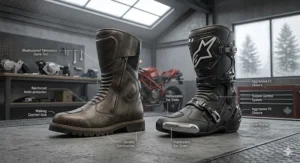
The core difference between sport touring boots vs race boots comes down to one word: compromise. Sport touring boots are built around the idea that you’ll be riding to the café, commuting through a Toronto downpour, or blasting 400 km of Trans-Canada highway — and then actually walking around at the other end. Race boots, by contrast, exist for one purpose: to keep your foot intact when things go very wrong at triple-digit speeds. Everything else — waterproofing, walkability, warmth — is secondary or simply absent.
For Canadian riders, this distinction matters more than almost anywhere else. Our riding season is short — typically May through October in most provinces, shorter in the Prairie regions — which means you need gear that performs hard during those precious months. You want boots that can handle early-season cold (think 5°C mornings outside Ottawa), mid-summer track days at Canadian Tire Motorsport Park, and late-season wet roads in Vancouver. Understanding sport touring boots vs race boots is the first step to making the right call for your riding life.
Throughout this guide, I’ll break down the seven best options available to Canadian buyers, explain what the specs actually mean in the real world, and help you figure out which direction suits your riding style — whether you’re a weekend track warrior, a daily commuter, or somewhere in between.
Quick Comparison: Sport Touring Boots vs Race Boots at a Glance
| Feature | Sport Touring Boots | Race Boots |
|---|---|---|
| Primary Use | Street, commuting, long-distance | Track, circuit, aggressive sport riding |
| Waterproofing | Usually yes (Gore-Tex or Drystar) | Rarely — often vented |
| Walkability | Good to excellent | Poor — stiff and awkward |
| Toe Slider | Sometimes (replaceable) | Always (magnesium or TPU) |
| Shifter Feel | Good | Exceptional — thin sole design |
| CE Certification | Level 1 or 2 | Level 1 or 2 (often higher spec) |
| Weight | Moderate | Lighter (for performance) |
| Canadian Climate Suitability | Excellent year-round | Best for summer track days |
| Price Range (CAD) | $300–$700 range | $400–$900+ range |
| Best For | All-season Canadian riders | Dedicated track/sport riders |
The table above tells a clear story: if you’re riding most days in Canada and need boots that work in rain, cold, and commuter traffic, sport touring is your category. If you’re booking track days at Shannonville Motorsport Park or Circuit ICAR and want the absolute best precision feedback control and protection, race boots are your answer. Many experienced Canadian riders actually own both — a practical touring pair for the street and a dedicated race boot for track days. That said, if budget is a concern (and in Canada, gear prices can run 20–30% higher than US equivalents due to exchange rates and import duties), the right sport touring boot can handle both worlds respectably.
💬 Just one click — help others make better buying decisions too! 😊
✨ Don’t Miss These Exclusive Deals!
🔍 Take your riding to the next level with these carefully selected motorcycle boots. Click on any highlighted item to check current pricing and availability on Amazon.ca. These picks will give you the protection and performance your rides deserve!
Top 7 Sport Touring and Race Boots: Expert Analysis for Canadian Riders
1. Alpinestars SMX-6 V2 Drystar
If there’s one boot that perfectly embodies the sport touring boots vs race boots debate, it’s this one — and it walks the line with surprising skill. The SMX-6 V2 Drystar is built around Alpinestars’ proprietary Drystar membrane, which provides waterproofing without the bulk of a Gore-Tex insert. In practical terms, that means you can ride through a typical Vancouver October drizzle without ruined socks, while still feeling the bike’s controls under your feet.
The CE-certified TPU lateral ankle brace runs from the shin down to the foot structure — and this isn’t just a marketing spec. That brace is the reason your ankle doesn’t hyperextend in a lowside crash. Coupled with a high-modulus TPU shin guard, heel counter, and integrated toe slider, you get genuine track-day-level protection wrapped in a boot you can actually walk a city block in. The compound rubber sole is thick enough for comfort on pavement but thin enough that you can feel the shifter and rear brake with good precision feedback control.
What most Canadian buyers overlook: the Drystar liner actually performs better in cool temperatures (under 15°C) than Gore-Tex equivalents, because it doesn’t trap as much internal heat. For spring and fall riding in most Canadian provinces, this is an underrated advantage. The shifter pad is also high-modulus TPU, meaning it won’t wear through after a season of aggressive gear changes the way softer materials do.
Canadian reviewers on Amazon.ca consistently mention the fit runs slightly narrow in the toe box — worth going up half a size if you have wider feet. Prime-eligible for most provinces; remote northern areas may see extended delivery.
✅ CE-certified with genuine ankle brace protection
✅ Drystar waterproofing works in Canadian rain and cold
✅ Integrated toe slider for track day crossover use
❌ Narrow toe box — size up if you have wide feet
❌ Not Gore-Tex — in sustained heavy rain, eventually less waterproof than GTX equivalents
Price range: $350–$480 CAD — strong value for a boot that bridges street and track use.
2. Alpinestars Toucan Gore-Tex
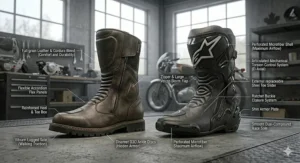
If the SMX-6 is the sporty commuter, the Toucan Gore-Tex is the long-haul touring workhorse that no Canadian should overlook. This boot is genuinely available on Amazon.ca in multiple sizes, and it’s built for the kind of riding most of us actually do: long days, variable weather, and the occasional gravel road outside a provincial park.
The 100% waterproof Gore-Tex lining here is the real deal — not a “water-resistant” coating that gives up after 20 minutes of steady rain. Canadian riders doing Iron Butt-style distances or touring through coastal BC know the difference. The lateral ankle protection features a bio-mechanical link between the upper boot and the lower foot structure — that’s the key engineering detail that separates this from a fashion touring boot. Your ankle has a mechanical guide keeping it in its natural range of motion during a crash, not just foam padding hoping for the best.
The steel shank midsole is another underrated spec. On a long ride — say, 600 km from Calgary to Jasper — a steel shank prevents “pegging fatigue,” where the ball of your foot aches from hours of pegs pressure. The replaceable sole is also worth noting: rather than buying new boots when the sole wears out, you can have them resoled, which matters when the Canadian dollar makes replacement gear expensive.
The closure system uses polymer buckles with aluminum frames and self-aligning quick-release closures — meaning you can put them on and take them off in a gas station parking lot without looking ridiculous.
✅ 100% Gore-Tex waterproofing — true all-weather performance
✅ Steel shank midsole — essential for long-distance Canadian touring
✅ Replaceable sole adds long-term value in CAD terms
❌ Less track-day precision than purpose-built sport boots
❌ Bulkier profile — not ideal under close-fitting race-cut pants
Price range: $380–$520 CAD — excellent value when you factor in the replaceable sole longevity.
3. Alpinestars Supertech R Vented
Now we’re firmly in race boot territory. The Supertech R Vented is Alpinestars’ flagship track boot and — bluntly — it is a different category of object compared to everything above. The laser-perforated microfiber upper, co-injected TPU/aluminum replaceable toe sliders, and separate biomechanical inner bootie represent the current state of the art in motorcycle foot protection.
That internal bootie is the key. Two fiberglass-reinforced polyamide braces act as hinges on each side of your ankle, allowing natural up-and-down movement while mechanically preventing dangerous lateral twisting. In a highside at track speed, your ankle needs that external skeleton — no amount of foam padding provides the same structural protection. For riders doing track days at Shannonville, Calabogie Motorsport Park, or Circuit Mont-Tremblant, this level of protection is what you should be targeting.
The vented construction means there’s no waterproof membrane — this is a summer track boot, full stop. Wearing these on a cold April morning outside Montreal will be miserable. This is a boot you pack in your track bag, swap into at pit lane, and swap out of when you’re back in the paddock. The lightweight racing boots feel shifter is exceptional — the thin, compound rubber Michelin-inspired sole gives you feedback through the footpeg that touring boots genuinely cannot match.
The co-injected TPU/aluminum replaceable toe sliders are certified CE Level 2, and you can verify the current availability of the Supertech R Vented on ca.alpinestars.com. Note that while these can sometimes be found through Amazon.ca marketplace sellers, premium sizing tends to sell through quickly — checking Alpinestars Canada direct is advisable.
✅ Biomechanical inner bootie — best-in-class ankle protection
✅ Replaceable slider pucks in aluminum/TPU — track regulation compliant
✅ Exceptional precision feedback control and shifter feel
❌ Zero waterproofing — purely a summer/track boot
❌ Premium price range — at the top of the $700–$900 CAD bracket
Price range: $700–$900 CAD — an investment, but justified if you’re on track regularly.
4. TCX RT-Race Pro Air
The TCX RT-Race Pro Air is the boot that genuinely democratizes race-level protection in Canada. Developed in collaboration with MotoGP riders and manufactured at TCX’s facility in Italy, it brings a suite of professional features into the $400–$550 CAD range — a meaningful price advantage over Alpinestars’ flagship in Canadian dollar terms.
The Double Flex Control system is TCX’s answer to the biomechanical ankle brace: a polyurethane joint in the ankle area that controls movement to the millimetre, preventing dangerous twisting while allowing natural rider movement. The Fasten Fit Control internal lacing system — connected to the boot lining through a quick-slide lace — gives you a completely customizable fit around the foot and ankle. This matters enormously for precision feedback control: a boot that fits like a glove transmits far more information from the peg to your brain than one with any internal movement.
The magnesium replaceable slider pucks on the toe and heel are genuinely premium-grade spec for this price point. Magnesium is lighter and stronger than standard polyurethane sliders, and more abrasion-resistant during a track slide. The Michelin dual-compound “Burnout” sole was co-developed with Michelin’s research centre and delivers grip areas specifically designed to interface with footpegs, the shifter lever, and the rear brake pedal — the lightweight racing boots feel shifter quality here is genuinely exceptional.
The Air Tech breathable mesh lining keeps the boot cool during summer track days; no waterproofing, which is the correct decision for a race-focused boot. Canadian track-day riders consistently rate this boot highly for fit-to-performance value. Available through Amazon.ca marketplace sellers and Canadian moto retailers like GP Bikes and FortNine (with pan-Canadian shipping).
✅ MotoGP-developed Double Flex Control ankle protection
✅ Magnesium replaceable slider pucks — premium spec at this price
✅ Michelin sole for exceptional shifter and peg feel
❌ Not waterproof — street use in Canadian rain is uncomfortable
❌ Sizing can run slightly small — order up if between sizes
Price range: $400–$550 CAD — the best performance-to-price race boot for Canadian buyers.
5. Alpinestars SMX-6 V3 Vented
The SMX-6 V3 Vented is the hot-weather, performance-focused evolution of the V2 Drystar reviewed above — and it answers a specific Canadian riding problem: what do you wear on a 35°C July day in the Okanagan or Southern Ontario when waterproofing would just make your feet sweat profusely?
Without a waterproof liner, the V3 Vented runs significantly cooler in summer heat, while retaining the CE-certified ankle brace, TPU shin guard, heel counter, and integrated replaceable toe sliders of its Drystar sibling. The updated V3 construction refines the flex zones across the foot and ankle, giving slightly improved precision feedback control compared to the V2 — useful if you’re mixing sport street riding with occasional track days. The compound rubber sole is revised for better grip across a broader temperature range, which in Canada means everything from 8°C spring mornings to 38°C July afternoon rides.
This is the boot I’d recommend to a Canadian rider based in, say, Hamilton or Kelowna who does primarily sport street riding with one or two track days per season. It’s versatile enough for both, light enough to not punish you in summer heat, and protective enough to qualify as genuine riding gear rather than streetwear cosplay. It won’t handle a monsoon ride home from work — keep a pair of waterproof overshoes in your kit — but for dry-season riding, the performance vs practicality balance is excellent.
Available on Amazon.ca in a range of sizes; Prime shipping applies for most provinces.
✅ Summer-optimized — no liner bulk in 30°C+ heat
✅ Retains full CE-certified ankle/shin/toe protection
✅ Versatile sport street + occasional track use
❌ No waterproofing — not an all-season Canadian boot
❌ Less protection than purpose-built full race boots
Price range: $320–$430 CAD — excellent mid-tier value for warm-season sport riders.
6. Dainese Axial 2 IN
Dainese’s Axial 2 IN is the choice for Canadian riders who prioritize race suit integration alongside maximum protection. The “IN” designation means the boot is designed to tuck inside racing leathers — the velcro cuff system and low-profile top collar seat cleanly under a race suit without creating pressure points or bulk. For anyone heading to a race school or proper track day with full leathers, this is a detail that matters considerably.
The polyurethane shells with replaceable sliders are CE Level 2 certified and cover the toe, heel, and lateral ankle zones. The REX-style lacing system threads through internal guides to cinch the boot firmly around the foot without external hardware that could snag on controls. Split cowhide leather inserts on high-wear areas add abrasion resistance beyond what microfiber can provide — particularly relevant if you’re running full race-pace laps where sustained lean angle puts real stress on boot materials. The stretch fabric cuff improves comfort over longer sessions without compromising the secure fit.
Where this boot stands out specifically for Canadian buyers is the Dainese brand’s robust warranty support through Canadian dealers. Unlike some European brands where warranty claims require shipping to international service centres, Dainese has established Canadian dealer relationships that make service more straightforward — important when you’re spending $600+ CAD on footwear. Note that the Axial 2 IN’s pricing on Amazon.ca through third-party sellers can vary considerably; verifying current stock directly on Amazon.ca before purchasing is recommended.
✅ CE Level 2 certified — premium crash protection
✅ “IN” construction integrates perfectly with racing leathers
✅ Cowhide leather inserts for superior abrasion resistance
❌ Suit-specific design limits standalone street wearability
❌ Premium price tier — expect to budget in the $580–$750 CAD range
Price range: $580–$750 CAD — worth it for track-focused riders already invested in Dainese leathers.
7. PROFIRST Short Ankle Leather Motorbike Boots (CE Approved)
Not every Canadian rider needs to spend $500+ CAD on boots, and the PROFIRST Short Ankle boots earn their spot on this list as the budget-accessible, Amazon.ca-native option that genuinely works for new and casual riders. These CE-approved, genuine leather boots are consistently available on Amazon.ca with Prime shipping across most provinces, and they represent the best entry point into proper motorcycle footwear for riders who aren’t yet ready to commit to premium prices.
The genuine leather construction provides real abrasion resistance — not the faux-leather or synthetic materials that disintegrate on contact with asphalt. CE approval means they’ve passed the European standard for motorcycle footwear protection, including impact protection and transverse rigidity tests. The short ankle design makes them comfortable to walk in — considerably more practical than any race boot for commuters or urban riders. The anti-slip sole performs well on typical Canadian pavement, including the wet, leaf-covered surfaces of autumn riding season.
The honest assessment: these don’t have the ankle pivot systems, replaceable slider pucks, or biomechanical bracing of premium options. They are street riding boots for riders doing urban commuting and weekend road trips, not track days. For someone transitioning from sneakers to proper gear — a surprisingly common situation among newer Canadian riders — these punch well above their weight class. Canadian buyers on Amazon.ca report good sizing accuracy and solid build quality for the price point.
✅ Genuine leather with CE approval — real protection at entry-level price
✅ Prime-eligible on Amazon.ca — fast delivery across most provinces
✅ Walkable, comfortable for commuting and urban riding
❌ No ankle pivot system or biomechanical brace
❌ Not waterproof — Canadian rain will reach your socks
Price range: $120–$200 CAD — the accessible starting point for new Canadian riders prioritizing safety over budget sneakers.
How to Choose Sport Touring Boots vs Race Boots in Canada: A Practical Framework
This is the section Amazon product listings will never give you — the actual decision logic for choosing between these two categories based on your specific Canadian riding life.
Step 1: Audit your actual riding. Be honest about what percentage of your riding is street vs. track. If you’ve been to a track day once in the last three years, you do not need dedicated race boots. A sport touring boot with replaceable toe sliders will serve you better 95% of the time and keep your feet dry the other 95%.
Step 2: Consider your Canadian season length. Riders in southern BC and Southern Ontario may have a 7-month season. Riders in Saskatchewan or the Maritimes might have 4–5 months. The shorter your season, the more you need a versatile boot that maximizes every riding day — which tips the scale toward sport touring.
Step 3: Assess your weather reality. If your average riding morning involves checking the forecast before deciding, sport touring with waterproofing is the practical call. If you only ride in confirmed dry conditions and you’re booking track days, a vented race boot makes sense.
Step 4: Think about the shifter feel honestly. Here’s the truth most gear guides won’t tell you: on the street, you will not feel the difference in precision feedback control between a quality sport touring boot and a race boot. You’d have to be riding at an extremely aggressive pace, consistently, to notice it. On a closed track, the difference is real and meaningful. So: are you actually on track? If yes, invest in the race boot. If you’re a street rider who likes the aesthetic, the sport touring boot gives you 85% of the performance and 100% more practicality.
Step 5: Price in the Canadian premium. Budget roughly 20–30% more than US retail for most premium brands due to exchange rates, import duties, and Canadian distribution costs. Factor that into your total gear budget rather than being surprised at checkout.
Step 6: Check Amazon.ca availability before committing. Not every model available on Amazon.com ships to Canada or ships without significant duty charges. Verify the product is sold and fulfilled on Amazon.ca, or budget accordingly through Canadian dealers like FortNine or GP Bikes.
Step 7: Consider buying both — eventually. Many experienced Canadian riders end up with a touring boot for the street and a race boot for track days. If budget allows, that’s genuinely the optimal solution rather than trying to force one boot to do two jobs perfectly.
Real-World Scenarios: Which Boot for Which Canadian Rider?
Understanding performance vs practicality in the abstract is one thing; matching it to actual rider profiles brings the decision to life.
Profile 1: The Toronto Daily Commuter / Weekend Sport Rider Sarah rides a Kawasaki Z900 in the GTA — 25 km each way to work, spring through October, with weekend blasts along Highway 7. She needs a boot that handles rain (because Toronto weather is unreliable at best), looks reasonable walking into her office building, and provides real crash protection. The Alpinestars SMX-6 V2 Drystar or Alpinestars Toucan Gore-Tex are her correct picks. Race boots would make her commute miserable and her workplace walk embarrassing. The sport touring category was literally built for her.
Profile 2: The Calabogie Track-Day Regular Marcus owns a Yamaha R6 in Ottawa and books 6–8 track days per year at Calabogie Motorsport Park. He rides to and from the track on street tires with street gear, changes to race leathers at the paddock. He’s exactly the rider who should own both — sport touring boots for the ride there and back, and a set of TCX RT-Race Pro Air or Alpinestars Supertech R Vented boots for on-track use. The precision feedback control and replaceable slider pucks make a measurable difference at pace. The investment is justified across a season of regular track use.
Profile 3: The Vancouver Island Adventure Tourer Dave rides a BMW S1000XR from Victoria, frequently heads up-island through rain, and occasionally attends sport riding days at Pacific Raceways. He’s the rider who benefits most from a high-end sport touring boot — the TCX RT-Race Pro Air isn’t right (no waterproofing, track-only), but the Alpinestars SMX-6 V2 Drystar or Alpinestars Toucan Gore-Tex hits his needs precisely. British Columbia coastal riding demands waterproofing above almost everything else. Performance vs practicality tips entirely toward practicality on Vancouver Island.
Profile 4: The Saskatchewan New Rider Priya just passed her motorcycle license in Regina and bought a Honda CB500F. Budget is tight, and she wants proper boots without spending half a month’s rent. The PROFIRST CE Approved boots from Amazon.ca are the correct starting point — real leather, CE certification, Prime shipping to Saskatchewan, and a price that doesn’t require financing. She’ll graduate to better boots in a season or two, but she’s protected right now, which is what matters.
What Sport Touring Boots vs Race Boots Actually Feel Like: Specs Into Real Experience
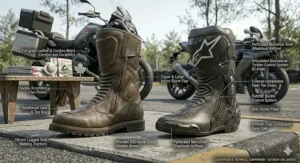
The spec sheet will tell you a race boot has a “thin compound rubber sole.” What it won’t tell you is that this thin sole means you can feel every tooth on the sprocket spinning beneath the footpeg — a slightly unnerving but ultimately useful sensation when you’re trail-braking into a corner and want confirmation your rear brake input is consistent. That’s what lightweight racing boots feel shifter precision actually means in practice: your foot communicates with the motorcycle like a second nervous system.
A sport touring boot, by contrast, has a more substantial midsole — the kind that won’t leave your metatarsals screaming after 500 km of highway pegs. According to motorcycle safety researchers, foot and ankle injuries are among the most common in motorcycle crashes, with ankle fractures accounting for a significant proportion of serious trauma. The ankle pivot systems in modern race and sport touring boots directly address this statistic. The key engineering difference is how they address it: race boots use rigid mechanical braces that essentially replace the mechanical function of your ligaments; touring boots use a lighter brace system that guides and supports rather than rigidly constrains.
This translates to a real experience difference. Put on a quality race boot and your ankle feels mechanically held in place — stable, but slightly inflexible. Put on a sport touring boot and your ankle moves more naturally, which makes walking comfortable but means the protection in a crash is somewhat less absolute. Neither is wrong; they’re calibrated for different risk profiles and different uses.
Canadian riders also need to consider thermal performance. Race boots with no waterproof liner and mesh construction can be genuinely cold below 10°C — and in most Canadian provinces, early-season riding frequently happens at those temperatures. A race boot on a 7°C April morning in Québec or Ontario isn’t just uncomfortable; it’s a safety concern, because cold feet lose proprioceptive sensitivity. Your fine motor control of the rear brake and shifter degrades when your feet are numb. A waterproof, insulated sport touring boot maintains foot temperature and dexterity in conditions that would make a vented race boot impractical.
For authoritative guidance on motorcycle safety standards and CE certification requirements relevant to Canadian gear purchases, Transport Canada’s road safety resources at tc.gc.ca provide useful background on motorcycle safety standards applicable to Canadian roads. The CE EN13634 standard, which governs the certification of most premium motorcycle boots, is explained clearly at Wikipedia’s motorcycle personal protective equipment page.
✨ Don’t Miss These Exclusive Deals!
🔍 Canadian riders: get the right boot for your riding style. Click any highlighted product to check current pricing and availability on Amazon.ca. Don’t let gear be the reason a perfect riding day goes wrong!
Common Mistakes When Buying Motorcycle Boots in Canada
Mistake 1: Buying race boots for street use because they look cooler. Race boots are engineered around the assumption that you’ll be sitting on a motorcycle virtually the entire time you’re wearing them. The stiff sole, the rigid ankle brace, the low walkability — none of this is a defect; it’s deliberate design for track use. Wearing them for a day of sport street riding means an increasingly miserable walking experience at every fuel stop. Buy the boot that matches your actual riding, not your aspirational self-image.
Mistake 2: Assuming Amazon.ca and Amazon.com have identical stock. They don’t. Several premium race boots are listed on Amazon.com but not available on Amazon.ca, or are listed by third-party sellers with significant shipping charges and customs implications. Always verify the “Ships from and sold by Amazon.ca” designation, or factor in duty costs if ordering cross-border. Canadian riders sometimes find better availability and warranty support through FortNine or GP Bikes for premium gear.
Mistake 3: Ignoring CE certification level. There are two levels of CE EN13634 certification: Level 1 and Level 2. Level 2 is demonstrably superior in impact protection, transverse rigidity, and abrasion resistance. On a budget, Level 1 is acceptable; if you’re spending $400+ CAD, demand Level 2. The certification level should appear on the boot’s hang tag and is usually specified in the product listing.
Mistake 4: Overlooking Canadian winter storage impact on boot materials. Leather and microfiber motorcycle boots stored in a cold, unheated garage through a Canadian winter — particularly in provinces like Manitoba or Northern Ontario where temperatures hit −30°C — can develop micro-cracks in the materials that compromise both comfort and protection. Store boots indoors, and treat leather uppers with a conditioner before storage. This isn’t in any Amazon product description, but it’s the difference between boots lasting two seasons and boots lasting ten.
Mistake 5: Skipping the sizing process. European sizing in motorcycle boots often runs differently from North American shoe sizes, and different brands have genuinely different lasts (the mould around which the boot is constructed). Alpinestars and TCX tend to run slightly narrow; some Dainese models run wide. If you’re ordering through Amazon.ca where easy returns are available, order your standard size and the next size up on the first purchase. Getting the right fit is not vanity — it’s safety, because a loose boot compromises the ankle brace system’s effectiveness.
Long-Term Cost and Maintenance in Canada
Let’s talk total cost of ownership in CAD, because Canadian riders face economic realities that make this calculation more important than it might seem for American buyers.
The exchange rate typically means Canadian prices run 20–30% higher than US MSRP. A race boot listed at $600 USD might land in the $780–$840 CAD range, depending on duty and the specific retailer. This is significant when you’re equipping yourself fully for a riding season that also demands jacket, helmet, gloves, and pants.
Sport touring boots: total cost analysis. A quality sport touring boot in the $380–$550 CAD range, properly cared for, should last 5–8 years for a typical Canadian rider putting on 8,000–15,000 km per season. That works out to $50–$110 CAD per year of use — remarkably good value per day of riding. Key maintenance: clean regularly, treat leather or microfiber with appropriate conditioners (Nikwax is widely available at Canadian Tire and MEC), replace buckles if they break (many are available as spare parts), and never store compressed with other gear in a way that distorts the ankle protection structures.
Race boots: total cost analysis. A premium race boot in the $600–$900 CAD range used for 6–8 track days per year, with proper storage and maintenance, can easily last 4–7 years. The replaceable slider pucks are an ongoing cost ($30–$60 CAD per set, depending on brand) but extend the boot’s usable life considerably. The key cost-saving maintenance step: replace sliders before they wear through to the boot body. Once the underlying microfiber or leather wears through at the toe, the structural protection in that zone is compromised.
Warranty in Canada: Always check whether the brand’s warranty applies in Canada as clearly as it does in the US. Most major brands (Alpinestars, TCX, Dainese, Sidi) have Canadian distribution arrangements that honour warranties through authorized dealers. Purchasing from unverified third-party Amazon.ca sellers can sometimes void warranty coverage — check the seller status before purchasing premium gear. The Competition Bureau of Canada and Canadian consumer protection law provide additional recourse, but a clear warranty through a Canadian-authorized channel is always preferable.

FAQ: Sport Touring Boots vs Race Boots for Canadian Riders
❓ Can I use race boots for everyday street riding in Canada?
❓ Are sport touring boots street legal for track days in Canada?
❓ How do replaceable slider pucks work and why do they matter?
❓ Do I need to worry about CE certification when buying boots on Amazon.ca Canada?
❓ Which sport touring or race boots ship fastest to remote Canadian areas?
Conclusion: Making the Right Call for Your Canadian Ride
The sport touring boots vs race boots decision ultimately comes down to a simple question: are you building a kit for Canadian life, or building a kit for the track? Canadian life means rain in Vancouver, cold in Calgary, salt on Toronto roads, and a season that doesn’t offer the luxury of single-purpose gear for most riders. Race boots are extraordinary tools for their specific environment — and genuinely the wrong choice for 80% of Canadian riders’ day-to-day riding.
My recommendation: start with a quality sport touring boot. The Alpinestars SMX-6 V2 Drystar is the benchmark mid-range pick for most Canadian riders. The Alpinestars Toucan Gore-Tex serves long-distance tourers who need uncompromising waterproofing. Once you’re logging regular track days and know that precision feedback control and replaceable slider pucks are performance tools you actually use, the TCX RT-Race Pro Air delivers race-level performance at a Canadian-friendly price point, and the Alpinestars Supertech R Vented represents the pinnacle of the category if budget allows.
For new riders on a budget: don’t ride without certified footwear. The PROFIRST CE Approved boots on Amazon.ca put real protection on your feet at an accessible price point — always better than the sneakers you used on your test day. Good gear is not optional in a Canadian riding season.
✨ Don’t Miss These Exclusive Deals!
🔍 Ready to find your next pair of motorcycle boots? Click any highlighted product in this article to check current pricing and availability on Amazon.ca. The right boot might just be one click away — check now before your favourite size sells out!
Recommended for You
- Track Day Motorcycle Boots Requirements: 7 Best CE Boots Canada 2026
- 7 Best All-Season Waterproof Motorcycle Boots in Canada (2026)
- Best Rain Motorcycle Boots Vancouver Commute 2026 | Canada
Disclaimer: This article contains affiliate links. As an Amazon Associate, I earn from qualifying purchases. If you purchase products through these links, we may earn a small commission at no additional cost to you.
✨ Found this helpful? Share it with your friends! 💬🤗
