
In This Article
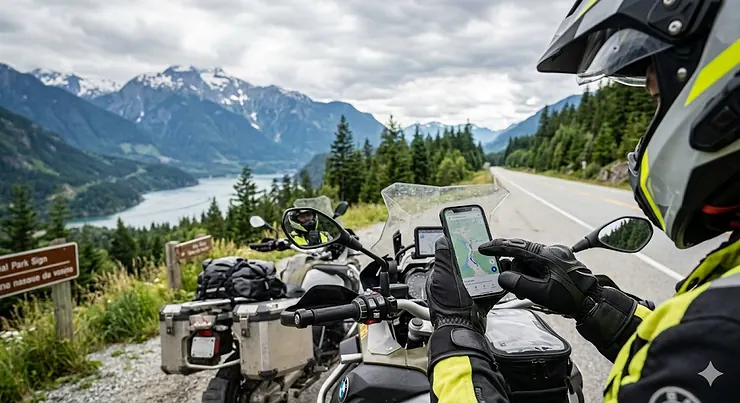
Picture this: you’re 40 kilometres outside Calgary on a crisp October morning, your GPS suddenly reroutes you through an unfamiliar mountain pass, and you need to zoom in on the map. With traditional motorcycle gloves, you’d have to pull over, remove your gloves in 5°C weather, adjust your route with frozen fingers, then wrestle the gloves back on. With touchscreen motorcycle gloves, you tap, swipe, and continue riding—all in three seconds.
The Canadian riding season is precious enough without wasting it fumbling with your phone. Modern touchscreen motorcycle gloves combine conductive fingertips with full protective features, letting you operate smartphones, GPS navigation systems, and even heated grip controllers without compromising safety. What most Canadian buyers overlook is that these gloves aren’t just convenient—they’re a safety upgrade. Being able to accept an emergency call or adjust navigation without stopping keeps you focused on the road and aware of your surroundings.
In this comprehensive guide, I’ve researched and analysed the top touchscreen-compatible motorcycle gloves available on Amazon.ca in 2026. You’ll find detailed comparisons covering everything from winter-ready heated models to ventilated summer options, all tested against the realities of Canadian riding conditions: unpredictable spring weather, scorching summer highways, and those brave souls who extend their season into November frost. Whether you’re commuting through downtown Toronto traffic, touring the Sea-to-Sky Highway, or navigating rural Manitoba gravel roads, there’s a touchscreen glove here engineered for your specific needs.
Quick Comparison: Top Touchscreen Motorcycle Gloves at a Glance
| Glove Model | Touchscreen Fingers | Protection Level | Best For | Price Range (CAD) |
|---|---|---|---|---|
| Alpinestars Faster | Index finger | CE certified, soft knuckle | Urban commuting | $100-$130 |
| ScorpionEXO Vortex Air | Thumb + index | Carbon fibre knuckles | Summer touring | $80-$110 |
| REV’IT Volcano | All fingertips | TPR knuckles, palm slider | Warm weather ADV | $90-$120 |
| RIDEIRON Heated CE | Thumb + index | CE Level 1, hard shell | Canadian winters | $140-$180 |
| COFIT Full Finger | Thumb + index + middle | Hard knuckle protection | Budget all-season | $50-$75 |
| Heated Gloves 7.4V | All fingertips | Waterproof, 4 heat levels | Extreme cold | $120-$160 |
| WTACTFUL Tactical | Thumb + middle | Lightweight, breathable | Light-duty/commuting | $35-$55 |
💬 Just one click — help others make better buying decisions too!😊
Top 7 Touchscreen Motorcycle Gloves in Canada: Expert Analysis
1. Alpinestars Faster Gloves — Premium Urban Performance
The Alpinestars Faster Gloves represent what happens when a MotoGP racing brand applies decades of track data to street riding. These gloves feature a leather palm with a softshell windbreaker membrane on the backhand, creating a balance between protection and all-day comfort that most urban riders appreciate immediately.
The touchscreen-compatible index fingertip uses conductive leather that actually works—a detail worth emphasizing because cheaper gloves often include touchscreen “compatibility” that’s so unresponsive you’ll give up and remove the glove anyway. The Faster’s sensitivity lets you pinch-zoom Google Maps or answer calls with the same precision as bare fingers. What really stands out is the sport fit with a slim cuff design that slides easily under jacket sleeves, preventing the wind tunnel effect that can make spring riding miserable in provinces like Alberta where temperatures swing 15 degrees in an hour.
Canadian riders from Vancouver to Halifax consistently praise the viscoelastic PU foam knuckle guard, which absorbs impacts while remaining flexible enough for clutch feathering in stop-and-go traffic. The ergonomic stretch insert between thumb and palm means your hand doesn’t fatigue during longer rides—crucial if you’re commuting 25 km each way through cities like Montreal or Ottawa.
✅ Pros: Excellent touchscreen sensitivity, windbreaker membrane blocks spring chills, CE certified protection, fits under jacket cuffs seamlessly
❌ Cons: Not waterproof (Canada needs waterproof options), slim cuff offers less wrist protection than gauntlet styles
Price Range: Around $100-$130 CAD
Value Verdict: Worth every dollar for daily urban commuters who ride March through November in variable Canadian weather.
2. ScorpionEXO Vortex Air — Summer Touring Champion
The ScorpionEXO Vortex Air tackles the specific challenge that hits Canadian riders every July: how to stay protected without turning your hands into sweat factories on 32°C highway runs. The carbon fibre knuckle protection delivers serious impact resistance while weighing considerably less than metal alternatives, and the strategic perforation placement channels airflow precisely where your hands generate the most heat.
Both the thumb and index finger feature conductive material for touchscreen use, which proves essential when you’re navigating unfamiliar routes through the Rockies or adjusting your music during boring prairie straightaways. What most Amazon.ca reviews don’t mention but riders discover quickly: the white colour option reflects significantly more sunlight than black, keeping your hands noticeably cooler during those Saskatchewan summer days when the asphalt shimmers at 45°C.
The hook-and-loop wrist closure system is straightforward—you won’t fumble with complicated straps when stopping for gas in small-town Ontario. Canadian customers note these gloves run slightly large, so if you’re between sizes, order down. The synthetic leather palm provides excellent grip feel on throttle and brake levers even when your hands are damp from humidity.
✅ Pros: Outstanding ventilation for Canadian summers, carbon fibre knuckles lighter than steel, reflects heat in white, touchscreen works reliably
❌ Cons: Sizing runs large (order one size down), minimal insulation means unusable below 12°C
Price Range: Around $80-$110 CAD
Value Verdict: Best value for summer-only riders who log serious highway kilometres between Victoria Day and Labour Day.
3. REV’IT Volcano Adventure Travel Gloves — Warm-Weather ADV Specialist
The REV’IT Volcano gloves are built for riders who view pavement as merely a suggestion. The microfiber palm delivers the precise grip control you need when standing on the pegs through gravel sections of the Trans-Labrador Highway or navigating BC forest service roads, while the air mesh exterior keeps ventilation flowing even during low-speed technical riding where wind chill doesn’t help.
Every single fingertip incorporates REV’IT’s Connect Finger Tip technology, giving you full smartphone control without the awkward “which finger works again?” dance that plagues gloves with limited touchscreen capability. This proves invaluable when you’re checking trail GPS coordinates or photographing that perfect Maritime coastline sunset—you can frame shots, adjust camera settings, and even edit photos without ever removing your gloves.
The TPR soft knuckle protectors flex naturally with your hand movement while still absorbing impact energy, and the Temperfoam reinforcement in the thumb and palm areas provides crash protection that doesn’t compromise all-day comfort. Canadian ADV riders particularly appreciate the convenient cuff puller—sounds minor until you’re trying to don gloves with sweaty hands during a mid-ride break in humid Ontario cottage country.
✅ Pros: Full five-finger touchscreen capability, excellent for dual-sport/ADV riding, durable construction holds up to off-road abuse
❌ Cons: Lightweight design offers minimal cold protection (summer only), not waterproof for unexpected rain
Price Range: Around $90-$120 CAD
Value Verdict: Perfect for adventure riders who spend weekends exploring Quebec’s abandoned logging roads or Newfoundland’s coastal trails.
4. RIDEIRON Heated Motorcycle Gloves CE — Canadian Winter Warrior
The RIDEIRON Heated CE gloves solve the equation that defeats most Canadian riders: how to maintain dexterity and protection when temperatures plummet. The 7.6V 3000mAh battery delivers up to 5 hours of continuous warmth—enough for a full day’s commute or a weekend tour through October’s early frost without needing a recharge.
What separates these from budget heated gloves is the CE Level 1 KP certification and hard shell knuckle protection. You’re getting legitimate motorcycle safety gear that happens to be heated, not ski gloves masquerading as riding equipment. The four heating modes (high at 131°F, medium at 122°F, low at 113°F, and smart auto-adjusting) let you fine-tune warmth as Canadian weather shifts—start on high for the -5°C morning ride to work in Edmonton, drop to medium by afternoon when it’s climbed to 8°C, switch to smart mode for the unpredictable evening.
The touchscreen-compatible thumb and index finger use high-sensitivity material that maintains responsiveness even when the heating elements are active—a detail that cheaper heated gloves often miss. The waterproof outer fabric and adjustable wrist straps create a seal that prevents prairie wind or coastal rain from stealing your hard-won warmth. Canadian customers from Whitehorse to Corner Brook report these extend their riding season by a full month on each end.
✅ Pros: Genuine CE protection with heating, 5-hour battery life handles full commutes, four heat settings plus smart mode, actually waterproof
❌ Cons: Bulkier profile than non-heated gloves, 3-4 hour charging time, higher price point
Price Range: Around $140-$180 CAD
Value Verdict: Essential investment for riders who refuse to garage their bikes at the first frost—pays for itself in extended riding weeks.
5. COFIT Motorcycle Gloves Full Finger — Budget Champion
The COFIT Full Finger gloves prove you don’t need to spend $150 CAD to get legitimate touchscreen functionality and protective features. The hard knuckle protection with finger padding delivers crash resistance that meets or exceeds gloves costing twice as much, while the breathable construction handles everything from spring morning commutes to summer afternoon rides across the Canadian Shield.
Touchscreen capability on the thumb, index, and middle finger gives you more options than many premium gloves—useful when your preferred GPS app requires specific gesture controls or when you’re typing quick text responses at red lights. The adjustable wrist design provides a snug fit that prevents the gloves from shifting during aggressive riding, something riders notice immediately when carving through Gatineau Park curves or navigating Toronto’s Gardner Expressway.
Canadian buyers on Amazon.ca consistently note these gloves run true to size, eliminating the sizing lottery that plagues many imports. The anti-slip palm grip performs well even in wet conditions—important for provinces like BC and Nova Scotia where summer rain is frequent. What you sacrifice at this price point is advanced materials: you’re getting synthetic construction rather than premium leather, which means a two-season lifespan versus the five years you might get from Alpinestars.
✅ Pros: Exceptional value under $75 CAD, three-finger touchscreen coverage, true-to-size fit, adequate protection for most riding
❌ Cons: Synthetic materials less durable than leather, minimal weather resistance, not suitable for extreme conditions
Price Range: Around $50-$75 CAD
Value Verdict: Ideal for budget-conscious riders, motorcycle students completing licensing, or as backup gloves for unpredictable Canadian weather.
6. Heated Gloves 7.4V Waterproof Touchscreen — Extreme Cold Specialist
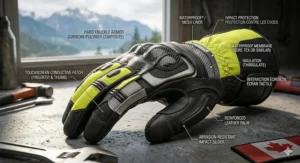
The Heated Gloves 7.4V represent the nuclear option for Canadian winter riding. The dual 7.4V 2500mAh batteries (one for each glove) provide independent temperature control, letting you compensate if one hand gets colder from wind exposure on your clutch side. Three heat settings deliver between 3-5 hours of operation depending on intensity—enough for most winter commutes even in places like Winnipeg where -25°C mornings are routine.
All fingertips feature conductive material for touchscreen operation, maintaining sensitivity even through the thermal insulation that makes these gloves suitable for extreme cold. The waterproof and breathable construction prevents the moisture buildup that turns other heated gloves into clammy torture chambers. Reflective strips add visibility during Canada’s long winter darkness when you’re commuting home at 4:30 PM in December twilight.
The adjustable temperature system automatically preheats when you first turn them on, bringing your hands to comfortable warmth within 90 seconds—a feature you appreciate deeply when you’ve been scraping ice off your visor in a Tim Hortons parking lot. Canadian customers note the sizing runs slightly small, so order up if you’re between sizes or plan to wear liner gloves underneath for sub-zero riding.
✅ Pros: Dual batteries for independent hand control, all-finger touchscreen, legitimate waterproofing, automatic preheat function
❌ Cons: Bulky design reduces dexterity, takes 3-4 hours to fully charge both batteries, sizing inconsistent
Price Range: Around $120-$160 CAD
Value Verdict: Necessary equipment for year-round Canadian commuters in provinces where winter means business.
7. WTACTFUL Tactical Touchscreen Gloves — Entry-Level Option
The WTACTFUL Tactical gloves occupy the budget end of touchscreen motorcycle gloves, offering basic functionality at prices that won’t trigger spousal negotiations. The touchscreen-compatible thumb and middle finger provide enough functionality for quick navigation checks or emergency calls, though the sensitivity doesn’t match premium conductive materials.
The lightweight, breathable design makes these suitable for warm-weather riding or short urban commutes where full racing protection feels excessive. The adjustable wrist closure provides a secure fit, and the durable stitching holds up better than the price suggests—several Canadian Amazon.ca reviewers report 18 months of regular use before needing replacement.
What you’re sacrificing here is comprehensive protection. These work for casual riding, running errands around town, or as summer gloves when you’re not planning aggressive riding. They’re not suitable for highway speeds, long-distance touring, or any riding where a crash could have serious consequences. Think of these as the motorcycle equivalent of a bicycle helmet: better than nothing, not enough for serious riding.
✅ Pros: Lowest price point ($35-$55 CAD), very breathable for summer, available immediately on Amazon.ca Prime
❌ Cons: Minimal impact protection, touchscreen sensitivity inconsistent, not durable for long-term use
Price Range: Around $35-$55 CAD
Value Verdict: Acceptable for new riders on extreme budgets or as backup gloves, but upgrade to proper protective gloves as soon as finances allow.
How Touchscreen Technology Actually Works in Motorcycle Gloves
Understanding the technology helps you evaluate whether a glove’s touchscreen capability will actually function in Canadian conditions. Capacitive touchscreens (used in all modern smartphones and GPS units) detect the electrical properties of your skin. When you touch the screen, you create a tiny change in the electrostatic field that the device registers as input.
Traditional motorcycle glove materials—leather, textile, rubber—act as insulators, blocking this electrical signal. Touchscreen-compatible gloves incorporate conductive materials in the fingertips: either conductive thread woven into the fabric, metallic nano-particles embedded in synthetic materials, or specially treated leather that maintains electrical conductivity.
Premium gloves like the Alpinestars Faster use conductive leather, which preserves the natural feel and durability of traditional leather while adding functionality. Budget options often use conductive thread, which works initially but degrades faster with use—you’ll notice touchscreen response declining after 6-12 months as the threads fray or the coating wears away.
Canadian riders face an additional challenge: touchscreen sensitivity decreases in cold temperatures as the materials become less conductive and your skin’s electrical properties change. This explains why your touchscreen gloves that work perfectly in September start failing by November. Higher-quality conductive materials maintain better performance in cold weather, making them worth the premium if you ride outside traditional summer months.
The number of touchscreen-enabled fingers matters more than marketing suggests. Single-finger designs (usually index only) work for basic tapping but struggle with pinch-zoom gestures or precise menu navigation. Full five-finger capability like the REV’IT Volcano provides maximum flexibility but costs more to manufacture. For most Canadian riders, thumb-plus-index coverage hits the sweet spot between functionality and value.
Real-World Scenario: Matching Gloves to Canadian Riding Styles
The Vancouver Commuter: Daily 18 km ride through variable Pacific weather, March through November. Needs: waterproofing, touchscreen for GPS navigation through downtown traffic, palm grip for wet conditions. Best Match: Alpinestars Faster for dry days, REV’IT Volcano for unpredictable weather, keep heated gloves for November frost.
The Prairie Long-Distance Tourer: Summer trips across Saskatchewan and Manitoba, 300+ km days, exposure to sun and wind. Needs: ventilation, UV protection, comfort for 6-hour rides, reliable touchscreen for route adjustments. Best Match: ScorpionEXO Vortex Air in white for heat reflection, COFIT as backup pair.
The Ontario Four-Season Warrior: Rides March frost through November freeze, 40 km daily commute, stores bike December-February only. Needs: heated gloves for shoulder seasons, waterproofing, Canadian winter capability. Best Match: RIDEIRON Heated CE as primary, Heated 7.4V for extreme cold days.
The Quebec ADV Explorer: Weekend dual-sport rides on trails and gravel, technical riding, photography stops. Needs: dexterity for off-road control, full-finger touchscreen for camera use, durability against brush. Best Match: REV’IT Volcano for all-around adventure capability.
The Maritime Beginner: Just completed M1 license, limited budget, short urban rides for grocery runs and errands. Needs: basic protection, affordability, touchscreen for learning routes. Best Match: WTACTFUL Tactical for immediate needs, save for COFIT upgrade within six months.
Common Mistakes When Buying Touchscreen Motorcycle Gloves in Canada
Mistake #1: Ignoring Seasonal Temperature Reality
Many Canadian riders buy one pair of touchscreen gloves and expect them to work year-round. A summer-weight mesh glove that’s perfect for July highway riding becomes useless torture in October. Similarly, heated winter gloves are sweltering disasters in June. The solution isn’t compromise—it’s owning dedicated seasonal pairs. Budget-conscious riders should prioritize a good three-season glove (spring/summer/fall) first, then add winter-specific heated gloves later.
Mistake #2: Assuming All Touchscreen Capability Is Equal
Gloves advertised as “touchscreen compatible” range from precise-as-bare-fingers to might-work-if-you-press-really-hard. Before buying, check Canadian reviewer feedback on Amazon.ca specifically about touchscreen responsiveness. Look for mentions of pinch-zoom capability, accuracy on small icons, and whether sensitivity declines in cold weather. Single cheap conductive patches fail quickly; quality conductive leather or full-material integration lasts.
Mistake #3: Overlooking Canadian-Specific Protection Needs
Gloves designed for California don’t account for gravel road debris common on rural Canadian highways, salt corrosion from winter road treatment, or the impact of extreme temperature swings on material durability. Canadian riders need reinforced palm sliders (you slide further on wet roads), sealed seams against moisture intrusion, and materials rated for temperature extremes. A glove that’s perfect for year-round riding in Texas will fail in Canada’s climate.
Mistake #4: Buying Based on Price Alone
The $40 CAD gloves might seem like genius frugality until they split after two months or leave you with road rash from a minor spill. Motorcycle gloves are crash protection first, convenience second. If budget forces a choice, buy better protective gloves without touchscreen capability rather than touchscreen gloves with minimal protection. Your hands are worth more than the $80 difference.
Mistake #5: Ignoring Sizing for Cross-Border Shopping
Many Canadian riders see lower USD prices on Amazon.com and attempt cross-border purchasing without considering duty fees, exchange rates, shipping costs, and the nightmare of returns. Factor in the 13-15% duty on imported clothing, current exchange rate (often 1.35-1.40 CAD per USD), and return shipping costs. That “cheap” US purchase often costs more than buying directly from Amazon.ca, with none of the buyer protection.
Touchscreen Motorcycle Gloves vs Traditional Gloves: Detailed Comparison
| Feature | Touchscreen Gloves | Traditional Gloves |
|---|---|---|
| Device Operation | Use phone/GPS without removing | Must remove gloves to use devices |
| Cold Weather Practicality | Stay warm while checking navigation | Exposed fingers freeze during stops |
| Emergency Response | Answer calls instantly | Fumble with removal during emergencies |
| Material Durability | Conductive materials may degrade faster | Standard materials last longer |
| Cost | Premium $30-60 CAD over equivalent traditional | Lower initial cost |
| Safety | Less distraction from constant glove removal | No electrical conductivity concerns |
The comparison reveals that touchscreen gloves provide genuine safety benefits beyond mere convenience. Canadian riders encounter unique situations—sudden weather changes requiring GPS rerouting, emergency calls from family during long tours, adjusting heated gear settings—where glove removal creates risk. The seconds spent fumbling with gloves are seconds your attention isn’t on traffic. For Canadian riders who use smartphones for navigation, communication, or bike computer monitoring, touchscreen gloves aren’t luxury—they’re sensible safety equipment.
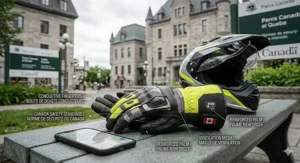
Understanding Protection Ratings: What CE Certification Means for Canadian Riders
While Canadian regulations under Transport Canada’s Motor Vehicle Safety Act don’t specifically mandate motorcycle glove standards, many quality gloves carry European CE certification that provides reliable protection benchmarks. CE Level 1 armor indicates the protection has passed impact absorption tests with a maximum force transmission of 9 kN, while CE Level 2 allows only 4.5 kN—lower numbers mean better protection.
For Canadian riders, this matters because our diverse riding conditions create varied crash scenarios. Urban commuting through Toronto sees low-speed falls onto asphalt (where abrasion resistance matters most), while prairie highway touring risks high-speed slides (where palm sliders and reinforced materials are critical), and mountain passes through the Rockies combine both with added gravel rash potential.
Hard-shell knuckle protection (carbon fibre or thermoplastic) provides superior impact resistance essential for Canadian highway riding where speeds regularly exceed 100 km/h. Soft armor (foam-based) offers better flexibility and comfort for urban speeds below 60 km/h. The RIDEIRON Heated gloves combine CE Level 1 protection with heating elements—proof that winter capability doesn’t require sacrificing safety.
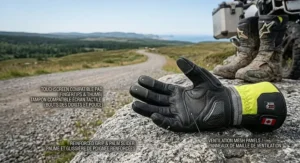
Palm sliders deserve special attention for Canadian conditions. Our frequent wet weather, gravel patches, and temperature-affected road surfaces create higher slide potential than dry climates. TPU palm sliders help your hand slide rather than grip, reducing the rotational forces that cause wrist fractures. If you’re touring or commuting on Canadian highways, palm sliders aren’t optional—they’re essential protection.
How to Choose Touchscreen Motorcycle Gloves for Canadian Conditions
Step 1: Define Your Primary Riding Season
Canadian seasons dictate glove requirements more than riding style. Spring (April-May) needs waterproofing and moderate insulation for 5-15°C temperatures. Summer (June-August) requires ventilation and heat reflection for 20-35°C riding. Fall (September-October) demands versatility as temperatures swing 20 degrees daily. Winter (November-March for brave souls) absolutely requires heating elements and wind protection. Buy gloves optimized for when you actually ride, not when you wish you rode.
Step 2: Calculate Your Budget in CAD
Entry-level touchscreen gloves start around $35-$55 CAD (WTACTFUL), mid-range quality sits at $80-$130 CAD (Alpinestars, ScorpionEXO), and premium heated winter options reach $140-$180 CAD (RIDEIRON). Budget for at least two pairs: a primary three-season glove and either heated winter gloves or lightweight summer backups. Spreading $250 CAD across two specialized pairs provides better value than spending $150 CAD on one “compromise” glove that excels at nothing.
Step 3: Evaluate Protection Needs Based on Riding Type
Urban commuters below 60 km/h can prioritize dexterity and touchscreen sensitivity over maximum armor. Highway tourers need palm sliders, reinforced palms, and hard knuckle protection. ADV riders require abrasion-resistant materials that withstand off-road encounters. Track riders should ignore touchscreen features entirely and focus on racing-specific protection. Match your actual riding (not aspirational riding) to protection requirements.
Step 4: Test Touchscreen Responsiveness Before Trusting Reviews
Canadian Amazon.ca buyers have 30-day returns on most gloves. Upon delivery, immediately test touchscreen capability with your actual devices: pinch-zoom on Google Maps, scroll through Spotify playlists, type a quick text message, adjust your action camera settings. If touchscreen response feels sluggish or inaccurate, initiate a return. Don’t assume you’ll “get used to it”—you won’t, and you’ll end up removing gloves anyway.
Step 5: Verify Amazon.ca Availability and Shipping to Your Province
Not all gloves ship to remote areas of Canada. Check shipping restrictions for Yukon, Northwest Territories, Nunavut, and rural Quebec/Newfoundland addresses. Prime eligibility saves $10-30 CAD on shipping and provides faster delivery. Watch for seasonal sales around Victoria Day and Labour Day when motorcycle gear often sees 15-25% discounts on Amazon.ca.
Maintenance Tips: Extending Touchscreen Glove Life in Canadian Climate
Salt and Road Grime Removal: Canadian winter roads deploy massive salt quantities that corrode leather and degrade synthetic materials. After any ride on treated roads, wipe gloves with a damp cloth and mild soap, then air dry away from direct heat. Salt crystals left embedded in seams accelerate wear and damage conductive materials.
Battery Care for Heated Gloves: Lithium batteries in heated gloves degrade faster in extreme cold. Store batteries indoors between rides, charge them at room temperature, and never leave them in the bike’s storage compartment overnight during Canadian winters. Proper battery care extends lifespan from 2 years to 4+ years.
Touchscreen Material Preservation: Conductive materials degrade with repeated flexing and abrasion. Avoid storing touchscreen gloves compressed under heavy objects. Clean touchscreen fingertips gently—aggressive scrubbing removes conductive coatings. Consider touchscreen performance decline around 18 months as normal; budget for replacement before complete failure.
Waterproofing Maintenance: Many gloves use DWR (durable water repellent) coatings that wear off over time. After 20-30 rides in rain, treat gloves with waterproofing spray designed for motorcycle gear (available on Amazon.ca for $15-25 CAD). This restores water beading and extends waterproof performance.
Seasonal Storage: When storing gloves for extended periods (winter storage for summer gloves, summer storage for heated gloves), stuff them loosely with newspaper to maintain shape. Store in a cool, dry location away from direct sunlight. UV exposure degrades materials faster than wear from riding.
FAQ: Touchscreen Motorcycle Gloves Canada
❓ Can touchscreen motorcycle gloves work with heated grips in Canadian winters?
❓ Are more expensive touchscreen gloves worth it for Canadian riders?
❓ Do touchscreen gloves work with all smartphone brands in Canada?
❓ Can I use touchscreen motorcycle gloves in Canadian winter below -10°C?
❓ How do I clean touchscreen motorcycle gloves without damaging the conductive materials?
Conclusion: Making the Smart Choice for Canadian Touchscreen Motorcycle Gloves
Choosing the right touchscreen motorcycle gloves transforms your Canadian riding experience from constant frustration—stopping to remove gloves for every navigation adjustment or call—to seamless integration between technology and the road. The gloves reviewed here represent the best options available on Amazon.ca in 2026, each optimized for specific Canadian riding conditions and budgets.
For urban commuters riding March through November, the Alpinestars Faster delivers premium quality with city-friendly features at a reasonable mid-range price. Summer tourers logging highway kilometres will appreciate the ScorpionEXO Vortex Air’s ventilation and comfort during those scorching July rides across the prairies. Adventure riders exploring Canada’s backcountry trails need the REV’IT Volcano’s durability and full-finger touchscreen capability. Budget-conscious riders or students completing their M1 licensing should start with the COFIT Full Finger for legitimate protection at accessible prices.
Canadian winter warriors face unique challenges that demand specialized equipment. The RIDEIRON Heated CE combines genuine motorcycle protection with heating technology that extends your season by weeks on each end—worth every dollar of its premium pricing if you refuse to let frost dictate your riding calendar. For extreme cold riding in provinces where -20°C is routine, the Heated 7.4V gloves provide the nuclear option.
Remember that gloves are your first line of defense in any crash. Prioritize protection features like CE certification, palm sliders, and hard knuckle armor over touchscreen convenience. A glove that fails to protect your hands isn’t worth owning regardless of how well it operates your iPhone. With proper research, realistic budget allocation, and honest assessment of your riding conditions, you’ll find touchscreen gloves that keep you connected, protected, and comfortable throughout Canada’s challenging riding seasons.
Check current pricing and availability on Amazon.ca for these products, read Canadian reviewer feedback, and take advantage of Prime shipping where available. The riding season is short enough in most of Canada—don’t waste it struggling with technology when you should be enjoying the road.
Recommended for You
- 7 Best Vegan Motorcycle Gloves Canada 2026: Ethical Riders
- 7 Best Textile Motorcycle Gloves Canada 2026
- 7 Best Gore-Tex Motorcycle Gloves Canada 2026
Disclaimer: This article contains affiliate links. As an Amazon Associate, I earn from qualifying purchases. If you purchase products through these links, we may earn a small commission at no additional cost to you.
✨ Found this helpful? Share it with your riding friends! 💬🤗
