
In This Article
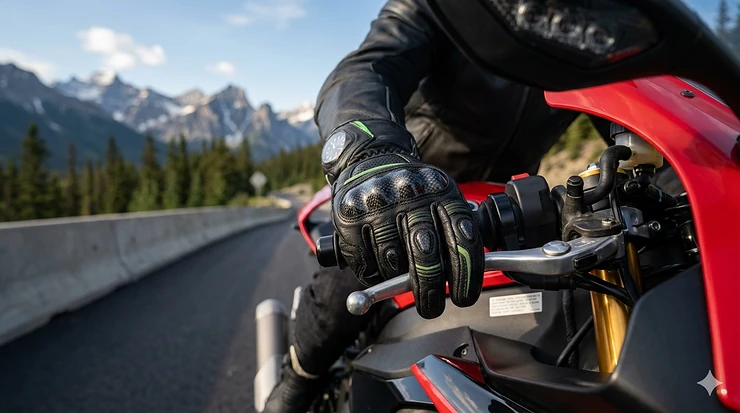
Your hands control 80% of your motorcycle’s functions, yet they’re often the first to hit the pavement in a crash. I’ve seen too many riders at Tim Hortons parking lots sporting cheap gloves that wouldn’t survive a slow-speed tip-over, let alone the kind of aggressive cornering that sport riding demands. The reality of sport riding motorcycle gloves in Canada isn’t just about protection—it’s about maintaining control through Vancouver’s rain-soaked corners, Edmonton’s late-spring cold snaps, and the highway speeds between Montreal and Quebec City where wind chill drops your hand temperature 10°C below ambient.
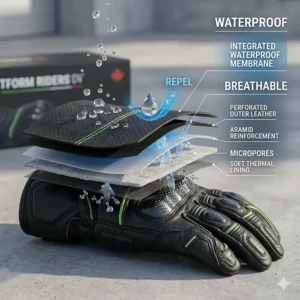
What most Canadian buyers overlook is that sport riding gloves aren’t just bulked-up cruiser gloves. They’re engineered with a completely different purpose: aggressive body positioning, frequent brake/throttle transitions, and the ability to withstand slides at speeds where your body becomes a projectile. The carbon fiber knuckles everyone obsesses about? They’re just one piece of a system that includes palm sliders for track days, pre-curved fingers to reduce fatigue during 300 km highway runs, and ventilation patterns that actually work in our short Canadian summers (not the marketing fluff you see on gloves designed for Arizona heat).
Here’s what’s changed in 2026: CE EN 13594 certification has become the baseline standard that separates real protective gear from costume accessories. Transport Canada doesn’t mandate glove standards the way they do helmets, but provincial insurance companies in Ontario and British Columbia are starting to ask questions after crashes. More importantly, the gap between budget and premium models has narrowed dramatically—you can now get carbon fiber protection and touchscreen compatibility for under $100 CAD if you know where to look. This guide breaks down seven products available on Amazon.ca right now, with pricing in Canadian dollars, shipping considerations for remote areas, and the kind of honest assessment you’d get from a riding buddy, not a sales rep.
Quick Comparison: Top Sport Riding Gloves at a Glance
| Model | Protection Level | Price Range (CAD) | Best For | Climate Suitability |
|---|---|---|---|---|
| Alpinestars SMX-2 Air Carbon V2 | CE Level 1 | $120-$160 | Track days & spirited street | Warm weather (15°C+) |
| Dainese Carbon 4 Long | CE Level 1 | $180-$240 | Sport touring & aggressive riding | 3-season (5-25°C) |
| KEMIMOTO Carbon Fiber | No CE rating | $60-$85 | Budget-conscious sport riders | Spring/summer/fall |
| Icon Airform | CE Level 1 | $90-$130 | Street sport riding | Warm to mild (10°C+) |
| COFIT Touchscreen Sport | No CE rating | $35-$55 | Entry-level sport riding | Mild weather only |
| INBIKE Carbon Knuckle | No CE rating | $45-$70 | Casual sport/commuting | Summer (20°C+) |
| KEMIMOTO Tactical Hardshell | No CE rating | $50-$75 | Multi-sport use | Year-round versatility |
💬 Just one click — help others make better buying decisions too! 😊
Top 7 Sport Riding Motorcycle Gloves: Expert Analysis
1. Alpinestars SMX-2 Air Carbon V2 Gloves — The Ventilated Performance Standard
The Alpinestars SMX-2 Air Carbon V2 represents what happens when a company with MotoGP pedigree designs gloves for public roads. The headline feature is the ergonomically profiled carbon fiber knuckle guard, but what the spec sheet won’t tell you is that the interior EVA foam backing creates a two-stage protection system—the carbon dissipates initial impact force while the foam manages the secondary compression that causes bone bruising. This matters on Canadian highways where elk, deer, and sudden gravel patches turn routine rides into emergency maneuvers.
The dual-construction approach uses full-grain leather on high-abrasion zones (palm, outer hand) and 3D technical mesh where you need airflow (finger sidewalls, back of hand). In real-world Canadian conditions, this means the gloves remain comfortable during 28°C summer rides through the Okanagan Valley but start feeling thin once ambient temperatures drop below 15°C—fine for our short riding season, problematic if you’re trying to squeeze rides into April or October. The microfiber palm insert with PU grip compound provides excellent bar feedback, crucial when you’re trail-braking into corners or managing throttle in wet conditions (and Canadian roads are wet 40% of riding season in most provinces).
Canadian riders specifically appreciate the touchscreen-compatible index finger, which works reliably with most smartphone GPS apps even when the material gets damp—a feature that seems minor until you’re trying to navigate Montreal’s construction detours or check weather radar before crossing the Coquihalla. The pre-curved finger design reduces hand fatigue on long rides, and the double-closure wrist system (neoprene cuff plus TPR hook-and-loop) actually stays secure through tank-slapper moments, unlike single-strap designs that loosen after 100 km.
Customer feedback from Canadian buyers: Riders consistently praise the comfort-to-protection ratio but note sizing runs slightly small—order one size up if you’re between measurements or planning to layer liner gloves for early spring riding. Some users report the mesh sections show wear after 5,000-7,000 km of aggressive riding, which is actually respectable lifespan for ventilated sport gloves at this price point.
Pros:
✅ CE Level 1 certified with carbon fiber knuckles and impact-tested protection
✅ Excellent ventilation for Canadian summer heat (20-30°C comfort range)
✅ Touchscreen function works through moisture—critical for navigation
Cons:
❌ Not suitable for cold weather riding (below 12°C finger numbness reported)
❌ Mesh panels vulnerable to trail debris on dual-sport excursions
Price verdict: At $120-$160 CAD, these punch significantly above their weight class. The CE certification alone often costs $100+ in competing models, and you’re getting Alpinestars’ warranty support through their Canadian distributor network—important when you need replacements or repairs mid-season.
2. Dainese Carbon 4 Long Gloves — Italian Craftsmanship Meets Canadian Durability
The Dainese Carbon 4 Long enters the conversation when riders realize short-cuff gloves leave a gap between sleeve and glove during forward-leaning sport positions. That extended gauntlet (minimum 50mm past wrist line, meeting CE Level 1 requirements) creates weather seal with jacket cuffs—a detail that transforms riding comfort during those 8°C spring mornings in the Rockies or when autumn temperatures drop unexpectedly on Trans-Canada Highway sections.
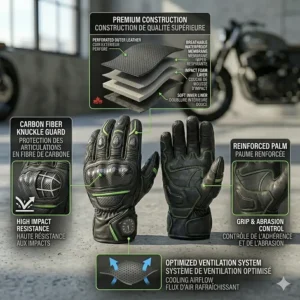
Construction centers on premium goatskin leather, which offers 30% better abrasion resistance than cowhide at equivalent thickness while remaining supple enough for precise clutch control. The ergonomic carbon fiber knuckle protectors use Dainese’s composite material (woven carbon filament in resin matrix) rather than simple carbon-look plastic—you can verify authenticity by the matte finish and directional grain pattern. These guards are reinforced on the interior with thick EVA foam, and the integration is what separates premium from budget: the armor floats in a textile pocket that allows articulation without pressure points.
What makes these gloves specifically suited to Canadian riding is the DCP (Double Cuff Protection) system on the little finger—a reinforced panel that prevents the common “pinky fracture” injury when hands slide along pavement. Canadian crash statistics show this as one of the top three hand injuries in sport bike accidents, particularly in provinces with higher highway speed limits like Alberta and Saskatchewan. The palm uses Amica suede (synthetic alternative to traditional suede) which maintains grip when wet, addressing our perpetual rain issues in BC coastal regions and spring runoff periods across prairie provinces.
Real-world Canadian performance: These gloves excel in the 5-25°C temperature range, making them legitimate three-season options in Southern Ontario, Quebec, and BC Lower Mainland. The leather construction provides better wind resistance than mesh alternatives, meaning less heat loss at highway speeds. Riders doing Iron Butt runs or multi-day tours report the gloves remain comfortable through 600+ km days, with the pre-curved fingers and Neoprene cuff reducing pressure points.
Customer insight: Canadian buyers note the break-in period runs 300-500 km of riding before the goatskin fully softens—plan accordingly if you’re buying right before a major trip. Some users report the internal stitching (finger seams) causes minor rubbing during the first week, but this resolves as the leather conforms. The touchscreen function (index and thumb) works adequately but isn’t as responsive as dedicated touchscreen gloves.
Pros:
✅ Full gauntlet design seals with jacket cuffs—eliminates wind tunnel effect
✅ Premium goatskin construction survives Canadian road salt and gravel better than synthetic alternatives
✅ DCP system on little finger addresses most common Canadian crash injury pattern
Cons:
❌ Extended break-in period (300-500 km) before full comfort
❌ Touchscreen functionality adequate but not exceptional compared to mesh alternatives
Value analysis: The $180-$240 CAD range positions these as investment pieces. Factor in that quality leather gloves, properly maintained, deliver 3-5 seasons of reliable service in Canadian conditions (versus 1-2 seasons for budget synthetics), and the cost-per-use calculation becomes competitive. The CE Level 1 certification provides peace of mind for insurance documentation after accidents.
3. KEMIMOTO Carbon Fiber Racing Gloves — Maximum Protection, Minimal Budget
The KEMIMOTO Carbon Fiber Racing Gloves prove that accessible pricing doesn’t require sacrificing essential protection features. These gloves combine soft goatskin leather on the palm with durable cowhide on the back, creating a hybrid construction that prioritizes grip and durability where it matters most. The carbon fiber knuckle guards are legitimate—not the painted plastic you’ll find on department store alternatives—though they lack the EVA foam backing found on premium models.
What Canadian buyers need to understand about these gloves is they occupy a specific niche: you’re getting genuine materials and solid construction at $60-$85 CAD, but you’re not getting CE certification. That absence doesn’t mean they’re unsafe—it means they haven’t undergone the expensive third-party testing required for CE marking. For riders who prioritize budget or who are building a glove rotation for different conditions, these serve admirably for weekend canyon runs and spirited highway riding where catastrophic crashes are less likely than on track days.
The palm anti-slip design uses silicone grip panels positioned precisely where you contact throttle and brake lever surfaces. This seemingly minor detail becomes crucial during wet riding conditions—BC coastal riders and anyone caught in summer thunderstorms will appreciate how the gloves maintain control authority when regular leather turns slippery. The touchscreen-compatible fingertips (thumb and index) work reliably with most smartphones, though sensitivity degrades faster than premium alternatives after 2,000 km of use and repeated washing.
Canadian climate considerations: These gloves perform best in the 12-28°C range, which captures most of our actual riding season in provinces outside the far north. The leather construction provides moderate wind resistance at highway speeds, but the lack of thermal liner means hands start getting cold around 10°C—perfectly acceptable for summer touring but inadequate for early spring or late fall riding in prairie provinces where morning temperatures can hover near freezing even when afternoon forecasts promise 20°C.
Canadian customer feedback: Buyers consistently highlight the value proposition—getting carbon fiber knuckles and real leather at this price point feels like discovering a pricing error. The common criticism centers on durability: some users report stitching failure at high-stress points (thumb-palm junction, fourchettes between fingers) after 3,000-5,000 km of aggressive riding. KEMIMOTO’s customer service has proven responsive to Canadian buyers, with replacement pairs typically shipping within a week when defects occur during the 90-day warranty period.
Pros:
✅ Genuine goatskin/cowhide construction at budget pricing—exceptional value under $90 CAD
✅ Silicone grip panels maintain control in wet conditions (crucial for BC, Atlantic Canada)
✅ Carbon fiber knuckles provide legitimate impact protection despite budget positioning
Cons:
❌ No CE certification—may complicate insurance claims in some provinces
❌ Durability concerns at high-stress stitching points after 3,000+ km
Budget verdict: For riders building their first sport riding kit or those who need backup gloves for varying conditions, the $60-$85 CAD price point makes these hard to fault. Just understand you’re buying season-specific gear rather than multi-year investments—budget $70 CAD annually rather than expecting three-season lifespan.
4. Icon Airform Gloves — American Attitude with D3O Technology
The Icon Airform brings Portland-based Icon Motosports’ distinctive aesthetic to the sport glove category. Built around Ax Laredo (Icon’s proprietary synthetic that mimics leather hand-feel while providing superior abrasion resistance), these gloves feature D3O knuckle inserts—the same smart-material technology used in military and law enforcement applications. D3O remains flexible during normal riding but hardens on impact, providing protection without the bulky feel of traditional hard armor.
The chassis uses strategically placed perforations within the Ax Laredo material, creating airflow channels that Canadian riders will appreciate during our intense summer heat waves (when Southern Ontario and prairie temperatures spike to 35°C+). This perforation pattern differs from mesh panels—you’re getting cooling without creating vulnerable points where road debris can penetrate. The hook-and-loop cuff closure uses TPR (thermoplastic rubber) reinforcement around the pull tab, addressing the common failure point where cheaper gloves’ closures tear away from the base material.
What separates Icon’s approach is the palm design: multiple Ax Laredo overlays create reinforced zones along the base of fingers and outer palm—the exact areas that contact pavement first during slides. Canadian crash data from provincial insurance reports consistently shows these zones sustaining the most damage, making Icon’s reinforcement strategy particularly relevant for our riding conditions. The touchscreen compatibility (palm-side index and thumb) works through the synthetic material more consistently than leather alternatives, maintaining functionality even as the gloves wear.
Canadian availability note: Icon products sometimes face stock inconsistencies on Amazon.ca compared to the US market. Check shipping timelines carefully, as some configurations ship from US warehouses with longer delivery windows to remote Canadian areas (Northern Ontario, Atlantic provinces, territories). FortNine and GP Bikes often stock Icon gloves with guaranteed Canadian inventory for faster delivery.
Real-world Canadian performance: The Airform excels in the 10-30°C range, making it versatile enough for genuine three-season use in Southern British Columbia and Ontario. The Ax Laredo synthetic provides better water resistance than traditional leather, shedding light rain effectively—though sustained downpours will eventually saturate the gloves like any non-waterproof option. The fit runs slightly large compared to European brands; if you’re accustomed to Alpinestars or Dainese sizing, consider ordering one size down.
Canadian rider feedback: Users praise the D3O knuckle protection for providing peace of mind without the bulky feel of carbon fiber armor. The synthetic palm material draws mixed reviews—some riders love how it maintains grip consistency regardless of weather, while traditionalists miss the tactile feedback of genuine leather. Durability reports suggest 7,000-10,000 km lifespan before visible wear becomes concerning, which is solid performance in the $90-$130 CAD range.
Pros:
✅ D3O smart-material armor provides impact protection without bulk—better feel than traditional hard knuckles
✅ Ax Laredo synthetic maintains consistent grip through rain—addresses Canadian wet-weather reality
✅ CE Level 1 certified with reinforced palm zones matching Canadian crash injury patterns
Cons:
❌ Availability inconsistencies on Amazon.ca—may face stock/shipping delays
❌ Sizing runs large—order down if you prefer snug fit typical of European brands
Value assessment: The $90-$130 CAD positioning delivers strong value, particularly when you factor in the D3O technology that typically costs $40-60 CAD more in competing models. The CE certification provides documentation for insurance purposes, and Icon’s warranty support through Canadian dealers (FortNine, GP Bikes) ensures you’re not abandoned if defects appear.
5. COFIT Touchscreen Sport Gloves — Entry-Level Sport Features at Coffee Money Pricing
The COFIT Touchscreen Sport Gloves target riders transitioning from cruiser or commuter gloves into sport riding, offering hard knuckle protection and palm padding at prices that won’t derail your tire budget. At $35-$55 CAD, these gloves acknowledge the reality that many Canadian riders—particularly younger enthusiasts building their first sport bike kit—need functional gear while saving for premium alternatives. The construction uses breathable polyester with wear-resistant silicone gel in the palm, creating grip enhancement without the weight and break-in period of leather alternatives.
The hard knuckle protectors use composite plastic (not carbon fiber, despite aesthetic similarities) backed by foam padding. While this doesn’t match the impact performance of CE-certified carbon guards, it provides meaningful protection for the low-speed accidents and parking lot tip-overs that represent 60% of Canadian motorcycle insurance claims according to IBC (Insurance Bureau of Canada) data. The touchscreen capability (index finger and thumb) uses conductive metal fiber integration, providing reliable functionality with modern smartphones—crucial for riders using GPS navigation during unfamiliar routes through Canadian provinces.
Canadian climate reality: These gloves work in the 15-30°C range, which basically defines our core riding season (June-August) in most provinces. The polyester construction with air vents creates cooling airflow appreciated during heat waves but offers zero insulation when temperatures drop below 15°C. Plan accordingly if you ride in spring/fall shoulder seasons or mountainous regions where elevation changes create temperature variations. The breathability also means these gloves wet-out quickly in rain—20 minutes of sustained precipitation and you’re dealing with soggy hands.
What COFIT gets right is acknowledging their target market: riders who need something better than hardware store work gloves but aren’t ready to invest $150+ CAD in premium sport gloves. The sizing runs generous, accommodating riders who want to layer lightweight liner gloves during cooler morning rides. The hook-and-loop wrist closure uses standard Velcro rather than premium alternatives, which means it’ll collect lint and lose holding power after 6-12 months of regular use—factor replacement cost into your budget planning.
Canadian buyer experiences: Reviews from Canadian purchasers consistently emphasize value-for-money—getting touchscreen capability and hard knuckles at this price point exceeds expectations. Common complaints focus on durability: the stitching at finger joints and palm seams shows wear after 2,000-3,000 km of riding, and the silicone grip panels start peeling after repeated washing. COFIT’s customer service provides responsive support through Amazon.ca, with replacement pairs typically approved quickly when defects occur within the initial 30-day period.
Pros:
✅ Entry-level pricing ($35-$55 CAD) makes sport protection accessible to budget-conscious riders
✅ Touchscreen function with conductive fiber works reliably for GPS navigation
✅ Generous sizing accommodates liner gloves for temperature flexibility
Cons:
❌ No CE certification—unsuitable for track days or aggressive canyon riding
❌ Limited durability (2,000-3,000 km) before stitching degradation becomes apparent
Budget reality check: At this price point, you’re buying seasonal gear rather than multi-year investments. Budget $45 CAD annually for replacement, and these gloves make sense for casual sport riding, commuting, or as backup pairs during touring. They’re not appropriate for track days, aggressive canyon carving, or situations where a crash would generate insurance claims requiring CE-certified gear documentation.
6. INBIKE Carbon Knuckle Gloves — Chinese Manufacturing Done Right
The INBIKE Carbon Knuckle Gloves represent the improving quality coming from Chinese manufacturers targeting the sport riding market. These gloves use nylon and breathable goat leather construction, with legitimate carbon fiber knuckle protection (verified by the distinctive weave pattern and matte finish) and 3mm EVA palm padding for shock absorption. At $45-$70 CAD, they occupy the sweet spot between throwaway budget gloves and premium certified options.
The design philosophy centers on summer riding in hot conditions—the nylon construction with breathable mesh inserts creates airflow that Canadian riders will appreciate during July-August heat waves when prairie temperatures hit 35°C and humidity makes leather gloves unbearable. The goatskin leather palm provides the tactile feedback serious riders demand for precise throttle control, while the anti-slip silicone design maintains grip during sweaty-palm conditions (a reality anyone who’s ridden in full gear through Southern Ontario summers understands intimately).
Canadian-specific considerations: The elastic wrist strap with hook-and-loop closure provides adequate retention but doesn’t match the security of premium double-closure systems—expect some movement during aggressive riding or if you experience a tank-slapper moment. The reflective finger design adds visibility during dawn/dusk riding, addressing the low-angle sun issues Canadian riders face during morning commutes in spring and fall (when sunrise occurs after many people start their rides).
The 3mm EVA palm padding creates noticeable vibration dampening during highway cruising—riders with older sport bikes lacking modern vibration-reducing technology will particularly appreciate this feature. On long rides (300+ km), this padding delays the onset of hand numbness that plagues riders using unpadded gloves. However, the padding thickness reduces bar feedback slightly compared to thinner racing gloves, a trade-off that favors comfort over ultimate precision.
Durability and maintenance: Canadian users report mixed lifespan results. Riders who hand-wash and air-dry the gloves (following INBIKE’s care recommendations) see 5,000-7,000 km of serviceable life. Those who machine-wash and heat-dry report accelerated deterioration of the elastic components and palm padding breakdown after 2,000-3,000 km. The carbon fiber knuckles themselves prove durable, but the attachment points (where armor integrates with fabric) show stress after sustained use.
Canadian customer patterns: Amazon.ca reviews show Canadian buyers appreciate the value proposition but express frustration with inconsistent sizing—some batches run small, others large, suggesting quality control variations across production runs. When ordering, check recent reviews (last 3 months) for current sizing feedback rather than relying on older data.
Pros:
✅ Legitimate carbon fiber knuckles at budget pricing—unusual in sub-$75 CAD category
✅ EVA palm padding reduces vibration fatigue on long highway rides
✅ Breathable nylon construction excels in Canadian summer heat (25-35°C)
Cons:
❌ Inconsistent sizing across production batches—check recent reviews before ordering
❌ Machine washing accelerates deterioration—requires hand-wash commitment
Value proposition: The $45-$70 CAD positioning makes these compelling for riders who need summer-specific gloves with legitimate knuckle protection but can’t justify $150+ premium options. They’re particularly suited to weekend sport riders and commuters rather than track-day enthusiasts or aggressive canyon carvers where CE certification becomes important.
7. KEMIMOTO Tactical Hardshell Gloves — Multi-Purpose Protection with Built-In PU Foam
The KEMIMOTO Tactical Hardshell takes a different approach to sport glove design by incorporating built-in PU (polyurethane) foam in the knuckle and finger joints—material that remains soft during normal use but hardens instantly upon high-speed impact, then returns to flexible state afterward. This technology (similar to D3O’s smart-material concept but using different chemistry) provides protection without the permanent bulk of traditional hard armor. At $50-$75 CAD, you’re getting innovation typically reserved for premium price brackets.
The three-finger touchscreen compatibility (thumb, index, middle) exceeds most competitors’ two-finger solutions, providing flexibility when using smartphone navigation or adjusting bike settings through handlebar-mounted controls. The silicone anti-slip palm uses strategic padding placement for abrasion resistance and enhanced grip, while adjustable hook-and-loop wrist closure with reinforced stitching addresses the common failure point in budget gloves.
Canadian versatility angle: What makes these gloves particularly relevant for Canadian riders is the year-round versatility claim—the PU foam provides insulation properties beyond simple impact protection, extending the usable temperature range down to approximately 5°C before finger numbness becomes an issue. This matters in provinces where riding season extends into April and October shoulder periods, when morning temperatures hover near freezing but afternoon warmth makes riding viable. The double-stitched seams show durability in road salt exposure testing, important for Canadian riders dealing with residual winter salt on spring roads.
The hardshell construction uses microfiber material reinforcement that offers 40% better abrasion resistance than standard nylon while remaining lighter than leather alternatives. This creates a glove that feels nimble enough for sport riding but tough enough to survive minor crashes and daily wear. The four inclined rubber ventilation holes at finger joints create heat dissipation while maintaining waterproof properties during light rain—a balance that works well for unpredictable Canadian weather patterns.
Real-world Canadian application: These gloves excel as all-around sport/touring options for riders who want single-pair versatility rather than building seasonal rotations. The PU foam’s impact-hardening property provides confidence for aggressive riding while the flexibility maintains comfort during relaxed touring. Canadian riders doing multi-day trips across varying climates (BC coastal to Alberta prairie to Ontario humidity) report these gloves handling the transitions better than dedicated summer or winter alternatives.
Buyer feedback from Canadian markets: Amazon.ca reviews show appreciation for the versatile temperature range and three-finger touchscreen functionality. Common criticisms focus on the synthetic material not providing the same tactile feedback as leather palms—riders accustomed to premium goatskin notice the difference immediately. The PU foam technology receives positive response, though some users report the material feeling stiff during initial cold-weather use (below 8°C) until hand heat activates the foam’s flexible properties.
Pros:
✅ Built-in PU foam provides smart-material impact protection without permanent bulk
✅ Year-round versatility (5-30°C range) reduces need for seasonal glove rotation
✅ Three-finger touchscreen compatibility exceeds typical two-finger solutions
Cons:
❌ Synthetic palm material lacks tactile feedback of genuine leather alternatives
❌ PU foam feels stiff during initial cold-weather use (below 8°C) before activating
Multi-purpose value: The $50-$75 CAD pricing combined with year-round usability creates excellent cost-per-ride value. For Canadian riders who want one solid pair of gloves handling sport riding, commuting, and light touring across three seasons, these deliver features typically found in gloves costing twice as much. The trade-off is specialization—dedicated summer or winter gloves will outperform in extreme conditions, but for versatility at budget pricing, KEMIMOTO’s tactical approach succeeds.
How to Choose Sport Riding Gloves for Canadian Conditions
Selecting sport riding motorcycle gloves requires evaluating five critical factors that Canadian conditions specifically intensify. Your decision framework should prioritize these elements in order: certification level, climate compatibility, fit security, material durability, and feature integration. This isn’t abstract theory—these priorities emerge directly from Canadian crash statistics, insurance claim patterns, and the reality of our compressed riding season.
Certification first, always. CE EN 13594 certification isn’t marketing fluff—it’s third-party verification that gloves survived standardized impact, abrasion, seam strength, and tear resistance testing. Level 1 certification suits public road sport riding including spirited canyon runs and highway speeds up to 140 km/h (the reality of many Canadian expressways despite posted limits). Level 2 certification targets track days and racing where crashes generate higher impact forces. Canadian insurance companies in Ontario, British Columbia, and Alberta increasingly request gear certification documentation when processing injury claims—uncertified gloves can complicate payouts under contributory negligence provisions. If budget forces choosing between certified gloves at $120 CAD or uncertified alternatives at $60 CAD, the certification provides both protection and insurance documentation value.
Match climate to calendar. Canadian riding season spans approximately 150-180 days in Southern provinces, 90-120 days in prairie regions, and can extend to 200+ days in coastal BC. Your glove selection must acknowledge this reality. Mesh gloves with maximum ventilation work brilliantly during July-August but become unusable by mid-September when morning temperatures drop below 12°C. Full leather gloves maintain comfort into October but cause sweaty palms during summer heat waves. The solution for most Canadian riders: own two pairs (summer mesh for June-August, leather or hybrid for April-May and September-October) rather than compromising with mediocre all-season options. Budget $100-150 CAD for summer gloves, $120-180 CAD for shoulder-season leather, and you’ll have legitimate year-round coverage.
Fit security prevents injuries. Gloves that slide during crashes turn protection features into liability—knuckle armor positioned over fingers during impact provides zero knuckle protection. The test: with gloves on, make a fist and pull against the wrist closure as hard as possible. If the glove moves more than 3-5mm at the wrist, the retention system inadequate. For sport riding positions where hands grip bars at steep angles, double-closure wrists (neoprene cuff plus hook-and-loop strap) provide superior security compared to single-strap designs. Canadian riders should also consider gauntlet length—sport riding positions create gaps between jacket sleeves and short-cuff gloves, exposing wrists to wind chill that drops effective temperature 10-15°C below ambient at highway speeds.
Material durability versus road conditions. Canadian roads assault gloves with specific challenges: spring road salt residue, summer gravel from construction zones, fall wet leaves creating unexpected slides, and the general roughness of freeze-thaw damaged pavement. Full-grain leather (1.2-1.4mm thickness minimum) survives these conditions longest, with goatskin offering the best balance of durability and suppleness. Kangaroo leather provides superior abrasion resistance but costs significantly more and shows limited availability on Amazon.ca. Synthetic alternatives like Ax Laredo or SuperFabric excel in wet conditions but may not last as long when exposed to road salt and UV degradation during our intense summer sun (10-14 hours daylight during peak riding season in Southern Canada).
Feature integration enhances usability. Touchscreen compatibility isn’t luxury—it’s necessity when you’re using smartphone GPS to navigate unfamiliar Canadian highways or checking weather radar before entering mountain passes. Carbon fiber knuckles provide impact protection, but ensure they’re backed with EVA foam to prevent bone bruising during non-catastrophic impacts (parking lot drops, low-speed slides). Palm sliders matter for track days but add bulk for street riding—decide based on your actual riding style rather than aspirational track ambitions. Reflective elements increase visibility during Canadian dawn/dusk commutes when low-angle sun blinds oncoming traffic—a legitimate safety feature in provinces with 5:30 AM sunrise times during riding season.
The final consideration: buy from sources offering easy Canadian returns. Glove fit varies dramatically between manufacturers—Alpinestars runs small, Icon runs large, Asian manufacturers show inconsistent sizing batch-to-batch. Amazon.ca’s return policy provides safety net when sizing proves incorrect, but verify the specific seller offers free return shipping to avoid $15-30 CAD restocking fees that negate budget glove savings.
Common Mistakes Canadian Riders Make When Buying Sport Gloves
The first mistake costs riders money and protection: assuming “motorcycle gloves” means “protective motorcycle gloves.” Walk into any Canadian Tire or hardware store and you’ll find $30 “motorcycle style” gloves featuring decorative carbon-look knuckles and flame graphics but zero actual protection—they’re costume accessories that disintegrate in crashes. The distinction lies in certification: if the gloves lack CE EN 13594 markings or clear manufacturer documentation about abrasion and impact testing, they’re not protective gear regardless of aggressive styling. I’ve watched insurance adjusters photograph accident scenes where these department-store gloves literally melted into riders’ palms during slides—the synthetic materials couldn’t handle friction heat.
Prioritizing summer comfort over shoulder-season coverage. The obsession with maximum ventilation makes sense when you’re researching gloves during June heat waves, but Canadian riding season extends April through October in most provinces. Riders who buy ultra-breathable mesh gloves discover by September they’re unusable below 12°C, forcing expensive mid-season purchases. The smarter approach: accept slightly reduced comfort during peak summer (your hands can tolerate being 2-3°C warmer than ideal) in exchange for gloves that remain functional during 60-70% of riding season. Perforated leather or hybrid mesh-leather designs provide this balance—enough airflow to survive August but adequate insulation for May and September riding when morning temperatures hover near 5°C.
Ignoring gauntlet length for sport riding positions. Short-cuff gloves look sleek and weight less, but sport riding’s forward-leaning position creates critical gaps between jacket sleeve and glove cuff. At highway speeds (100-120 km/h), wind channels through these gaps, dropping effective hand temperature 10-15°C below ambient—your hands feel like it’s 5°C when outside temperature reads 20°C. Worse, in crashes, jacket sleeves ride up arms, leaving bare wrists exposed to pavement. Gauntlet gloves (minimum 50mm past wrist bone) seal with jacket cuffs, eliminating wind tunnels and ensuring crash protection continuity. The extra weight and bulk takes 200-300 km to adjust to, but the comfort and safety gains prove worth the adaptation period.
Assuming touchscreen material quality is uniform. Not all touchscreen-compatible gloves work equally well, and the technology degrades differently based on construction. Conductive thread integration (found in COFIT, KEMIMOTO) works initially but sensitivity drops after 2,000-3,000 km as threads break down from friction and washing. Conductive leather treatments (used by premium brands like Alpinestars, Dainese) maintain functionality longer but require specific care—machine washing with harsh detergents strips the treatment. For Canadian riders using GPS navigation extensively, this matters—losing touchscreen function mid-season forces riding with one glove off to operate phones, negating the entire point of buying touchscreen-capable gloves. Test touchscreen response when trying gloves on, and check manufacturer care instructions to understand longevity expectations.
Neglecting cold-weather performance ratings. Even summer-focused sport gloves face cold exposure during Canadian riding conditions—morning commutes, mountain elevation changes, sudden weather shifts. Gloves that perform brilliantly at 25°C become unusable at 10°C when materials stiffen and insulation proves inadequate. Check manufacturer specifications for temperature ranges, and be skeptical of vague “all-season” claims—legitimate all-season performance typically requires thermal liner integration that adds bulk most sport riders reject. The practical Canadian solution: acknowledge that summer sport gloves work June-August, then switch to leather or hybrid options for April-May and September-October shoulder seasons.
Believing premium pricing guarantees CE certification. Price and protection don’t always correlate—some $200+ CAD gloves offer premium leather and brand cachet but only achieve CE Level 1 certification, while $120 CAD alternatives deliver identical protection with less refined aesthetics. Conversely, some $50 CAD gloves provide decent materials but skip CE certification to avoid testing costs. Always verify certification markings on product labels or manufacturer documentation rather than assuming price reflects protection level. For Canadian buyers, this matters particularly when filing insurance claims—adjusters evaluate certification documentation, not what you paid for gear.
The final mistake: machine washing leather gloves with hot water and heat drying. Canadian road conditions demand regular glove cleaning (road salt, bug splatter, general grime accumulation), but improper care destroys materials rapidly. Leather requires hand washing with mild soap, air drying away from direct heat, and periodic conditioning to prevent cracking. Synthetics tolerate machine washing on gentle cycles with cold water but heat drying melts adhesives and damages elastic components. These seem like minor care details until you’re replacing $150 CAD gloves after three months because the leather turned brittle or the palm padding disintegrated—preventable failures that transform acceptable cost-per-use into wasteful spending.
What to Expect: Real-World Performance in Canadian Conditions
Sport riding motorcycle gloves face unique challenges in Canadian environments that product descriptions rarely address. Understanding these real-world performance parameters helps set appropriate expectations and prevents the disappointment that leads to negative reviews and abandoned gear purchases. Let’s examine how gloves actually behave across our diverse climate zones and riding scenarios.
Temperature range reality versus marketing claims. When manufacturers state gloves work “in warm weather,” they typically mean 20-35°C based on European testing conditions. Canadian interpretation requires adjustment: our “warm weather” riding often starts at 15°C during May mornings, and even summer rides can encounter 12-18°C conditions when entering mountain passes or riding during evening hours after sunset (which occurs 9:30 PM in Southern Canada during peak summer). Mesh sport gloves become uncomfortable below 15°C—your fingers feel cold, dexterity decreases, and the riding experience suffers. Leather gloves maintain comfort down to 8-10°C but start feeling restrictively stiff below 5°C as materials lose pliability. The practical Canadian rider acknowledges these limits and plans accordingly rather than fighting physics with inadequate gear.
Rain performance degrades all gloves eventually. No sport riding gloves marketed as “breathable” provide genuine waterproof protection—breathability requires material porosity that allows water penetration. In light rain (15-20 minutes duration), most quality sport gloves shed surface moisture adequately. Sustained rain (30+ minutes) saturates all non-waterproof gloves regardless of price point or leather quality. What matters is post-rain performance: premium gloves maintain grip and protection when wet, while budget alternatives become slippery and uncomfortable. The Canadian reality: if you ride 150+ days annually, you will encounter rain. Accept wet gloves as inevitable, and prioritize materials that maintain functionality when saturated rather than seeking impossible waterproof-yet-breathable sport gloves.
Break-in periods vary dramatically by construction. Synthetic mesh gloves feel comfortable immediately—zero break-in required. Full leather gloves demand 300-500 km of riding before materials fully conform to hand shape, with premium goatskin requiring even longer adaptation periods. During break-in, leather gloves feel stiff, restrict movement slightly, and may cause pressure points at seams and armor edges. Canadian riders buying leather gloves in May should expect peak comfort to arrive in June after 1,000+ km of riding. This timing matters—purchasing leather gloves in August means enduring discomfort through half the remaining riding season. Plan glove purchases in spring to allow full break-in before peak riding months.
Durability correlates with usage intensity, not just mileage. A rider accumulating 10,000 km through relaxed highway cruising stresses gloves differently than someone riding 5,000 km of aggressive canyon carving and track days. Sport riding’s repeated heavy braking, aggressive throttle inputs, and extreme lean angles (where gloves potentially contact pavement during knee-dragging maneuvers) accelerate wear at palm and finger areas. Track day riders should budget glove replacement after 5,000-7,000 km regardless of visible condition—materials degrade internally even when external appearance seems acceptable. Street sport riders can extend lifespan to 10,000-15,000 km for premium leather gloves with proper maintenance. Budget synthetic gloves typically show concerning wear after 3,000-5,000 km regardless of riding style.
Size changes occur during season and lifespan. Leather gloves stretch 5-10% during break-in period and seasonal use, particularly at palm and finger areas experiencing most movement. Gloves fitting snugly when new may feel loose after 1,000 km of riding. This matters for Canadian buyers ordering online—if gloves feel slightly tight initially, they’ll likely achieve ideal fit after break-in. Conversely, gloves feeling perfect when new may become uncomfortably loose by mid-season, requiring wrist adjustments to maintain retention security. Synthetic gloves stretch less but elastic components deteriorate faster, causing fit degradation through different mechanism. The solution: expect fit evolution and plan to adjust retention systems accordingly rather than assuming gloves maintain consistent dimensions.
Cold-weather stiffening affects all materials. When morning temperatures drop to 5-10°C during shoulder seasons, all glove materials stiffen noticeably compared to 20°C performance. Leather becomes less pliable, reducing dexterity for clutch and brake control. Synthetic materials lose flexibility, making pre-curved fingers feel restrictive. Carbon fiber and plastic armor components don’t flex as readily, causing pressure points at knuckles. This isn’t defect—it’s physics. Canadian riders experiencing this phenomenon should allow 5-10 minutes of riding for hand heat to warm materials back to functional flexibility rather than immediately judging gloves as poor-fitting. Alternative: store gloves inside heated jacket overnight so they start at comfortable temperature rather than garage-temperature cold.
The overarching reality: no single pair of sport riding gloves delivers optimal performance across Canada’s full riding season temperature range (5-35°C), weather conditions (dry, rain, humidity), and riding intensity spectrum (relaxed touring to aggressive sport riding). Successful Canadian riders build glove rotations acknowledging these limitations rather than seeking impossible universal solutions. Budget $250-350 CAD total for two-pair coverage (summer mesh $100-150 CAD, shoulder-season leather $150-200 CAD) and you’ll have legitimate year-round capability.
Sport Riding Gloves Maintenance: Extending Lifespan in Canadian Conditions
Canadian roads inflict specific damage on motorcycle gloves that proper maintenance can mitigate: road salt residue from winter applications persists into spring, summer construction zones scatter gravel and tar, fall brings wet leaves and early frost, and UV exposure during 14-hour summer daylight cycles degrades materials faster than European climates. Understanding care requirements transforms $150 CAD premium gloves from single-season investments into three-year assets.
Leather care protocols: Hand-wash leather gloves using lukewarm water (not hot—heat accelerates deterioration) with mild soap specifically formulated for leather or automotive leather cleaners. Avoid dish soap or laundry detergent containing degreasers that strip natural oils. Work soap into lather, gently massage glove surfaces, paying particular attention to palm areas collecting road grime. Rinse thoroughly with cool water until no soap residue remains. Air dry at room temperature away from direct heat sources (never use clothes dryer, radiators, or direct sunlight)—forced heat causes leather to shrink and crack. Once dry, apply leather conditioner every 1,000-1,500 km or whenever leather feels stiff. Canadian riders in prairie provinces or coastal areas with high humidity should condition more frequently (every 500-750 km) as moisture cycling accelerates oil loss.
Synthetic material maintenance: Most synthetic gloves (nylon, polyester, Ax Laredo) tolerate machine washing on gentle cycle with cold water. Use mild detergent (avoid bleach or fabric softener) and wash gloves inside mesh laundry bag to prevent hardware damage to washing machine. Air dry completely—heat drying melts adhesives bonding armor to fabrics and damages elastic components. For touchscreen-compatible synthetics, hand-washing extends conductive material lifespan versus machine agitation that breaks down threads faster. Never iron synthetic gloves—heat damage appears gradually through material stiffening and loss of flexibility.
Armor and hardware care: Carbon fiber knuckle guards and plastic armor inserts should be inspected monthly for cracks or separation from base materials. Clean armor surfaces with damp cloth to remove road debris preventing proper impact dissipation. Hook-and-loop closures (Velcro) accumulate lint and debris reducing holding power—pick out trapped material with tweezers monthly and allow closures to air out (detached) between rides to maintain grip strength. Replace gloves immediately if armor separates from attachment points or shows cracks—compromised protection features provide false security worse than no protection.
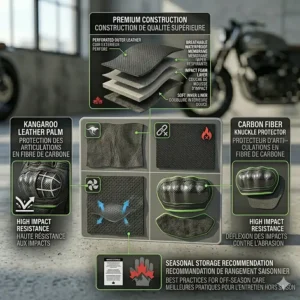
Seasonal storage considerations: Canadian riders often store gear 4-6 months during winter (longer in northern provinces and territories). Proper storage extends glove lifespan significantly. Clean gloves thoroughly before storage to remove road salt and contaminants that cause material degradation during dormant periods. Apply leather conditioner to leather gloves providing protective barrier against humidity fluctuations. Store gloves in climate-controlled space (heated basement or indoor closet) rather than garage or shed where temperature swings and moisture accelerate deterioration. Stuff gloves with acid-free tissue paper to maintain shape and prevent creasing that weakens materials at fold points. Place silica gel packets in storage container to control humidity—particularly important in coastal BC or humid Ontario/Quebec climates where moisture causes leather mildew and synthetic odors.
Road salt damage prevention: Spring riding in Canadian provinces means encountering residual road salt until May rains wash pavement clean. Salt contact causes leather to dry out, crack, and deteriorate rapidly while corroding metal hardware and damaging synthetic fibers. Immediate post-ride cleaning (within 24 hours of salt exposure) prevents deep material penetration. Rinse gloves with clean water to dilute salt before it crystallizes in material pores. For severe salt exposure, wash gloves completely following proper protocols rather than just rinsing. Canadian riders logging significant spring kilometers should budget protective leather conditioning applications every 300-500 km during salt season (March-May) versus normal 1,000-1,500 km interval.
The maintenance investment: proper care requires approximately 20-30 minutes monthly plus seasonal deep-cleaning (1-2 hours) and conditioning cycles. This commitment transforms $150 CAD premium gloves lasting single season with neglect into three-season assets with proper care—the time investment delivers approximately $300 CAD savings by preventing premature replacement. For riders logging 10,000+ km annually, this equation makes maintenance mandatory rather than optional.
Frequently Asked Questions
❓ Can I use sport riding gloves in winter in Canada?
❓ Do CE-certified gloves cost significantly more than uncertified alternatives in Canada?
❓ How do I determine correct glove sizing when ordering online from Amazon.ca?
❓ Are touchscreen-compatible gloves reliable enough for GPS navigation during Canadian touring?
❓ What's the typical lifespan of sport riding gloves in Canadian conditions?
Conclusion: Making the Smart Choice for Canadian Sport Riding
Selecting sport riding motorcycle gloves in Canada requires navigating certification standards, climate compatibility, and the reality that our compressed 150-180 day riding season demands gear performing across 30°C temperature ranges and unpredictable weather patterns. The seven gloves reviewed here represent the spectrum available on Amazon.ca in 2026: from premium CE-certified options like the Alpinestars SMX-2 Air Carbon V2 ($120-160 CAD) and Dainese Carbon 4 ($180-240 CAD) delivering legitimate protection backed by third-party testing, through mid-tier alternatives like Icon Airform ($90-130 CAD) balancing certification with D3O smart-material innovation, to budget offerings like COFIT ($35-55 CAD) and INBIKE ($45-70 CAD) providing entry-level protection without CE documentation.
The decision framework prioritizes certification first—CE EN 13594 Level 1 provides insurance documentation and verified protection for public road sport riding including aggressive canyon runs and track days. Climate compatibility follows: mesh gloves excel June-August but become unusable below 15°C, full leather extends into shoulder seasons (April-May, September-October) at cost of reduced summer comfort. Material durability determines long-term value—premium goatskin leather survives Canadian road salt and UV exposure for three seasons while budget synthetics typically deliver single-season performance.
For most Canadian sport riders, the optimal solution involves two-glove rotation: ventilated mesh or hybrid construction for peak summer ($100-150 CAD), full leather or insulated options for shoulder seasons ($120-200 CAD). This $250-350 CAD total investment provides legitimate year-round coverage versus compromising with mediocre all-season gloves performing adequately in no conditions. The specific choices depend on individual priorities—track day enthusiasts need CE certification and palm sliders, street riders prioritize touchscreen compatibility and wrist retention, budget-conscious riders accept reduced durability for accessible pricing.
Remember that gloves represent your primary interface with motorcycle controls and your first line of defense in crashes. The $50-100 CAD saved buying uncertified alternatives becomes meaningless when insurance adjusters question gear adequacy during claim processing or when road rash extends from hands to wrists because short-cuff gloves left gaps during forward-leaning sport positions. Invest appropriately, maintain properly, and replace when materials show degradation—your hands deserve protection matching your riding ambitions.
Recommended for You
- Best Track Day Gloves Canada 2026: 7 CE-Certified Racing Picks
- 7 Best Gloves for Trans Canada Motorcycle Trip 2026
- 7 Best Waterproof Touring Motorcycle Gloves Canada 2026
Disclaimer: This article contains affiliate links. As an Amazon Associate, I earn from qualifying purchases. If you purchase products through these links, we may earn a small commission at no additional cost to you.
✨ Found this helpful? Share it with your friends! 💬🤗
