

In This Article
Picture this: you’re cruising down the Trans-Canada Highway, wind in your face, freedom at your fingertips. But here’s the sobering truth—between 1996 and 2010, motorcycle fatalities in British Columbia increased 57%. Your helmet isn’t just gear; it’s your lifeline.
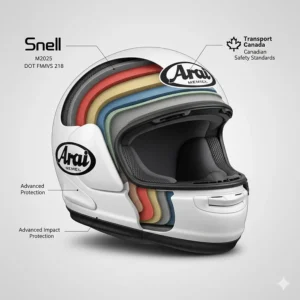
In Canada, every province mandates helmet use, but not all helmets are created equal. DOT approved helmets Canada must meet stringent Federal Motor Vehicle Safety Standard No. 218 (FMVSS 218), ensuring they’ve passed rigorous impact, penetration, and retention tests. Here’s what makes this certification crucial: in Canada, motorcycle helmets must be certified by one of three major standards—DOT, ECE, or Snell.
Understanding helmet certifications Canada isn’t just about staying legal—it’s about understanding what stands between you and a life-changing injury. Whether you’re a seasoned rider navigating Ontario’s twisting backroads or a weekend warrior exploring the Rockies, knowing the difference between ECE certified helmet Canada options and SNELL rated helmet Canada models can literally save your life. The impact testing standards, safety certification differences, and regulatory compliance requirements vary significantly, affecting how well your helmet protects you when it matters most.
Quick Comparison Table: Top DOT Helmets at a Glance
| Helmet Model | Certifications | Price (CAD) | Type | Best For |
|---|---|---|---|---|
| ILM Model 902 | DOT | $155-180 | Modular Flip-Up | Budget-Conscious Riders |
| HJC CS-R3 | DOT, ECE | $200-250 | Full-Face | All-Around Protection |
| Bell Qualifier DLX | DOT | $240-280 | Full-Face | Touring & Daily Commutes |
| ILM Model 313 | DOT | $120-160 | Full-Face | Entry-Level Riders |
| LS2 Rapid III | ECE 22.06, DOT | $180-220 | Full-Face | Sport Riding |
| ILM Model 726X | DOT, ECE | $90-130 | 3/4 Open Face | Cruiser Style |
| VEVOR Smart Helmet | DOT | $160-200 | Modular | Tech-Savvy Riders |
💬 Just one click – help others make better buying decisions too! 😊
✨ Don’t Miss These Exclusive Deals!
🔍 Take your riding safety to the next level with these carefully selected products available in Canada. Click on any highlighted item to check current pricing and availability on Amazon.ca. These helmets will help you create authentic protection your family will appreciate!
Top 7 DOT Approved Helmets Canada: Expert Analysis
1. ILM Motorcycle Dual Visor Flip-Up Modular Helmet Model 902
When it comes to versatility without breaking the bank, the ILM Model 902 stands as a Canadian favourite. This modular helmet delivers DOT-certified protection with a flip-up design that’s perfect for those quick gas station stops or chatting with fellow riders.
Key Specifications:
- DOT FMVSS 218 certification
- Dual visor system (clear + tinted sun visor)
- Removable, washable liner
- Available in sizes S-XXL
Price Range: $155-180 CAD
Canadian Availability: Readily available on Amazon.ca with Prime shipping across most provinces.
Canadian riders appreciate the practical flip-up design during our unpredictable weather. One Toronto-based customer noted, “The sun visor saved me countless times during those blinding winter sunsets on the 401.” The helmet runs slightly small, so sizing up is recommended for a comfortable fit.
✅ Pros:
- Exceptional value for money
- Quick-release chin strap
- Multiple ventilation ports reduce fogging
❌ Cons:
- Visor can fog in extreme cold without anti-fog treatment
- Heavier than premium models (approximately 1,650g)
2. HJC CS-R3 Full-Face Helmet
The HJC CS-R3 represents the sweet spot between affordability and premium protection. With both DOT and ECE certifications, this helmet exceeds Canadian legal requirements and provides peace of mind for serious riders.
Key Specifications:
- DOT and ECE 22.05 dual certification
- Advanced CAD technology shell design
- RapidFire II shield replacement system
- Crown and forehead ventilation
Price Range: $200-250 CAD
Canadian Availability: Available through FortNine, GP Bikes, and Amazon.ca with nationwide shipping.
HJC’s reputation in Canada spans decades, and the CS-R3 continues that legacy. The helmet’s intermediate oval shape fits most Canadian riders well. According to customer feedback from Vancouver riders, the ventilation system performs exceptionally during humid summer rides along the Sea-to-Sky Highway.
✅ Pros:
- Dual certification provides maximum legal compliance
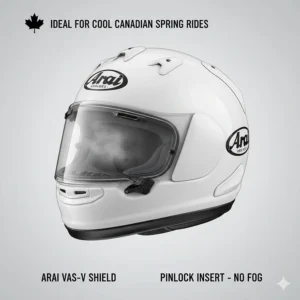
- Pinlock-ready shield prevents fogging
- Aerodynamic design reduces wind noise at highway speeds
❌ Cons:
- Limited colour options in Canada
- Shield replacement can be pricey ($40-60 CAD)
3. Bell Qualifier DLX MIPS
The Bell Qualifier DLX brings American engineering excellence to Canadian roads with an added twist—MIPS (Multi-directional Impact Protection System) technology that addresses rotational forces during impacts.
Key Specifications:
- DOT certification with MIPS technology
- Velocity Flow ventilation system
- Transition shield included
- NutraFog II anti-fog treatment
Price Range: $240-280 CAD
Canadian Availability: Widely available at motorcycle dealerships and ADM Sport locations across Canada.
Bell’s commitment to innovation shines here. The MIPS liner reduces rotational motion transferred to your brain during angled impacts—a common scenario in real-world crashes. Alberta riders particularly value the included transition shield for those long prairie rides where sun conditions change rapidly.
✅ Pros:
- MIPS technology for enhanced safety
- Transition shield adapts to changing light
- Comfortable padding even during 4+ hour rides
❌ Cons:
- Heavier than non-MIPS models
- Premium price point may deter budget shoppers
4. ILM Full-Face Helmet Model 313
For new riders entering Canada’s motorcycle community, the ILM Model 313 offers DOT-certified protection at an entry-level price that won’t intimidate your wallet.
Key Specifications:
- DOT FMVSS 218 certified
- Removable winter neck scarf (perfect for Canadian weather!)
- Dual visors (clear and tinted)
- ABS shell with EPS foam liner
Price Range: $120-160 CAD
Canadian Availability: Amazon.ca exclusive with free shipping for Prime members.
What sets this apart is the thoughtful inclusion of a removable winter neck scarf—a feature that Canadian riders genuinely appreciate during those crisp autumn rides through Algonquin Park or early spring commutes in the Maritimes. The Model 313 proves that DOT certification doesn’t require a premium price tag.
✅ Pros:
- Unbeatable price-to-safety ratio
- Winter neck scarf included (saves $20-30 separately)
- Lightweight at approximately 1,400g
❌ Cons:
- Build quality feels budget-oriented
- Ventilation could be better for summer riding
5. LS2 Rapid III
The LS2 Rapid III represents European engineering meeting North American safety standards. With the latest ECE 22.06 certification (and DOT approval), this helmet showcases how modern safety testing has evolved.
Key Specifications:
- ECE 22.06 and DOT certified
- Kinetic Polymer Alloy (KPA) shell
- Weight: 1,350g (under 3 lbs)
- Integrated spoiler for stability
Price Range: $180-220 CAD
Canadian Availability: Available through FortNine and select dealerships; some models on Amazon.ca.
The Rapid III brings cutting-edge safety at a mid-range price. ECE is the most commonly used certification overseas—over 50 countries have it as their benchmark. Canadian riders planning international trips appreciate having a helmet that meets global standards.
✅ Pros:
- Latest ECE 22.06 certification includes rotational impact testing
- Lightweight reduces neck fatigue
- Removable, washable hypoallergenic liner
❌ Cons:
- Limited availability in Canada compared to US market
- Some sizing inconsistencies reported
6. ILM Open Face 3/4 Helmet Model 726X
For cruiser enthusiasts and riders who prefer the open-face experience, the ILM Model 726X delivers DOT and ECE protection without the full-face enclosure.
Key Specifications:
- DOT and ECE certified
- Detachable sun shield and face mask
- Quick-release buckle system
- Multi-vent cooling system
Price Range: $90-130 CAD
Canadian Availability: Amazon.ca with excellent customer reviews from Canadian buyers.
This 3/4 helmet strikes a balance between freedom and protection. While full-face helmets offer superior safety, the Model 726X meets Canadian legal requirements and provides significantly more protection than beanie-style “novelty” helmets. Ontario cruiser riders appreciate the classic aesthetic combined with modern safety features.
✅ Pros:
- Exceptional ventilation for summer rides
- Classic styling appeals to cruiser crowd
- Detachable accessories allow customization
❌ Cons:
- Reduced face and chin protection versus full-face
- More wind noise at highway speeds
7. VEVOR Smart Motorcycle Helmet (Modular with Bluetooth)
The VEVOR Smart Helmet represents the future of motorcycle safety—combining DOT certification with integrated Bluetooth communication technology.
Key Specifications:
- DOT approved
- Built-in Bluetooth 5.0 speakers
- Dual anti-fog visors
- ABS shell with high-density EPS
Price Range: $160-200 CAD
Canadian Availability: Amazon.ca with fulfillment centres ensuring quick delivery across Canada.
This modular VEVOR helmet addresses modern riders’ needs—hands-free calling, GPS navigation audio, and music streaming while maintaining DOT safety standards. Quebec riders particularly appreciate the built-in communication system for group rides through the Laurentians, eliminating the need for separate Bluetooth headsets.
✅ Pros:
- Integrated Bluetooth eliminates aftermarket installation
- Modular design for versatility
- USB rechargeable battery (8+ hours talk time)
❌ Cons:
- Heavier due to Bluetooth module
- Battery requires charging before rides
Understanding Helmet Certifications Canada: DOT vs ECE vs SNELL
Navigating helmet certifications Canada can feel like decoding a foreign language. Let’s break down what each certification really means for your protection.
DOT (Department of Transportation) Certification
The Department of Transportation sets a standard known as FMVSS 218, where helmets must undergo rigorous testing to ensure adequate protection. DOT testing focuses on three critical areas:
Impact Attenuation: The helmet must absorb impact energy effectively. Testing involves dropping helmets onto flat and hemispherical anvils from specific heights.
Penetration Resistance: A pointed striker is dropped onto the helmet to ensure the shell won’t fail catastrophically.
Retention System Strength: The chin strap must withstand significant force without releasing or breaking.
Here’s what makes DOT unique in North America: manufacturers self-certify their helmets. They conduct the testing and affix the DOT sticker. The National Highway Traffic Safety Administration (NHTSA) then conducts random market sampling to ensure compliance. Helmets failing these spot-checks face recalls and penalties.
ECE (Economic Commission for Europe) Certification
ECE 22.05 (recently updated to 22.06) is the most comprehensive battery of testing, including optical quality of face shields and shell rigidity. Unlike DOT, ECE requires independent third-party testing before certification.
The ECE 22.06 update introduced rotational impact testing—addressing how helmets handle oblique impacts that cause brain injuries through rotational acceleration. This represents a significant advancement in motorcycle helmet safety science.
Key ECE Testing Elements:
- Multiple impact points across the helmet shell
- Rigorous strap system testing
- Visor quality and peripheral vision assessment
- Batch testing to ensure production consistency
SNELL Memorial Foundation Certification
SNELL certification represents the gold standard for many professional racers. Snell M2020 helmets undergo multiple impact tests to evaluate protection against repeated blows. The foundation updates standards every five years, with M2025 being the latest iteration.
SNELL testing uses higher impact velocities than DOT—helmets are dropped onto both flat and hemispherical anvils at speeds up to 7.75 meters per second (versus DOT’s 6.0 m/s). This more rigorous testing means thicker EPS foam and stiffer shells.
Which Certification Should Canadian Riders Choose?
In Canada, for a helmet to be legal for street use, it must meet at least one of these certifications: DOT, ECE, or Snell. Provincial regulations accept any of these standards, though DOT remains most common.
For Canadian riders, here’s practical advice:
🏍️ Street Riding: DOT certification meets all provincial legal requirements. Adding ECE provides extra assurance of third-party testing.
🏁 Track Days: Many Canadian tracks require SNELL certification. Check your track’s specific requirements before purchasing.
🌍 International Travel: ECE certification is accepted in over 50 countries, making it ideal for riders planning cross-border adventures.
💰 Budget Conscious: DOT-only helmets typically cost $50-100 CAD less than dual-certified options while meeting Canadian legal requirements.
Impact Testing Standards: How Helmets Actually Protect You
Understanding impact testing standards means looking beyond certification stickers to understand real-world protection mechanisms.
The Physics of Impact Protection
When your helmet hits pavement at 50 km/h, it needs to manage catastrophic energy. Here’s how:
Energy Absorption: The EPS (Expanded Polystyrene) foam liner crushes during impact, converting kinetic energy into heat and permanent deformation. This prevents that energy from reaching your skull.
Load Distribution: The outer shell distributes point impacts across a larger area, preventing penetration and spreading forces over more foam.
Deceleration Management: Your brain floats in cerebrospinal fluid inside your skull. Sudden deceleration causes it to impact the skull interior. Helmets slow deceleration rates to reduce brain injury severity.
Multi-Directional Impact Protection
Modern safety research shows that rotational forces during angled impacts cause severe brain injuries—concussions, diffuse axonal injury, and subdural hematomas. New technologies address this:
MIPS (Multi-directional Impact Protection System): A low-friction layer allows 10-15mm of rotational movement, redirecting rotational energy away from the brain.
ECE 22.06 Rotational Testing: The latest European standard includes oblique impact tests on a 45-degree anvil, measuring rotational acceleration and Brain Injury Criterion (BrIC).
Snell M2025 Updates: Incorporates oblique impact testing similar to ECE 22.06, bringing this previously European-focused safety measure to American standards.
Real-World Impact Scenarios
Laboratory testing can’t replicate every real-world scenario, but standards approximate common crash dynamics:
- Flat Anvil Testing: Simulates impacts with flat surfaces like roads
- Hemispherical Anvil: Replicates striking curbs, road signs, or vehicle parts
- Penetration Tests: Address sharp object impacts (branches, debris)
- Retention Testing: Ensures helmets stay on during tumbling crashes
Canadian riders face unique challenges—hitting black ice and sliding across frozen roads creates different impact dynamics than warm-weather crashes. DOT and ECE standards account for temperature variations in foam performance.
Safety Certification Differences: What Really Matters
Let’s cut through marketing jargon and examine safety certification differences that actually affect your protection.
Testing Philosophy Comparison
DOT Philosophy: Establishes minimum safety thresholds for legal road use. Prioritizes energy absorption through softer foam, allowing more impact compression.
ECE Philosophy: Balances impact absorption with weight considerations. ECE operates under the assumption that impact absorption must be balanced with weight, as a lighter helmet gives your head less inertia in a crash.
SNELL Philosophy: Maximizes impact absorption for worst-case scenarios. Uses stiffer shells and denser foam for high-energy impacts.
Compliance and Verification
Here’s where certifications diverge significantly:
DOT Compliance:
- Manufacturer self-certification
- NHTSA conducts random market sampling
- Non-compliant helmets face recalls and fines
- No pre-market approval required
ECE Compliance:
- Mandatory third-party laboratory testing
- Batch testing (50 random helmets per production run)
- Approval required before market release
- Annual production monitoring
SNELL Compliance:
- Independent testing of every helmet design
- Ongoing spot-checks throughout production life
- Optional certification (not legally required anywhere)
- Most rigorous ongoing quality assurance
The “Stiffer vs Softer” Debate
A fascinating difference exists between SNELL and ECE/DOT approaches:
SNELL helmets use stiffer shells and denser foam to pass higher-energy impact tests. This means:
- Better protection in severe, high-speed crashes
- More force transmitted in low-speed impacts
- Heavier helmets (typically 100-200g more)
ECE helmets use softer shells and foam optimized for common crash speeds. This means:
- Better protection in typical street riding accidents
- Reduced weight and improved comfort
- Less protection in extreme racing scenarios
DOT helmets fall somewhere in the middle, though self-certification creates variability.
Which approach is “better”? It depends on your riding style. Track riders benefit from SNELL’s high-impact protection. Street riders typically experience lower-speed crashes where ECE optimization provides superior protection.
Regulatory Compliance Requirements Across Canadian Provinces
Canada’s federal structure means helmet laws vary by province, though all mandate helmet use. Understanding regulatory compliance requirements ensures you’re legal wherever you ride.
Federal Framework
While Canada eliminated its national helmet standard (CSA CAN-3-D230) in the 1980s, provinces uniformly accept international standards. Since the nation eliminated the Canadian-specific standard, helmets allowed on Canadian roads must have one of the following certifications: DOT, ECE, or Snell.
Provincial Variations
Ontario: Ontario law requires you and your passenger to wear approved helmets with the chin strap securely fastened every time you drive a motorcycle or moped. Notable exception: Sikh riders have a religious exemption.
British Columbia: All motorcyclists and motorcycle passengers in British Columbia must wear a motorcycle safety helmet that meets designated safety standards. Police can inspect helmets roadside and seize non-compliant ones.
Quebec: Operates under similar requirements through SAAQ (Société de l’assurance automobile du Québec), accepting DOT, ECE, and SNELL certifications.
Alberta & Prairie Provinces: Follow federal guidelines accepting all three major certifications without additional provincial restrictions.
Maritime Provinces: Mandate helmet use with accepted certifications mirroring national standards.
Enforcement and Penalties
Helmet law enforcement varies significantly:
Roadside Inspections: If police have probable cause to suspect a helmet doesn’t meet approved standards, they’re authorized to inspect helmets roadside and seize non-compliant helmets.
Fines: Range from $100-500 CAD depending on province, with some jurisdictions adding demerit points.
Insurance Implications: Riding without an approved helmet can void insurance coverage, leaving you personally liable for accident costs.
The “Novelty Helmet” Problem
Beware of novelty helmets—skull caps or thin shells sold as “for display only” or “non-DOT” helmets. These provide virtually no protection and are illegal throughout Canada. Legitimate DOT helmets have:
✔️ DOT sticker on the helmet’s rear exterior
✔️ Manufacturer information and model number inside
✔️ Cushioned liner made of EPS foam (minimum 1 inch thick)
✔️ Securely fastened chin strap with proper D-ring or quick-release system
✔️ Weight appropriate for protective materials (minimum 1,200g for full-face)
How to Choose the Perfect DOT Approved Helmet for Canadian Riding
Selecting your helmet involves more than checking certification stickers. Here’s a systematic approach to finding your ideal protective gear.
Step 1: Measure Your Head Correctly
Grab a flexible measuring tape and wrap it around your head about 2.5 cm (1 inch) above your eyebrows. This measures the widest part of your head.
Size Chart Reference:
- XS: 53-54 cm
- S: 55-56 cm
- M: 57-58 cm
- L: 59-60 cm
- XL: 61-62 cm
- XXL: 63-64 cm
Pro Tip: Head between sizes? Always choose the smaller size initially. Quality helmets compress slightly during break-in, and a too-loose helmet is dangerously ineffective.
Step 2: Determine Your Head Shape
Helmets come in three basic internal shapes:
Long Oval: Front-to-back dimension longer than side-to-side (common in people of Northern European descent)
Intermediate Oval: Slightly longer front-to-back (most common shape, fits 75% of riders)
Round Oval: Nearly circular head shape (common in people of Asian descent)
Buying a helmet that doesn’t match your head shape causes pressure points, discomfort, and reduced safety. Try helmets from different manufacturers as each brand typically caters to specific shapes.
Step 3: Assess Your Riding Style
Commuters: Full-face helmets with good ventilation and integrated sun visors (like the ILM Model 902 or HJC CS-R3)
Touring Riders: Modular helmets allowing easy communication and fueling stops (consider VEVOR Smart Helmet with Bluetooth)
Sport Riders: Aerodynamic full-face with racing pedigree (LS2 Rapid III or Bell Qualifier DLX)
Cruiser Enthusiasts: Open-face helmets maintaining classic aesthetics while meeting safety standards (ILM Model 726X)
Adventure Riders: Dual-sport helmets with peak visors for sun protection (look beyond basic DOT options to ADV-specific designs)
Step 4: Consider Canadian Climate Factors
Our riding season varies dramatically by province:
Winter Preparation (BC Coastal & Southern Ontario): Year-round riders need:
- Anti-fog coating or Pinlock-ready shields
- Removable winter liners or neck scarves
- Adequate ventilation that closes completely
Summer Heat (Prairie Provinces): Look for:
- Maximum ventilation with multiple intake/exhaust ports
- Moisture-wicking liners
- Integrated sun visors
Rapid Weather Changes (Mountain Regions): Prioritize:
- Quick-change visor systems
- Transition shields adapting to light conditions
- Waterproof gaskets around visor edges
Step 5: Try Before You Buy (When Possible)
Online shopping offers convenience, but proper fit requires trying helmets on:
- Put the helmet on correctly: Open chin strap, spread shell sides apart, slide down evenly
- Check initial fit: Should feel snug, especially on cheeks and forehead
- Roll test: Grasp helmet (not straps) and try rolling it off your head. A proper fit resists removal
- Hold test: Wear for 10-15 minutes. Pressure points that don’t ease are deal-breakers
- Vision check: Look side-to-side and up-and-down. Peripheral vision should be unobstructed
Return Policies: Amazon.ca typically offers 30-day returns on unworn helmets. Many Canadian retailers (FortNine, GP Bikes) have similar policies. Always verify before purchasing.
Step 6: Verify Certification Authenticity
Counterfeit helmets exist. Verify authenticity:
- DOT Sticker: Must be permanently affixed to rear exterior (not just a sticker you could remove)
- Interior Labels: Manufacturer info, model number, size, and certification standards
- Build Quality: Proper EPS liner thickness, quality stitching, secure visor mechanisms
- Price Reality Check: Genuine DOT helmets under $80 CAD should raise suspicion
Step 7: Budget Appropriately
Under $150 CAD: Entry-level DOT protection (ILM Model 313, ILM Model 726X)
$150-250 CAD: Mid-range with added features (ILM Model 902, LS2 Rapid III, HJC CS-R3)
$250-400 CAD: Premium protection with advanced features (Bell Qualifier DLX MIPS)
$400+ CAD: Top-tier brands (Shoei, Arai, Schuberth) with cutting-edge technology
Remember: your brain is irreplaceable. Investing in proper protection is the smartest purchase you’ll make.
DOT Helmet Maintenance and Replacement Guidelines
Buying the right helmet is step one. Maintaining it properly ensures continued protection throughout its lifespan.
When to Replace Your Helmet
After Any Impact: Even if the shell looks fine, internal EPS foam crushes during impacts and can’t protect you again. Replace immediately after any crash.
Every 3-5 Years: Motorcycle helmets should be replaced every 3-5 years, or after any impact, as EPS foam liner hardens and degrades from sweat, hair oils, and time.
Visible Damage Signs:
- Cracks in outer shell
- Compressed or crumbling EPS liner
- Loose or damaged retention system
- Deteriorating interior padding
Environmental Degradation: Canadian temperature extremes accelerate helmet aging. Garage-stored helmets in unheated spaces experience freeze-thaw cycles affecting foam integrity.
Proper Care and Cleaning
Weekly Maintenance:
- Remove and wash liner/cheek pads in cold water with mild soap
- Wipe shell exterior with damp cloth
- Clean visor with microfiber cloth and approved cleaner (never paper towels—they scratch)
Monthly Tasks:
- Inspect retention system for wear
- Check visor mechanism functionality
- Verify all vents open/close properly
- Clean air vents with compressed air
Storage Best Practices:
- Store in cool, dry location away from sunlight
- Use helmet bag to prevent scratches and dust
- Never hang by chin strap (deforms liner)
- Avoid temperatures below -20°C or above 40°C
Visor Replacement
Scratched visors reduce visibility and increase accident risk. Replace when:
- Scratches don’t buff out with approved polishing compounds
- Anti-fog coating deteriorates
- Sealing gasket hardens or cracks
Canadian Pricing: Replacement visors range $25-80 CAD depending on brand and features.
❓ Frequently Asked Questions About DOT Approved Helmets Canada
❓ What does DOT approved mean for motorcycle helmets in Canada?
❓ How much should I expect to pay for a quality DOT helmet in Canada?
❓ Can I use an ECE certified helmet instead of DOT in Canada?
❓ Do I need SNELL certification for motorcycle riding in Canada?
❓ How often should I replace my DOT approved helmet?
Conclusion: Your Brain Deserves DOT Protection
Choosing DOT approved helmets Canada isn’t about checking a legal box—it’s about coming home safely after every ride. Whether you opt for the budget-friendly ILM Model 313 at $120 CAD or invest in the advanced Bell Qualifier DLX MIPS at $280 CAD, you’re making a statement that your life matters.
The helmet certifications Canada accepts—DOT, ECE, and SNELL—each bring different strengths. Understanding impact testing standards, safety certification differences, and regulatory compliance requirements empowers you to make informed decisions. For most Canadian riders, a DOT-certified helmet from reputable brands like ILM, HJC, or Bell provides excellent protection at reasonable prices.
Remember these key takeaways:
🛡️ Fit trumps certification—a perfectly fitted DOT helmet protects better than a loose SNELL helmet
🍁 Canadian climate matters—choose features addressing our temperature extremes
💰 Protection isn’t negotiable—invest appropriately in the only gear designed to save your life
📅 Replace regularly—even perfect storage can’t prevent foam degradation over 5 years
The Trans-Canada Highway, the Icefields Parkway, the Cabot Trail—Canada’s roads call to us. Answer that call protected by DOT approved helmets Canada, and ride knowing you’ve done everything possible to protect your most valuable asset: your brain.
Ride safe, ride smart, ride protected. 🏍️
Recommended for You
- 7 Best Arai Helmet Canada Models: Expert Reviews 2026
- 7 Best AGV Helmet Canada 2026: Premium Italian Design
- 7 Best HJC Helmets Canada 2026: Expert Safety Guide
Disclaimer: This article contains affiliate links to Amazon.ca. If you purchase products through these links, we may earn a small commission at no additional cost to you.
✨ Found this helpful? Share it with your riding community! 💬🤗
