
In This Article
Let’s be real — most of us spend weeks agonising over helmets and jackets, then slide on a pair of runners and call it a day. If that sounds familiar, this guide on low-cut motorcycle shoes vs boots safety is exactly what you need to read before your next ride.
Here’s a sobering thought: according to Statistics Canada, motorcycles and mopeds make up just 3.2% of Canada’s registered vehicles, yet they account for 11.7% of all traffic fatalities and 12.7% of serious injuries. Your feet are one of the first things that hit the pavement in a slide. There are 26 bones in each foot — and none of them are protected by jeans or a leather jacket.
The central question in the low-cut motorcycle shoes vs boots safety debate isn’t “which looks cooler?” It’s: “How much ankle protection are you willing to trade for convenience?” Low-cut moto shoes offer CE-certified protection, shift pads, and reinforced toe boxes in a profile that walks naturally off the bike. Full boots add shin coverage and more rigid ankle support, which matters more as ride intensity increases. Neither answer is universally right — but one is likely right for you, and this guide helps you figure out which.
For Canadian riders, the stakes are even higher. Spring thaw brings wet, gritty roads. Summer means long touring days with fatigue-inducing heat. And if you’re commuting through downtown Toronto or navigating Vancouver’s rain-soaked streets, the grip, waterproofing, and ankle support in your footwear directly affect how you handle your bike. We’ve done the research — sourcing products available on Amazon.ca, verifying CE certification, and providing honest commentary so you can make a smart, informed decision. All prices are in Canadian dollars (CAD).
Quick Comparison: Low-Cut Motorcycle Shoes vs Full Boots
| Feature | Low-Cut Moto Shoes | Full Motorcycle Boots |
|---|---|---|
| Ankle Coverage | At or just above ankle bone | Mid-calf to shin |
| CE EN 13634 Certification | Available (Level 1 or 2) | Available (Level 1 or 2) |
| Walkability Off Bike | ✅ Excellent | ⚠️ Moderate to Limited |
| Shift Pad Protection | Usually included | Usually included |
| Cold/Winter Performance | Limited insulation | Better with lined options |
| Ideal Use Case | Urban commuting, casual riding | Touring, highway, ADV riding |
| Typical Price Range (CAD) | $100–$300 | $200–$600+ |
| Amazon.ca Availability | ✅ Yes | ✅ Yes |
Looking at this table, the biggest trade-off is clear: low-cut shoes win on wearability, but full boots win on coverage. What this table doesn’t show you is how much that extra ankle-and-shin coverage matters in a real crash — a low-speed slide at 30 km/h can still result in serious ankle fractures if the boot doesn’t support the joint laterally. That said, a CE-certified low-cut shoe is exponentially safer than street sneakers, so even stepping up to an entry-level moto shoe is a meaningful improvement for urban riders who currently ride in casual footwear.
💬 Just one click — help others make better buying decisions too! 😊
✨ Don’t Miss These Exclusive Deals!
🔍 Ready to upgrade your riding footwear? Click any highlighted product below to check current pricing and availability on Amazon.ca. Whether you’re commuting in Calgary or cruising the Sea-to-Sky Highway, the right shoes could save your feet — and your season.
Top 7 Motorcycle Shoes & Boots on Amazon.ca: Expert Analysis
1. Alpinestars SMX-6 V3 Motorcycle Boots
The Alpinestars SMX-6 V3 is the benchmark by which most sport-touring boots get judged — and for good reason. It carries full CE EN 13634:2017 Level 2 certification, meaning it’s passed the highest standard of abrasion resistance and impact cut resistance available for motorcycle footwear. The replaceable toe sliders are a feature you’d usually only find on track-day boots, which tells you this isn’t just a fashion item. The medial ankle and heel support system uses a dual-density construction: softer where you need flex, rigid where you need support after impact.
For the Canadian rider, the SMX-6 V3 is particularly compelling because it’s built to handle variable conditions. The microfibre upper resists moisture absorption better than full leather, which means your feet stay drier on a wet morning commute in Montreal. The breathable liner also makes it viable for shoulder-season riding — those shoulder months in April and September when you’re never quite sure if it’s a jacket day or a T-shirt day.
Canadian buyers consistently note that sizing runs slightly narrow, so consider going half a size up if you’re between sizes or plan to wear thick socks in autumn. Available on Amazon.ca, typically Prime-eligible with $35+ free shipping for non-Prime members.
✅ Pros:
- Level 2 CE certification — top-tier abrasion and impact cut resistance
- Replaceable toe sliders extend the boot’s usable lifespan
- Breathable yet reasonably water-resistant for variable Canadian weather
❌ Cons:
- Runs narrow — size up if in doubt
- At the upper end of price range for ankle-height boots
💰 Price range: mid-$300s to low-$400s CAD — premium, but the Level 2 CE rating justifies it for serious riders.
2. RIDEIRON Motorcycle Shoes Men with Shift Pad
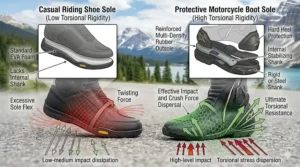
The RIDEIRON is where the casual riding shoes shift pad debate gets interesting. These look, at a glance, like a stylish athletic sneaker — but beneath the surface there’s reinforced ankle support, an anti-slip sole, and a built-in shift pad on the left toe box that will spare your favourite jeans from gear-change scuffs. The breathable upper makes these a genuine summer riding option, and the side zipper makes on-and-off quick enough that you won’t be tempted to ride in flip-flops “just for a short trip.”
Here’s my honest take: the RIDEIRON is a gateway boot. It’s designed for the rider who currently wears regular sneakers and needs something that protects better without looking like they’re suiting up for a race. For urban Canadian riders commuting in summer — think the flat grid of Winnipeg or the dense streets of downtown Ottawa — this is a compelling step-up that doesn’t require a wardrobe change at the office. What most buyers overlook is that “breathable” boots in Canadian summer actually matter enormously; heat fatigue is a real safety issue on long rides.
Canadian reviews highlight good durability for daily use, with the shift pad holding up well over a full riding season. Available on Amazon.ca, often Prime-eligible.
✅ Pros:
- Built-in shift pad — protects both the shoe and your gear lever area
- Looks like a sneaker, rides like a moto shoe
- Side zipper for easy on-and-off
❌ Cons:
- Not waterproof — poor choice for Vancouver’s rainy season
- CE certification level should be verified at point of purchase
💰 Price range: low-to-mid $100s CAD — excellent entry-level value.
3. Alpinestars Radon Drystar Motorcycle Boots
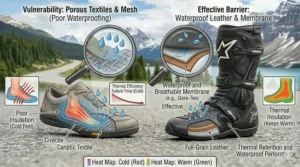
If you commute in Canada year-round, the Alpinestars Radon Drystar is the product category you’ve been waiting for. Alpinestars’ Drystar membrane is their proprietary waterproofing technology — it keeps water out while remaining breathable enough that your feet don’t turn into a sauna during the warmer months. This is a touring-height boot (mid-calf), which means it resolves the ankle coverage debate decisively in favour of protection. The CE-certified construction includes reinforced ankle zones and a rigid heel counter.
What this boot does that most touring boots don’t is remain genuinely walkable. If you’re riding to a meeting, a coffee shop, or a trailhead — scenarios common for the dual-purpose Canadian rider — you won’t be doing an awkward shuffle across the parking lot. The sole has enough flex at the toe for a semi-natural gait. For riders in British Columbia doing highway plus ferry plus hiking-trail itineraries, this is the kind of all-rounder that earns its spot in the gear bag permanently.
The trade-off: like most Drystar products, it runs warm in July and August. If you’re doing summer city riding in Toronto at 35°C, you may prefer a non-waterproofed option and accept the occasional wet feet.
✅ Pros:
- Drystar waterproof membrane — essential for BC and Atlantic Canada rainy seasons
- Touring height provides full ankle and lower-calf coverage
- Versatile enough for on-bike and off-bike wear
❌ Cons:
- Runs warm — not ideal for peak-summer urban riding
- Mid-calf height means less compatibility with slim riding pants
💰 Price range: mid-$300s to $400 CAD — strong value for an all-weather touring boot.
4. PROFIRST Mens CE Armour Motorcycle Short Ankle Boots
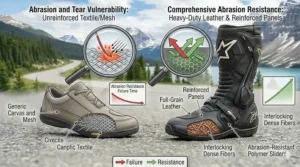
The PROFIRST is the protection compromise analysis made visible. These are CE-armoured short ankle boots that wear like a fashion boot — the leather upper and clean lines mean you could walk into most casual offices without turning heads. Inside, there’s CE armour at the ankle and toe zones, an anti-slip rubber sole, and waterproofing claimed via the leather construction. The short ankle cut means you get more coverage than a low-cut shoe but less than a mid-calf touring boot.
For the Canadian buyer, the PROFIRST fills a gap that more expensive brands sometimes miss: you don’t always want to spend $400 on boots, especially if you’re a newer rider still figuring out whether you’ll commute year-round or mostly weekends. At this price point, getting CE-armoured construction is a genuine win. The waterproof claim holds reasonably well in light rain — adequate for most Canadian spring showers, though not for extended riding in BC downpours.
One honest caveat: the armour inserts are rated but the exact CE level should be confirmed at purchase. For riders doing mostly urban low-speed commuting, this represents excellent value and meaningful protection over casual footwear.
✅ Pros:
- CE armour in ankle and toe zones
- Looks like a casual fashion boot — office-compatible
- Waterproof leather construction for Canadian spring/fall
❌ Cons:
- Confirm exact CE level rating at purchase
- Ankle height is short — less protection in high-energy crashes
💰 Price range: $100–$180 CAD — strong mid-tier value for commuters.
5. Scoyco Motorcycle Shoes Anti-Slip Protective Touring Boots
The Scoyco sits in the sweet spot between “riding shoe” and “ankle boot” — it’s cut slightly higher than a typical sneaker-style moto shoe, covering the ankle bone fully while still being breathable enough for summer riding. The anti-slip sole is legitimately grippy, which matters more than most riders realise: every time you put your foot down at a light on wet asphalt, a slick sole is a fall-risk. Shockproof construction in the heel and toe rounds out a solid safety package at a budget-friendly price.
For newer Canadian riders on a budget — perhaps picking up their first bike this spring — the Scoyco is a sensible starting point. It won’t pass muster for experienced highway riders doing 500+ km touring days, but for sub-100 km city and suburban rides, it provides meaningful protection over street shoes. The breathable mesh upper is genuinely comfortable in Ontario and Alberta summer heat, and the anti-slip sole earns its keep on spring roads still coated in road salt residue.
Available on Amazon.ca with standard shipping. Not always Prime-eligible, so factor in delivery times if ordering for an upcoming weekend ride.
✅ Pros:
- Anti-slip sole — critical for wet Canadian road conditions
- Full ankle-bone coverage despite a low-profile design
- Budget-accessible price point for new riders
❌ Cons:
- Limited cold-weather performance — not suitable for fall/winter riding
- Less robust armour than premium-tier competitors
💰 Price range: $60–$110 CAD — ideal first step-up for riders ditching street shoes.
6. BORLENI Motorcycle Riding Shoes Casual Breathable Powersports Shoes
The BORLENI leans hard into the urban mobility solutions angle: it’s designed to look like a casual street shoe while providing enough protection for everyday riding. The casual breathable design means you’re not carrying a bag of heavy boots when you arrive at your destination — these go from bike to boardroom (or at least bike to coffee shop) without fuss. Protective inserts cover the ankle and toe regions, and the powersports-specific sole provides the grip and rigidity you need on foot pegs.
What sets the BORLENI apart from pure fashion moto-shoes is that the protective inserts are genuinely structural, not just decorative foam. The ankle insert provides meaningful resistance to lateral roll — which is the most common mechanism of ankle injury in low-speed motorcycle crashes. For the Toronto or Vancouver urban commuter who’s already carrying enough gear and doesn’t want to schlep a pair of boot bags, this is a legitimately practical solution.
Customer feedback on Amazon.ca highlights consistent sizing and good durability over a six-to-twelve-month riding season. The breathable upper is particularly praised by summer riders.
✅ Pros:
- Looks and feels like a casual shoe — ideal for urban commuters
- Structural ankle and toe inserts beyond decorative padding
- Breathable upper for hot summer commuting
❌ Cons:
- Not waterproof — not suitable for year-round wet-weather riding
- CE certification documentation should be verified before purchase
💰 Price range: low-to-mid $100s CAD — excellent value for urban summer riding.
7. Zeozoom Motorcycle Riding Boots Leather for Men and Women
The Zeozoom rounds out our list as a unisex leather option — important because women’s motorcycle footwear on Amazon.ca is often an afterthought, and this model genuinely caters to both. Full leather construction provides inherent abrasion resistance, anti-slip soles handle Canadian road conditions well, and the design is clean enough to work in both casual and semi-formal environments. For riders who prefer traditional aesthetics over the “sporty athletic” look of other entries on this list, the Zeozoom hits the right note.
Leather boots also have a practical advantage in Canadian conditions that synthetic materials sometimes don’t match: properly maintained leather becomes more water-resistant over time and conforms to the shape of your foot, meaning long touring days become progressively more comfortable. The caveat is maintenance — leather needs conditioning, especially after exposure to road salt in Canadian winters. A simple monthly wipe-down with leather conditioner keeps these boots performing for years.
The Zeozoom is a good pick for riders who commute medium distances (30–80 km round trip) and want footwear that transitions from the bike to a restaurant or social gathering without looking like they’ve arrived ready for a track day.
✅ Pros:
- Unisex design — genuine option for women riders on Amazon.ca
- Leather construction provides natural abrasion resistance
- Classic aesthetic works in casual and semi-formal settings
❌ Cons:
- Requires regular leather maintenance, especially with Canadian road salt exposure
- Less ankle armour rigidity than purpose-built CE-rated sport boots
💰 Price range: $100–$200 CAD — solid mid-range option for traditional-style riders.
How to Choose Motorcycle Footwear in Canada: A Practical Decision Guide
Choosing between low-cut shoes and full boots comes down to four factors that most product pages won’t help you weigh honestly.
1. Your typical ride type and distance. If 80% of your riding is urban commuting under 50 km — city centre routes in Hamilton, Edmonton, or Halifax — a CE-certified low-cut shoe or ankle boot gives you adequate protection plus the walkability that makes you less likely to leave it at home. If you regularly do 200+ km highway riding, you want mid-calf or taller boots with rigid ankle support. The physics change at highway speeds; a slide at 100 km/h on the Trans-Canada involves forces that low-cut shoes simply aren’t engineered for.
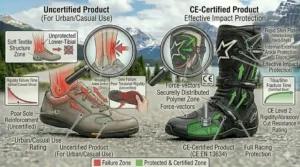
2. The ankle coverage debate, settled. Here’s the practical answer: any CE EN 13634-certified footwear — shoe or boot — provides meaningful protection over street shoes. The EN 13634:2017 standard tests for abrasion resistance, impact cut resistance, transverse rigidity, and height/retention. A Level 1 shoe passes; a Level 2 boot passes at a higher threshold. The critical number is whether the ankle bone is covered. If the footwear reaches and covers the ankle bone with a certified insert, you’re significantly better protected than in casual footwear.
3. Canadian climate considerations. Waterproofing should be high on your list if you ride in BC, Ontario, or Atlantic Canada, where rain is a seasonal constant. If you’re in Alberta or Saskatchewan where summers are drier but winters are extreme, a warmer lined touring boot makes more sense for the shoulder seasons. All riders should avoid boots with salt-damaged soles — road salt accelerates sole delamination, so rinse your boots after early-spring rides.
4. CE certification — verify, don’t assume. Plenty of products use the word “protective” or claim “CE-tested” without displaying the EN 13634:2017 label. Before purchasing, look for the CE mark with a motorcycle icon and the four-digit numeric rating (e.g., 1-2-2-1) on the inner tongue or lining. If you can’t find this information clearly on the Amazon.ca listing, contact the seller before purchasing.
5. Shift pad: essential, not optional. If you ride a manual gearbox motorcycle — which is most motorcycles — and you’re using footwear without a shift pad, you’re wearing through the left toe of your footwear unnecessarily and potentially losing tactile feel on gear changes. Every option on this list addresses this, but budget moto shoes from unverified brands often skip it.
Real-World Canadian Rider Scenarios: Which Boot Fits Your Life?
🏙️ The Urban Toronto Commuter — Maya, commutes 18 km daily
Maya rides a mid-size naked bike year-round (April through November) in downtown Toronto. She locks up at the office and needs footwear that doesn’t scream “motorcycle gear” in a client meeting. Road conditions range from summer heat to October rain and early frost.
Best match: PROFIRST CE Ankle Boots or BORLENI Riding Shoes — the CE armour is there for protection during her stop-and-go commute, the aesthetic passes for casual business, and the waterproofing handles Toronto autumn rain. She’d size up half a size and keep a tube of leather conditioner at her desk.
🏔️ The Weekend Vancouver Island Adventurer — Brendan, 200–400 km weekend rides
Brendan rides a mid-adventure bike on Vancouver Island, which means logging roads, ferry terminals, and the Pacific Marine Circle Route. Weather changes hourly, the roads are wet more often than not, and he covers serious distance.
Best match: Alpinestars Radon Drystar — the waterproof membrane handles Island weather, the mid-calf height gives him ankle security on uneven road surfaces, and the walkability lets him explore trailheads without changing footwear. The warm-weather trade-off is real, but Island summer temperatures rarely demand anything else.
🌾 The Suburban Calgary Weekender — Darlene and Tyler, occasional cruiser riders
This couple rides a cruiser on warm weekends from May to September in and around Calgary — flat prairie roads, good visibility, moderate speeds. They prioritize comfort and ease of entry since they don’t ride daily.
Best match: RIDEIRON Motorcycle Shoes or Zeozoom Leather Boots — both provide meaningful step-up protection over sneakers, both are easy on-and-off, and for Calgary’s dry summers, waterproofing is a lower priority than comfort and breathability.
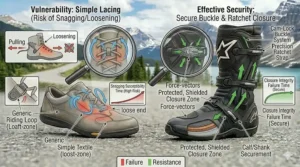
The Protection Compromise Analysis: What You Actually Lose with Low-Cut Shoes
This is the section the enthusiast forums debate endlessly, and it deserves a straight answer.
What low-cut CE shoes provide:
- CE EN 13634-certified abrasion and impact cut resistance
- Ankle bone coverage (if designed correctly)
- Shift pad protection
- Anti-slip soles
- Toe reinforcement
What full boots add:
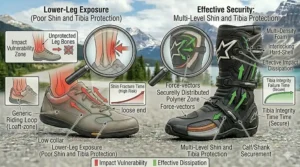
- Lateral ankle roll resistance via rigid external structure (critical in high-speed crashes)
- Shin protection (the Height “2” rating in EN 13634)
- Greater resistance to ankle flexion injuries in impacts
- More insulation and weatherproofing options
The honest risk calculation: At speeds under 60 km/h — typical urban riding — a CE-certified low-cut shoe provides meaningful protection for the most common injury types: abrasion, crush, and direct impact. At highway speeds (90–110 km/h), the energy involved in a crash increases dramatically, and the additional structural support of a full boot begins to matter significantly more. A low-cut shoe’s ankle insert cannot prevent the lateral ankle displacement that occurs when a bike lands on a rider’s leg at 100 km/h.
Industry research and crash data referenced by the Motorcycle Confederation of Canada consistently shows that lower extremity injuries are among the most common in non-fatal motorcycle crashes. The feet and ankles are contact points in virtually every low-side crash. Choosing a CE-certified shoe over a street sneaker is a major safety upgrade. Choosing a full boot over a CE shoe is a meaningful further upgrade — especially for riders doing highway or touring miles.
The right answer isn’t “always wear full boots.” It’s: match your footwear to your ride. Urban slow-speed commuting in CE shoes? Reasonable compromise. Highway touring in low-cut shoes? Unnecessary risk.
Motorcycle Boots vs Work Boots Safety Difference: A Straight Comparison
This question comes up constantly — particularly from trades workers or outdoor workers who already own good-quality CSA-certified work boots. “My Red Wings are tough as nails — why do I need moto-specific boots?”
The short answer: because the hazards are fundamentally different.
| Safety Feature | CSA Work Boot | CE Motorcycle Boot |
|---|---|---|
| Standard | CSA Z195 (Canada) | CE EN 13634:2017 |
| Steel/Composite Toe | ✅ Yes | ✅ Usually yes |
| Ankle Abrasion Resistance | ⚠️ Limited | ✅ Tested specifically |
| Shift Pad | ❌ No | ✅ Usually yes |
| Anti-Twist Midsole | ❌ No | ✅ Often yes |
| Transverse Rigidity Testing | ❌ No | ✅ Yes |
| Impact Cut Resistance | ❌ Not at highway slide speeds | ✅ Yes |
| Sole Grip (Wet Road) | ✅ Yes | ✅ Yes |
CSA Group Z195 certification is Canada’s standard for occupational protective footwear. It tests for compression, puncture, and electrical hazard resistance — all relevant for construction sites. However, it does not test for the high-speed abrasion resistance, transverse rigidity, or impact cut resistance that define motorcycle crash protection. Your steel-toed work boots will protect your toes from a dropped beam; they won’t protect your ankle from a 60 km/h slide across asphalt.
Conversely, most motorcycle boots are not appropriate for construction sites. The soles aren’t always rated for standing on sharp materials, and they may lack the electrical hazard resistance of CSA footwear. These are purpose-built standards for genuinely different risk environments. If you do both — work boots on-site, moto boots on the bike.
What to Expect: Real-World Performance in Canadian Riding Conditions
Spring (April–May): Road Salt, Grit, and Wet Pavement
Canadian spring roads are arguably the most demanding footwear environment: residual road salt, freeze-thaw pavement cracking, gravel wash, and unpredictable wet-dry transitions. Leather boots need conditioned soles to resist salt delamination. Synthetic uppers can become sticky if they absorb salt residue. Best practice: rinse boots with water (not soap) after rides on recently de-iced roads, and allow to dry naturally, away from direct heat.
Summer (June–August): Heat Management
Canadian summer is the prime riding season, but urban heat — particularly in southern Ontario and BC’s Lower Mainland — means footwear ventilation becomes a safety issue. Overheated feet cause fatigue; fatigue reduces reaction time. CE-certified breathable riding shoes (like the RIDEIRON or BORLENI) are a genuinely safer option in peak summer compared to forcing thick touring boots all day in 35°C heat. If you ride in high summer on mixed urban/highway routes, consider a mesh-upper shoe for city legs and carry more protective boots for highway stretches.
Fall (September–October): The Transition Window
This is when most Canadian riders get caught out. Early September feels like summer; late October brings cold rain, wet leaves, and early frost. Waterproof footwear (Alpinestars Radon Drystar) earns its worth in the fall transition window. Cold temperatures also affect reaction time; a boot with some thermal insulation reduces hand-and-foot cold fatigue on morning commutes.
Winter Storage
Most Canadian riders put their bikes away from November to March. Store leather boots stuffed with newspaper to maintain shape, conditioned with a leather product, and away from temperature extremes. Synthetic boots benefit from a clean, dry storage location. Inspect buckles, zippers, and CE armour inserts before the spring season begins — armour can degrade or shift if stored improperly.
Common Mistakes When Buying Motorcycle Footwear in Canada
1. Assuming “looks protective” means “is protective.” Many fashion-forward motorcycle shoes are made with decorative seams and aesthetic armour panels that provide minimal tested protection. Always look for the EN 13634:2017 CE label on the tongue or lining — not just claims on the Amazon.ca product page.
2. Buying for aesthetics, ignoring fit. The best protection in the world is compromised if the boot doesn’t fit correctly. Armour inserts that shift during a crash because the boot is too loose provide false security. As the Transport Canada road safety data reminds us, serious lower-extremity injuries are common in motorcycle crashes — proper fit keeps armour in place when it matters.
3. Ignoring Canadian shipping realities. Some premium moto footwear brands (REV’IT!, Dainese, full-priced TCX) are not always stocked on Amazon.ca and may ship from the US, triggering customs duties and adding 2–3 weeks of delivery time. Always verify Amazon.ca availability (not just Amazon.com shipping to Canada) before committing to a purchase, especially before a planned riding trip.
4. Neglecting maintenance after Canadian winters. Road salt destroys sole adhesion. Many riders are surprised by a sole delaminating mid-ride — often because the boot sat all winter with salt residue baked into the outsole bond. A quick wipe-down after each early-spring ride and a proper end-of-season clean extends the life of any motorcycle boot by years.
5. Over-indexing on waterproofing for summer use. Waterproof boots trap heat. If you’re buying primarily for June-through-August riding in Calgary or Toronto, a breathable non-waterproof option that you’ll actually wear beats a waterproof boot you leave at home because your feet overheat. In Canada’s varied climate, many riders own two pairs: a breathable summer shoe and a waterproof fall/shoulder-season boot.
Features That Actually Matter (And Those That Don’t)
✅ Matters — A Lot:
- CE EN 13634:2017 certification with visible label. Non-negotiable. The difference between tested protection and marketing claims.
- Ankle bone coverage. The minimum bar. If the boot doesn’t clear your ankle bone, it’s not a motorcycle boot.
- Shift pad on left toe. Protects both your footwear and your gear lever feel. Essential for manual transmission bikes.
- Anti-slip sole with oil resistance. Parking lots, gas stations, and wet roads are all environments where grip matters before you’re even on the bike.
- Retention system (laces, buckle, or zipper that stays secured). EN 13634 actually tests this — boots that open during an impact are not effective protection.
⚠️ Matters Situationally:
- Waterproofing. Essential in rainy climates (BC, Atlantic Canada, Ontario spring). Less critical for Alberta summer riding.
- Height (ankle vs. mid-calf). Match to your ride type — ankle height is fine for urban, mid-calf preferred for highway and touring.
- Insulation. Only relevant if you ride in temperatures below 10°C. Adds bulk that may be unwanted in summer.
❌ Often Overstated:
- “1,000-denier” or similar material claims without CE backing. Material weight alone means nothing without tested abrasion results.
- Decorative reinforcement panels. Visual armour that isn’t part of a certified system doesn’t protect you.
- “Military-grade” or similar non-standard marketing language. These terms have no regulatory definition in Canada. Look for the CE label, full stop.
FAQ: Low-Cut Motorcycle Shoes vs Boots Safety in Canada
❓ Are low-cut motorcycle shoes legal for riding in Canada?
❓ What does CE EN 13634:2017 actually mean for my safety?
❓ Can I use CSA-certified work boots for motorcycle riding in Canada?
❓ Do motorcycle shoes on Amazon.ca ship to all provinces, including remote areas?
❓ Should I size up when buying motorcycle boots for Canadian winter riding with thick socks?
Conclusion: The Right Boot for the Right Ride
The low-cut motorcycle shoes vs boots safety question doesn’t have a single right answer — it has the right answer for your riding. What we know clearly: any CE EN 13634:2017-certified footwear is dramatically safer than street shoes. The step from sneakers to a CE-rated moto shoe is the most impactful footwear decision you can make. After that, the choice between ankle-height shoes and mid-calf boots depends on your ride type, climate, and how far you’re willing to compromise wearability for protection.
For urban Canadian riders commuting under 50 km in variable weather — the majority of riders in Toronto, Vancouver, Ottawa, and Calgary — a quality CE-certified ankle boot or moto shoe like the RIDEIRON, PROFIRST, or Alpinestars SMX-6 V3 provides excellent protection in a package you’ll actually wear every day. For riders doing highway touring or mixed-terrain adventuring, the Alpinestars Radon Drystar or a similar mid-calf waterproof boot is the smarter investment.
Whatever you choose, verify the CE label before you buy, match your waterproofing to your climate, and treat your boots like the safety equipment they are — not just an accessory. Your feet have 26 bones each. They deserve better than a pair of runners.
✨ Ready to Make the Switch?
🔍 Check current pricing and availability on Amazon.ca for any of the products above. Click the highlighted items to compare, read Canadian reviews, and find Prime-eligible options. Your next ride is only as safe as your least protected gear — make it count!
Recommended for You
- Best 7 Casual Riding Shoes for Office Commute in Canada 2026
- Motorcycle Sneakers Look Normal: 7 Best Picks for Canadian Riders 2026
- Sport Touring Boots vs Race Boots: 7 Best Picks for Canadian Riders 2026
Disclaimer: This article contains affiliate links. As an Amazon Associate, I earn from qualifying purchases. If you purchase products through these links, we may earn a small commission at no additional cost to you.
✨ Found this helpful? Share it with your friends! 💬🤗
