
In This Article
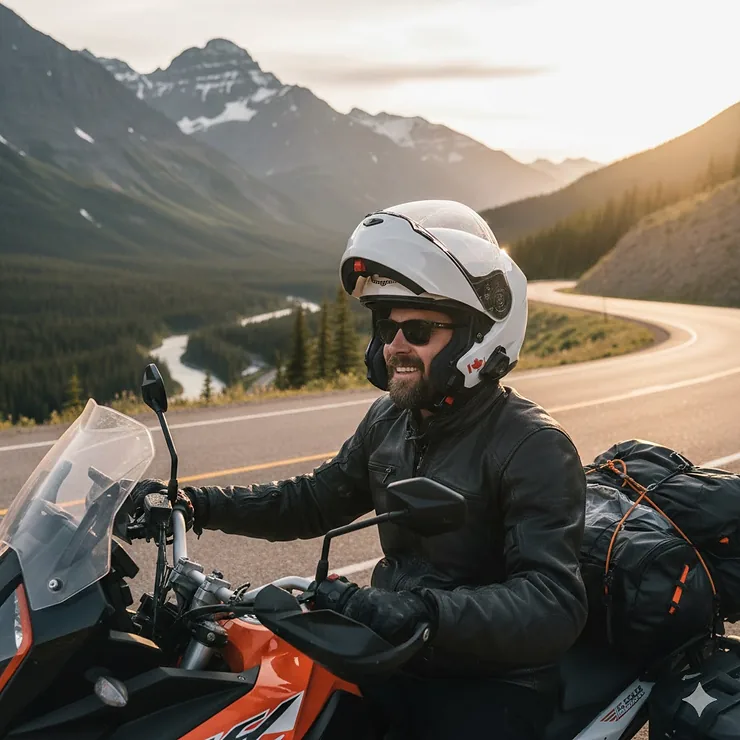
Picture this: you’re cruising through the Canadian Rockies on a perfect summer day, the sun beating down as you navigate hairpin turns. You pull over for a quick photo op, and instead of wrestling with your full-face helmet while sweat drips down your face, you simply flip up the chin bar with one hand. That’s the magic of a touring modular helmet—versatility meets protection without compromise.
For Canadian riders tackling everything from prairie highways to mountain passes, modular helmets have become the go-to choice for long-distance comfort. These innovative flip-up designs offer the full protection of a traditional full-face helmet while providing the convenience of quick access to your face without removing the entire unit. Whether you’re stopping at Tim Hortons for a double-double or chatting with fellow riders at a scenic viewpoint, modular helmets make life easier.
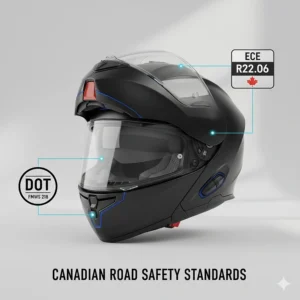
The touring landscape in Canada presents unique challenges. Temperature swings from the cool Maritime mornings to the scorching heat of an Okanagan afternoon demand equipment that adapts. Modern modular helmets deliver exceptional ventilation when you need airflow and solid weather protection when conditions turn nasty. With DOT, ECE 22.06, and Snell certifications becoming standard across quality models, safety no longer takes a back seat to convenience. In this comprehensive guide, we’ll explore the best touring modular helmets available in Canada for 2026, complete with Canadian pricing, real customer feedback, and expert analysis to help you make an informed decision.
Quick Comparison Table
| Helmet Model | Price (CAD) | Weight | Shell Material | Noise Level | Best For |
|---|---|---|---|---|---|
| Schuberth C5 | $1,199-$1,749 | 1,647g | DFP Fiberglass | 85 dB | Premium touring |
| Shoei Neotec 3 | $900-$1,100 | 1,732g | AIM Composite | 96 dB | All-around touring |
| AGV Tourmodular | $1,200-$1,400 | 1,703g | Carbon/Aramid/Fiberglass | 99 dB | Tech-savvy riders |
| HJC i91 | $450-$550 | 1,810g | Polycarbonate | 102 dB | Budget-conscious |
| Scorpion EXO-AT960 | $400-$500 | 1,750g | Polycarbonate | 103 dB | Adventure touring |
| LS2 Advant X | $500-$700 | 1,680g | Carbon Fiber | 102 dB | Value seekers |
| HJC C91 | $350-$450 | 1,795g | Polycarbonate | 104 dB | Entry-level touring |
💬 Just one click – help others make better buying decisions too!😊
Top 7 Touring Modular Helmets: Expert Analysis
1. Schuberth C5 – The Quietest Touring Companion
If silence is golden, the Schuberth C5 is worth its weight in platinum. This German-engineered marvel represents the pinnacle of modular helmet design, delivering an astonishing 85 decibels at 100 km/h on a naked bike—making it the quietest modular helmet available anywhere.
The C5 features Schuberth’s proprietary Direct Fiber Processing technology, creating an exceptionally strong yet lightweight fiberglass shell reinforced with basalt layers. At 1,647 grams in size medium, it strikes an impressive balance between protection and comfort for all-day riding across Canada’s vast distances.
🍁 Canadian Availability: Available at GP Bikes, Blackfoot Online, FortNine, and RidingGear.ca
💰 Price Range: $1,199-$1,749 CAD depending on graphics
⚖️ Weight: 1,647g (M)
🛡️ Certifications: DOT, ECE 22.06, P/J homologated
✅ Pros:
- Industry-leading noise reduction for fatigue-free touring
- Premium seamless liner system with customizable fit
- Communications-ready with pre-installed speakers and antennas
- Excellent ventilation with dual chin intakes
❌ Cons:
- Premium pricing may exceed budget riders’ comfort zone
- Limited to 2 shell sizes compared to competitors’ 3
Canadian Customer Feedback: Riders from British Columbia to Nova Scotia consistently praise the C5’s exceptional quietness during long highway stretches and its ability to handle Canada’s temperature extremes with the effective ventilation system.
2. Shoei Neotec 3 – Japanese Precision Meets Touring Excellence
The Shoei Neotec 3 builds on the legendary reputation of its predecessors, offering Japanese craftsmanship that touring riders across Canada have trusted for years. This latest iteration brings substantial improvements in aerodynamics, noise reduction, and overall comfort.
Featuring Shoei’s Advanced Integrated Matrix shell construction with 5 layers of organic and synthetic fibres, the Neotec 3 achieves remarkable impact protection while keeping weight reasonable at 1,732 grams. The helmet’s center-locking CNS-3C visor mechanism represents a significant upgrade, reducing accidental opening and improving seal quality for quieter rides.
🍁 Canadian Availability: FortNine, Triple Clamp Moto, Amazon.ca
💰 Price Range: $900-$1,100 CAD
⚖️ Weight: 1,732g (M)
🛡️ Certifications: DOT, ECE 22.06
✅ Pros:
- Excellent visor system with minimal optical distortion
- Superior ventilation with multiple closable intakes
- 3D Max Dry liner with noise isolators
- Seamless Shoei Comlink communication system integration
❌ Cons:
- Slightly heavier than premium carbon alternatives
- Premium price point, though lower than Schuberth C5
Canadian Customer Feedback: Quebec riders particularly appreciate the helmet’s performance in varied weather, from humid summers to frigid winters, while Ontario tourers note the exceptional fit quality that justifies the investment.
3. AGV Tourmodular – Italian Innovation with Smart Tech
The AGV Tourmodular stands as the first modular helmet featuring integrated DMC Mesh technology through AGV INSYDE by Cardo. For Canadian riders who value staying connected with their riding groups across vast distances, this represents a game-changing feature.
Built with AGV’s tri-composite shell combining carbon, aramid (Kevlar), and fiberglass, the Tourmodular achieves exceptional strength at 1,703 grams. The helmet offers 30 different fit combinations through interchangeable cheek pads, allowing unprecedented customization for Canadian riders’ diverse head shapes.
🍁 Canadian Availability: FortNine, Peakboys.ca
💰 Price Range: $1,200-$1,400 CAD
⚖️ Weight: 1,703g (M)
🛡️ Certifications: DOT, ECE 22.06, P/J homologated
✅ Pros:
- Integrated DMC communication system supports up to 15 riders
- Exceptional 190° horizontal and 85° vertical field of vision
- Zero Z-Lift at 130 km/h for stable high-speed touring
- Massive 2,253 mm² ventilation surface area
❌ Cons:
- Premium pricing for the integrated communication system
- Communication system is Cardo-proprietary
Canadian Customer Feedback: Adventure riders exploring the Trans-Canada Highway rave about the communication range, while solo tourers appreciate the massive ventilation that handles everything from humid Maritime summers to dry Alberta heat.
4. HJC i91 – Best Mid-Range Value for Canadian Riders
The HJC i91 delivers impressive features at a price point that makes premium touring accessible to more Canadian riders. Don’t let the budget-friendly price fool you—this helmet incorporates many technologies found in far more expensive options.
Constructed with an advanced polycarbonate composite shell using CAD technology, the i91 achieves DOT FMVSS 218 certification while keeping costs down. The helmet comes standard with a Pinlock anti-fog insert, addressing Canada’s challenging weather conditions right out of the box.
🍁 Canadian Availability: GP Bikes, Driven Powersports, Goodtime Centre, Amazon.ca
💰 Price Range: $450-$550 CAD
⚖️ Weight: 1,810g (M)
🛡️ Certifications: DOT
✅ Pros:
- Exceptional value with Pinlock included
- Three shell sizes for better fit across head sizes
- Dynamic HJ-V12 sun visor eliminates sunglasses need
- Ready for Smart HJC Bluetooth systems
❌ Cons:
- Polycarbonate shell heavier than fiberglass alternatives
- Slightly noisier than premium options at highway speeds
Canadian Customer Feedback: Saskatchewan and Manitoba riders covering long prairie highways appreciate the value proposition, noting the helmet performs admirably for cross-country touring without breaking the bank.
5. Scorpion EXO-AT960 – Adventure-Ready Versatility
The Scorpion EXO-AT960 represents one of the few true adventure modular helmets, offering Canadian riders the flexibility to tackle both highway touring and light off-road excursions. The removable peak visor transforms the helmet’s character from adventure-ready to sleek touring in seconds.
Built on an advanced polycarbonate shell with dual-density EPS across three shell sizes, the AT960 achieves both DOT and ECE 22.06 P/J certification. The oversized eye port provides exceptional peripheral vision and downward visibility—crucial for navigating technical terrain or city traffic.
🍁 Canadian Availability: FortNine, ScorpionEXO.com/ca
💰 Price Range: $400-$500 CAD
⚖️ Weight: 1,750g (M)
🛡️ Certifications: DOT, ECE 22.06 P/J
✅ Pros:
- Removable peak visor for dual-purpose versatility
- Compatible with goggles for off-road use
- EXO-COM Bluetooth system integration
- Excellent value at under $500 CAD
❌ Cons:
- Slightly heavier and noisier than premium tourers
- Some users report visor seal issues in extreme conditions
Canadian Customer Feedback: British Columbia dual-sport riders love the versatility for tackling both the Sea-to-Sky Highway and backcountry forest service roads, while the removable peak proves handy for different riding styles.
6. LS2 Advant X – Carbon Fiber on a Budget
The LS2 Advant X achieves something remarkable—offering genuine carbon fiber construction at a price point typically associated with polycarbonate helmets. For Canadian riders seeking premium materials without premium pricing, this helmet delivers exceptional value.
The multi-layer carbon shell construction across two shell sizes (XS-L and XL-3XL) results in a remarkably light 1,680 grams. The helmet features full 180-degree chin bar rotation, allowing riders to flip the chin guard completely back for maximum ventilation during hot summer rides.
🍁 Canadian Availability: Champion Helmets CA, select dealers
💰 Price Range: $500-$700 CAD
⚖️ Weight: 1,680g (M)
🛡️ Certifications: DOT, ECE 22.06
✅ Pros:
- Genuine carbon fiber at mid-range pricing
- 180-degree flip-back chin bar for maximum versatility
- 3D Optical A-class visor with scratch resistance
- Pinlock lens included in box
❌ Cons:
- Only 2 shell sizes limits fit optimization
- Slightly noisier than premium Schuberth or Shoei options
Canadian Customer Feedback: Ontario riders appreciate the carbon construction’s weight savings on long trips, while the 180-degree flip capability proves invaluable during humid summer rides through southern Ontario.
7. HJC C91 – Entry-Level Excellence
The HJC C91 proves that you don’t need to spend a fortune to enjoy the benefits of a quality modular helmet. Perfect for riders new to touring or those seeking a reliable backup helmet, the C91 delivers solid performance at an attractive price point.
Featuring an advanced polycarbonate composite shell with HJC’s ACS Advanced Channeling Ventilation System, the C91 provides full front-to-back airflow that flushes heat and humidity effectively. The SuperCool moisture-wicking liner keeps riders comfortable across Canada’s diverse climate zones.
🍁 Canadian Availability: FortNine, select HJC dealers
💰 Price Range: $350-$450 CAD
⚖️ Weight: 1,795g (M)
🛡️ Certifications: DOT
✅ Pros:
- Most affordable option on our list
- RapidFire shield replacement system for tool-less changes
- Smart HJC ready for 10B or 20B Bluetooth
- Integrated sun visor included
❌ Cons:
- Basic polycarbonate construction
- Pinlock anti-fog insert sold separately
- Some riders report snug jaw area requiring break-in
Canadian Customer Feedback: Budget-conscious riders across Alberta and the Prairies find the C91 delivers surprising value, with many noting it performs well for occasional touring without the premium price tag of higher-end models.
Understanding Touring Modular Helmet Technology
What Makes a Helmet “Touring-Ready”?
A touring modular helmet differs significantly from standard street helmets through specific design elements optimized for long-distance riding. According to Wikipedia’s comprehensive coverage of motorcycle helmets, modular helmets—also called flip-up helmets—combine the safety of full-face protection with the convenience of open-face accessibility. For touring specifically, several factors elevate a helmet from good to exceptional.
Noise reduction stands paramount for touring. Studies show that prolonged exposure to wind noise above 85 decibels causes rider fatigue and can lead to hearing damage over time. Premium touring modular helmets like the Schuberth C5 achieve remarkable 85 dB readings through advanced aeroacoustic design, while even mid-range options now target sub-100 dB performance.
Extended comfort padding represents another crucial element. Long days in the saddle from Newfoundland to Vancouver Island demand helmets with moisture-wicking, antibacterial liners that remain comfortable hour after hour. Modern touring helmets feature removable, washable interiors with multiple thickness options to customize fit as liners compress over time.
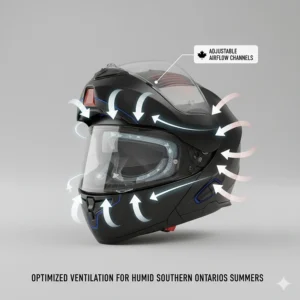
Ventilation system efficiency cannot be overstated for Canadian touring conditions. Temperature variations across a single day’s ride can span 20°C or more. Effective touring helmets employ multiple intake vents with closable options, internal channeling through EPS foam, and rear extraction ports to maintain consistent airflow without compromising quietness.
Safety Standards in Canada
Canadian riders must understand helmet certification requirements before purchasing. According to the British Columbia Ministry of Transportation, helmets sold in Canada must meet specific safety standards. All provinces recognize DOT FMVSS 218, ECE 22.05 (and the newer 22.06), and Snell certifications.
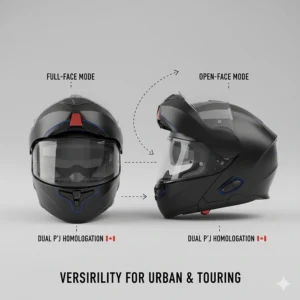
The Alberta government’s motorcycle safety guidelines specify that helmets must display proper certification labels. For modular helmets specifically, the P/J certification becomes important—”P” indicates the chin bar provides protective coverage even when closed, while “J” means the helmet is also certified for jet (open-face) use. Not all modular helmets carry P/J certification, meaning riders should not operate them with the chin bar raised unless specifically certified.
Recent updates to ECE 22.06 standards have raised the bar significantly, requiring more stringent impact testing and adding requirements for rotational force protection. Many 2026 touring modular helmets now feature this latest certification, providing Canadian riders with enhanced confidence in their protective equipment.
The Science of Modular Helmet Construction
Understanding what’s inside your helmet helps appreciate why certain models command premium prices. The Road Safety Strategy Canada organization notes that quality helmets reduce head injury risk by approximately 69% and death risk by 42%.
Shell materials form the first line of defense. Entry-level helmets typically use polycarbonate—a tough, impact-resistant plastic that’s economical to produce. Mid-range helmets often employ fiberglass composite shells, offering superior strength-to-weight ratios. Premium options like the LS2 Advant X utilize carbon fiber, delivering maximum strength with minimal weight. The AGV Tourmodular goes further with its tri-composite design, layering carbon, aramid (Kevlar), and fiberglass for optimized impact distribution.
Multi-density EPS foam liners work as the second critical safety component. Modern touring helmets feature multiple foam densities—softer foam for lower-speed impacts and denser foam for high-energy crashes. This layered approach better protects across the range of potential accident scenarios Canadian riders might encounter.
Chin bar integrity remains the modular helmet’s Achilles heel compared to traditional full-face designs. Quality modular helmets address this through reinforced locking mechanisms, metal components in critical stress points, and rigorous testing. The best touring modulars now pass full-face certification standards even with the moveable chin bar design.
Essential Features for Canadian Touring
Pinlock Anti-Fog Compatibility
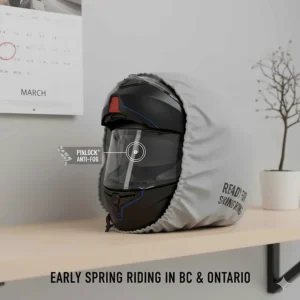
Canadian weather presents unique challenges, especially during shoulder seasons when morning temperatures hover near freezing while afternoons warm considerably. Pinlock anti-fog compatibility isn’t just convenient—it’s essential for safe riding across Canada’s diverse climate zones.
Pinlock systems work by creating a sealed air chamber between the main visor and an inner lens, preventing condensation from forming. All helmets in our top 7 list come either Pinlock-ready or include the insert. The Shoei Neotec 3’s MaxVision Pinlock Evo represents the current gold standard, with pins positioned to maximize clear viewing area while maintaining fog-free performance from -30°C Maritime winters to +35°C Prairie summers.
For riders tackling the Cabot Trail in early morning fog or the Icefields Parkway where temperatures plummet without warning, Pinlock anti-fog technology transforms from luxury to necessity. Even budget-friendly options like the HJC i91 now include Pinlock inserts, though premium helmets typically feature larger pins and higher-quality sealing for superior performance in extreme conditions.
Ventilation for Variable Canadian Climates
Effective ventilation separates mediocre touring helmets from great ones. The Canadian touring experience often means departing in cool morning air, riding through midday heat, and returning as temperatures drop again. Top-tier ventilation systems adapt to these changing conditions without forcing riders to stop every hour.
The AGV Tourmodular leads our list with an impressive 2,253 mm² of ventilation surface area—significantly more than competitors. Its system includes 3 large front air vents, a wraparound top vent, and 16 channeled air extractors. This extensive network moves air through the helmet efficiently while maintaining the quietness touring riders demand.
The Schuberth C5 takes a different approach with dual chin air intakes featuring exchangeable filters. This design proves particularly valuable for Canadian riders encountering varying air quality—from pristine mountain air to urban environments or areas affected by wildfire smoke during summer months.
Even mid-range options like the Scorpion EXO-AT960 deliver thoughtful ventilation with dual-position mouth vents that can function as defrosters or general ventilation depending on rider needs and conditions.
Communication System Integration
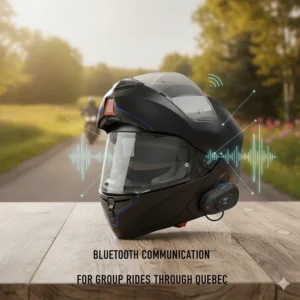
Modern touring increasingly involves staying connected—whether for navigation, music, or communication with riding partners. The touring modular helmets in our guide approach communication integration differently, offering options for various rider preferences and budgets.
The AGV Tourmodular revolutionizes communication with its integrated DMC Mesh technology through AGV INSYDE by Cardo. This system supports connection with up to 15 riders at ranges up to 6 km total distance, making it ideal for organized group rides across Canada. The technology seamlessly switches between Mesh and Bluetooth modes, ensuring compatibility with various devices.
The Schuberth C5 takes a different proprietary approach with its SC2 system. Pre-installed speakers, microphone connections, and three antennas (FM Radio, Bluetooth, and Mesh) make installation nearly plug-and-play. While limited to Schuberth’s communication ecosystem, the integration maintains the helmet’s sleek exterior without external mounting hardware.
For riders preferring flexibility, helmets like the HJC i91 and Scorpion EXO-AT960 offer large speaker pockets compatible with aftermarket systems from Sena, Cardo, or other manufacturers. This approach costs less initially while allowing riders to choose their preferred communication platform.
Sizing and Fit Considerations
Understanding Head Shapes
Helmet fit represents perhaps the single most critical factor in both comfort and safety, yet many riders overlook head shape compatibility. Helmets are generally designed for three head shapes: round oval, intermediate oval, and long oval. Most manufacturers don’t clearly advertise which shape their helmets suit best, leaving riders to discover fit issues after purchase.
Round oval heads measure nearly identical front-to-back and side-to-side. Riders with round heads often find helmets press uncomfortably at the sides while feeling loose front and back. The AGV Tourmodular tends to accommodate rounder head shapes well with its Italian-influenced design.
Intermediate oval represents the most common head shape (approximately 60% of riders), measuring slightly longer front-to-back than side-to-side. Most helmets, including the Shoei Neotec 3 and HJC i91, target this shape.
Long oval heads measure significantly longer front-to-back than side-to-side. Riders with long oval heads typically find Asian and European helmets uncomfortable at pressure points. The Schuberth C5 with its German engineering often suits long oval shapes, though individual variation remains significant.
Canadian retailers like FortNine and GP Bikes typically allow in-store fitting appointments, which prove invaluable for determining proper head shape match before committing to a purchase. Many riders find trying multiple brands reveals dramatic comfort differences even in identically-sized helmets.
Shell Sizes Matter
Premium helmets typically offer multiple shell sizes rather than simply changing internal padding thickness. The Shoei Neotec 3 and AGV Tourmodular both feature 3 shell sizes, while some models like the Schuberth C5 offer 2. More shell sizes generally mean better fit across the size range.
For example, a size Large helmet from a manufacturer offering 3 shell sizes will have a more compact external profile than one from a manufacturer using 2 shell sizes, where the Large might share the same outer shell as an XL or XXL. Smaller external profiles typically translate to better aerodynamics, less weight, and reduced neck strain—all crucial for touring comfort.
The Importance of Proper Fit Testing
A proper fitting helmet should feel snug but not painfully tight. When first donning a new helmet, riders should expect some resistance and pressure—helmets break in as padding compresses slightly over the first 15-20 hours of use. If a helmet slides on effortlessly, it’s likely too large.
Testing fit properly involves:
The two-finger test: With the helmet on and straps fastened, attempt to rotate the helmet forward and backward. You should be unable to comfortably fit more than two fingers between your forehead and the front padding.
The roll test: With straps fastened, try to roll the helmet off your head by pushing up from the back. A properly fitted helmet should not come off even with significant upward force.
The pressure point check: Wear the helmet for 15-20 minutes in-store if possible. Uniform pressure across the entire head is normal, but specific painful pressure points indicate poor head shape match or incorrect sizing.
For Canadian riders planning long-distance tours, investing time in proper fit testing pays dividends. A helmet that feels acceptable for 30 minutes may become torture after 8 hours riding from Calgary to Jasper.
Price vs. Performance Analysis
Budget Category ($350-$550 CAD)
The budget category demonstrates that modern manufacturing techniques have democratized quality helmet construction. The HJC C91 at $350-$450 CAD and HJC i91 at $450-$550 CAD both deliver legitimate touring capability without premium pricing.
What you sacrifice at this price point:
- Shell materials remain polycarbonate rather than composite or carbon
- Weight runs 100-150 grams heavier than premium options
- Noise levels typically measure 3-6 decibels higher
- Liner quality, while adequate, lacks premium moisture-wicking fabrics
- Ventilation design tends toward functional rather than optimized
What you retain:
- All necessary safety certifications (DOT minimum, often ECE as well)
- Pinlock anti-fog compatibility (though inserts may cost extra)
- Integrated sun visors
- Communication system readiness
- Removable, washable liners
For riders tackling 10,000-15,000 km per season, budget helmets deliver genuine value. Canadian riders logging primarily weekend trips or occasional multi-day tours will find these options more than adequate. The key consideration becomes comfort over extended periods—trying before buying becomes crucial in this category.
Mid-Range Category ($500-$800 CAD)
The mid-range category represents the sweet spot for many Canadian touring riders, offering significant upgrades over budget options without approaching premium pricing. The LS2 Advant X at $500-$700 CAD and Scorpion EXO-AT960 at $400-$500 CAD exemplify this category’s value proposition.
Meaningful improvements in this range include:
- Introduction of composite and even carbon fiber shells
- Weight reductions of 50-100 grams compared to budget options
- Improved noise isolation (typically 2-4 dB quieter)
- Enhanced ventilation systems with more intake/exhaust points
- Better quality visors with superior optical clarity
- Premium liner fabrics with antibacterial treatments
The mid-range category makes sense for riders covering 15,000-25,000 km annually or those placing high priority on comfort and quietness. The performance gap between budget and mid-range proves more significant than the gap between mid-range and premium for most applications. Canadian riders who’ve upgraded from budget to mid-range helmets consistently report the improvement justifies the additional investment.
Premium Category ($900-$1,749 CAD)
Premium touring modular helmets represent the pinnacle of current technology, with the Shoei Neotec 3 ($900-$1,100 CAD), AGV Tourmodular ($1,200-$1,400 CAD), and Schuberth C5 ($1,199-$1,749 CAD) exemplifying what manufacturers can achieve without cost constraints.
What premium pricing delivers:
- Cutting-edge shell materials including proprietary fiber processing
- Industry-leading noise reduction (85-96 dB range)
- Multiple shell sizes for optimized fit across size range
- Seamless communication system integration
- Premium liner systems with customizable fit options
- Advanced aerodynamics tested in wind tunnels
- Longer warranty coverage and better customer service
The law of diminishing returns applies—premium helmets deliver perhaps 15-20% better performance than mid-range options while costing 80-120% more. However, for riders logging 25,000+ km annually or those who simply demand the absolute best, premium helmets justify their cost through tangible improvements in comfort, quietness, and overall refinement.
Iron Butt rally participants, full-time travelers, and riders who view their helmet as a long-term investment rather than consumable purchase find premium options worth every dollar. The key consideration: will you notice and appreciate the incremental improvements these helmets provide?
Maintenance and Care Tips
Cleaning and Storage
Proper maintenance extends helmet lifespan while maintaining safety integrity. Canadian touring conditions—from Maritime salt air to Prairie dust storms—demand regular cleaning attention.
Weekly maintenance during active riding season should include:
- Removing and hand-washing liner components in mild soap
- Wiping exterior shell with damp microfiber cloth
- Cleaning visor inside and outside with appropriate products
- Inspecting chin bar mechanism for smooth operation
- Checking all ventilation ports for blockage
Monthly deep cleaning involves:
- Complete disassembly of removable components
- Detailed inspection of EPS foam for damage
- Cleaning communication system speakers if installed
- Applying protective treatments to rubber seals
- Lubricating moving parts per manufacturer specifications
Storage considerations prove particularly important in Canadian climates. Helmets should never be stored:
- In direct sunlight (UV degrades materials)
- In extreme cold (below -30°C can affect foam)
- In high humidity without ventilation (promotes mildew)
- Near petroleum products (can degrade shells)
Invest in a quality helmet bag for transport and storage. The few dollars spent prevents scratches, preserves padding shape, and keeps the helmet clean during off-season storage.
When to Replace Your Helmet
Safety organizations recommend helmet replacement every 5 years regardless of visible wear, as materials degrade over time even without impacts. However, Canadian touring conditions may accelerate this timeline.
Immediate replacement required after:
- Any significant impact (even if no visible damage)
- Cracks in shell or chin bar mechanism
- Compressed foam that doesn’t recover
- Loose or malfunctioning chin bar latch
Consider replacement when:
- Helmet exceeds 3-5 years of age
- Liner compression creates loose fit despite new pads
- Visor mechanism shows significant wear
- Noise levels increase noticeably from baseline
Many manufacturers offer crash replacement programs, providing discounted new helmets after accidents. Keep purchase receipts and register your helmet—these programs can save hundreds of dollars on premium helmets while ensuring continued safety protection.
The hidden benefit of regular replacement: helmet technology advances rapidly. A 2026 mid-range helmet often exceeds the safety and comfort of premium models from 2021, meaning replacement cycles keep Canadian riders equipped with current protection standards and features.
FAQ: Your Touring Modular Helmet Questions Answered
❓ Can you legally ride with the chin bar up on a modular helmet in Canada?
❓ What's the typical price range for quality touring modular helmets in Canada?
❓ How much quieter are premium modular helmets compared to budget options?
❓ Do modular helmets provide the same crash protection as full-face helmets?
❓ How important is Pinlock anti-fog technology for Canadian riding conditions?
Choosing Your Perfect Touring Modular Helmet
Selecting the ideal touring modular helmet comes down to matching features with your specific riding patterns, budget constraints, and priorities. Canadian riders face unique considerations that distinguish our requirements from riders in other markets.
For premium touring enthusiasts logging 25,000+ km annually across Canada’s diverse terrain, the Schuberth C5 or Shoei Neotec 3 deliver unmatched refinement. The exceptional quietness combats fatigue on long prairie highways, while superior ventilation handles everything from humid Great Lakes summers to dry Okanagan heat. These helmets represent genuine buy-once investments that reward discerning riders for years.
For value-conscious tourers seeking maximum features at mid-range pricing, the LS2 Advant X and Scorpion EXO-AT960 punch well above their weight class. Carbon fiber construction and extensive feature sets rival helmets costing twice as much. Canadian riders covering 15,000-20,000 km seasonally find these options deliver 90% of premium helmet performance at 40-50% of the cost.
For budget-focused riders entering touring or maintaining backup helmets, the HJC C91 and HJC i91 prove that quality no longer requires premium pricing. While compromises exist in weight, noise, and materials, these helmets meet all Canadian safety standards while delivering legitimate touring capability for recreational riders.
For adventure-oriented riders mixing on-road touring with light off-pavement exploration, the Scorpion EXO-AT960’s removable peak visor and goggle compatibility create genuine dual-purpose utility without forcing riders into separate helmet purchases.
Remember that personal fit matters more than specifications. A $350 helmet that fits your head shape perfectly will serve you better than a $1,500 helmet creating pressure points. Use this guide to narrow options, then visit Canadian retailers like FortNine, GP Bikes, or regional motorcycle shops for hands-on fitting before committing to any purchase.
The right touring modular helmet transforms long-distance riding from endurance test to pure enjoyment. Whether you’re planning a run to the Arctic Circle on the Dempster Highway or exploring the Cabot Trail in Nova Scotia, these helmets provide the protection, comfort, and convenience modern touring demands. Invest time in selecting wisely, and your helmet will reward you with thousands of comfortable kilometres across Canada’s incredible riding landscape.
✨ Don’t Miss These Exclusive Deals!
🔍 Take your touring adventures to the next level with these carefully selected helmets available in Canada. Click on any highlighted product to check current pricing and availability on Amazon.ca. These helmets will help you create authentic riding experiences your riding buddies will envy!
Conclusion: Your Journey to Better Touring Starts Here
The Canadian touring landscape offers unparalleled beauty and diversity, from the rugged coastlines of Newfoundland to the towering peaks of the Rockies. Experiencing these incredible routes demands equipment that keeps you comfortable, protected, and focused on the journey rather than wrestling with inadequate gear.
Modern touring modular helmets represent remarkable engineering achievements. The convenience of flip-up functionality no longer requires compromising safety, noise isolation, or comfort. Whether you choose the whisper-quiet Schuberth C5, the refined Shoei Neotec 3, the tech-forward AGV Tourmodular, or excellent value options like the HJC i91 and LS2 Advant X, you’re selecting from genuinely impressive protective equipment.
For Canadian riders specifically, these helmets address our unique challenges: dramatic temperature swings that demand versatile ventilation, vast distances requiring exceptional comfort, and varied terrain from urban commutes to remote highways. The Pinlock anti-fog compatibility proves essential for our climate extremes, while noise reduction technology combats the fatigue that comes with logging serious kilometres.
Your investment in a quality touring modular helmet pays dividends beyond simple head protection. The right helmet reduces fatigue, increases awareness through better visibility and lower noise levels, and makes every rest stop more convenient through its flip-up design. It’s equipment that genuinely enhances the touring experience while providing crucial safety protection.
As you consider which helmet suits your needs, remember that this guide provides direction—but only your specific head shape, riding patterns, and priorities determine the perfect choice. Take advantage of Canadian retailers’ expertise and fitting services. Don’t rush the decision. The right touring modular helmet will accompany you for thousands of kilometres and countless memorable rides across this incredible country.
Safe travels, and may your chosen helmet serve you well through many seasons of Canadian touring adventures. The open road awaits—properly protected and comfortably equipped, you’re ready to experience everything it offers.
Recommended for You
- 7 Best Modular Helmet for Glasses Wearers Canada 2026
- 7 Best Modular Helmet with Bluetooth Canada 2026
- 7 Best Modular Helmet Canada: Expert Reviews 2026
Disclaimer: This article contains affiliate links to Amazon.ca. If you purchase products through these links, we may earn a small commission at no additional cost to you.
✨ Found this helpful? Share it with your riding buddies! 💬🤗
