
In This Article
You’ve probably heard riders passionately debate this question at every Tim Hortons parking lot meet-up across Canada: Shoei or Arai? Both brands represent the pinnacle of motorcycle helmet engineering, yet they approach rider protection from distinctly different philosophies. For Canadian motorcyclists investing $1,000+ CAD in a premium lid, understanding these differences isn’t just about bragging rights—it’s about finding the perfect match for your head shape, riding style, and the unique demands of Canadian roads and weather.
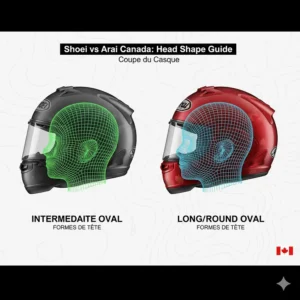
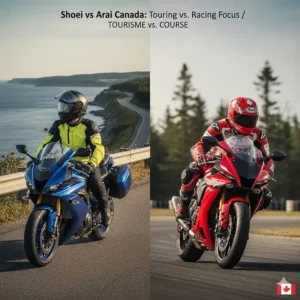
Shoei vs Arai Canada represents more than a simple brand comparison. These Japanese manufacturers have spent decades perfecting their craft, each adhering to manufacturing principles that haven’t changed since their founding. While Shoei focuses on advanced aerodynamics and wind tunnel testing to create helmets that feel like they disappear at speed, Arai maintains its commitment to the “R75 shape” philosophy—believing that a rounder shell better distributes impact forces. According to Wikipedia’s comprehensive analysis of motorcycle helmets, properly certified helmets reduce the risk of head injury by 69% and death by 42%, making your choice genuinely life-saving.
For Canadian riders, this decision carries additional weight. You’re not just selecting a helmet for summer cruises—you need protection that performs in spring rain, handles highway winds from Alberta to the Maritimes, and meets Canadian safety standards enforced by the RCMP. Whether you’re carving through British Columbia’s Sea-to-Sky Highway or commuting through Toronto traffic, this guide examines seven premium models available on Amazon.ca, complete with CAD pricing, Canadian customer feedback, and the manufacturing philosophy differences that define these legendary brands.
Quick Comparison Table: Shoei vs Arai at a Glance
| Feature | Shoei | Arai |
|---|---|---|
| Manufacturing Philosophy | Advanced aerodynamics, wind tunnel testing, integrated tech features | R75 round shell, handcrafted approach, maximum impact distribution |
| Fit Profile | Intermediate oval (most common), multiple shell sizes | Long oval, intermediate oval, round oval across different models |
| Price Range (CAD) | $449 – $1,290 | $779 – $1,429 |
| Weight Focus | Lighter shells with AIM+ construction | Slightly heavier but prioritizes shell strength |
| Safety Certifications | DOT, Snell M2020/M2025, ECE 22.05/22.06 | DOT, Snell M2020, ECE 22.05 |
| Best For | Riders seeking modern features, quieter operation, integrated comms | Traditionalists wanting proven safety philosophy, custom fit options |
| Warranty | 5 years | 5 years |
| Canadian Availability | Excellent (FortNine, GP Bikes, Amazon.ca) | Good (specialty dealers, RidingGear.ca, Amazon.ca) |
💬 Just one click – help others make better buying decisions too! 😊
Top 7 Premium Helmets: Expert Analysis for Canadian Riders
1. Shoei RF-1400 – The Best All-Rounder for Canadian Streets
The Shoei RF-1400 represents the sweet spot for Canadian riders seeking premium protection without modular or touring-specific features. This helmet emerged from thousands of hours in Shoei’s proprietary wind tunnel, resulting in 4% less drag and 6% less lift compared to its predecessor. Priced around $829-$879 CAD on Amazon.ca, it’s Shoei’s lightest Snell-certified full-face at approximately 1,650 grams (size medium).
Key Specifications:
- Shell: AIM+ (Advanced Integrated Matrix Plus Multi-Ply)
- Weight: 3.64 lbs (1,650g) medium
- Shield: CWR-F2 with Pinlock EVO included
- Certifications: DOT, Snell M2020/M2025
The RF-1400 features a significantly improved ventilation system with enhanced air extraction channels that pull moisture away from the eye port—crucial for Canadian riders transitioning between cold mornings and afternoon warmth. FortNine Canada customer reviews consistently praise its whisper-quiet operation at highway speeds, with one Ontario rider noting it’s noticeably quieter than competitors when cruising at 120 km/h.
Canadian Customer Feedback: Riders across provinces report excellent performance in variable weather, though some mention the snug fit requires a proper break-in period. The central visor latch (borrowed from racing designs) works flawlessly even with winter gloves.
✅ Pros:
- Exceptionally quiet at Canadian highway speeds
- Lightest Snell-certified option from Shoei
- Three shell sizes ensure proper fit range
❌ Cons:
- Premium price point for entry model
- Some users report tight fit initially (normal for premium helmets)
2. Arai Corsair-X – Race-Bred Excellence for Performance Enthusiasts
Arai’s flagship Corsair-X embodies everything the Japanese manufacturer stands for: uncompromising protection through the R75 shape philosophy and meticulous handcrafted construction. Ranging from $1,179-$1,429 CAD at Canadian dealers like RidingGear.ca, this helmet targets serious riders who prioritize safety margins over cost.
Key Specifications:
- Shell: PB-SNC (Peripherally Belted Super Fiber with new Z Resin)
- Internal shape: Intermediate oval
- VAS (Variable Axis System) shield mechanism
- Certifications: DOT, Snell M2020, ECE 22.05
The Corsair-X features Arai’s revolutionary VAS shield mechanism with a moving pivot point, allowing for a lower shield mount without sacrificing smooth operation. Canadian track day enthusiasts particularly appreciate the exceptional ventilation—the IC Duct5 takes in 11% more air than previous designs, while Type-12 diffuser intakes each capture 19% more airflow.
Canadian Customer Feedback: Alberta riders report the helmet remains stable at high speeds on mountain passes, while Ontario track regulars note it meets stringent Snell requirements that many track organizations mandate. Some users mention the external shield pods take getting used to aesthetically.
✅ Pros:
- Uncompromising safety philosophy with R75 design
- Superior ventilation for hot summer rides
- Handcrafted quality with five quality-control checkpoints
❌ Cons:
- Premium pricing ($1,400+ CAD for graphics)
- Slightly heavier than modern Shoei equivalents
3. Shoei Neotec 3 – The Ultimate Modular for Canadian Touring
For riders who value versatility on Canadian long-distance routes, the Shoei Neotec 3 delivers modular convenience without compromising safety. Priced around $1,249-$1,290 CAD, this helmet represents Shoei’s most refined flip-up design, perfect for touring from coast to coast.
Key Specifications:
- Shell: AIM (Advanced Integrated Matrix)
- Weight: Approx. 1,770g (medium)
- Integrated QSV-2 sun visor
- Built-in Sena SRL-3 communication readiness
The Neotec 3 introduces cutting-edge flip-up technology with an incredibly smooth chin bar operation that works reliably even in Canadian winter conditions. The integrated sun visor deploys quickly—essential when riding westbound into prairie sunsets or through changing mountain light. Canadian customers at GP Bikes report the helmet’s noise reduction improved by approximately 30% over the original Neotec.
Canadian Customer Feedback: Long-distance riders praise its comfort on multi-hour rides across the Trans-Canada Highway. The ratcheting chinstrap proves easier to adjust with gloves compared to traditional D-rings. Quebec riders note the Pinlock EVO system prevents fogging even in humid conditions.
✅ Pros:
- Best-in-class modular mechanism
- Excellent noise reduction for touring
- Integrated sun visor saves carrying extra shield
❌ Cons:
- Heavier than full-face alternatives
- Premium touring price point
4. Arai Signet-X – Perfect for Long Oval Head Shapes
The Arai Signet-X solves a common problem for Canadian riders: if you have a long oval head shape, most helmets create pressure points. This model, priced from $1,009-$1,199 CAD at authorized Canadian dealers, specifically addresses this fit challenge while maintaining Arai’s legendary safety standards.
Key Specifications:
- Shell: PB-CLC (Complex Laminate Construction)
- Internal shape: Long oval
- FCS (Facial Contour Support) cheek pads
- Certifications: DOT, Snell M2020
The Signet-X features peel-away temple pads that add customization without purchasing extra components—a thoughtful touch for Canadian riders who might not have easy access to replacement parts. The enhanced FCS cheek pad design uses innovative spring support that applies just the right pressure during wear, preventing hot spots on long rides through the Rockies or Laurentians.
Canadian Customer Feedback: Riders who previously struggled with “round” helmets report the Signet-X fits like it was custom-made. British Columbia adventure riders particularly appreciate the massive inlet and exhaust vents that work well at various elevations.
✅ Pros:
- Ideal fit for long oval heads
- Excellent ventilation system
- Customizable interior without extra purchases
❌ Cons:
- Limited to long oval fit (won’t suit round heads)
- Premium Arai pricing
5. Shoei GT-Air 3 – Modern Touring Technology Meets Comfort
The Shoei GT-Air 3 redefines touring helmets with sleek design and enhanced features, available for $779-$879 CAD on Amazon.ca. This helmet targets riders who want touring convenience without the weight penalty of modular designs.
Key Specifications:
- Shell: AIM (Advanced Integrated Matrix)
- Weight: 3.91 lbs (1,772g)
- QSV-2 internal sun visor
- Sena SRL-3 integration ready
The GT-Air 3 incorporates a central visor latching system (similar to the RF-1400) that proves far more secure than offset designs—especially important when riding through gusty prairie winds or mountain passes. The Pinlock EVO insert comes standard, addressing Canadian riders’ primary concern about fog during temperature transitions.
Canadian Customer Feedback: Ontario commuters report the internal sun visor works perfectly for east-west highway riding. The ratcheting chinstrap receives unanimous praise for ease of use with winter gloves. Some riders note it won’t fit in older Givi side cases due to slightly larger shell dimensions.
✅ Pros:
- Internal sun visor convenience
- Quieter than previous GT-Air generations
- Bluetooth-ready for Canadian road trips
❌ Cons:
- Slightly larger shell (storage considerations)
- Not Snell certified (ECE and DOT only)
6. Arai Contour-X – Modern Design Meets Traditional Safety Philosophy
The Arai Contour-X represents the brand’s fresh approach to attracting a new generation while maintaining traditional safety values. Priced from $1,059-$1,289 CAD at Canadian dealers, this helmet offers race-derived performance for street riders.
Key Specifications:
- Shell: PB E-CLC (Enhanced Complex Laminate Construction)
- Substantial weight reduction vs. previous materials
- 13 ventilation ports (7 intake, 6 exhaust)
- VAS MAX Vision visor with Pinlock ready
The Contour-X features a 5mm flare around the base for easier on/off—a small detail that makes a big difference when wearing thick Canadian winter gloves in parking lots. The comprehensive ventilation system includes the signature 3D Arai logo that feeds cooling air, dual F1-derived tear duct intakes, and a 2-position sliding air-scoop chin vent.
Canadian Customer Feedback: Riders appreciate the lighter weight while maintaining Arai’s strength standards. The helmet slips through the air efficiently on highway rides across flat prairie provinces. Some users mention the VAS MAX shield can be tricky to adjust initially but works flawlessly once learned.
✅ Pros:
- Weight reduction without compromising protection
- Excellent ventilation for variable Canadian weather
- Modern styling appeals to younger riders
❌ Cons:
- Learning curve for VAS shield system
- Premium Arai pricing structure
7. Shoei RF-SR – Premium Protection at Mid-Range Pricing
The Shoei RF-SR delivers Snell certification and composite shell construction at a more accessible $449-$499 CAD price point—making it an excellent entry into premium helmets for Canadian riders.
Key Specifications:
- Shell: CLC (Complex Laminate Construction)
- Derived from RF-1200 design
- Weight: Lighter than price suggests
- Certifications: DOT, Snell M2020
The RF-SR borrows heavily from the popular RF-1200, putting premium features into a more affordable package. While it lacks an internal sun visor (available as photochromic shield option), it offers genuine Snell certification that many Canadian track day organizations require. The ventilation system rivals more expensive models, essential for riders experiencing Ontario’s humid summers or coastal maritime conditions.
Canadian Customer Feedback: Budget-conscious riders praise this helmet as the best value in Shoei’s lineup. Cross-country riders report excellent comfort over 500+ kilometer days. The composite shell provides peace of mind without the thousand-dollar price tag.
✅ Pros:
- Snell certified at mid-range price
- Excellent ventilation performance
- Composite shell vs. cheaper polycarbonate
❌ Cons:
- No internal sun visor
- Fewer premium features than RF-1400
✨ Don’t Miss These Exclusive Deals!
🔍 Take your riding safety to the next level with these carefully selected premium helmets available in Canada. Click on any highlighted helmet name above to check current pricing and availability on Amazon.ca or authorized Canadian dealers. These helmets will help you ride with confidence knowing you’re protected by the best engineering Japanese manufacturers offer!
Manufacturing Philosophy Differences: Why Shoei or Arai Better Depends on Your Priorities
The question “Shoei or Arai better” misses the point—these brands excel in different areas based on fundamentally different manufacturing philosophies that have remained consistent for decades.
Shoei’s Wind Tunnel Approach
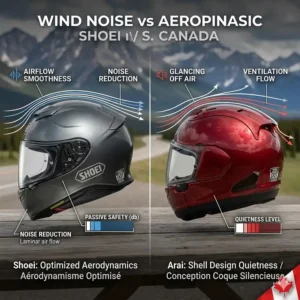
Shoei invested heavily in proprietary wind tunnel technology, treating helmet development like Formula 1 teams approach race car design. Every Shoei model spends countless hours being refined for aerodynamic efficiency, noise reduction, and stability at speed. This scientific approach yields measurably quieter helmets—a massive advantage for Canadian riders logging highway kilometers between cities. Their AIM+ shell construction prioritizes lightness while maintaining safety standards, making Shoei helmets notably lighter than equivalent Arai models.
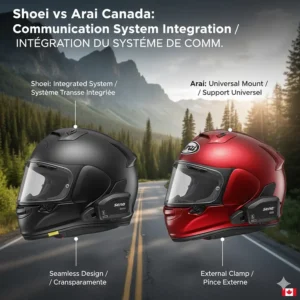
The Tokyo manufacturer also embraced modern features earlier than Arai, integrating Bluetooth communication cutouts, quick-release mechanisms, and modular designs into their lineup. For riders who value cutting-edge features and empirical testing data, Shoei’s methodology resonates perfectly.
Arai’s R75 Philosophy
Arai’s approach hasn’t changed since founder Hirotake Arai established the company in 1926: the R75 concept means no contours in the outer shell violate the 75-degree radius rule. Why? Because hard edges could catch on pavement when sliding at highway speeds, while a rounder shape has a better chance of glancing off objects safely. This philosophy produces slightly bulkier helmets that some riders find less aerodynamic—but Arai argues this roundness provides superior impact distribution.
Every Arai helmet passes through five separate quality-control departments, from shell creation through final assembly. They’re handcrafted by skilled technicians in Japan, never outsourced. This meticulous approach costs more but yields helmets that loyal customers describe as “worth every penny.” Arai also pioneered offering multiple internal shapes (long oval, intermediate oval, round oval) so riders can find their perfect fit match.
The Price-to-Performance Ratio Reality
In Canada, expect Shoei models to range $449-$1,290 CAD versus Arai’s $779-$1,429 CAD spectrum. Does the extra cost justify Arai’s approach? For riders who’ve experienced concussions or track crashes, many argue yes—they trust the R75 philosophy’s proven impact management. For touring riders prioritizing comfort and features, Shoei’s lighter weight and quieter operation often provides better value.
According to comprehensive safety standard analysis, both brands exceed minimum DOT requirements, with most models achieving Snell M2020 or M2025 certification—the gold standard that many Canadian track organizations mandate.
Fit Profile Characteristics: Finding Your Perfect Match
Understanding fit profiles prevents the most common premium helmet mistake: buying based on reviews rather than your actual head shape. Canadian riders can’t always visit dealers for professional fitting, making this knowledge crucial.
Head Shape Categories Explained
Your head falls into one of three categories when viewed from above:
Long Oval: Front-to-back dimension significantly longer than side-to-side width. Arai Signet-X specifically targets this shape, while Shoei offers limited options.
Intermediate Oval: Most common shape with balanced proportions. Both manufacturers design primarily for this profile—Shoei RF-1400, Arai Corsair-X, and most models fit here.
Round Oval: Nearly equal dimensions front-to-back and side-to-side. Arai Quantum-X caters to this shape exclusively.
How to Determine Your Shape
Have someone photograph your head from directly above (or use a mirror). Focus on skull shape, not facial features. Look for: (1) Forehead pressure points indicating wrong shape, (2) Cheek pad comfort vs. pressure, and (3) Whether the helmet rocks back-and-forth (too round) or side-to-side (too long).
Sizing Differences Between Brands
Shoei generally runs slightly larger than Arai in equivalent sizes. A rider wearing Shoei Large might need Arai XL. Both brands offer multiple shell sizes—Shoei uses three shells (XS-M, L, XL-XXL) while Arai varies by model. This affects weight distribution and fit precision.
Canadian customers ordering online from Amazon.ca should carefully review sizing charts and take advantage of generous return policies. FortNine and GP Bikes offer excellent customer service for fit questions specific to Canadian head shapes.
Break-In Period Expectations
Premium helmets require 20-40 hours of break-in. They should feel snug—almost uncomfortably tight—when new. Cheek pads compress approximately 15-20% during this period. If a helmet feels “perfect” immediately, it’s probably too large and won’t provide optimal protection or comfort long-term.
Arai vs Shoei Quality: Construction and Materials Comparison
When examining Arai vs Shoei quality, the brands take different paths to exceptional results. Both manufacture exclusively in Japan, refusing to outsource production despite cost pressures that moved competitors to cheaper countries.
Shell Construction Technologies
Shoei’s AIM+ (Advanced Integrated Matrix Plus Multi-Ply): This proprietary shell construction combines multiple types of fibers in a complex matrix, creating a lighter shell without sacrificing strength. The “plus” designation indicates Shoei’s newest formulation, used in RF-1400 and premium models. It achieves lighter weight while meeting or exceeding Snell M2025’s rigorous impact requirements.
Arai’s PB-SNC (Peripherally Belted Super Fiber with Z Resin): Arai developed its own Z Resin that bonds layers more securely using less resin material, improving shell strength while reducing weight. The peripheral belt (that famous Kevlar strip running around the helmet) provides abrasion resistance when sliding on pavement—something Arai considers essential that other manufacturers overlook.
EPS Liner Design Philosophy
Both brands use multi-density EPS (expanded polystyrene) liners, but their philosophies differ. Shoei’s liner prioritizes consistent energy absorption across the shell, using computer modeling to optimize density placement. Arai uses a more conservative approach with thicker liners in critical areas, accepting slightly more weight for potentially better protection in severe impacts.
Interior Materials and Comfort
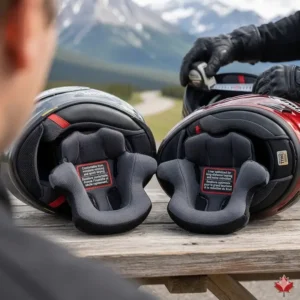
Shoei interiors feature antimicrobial Eco-Pure liners that resist odor formation—crucial for Canadian riders experiencing humid summer conditions. They’re fully removable and machine washable. Arai uses similar antimicrobial treatments but focuses more on customizable padding systems. Their FCS (Facial Contour Support) cheek pads with spring support technology provide variable pressure that adapts during wear.
Shield and Visor Mechanisms
Shoei’s CWR-F2 shield system uses a central latch that proved more secure in testing than offset designs. The mechanism allows for precise positioning stops and works smoothly with winter gloves. Arai’s VAS (Variable Axis System) with moving pivot point provides a wider field of view and lower shield mount, but requires learning the operation technique.
Both include Pinlock-ready shields—absolutely essential for Canadian riders dealing with temperature transitions when stopping for coffee during autumn rides.
Safety Standards and Certifications: What They Mean for Canadian Riders
Canadian riders must navigate various safety certifications, and premium helmets like Shoei vs Arai Canada models typically exceed minimum requirements significantly.
DOT (FMVSS 218) – The Canadian Legal Minimum
All helmets sold legally in Canada must meet DOT standards, which focus on impact attenuation, penetration resistance, and retention system strength. DOT uses a self-certification process where manufacturers test their own products, though NHTSA conducts random compliance checks. Both Shoei and Arai exceed these baseline requirements by substantial margins.
Snell M2020/M2025 – The Gold Standard
The Snell Memorial Foundation provides voluntary, independent third-party testing that’s significantly more rigorous than DOT requirements. Snell testing includes multiple impact tests, edge anvil strikes, and higher energy scenarios. Most Shoei and Arai models achieve Snell certification—particularly important for Canadian riders who attend track days, as many organizations require Snell-certified helmets.
The newer M2025 standard (effective October 2024) introduces separate ratings: M2025D for North American helmets and M2025R for global markets, reflecting different regulatory priorities.
ECE 22.05/22.06 – European Standard
The Economic Commission for Europe standard is mandatory across 50+ countries and emphasizes different testing aspects than DOT. ECE 22.06 (implemented January 2024) adds rotational impact testing, multiple speed scenarios, and accessory testing. Both manufacturers offer ECE-certified models, particularly valuable for Canadian riders traveling internationally or those who simply want the most comprehensive testing coverage.
According to RCMP motorcycle safety guidelines, helmets meeting DOT, ECE, or Snell certifications are legal across Canadian provinces, giving riders flexibility in choosing their preferred standard.
Multiple Certifications: Best of All Worlds
Many premium models carry dual or triple certifications (DOT + Snell + ECE). This isn’t just marketing—it means the helmet passed multiple independent testing protocols with different methodologies. For Canadian riders making a $1,000+ CAD investment, these multiple certifications provide confidence that your helmet performs across various impact scenarios.
Ventilation Systems: Critical for Canadian Weather Variability
Canadian riders experience dramatic temperature swings—morning rides might start at 10°C and reach 30°C by afternoon. Premium helmet ventilation separates good riding experiences from miserable ones.
Shoei’s Optimized Airflow Engineering
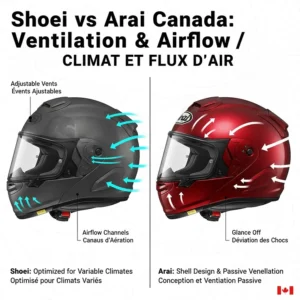
Shoei’s wind tunnel development extends beyond aerodynamics into ventilation optimization. The RF-1400’s enhanced air extraction system pulls hot, moist air from the eye port area through ducted channels behind cheek pads, exhausting through side cowl vents. This active air management prevents fogging better than passive ventilation designs.
The GT-Air 3 and Neotec 3 feature similar sophisticated ventilation with multiple configurable intake and exhaust ports. Riders can fine-tune airflow for different conditions—closed for cold spring mornings through the Canadian Rockies, fully open for humid Ontario summers.
Arai’s Traditional Multi-Port Approach
Arai takes a more straightforward approach with numerous intake and exhaust ports strategically positioned. The Corsair-X features the IC Duct5 (11% more airflow) and Type-12 diffuser intakes (19% more airflow each) compared to previous generations. Their 3D logo isn’t just branding—it channels air into central intake points.
The Contour-X pushes this further with 13 ventilation ports total (7 intake, 6 exhaust), including dual F1-derived tear duct intakes and a 2-position sliding chin vent. All vents are lightly mounted to remain frangible—they detach in impacts to prevent snagging.
Real-World Performance in Canadian Conditions
Customer reviews from FortNine and GP Bikes consistently report Shoei models run slightly quieter but Arai provides marginally more airflow at low speeds. For urban Canadian riders commuting in traffic, Arai’s aggressive ventilation prevents sweat buildup. Highway cruisers often prefer Shoei’s balanced approach that maintains airflow without excessive wind noise.
Both brands’ ventilation works well with Pinlock fog-resistant shields—absolutely critical when riding through Maritime fog or transitioning from air-conditioned buildings into summer heat.
Price Analysis: Premium Helmet Investment for Canadian Riders
Understanding the price-to-performance ratio helps Canadian riders make informed decisions when spending $1,000+ CAD on head protection.
Entry-Level Premium (Under $600 CAD)
The Shoei RF-SR at $449-$499 CAD represents the most affordable genuine Snell-certified option. It sacrifices features like internal sun visors but maintains composite shell construction and quality standards. Perfect for riders entering the premium segment or those prioritizing track day requirements on a budget.
Mid-Range Premium ($600-$900 CAD)
Shoei GT-Air 3 ($779-$879 CAD) and RF-1400 solid colours ($829 CAD) occupy this sweet spot. They deliver modern features, excellent comfort, and latest safety standards without graphic premiums. Most Canadian riders find this range offers optimal value—proven protection without paying for race replicas or limited editions.
High-End Premium ($900-$1,300+ CAD)
Arai Corsair-X ($1,179-$1,429 CAD),
Shoei Neotec 3 ($1,249-$1,290 CAD), and
Arai Signet-X ($1,009-$1,199 CAD) represent ultimate expressions of each manufacturer’s philosophy. The price premium buys handcrafted construction, specialized fit profiles, or modular convenience.
Graphic vs. Solid Colour Pricing
Expect $100-$300 CAD premiums for graphic designs versus solid colours. Limited editions or race replicas can add $400+ CAD. Canadian riders should evaluate whether aesthetics justify this cost—the underlying safety and construction remains identical.
Long-Term Cost Considerations
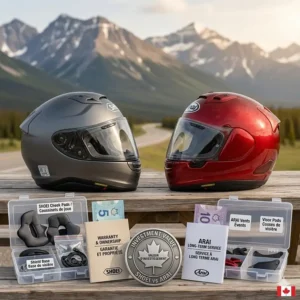
Premium helmets typically last 5-7 years with proper care (barring impacts). Replacement parts (shields, cheek pads, liners) cost $30-$150 CAD—widely available from Canadian dealers like FortNine and GP Bikes. Both brands offer 5-year warranties covering manufacturing defects.
Calculated per-year cost: A $1,200 CAD helmet worn 6 years costs $200 annually. Compare this to replacing a $300 budget helmet every 2-3 years due to degraded materials or poor comfort leading to replacement.
FAQ: Your Shoei vs Arai Canada Questions Answered
❓ Which helmet brand is safer, Shoei or Arai?
❓ What's the price difference between Shoei and Arai helmets in Canada?
❓ How do I know if I need a Shoei or Arai fit profile?
❓ Are Shoei helmets quieter than Arai for highway riding in Canada?
❓ Which brand offers better warranty and customer service in Canada?
Conclusion: Making Your Shoei vs Arai Canada Decision
After examining seven premium helmets, manufacturing philosophies, and real-world Canadian performance, the Shoei vs Arai Canada question resolves to personal priorities rather than absolute superiority. Shoei dominates if you value modern features, lighter weight, quieter operation, and slightly more affordable pricing. Their wind tunnel-developed designs excel on Canadian highways, making long-distance touring more comfortable while integrating seamlessly with Bluetooth communication systems.
Arai wins for riders who prioritize the proven R75 safety philosophy, prefer handcrafted traditional construction, or have non-standard head shapes requiring their specialized fit profiles. Yes, you’ll pay $100-$300 CAD more on average, but you’re buying into a manufacturing philosophy unchanged since 1926—one that many professional racers trust with their lives.
For most Canadian riders, we recommend starting with the Shoei RF-1400 ($829 CAD) if you want proven all-around performance with Snell certification, or the Shoei GT-Air 3 ($779 CAD) if touring features like integrated sun visors matter more. Those with long oval heads or who’ve experienced the “Arai difference” should invest in the Arai Signet-X ($1,009 CAD) despite the premium—proper fit trumps all other considerations.
Remember that according to Wikipedia’s motorcycle helmet research, wearing any certified helmet reduces head injury risk by 69% and death by 42%. Whether you choose Shoei’s aerospace engineering or Arai’s artisan craftsmanship, you’re investing in the single most important piece of safety equipment for Canadian roads. Both brands will serve you exceptionally well across prairie highways, mountain passes, coastal routes, and urban commutes that define Canadian motorcycling.
Visit Amazon.ca, FortNine, or your local dealer to try multiple models—because the best premium helmet is the one that fits your head perfectly, matches your riding style, and makes you eager to pull it on for every ride.
Recommended for You
- Full Face vs Modular Helmet: 7 Best Picks Canada 2026
- 7 Best Motorcycle Helmets for Big Head Canada 2026 – XXL Guide
- 7 Best Motorcycle Helmet for Women in Canada 2026
Disclaimer: This article contains affiliate links to Amazon.ca and Canadian motorcycle retailers. If you purchase products through these links, we may earn a small commission at no additional cost to you. All product recommendations are based on genuine research and Canadian customer feedback.
✨ Found this helpful? Share it with your riding buddies! 💬🤗
