
In This Article
I’ll be blunt—your helmet is the single piece of gear that determines whether you walk away from a crash or get carried away. In Canada, where we face unique riding conditions from Alberta’s mountain passes to Ontario’s highway congestion, choosing the right helmet isn’t just about compliance with DOT or ECE standards. It’s about understanding which helmets actually perform when physics gets ugly.
Here’s what most riders don’t know: a $100 helmet with a SHARP 5-star rating can literally save your life better than a $800 helmet with mediocre test scores. Price doesn’t equal safety. The UK’s Safety Helmet Assessment and Rating Programme (SHARP) has tested over 500 helmets, subjecting each to 32 different impact tests—far exceeding the minimum legal requirements. According to SHARP’s official research, wearing highly-rated helmets could prevent up to 50 motorcyclist deaths annually in the UK alone.
Canadian riders face additional challenges: our provincial regulations accept DOT, Snell M2020, and ECE 22.06 certifications, but these are just minimum standards. The real question isn’t “Is it legal?” but “Will it protect my brain from both linear and rotational impacts?” That’s where independent testing, MIPS technology, and multi-density EPS liners come into play.
In this guide, I’ve researched actual products available on Amazon.ca, verified Canadian pricing, and cross-referenced safety ratings to bring you seven helmets that truly excel at protection. Whether you’re commuting through Toronto traffic or touring the Trans-Canada Highway, these helmets represent the safest options money can buy in 2026.
Quick Comparison Table: Top Safety Features at a Glance
| Helmet Model | Safety Rating | Weight | Price Range (CAD) | Best For |
|---|---|---|---|---|
| Shoei RF-1400 | SNELL M2020 / DOT | 1,640g | $800-$950 | Premium all-around protection |
| HJC i10 | SNELL M2020 / DOT / SHARP 5★ | 1,590g | $230-$270 | Budget-conscious riders |
| AGV K6 / K6 S | SHARP 5★ / ECE 22.06 | 1,255g | $570-$910 | Lightweight sport touring |
| Bell Qualifier DLX MIPS | DOT / MIPS | 1,620g | $350-$430 | Rotational impact protection |
| Arai Corsair-X | SNELL M2020 / DOT | 1,575g | $950-$1,200 | Track-focused safety |
| HJC RPHA 11 Pro | SNELL M2020 / SHARP 4★ | 1,435g | $480-$620 | Lightweight racing helmet |
| LS2 Stream Evo | ECE 22.06 / DOT | 1,475g | $280-$340 | Value-oriented protection |
💬 Just one click – help others make better buying decisions too! 😊
Top 7 Safest Motorcycle Helmets Canada: Expert Analysis
1. Shoei RF-1400 – The Gold Standard for Canadian Riders
When it comes to pure protective engineering, the Shoei RF-1400 represents Japanese precision at its finest. This helmet doesn’t just meet SNELL M2020—it exceeds it by significant margins.
Key Specifications:
- Shell Construction: Multi-Ply Matrix AIM+ (fiberglass, organic fibers, high-performance fibers)
- Safety Certifications: SNELL M2020, DOT FMVSS 218
- Weight: 1,640 grams (medium)
- Shell Sizes: 4 sizes (better fit = better safety)
The RF-1400 employs a sophisticated six-ply matrix shell that’s designed to distribute impact energy across the maximum surface area. What makes this helmet exceptional is Shoei’s multi-density EPS liner system—different foam densities positioned strategically to handle varying impact speeds. Think of it as having airbags designed for specific collision scenarios.
Canadian riders particularly appreciate the Emergency Quick Release System (E.Q.R.S.), which allows first responders to remove cheek pads without moving your neck—critical in provinces with long ambulance response times. The helmet also underwent extensive wind tunnel development, achieving a 6% reduction in lift and 4% reduction in drag compared to the RF-1200.
Price in Canada: $799-$949 CAD on Amazon.ca and authorized dealers
Canadian Customer Feedback: Riders from Fort Nine Canada consistently praise the RF-1400’s exceptional noise reduction and comfort during long rides across the Prairies. One Toronto commuter noted the helmet remained remarkably quiet even at highway speeds, reducing fatigue significantly.
✅ Pros:
- SNELL M2020 certification (most rigorous standard)
- Four shell sizes ensure optimal fit
- Emergency quick-release cheek pads
❌ Cons:
- Premium price point
- Visor mechanism requires learning curve
2. HJC i10 – Outstanding Safety on a Budget
If you believe premium safety requires premium pricing, the HJC i10 will change your mind. This helmet achieved a perfect SHARP 5-star rating while costing less than many 3-star competitors.
Key Specifications:
- Shell Construction: Advanced Polycarbonate Composite
- Safety Certifications: SNELL M2020, DOT, SHARP 5-star
- Weight: 1,590 grams
- Ventilation: Advanced Channeling System (ACS)
The i10 proves that shell material matters less than engineering. While it uses polycarbonate instead of expensive carbon fiber, HJC’s Advanced Channeling Ventilation System and multi-density EPS liner deliver exceptional impact absorption across all test zones. SHARP testing showed superior energy management in critical side-impact areas—where brain injuries often occur.
What’s remarkable about this helmet is its value proposition. You’re getting Snell M2020 certification, which requires passing more demanding tests than DOT alone, at approximately 25% the cost of premium alternatives. For new riders building their gear collection or experienced riders wanting a solid backup helmet, the i10 represents unbeatable protection per dollar.
Price in Canada: $229-$269 CAD at FortNine and GP Bikes
Canadian Customer Feedback: Multiple riders on FortNine.ca report this helmet punches well above its weight class. One reviewer replaced their Shoei with the i10 during budget constraints and found the protection and comfort comparable, though slightly noisier.
✅ Pros:
- SHARP 5-star rating at budget price
- SNELL M2020 certified
- Excellent ventilation for Canadian summers
❌ Cons:
- Cheek padding runs tight initially
- Wind noise higher than premium helmets
3. AGV K6 / K6 S – World’s Lightest Full-Face Protection
The AGV K6 and its updated sibling the K6 S hold a unique distinction: they’re the lightest full-face road helmets in the world while maintaining a SHARP 5-star safety rating.
Key Specifications:
- Shell Construction: Carbon-Aramid fiber composite
- Safety Certifications: SHARP 5-star, ECE 22.06
- Weight: 1,255 grams (K6), 1,298 grams (K6 S)
- EPS Liner: 5-density system in 4 shell sizes
AGV’s engineering philosophy centers on “safety integrated in shape.” The helmet’s aerodynamic profile isn’t just for speed—it’s designed so the shell breaks away upon impact, reducing energy transfer to your brain. The K6 S version now exceeds ECE 22.06 requirements by 36%, according to independent testing.
The five-density EPS liner is extraordinary. Most helmets use 2-3 densities; AGV uses five different foam densities positioned where specific impact speeds are most likely. Lower-density foam handles low-speed impacts, while higher-density foam manages high-velocity crashes. This approach earned the K6 its SHARP 5-star rating with particularly impressive scores in oblique impact testing.
For Canadian riders, the lighter weight reduces neck strain during long touring rides—a significant factor when you’re covering the 7,821 kilometers of the Trans-Canada Highway.
Price in Canada: $569-$909 CAD (K6 S available at GP Bikes)
Canadian Customer Feedback: FortNine.ca reviewers emphasize the helmet’s remarkable lightness makes shoulder checks effortless. Several riders note sizing runs small—order one size larger than your typical helmet.
✅ Pros:
- SHARP 5-star with ECE 22.06 certification
- Lightest full-face helmet available
- 5-density EPS for comprehensive protection
❌ Cons:
- Sizing runs small
- Premium pricing
- Limited North American availability
4. Bell Qualifier DLX MIPS – Rotational Impact Innovation
The Bell Qualifier DLX MIPS addresses a critical safety concern that traditional testing often misses: rotational brain injuries. The Multi-directional Impact Protection System (MIPS) could be the difference between a concussion and a traumatic brain injury.
Key Specifications:
- Shell Construction: Polycarbonate/ABS thermoplastic
- Safety Certifications: DOT FMVSS 218, MIPS
- Weight: 1,620 grams
- Special Feature: ProTint photochromic visor included
MIPS technology uses a low-friction slip plane between the helmet’s shell and liner. During angled impacts—the most common type in motorcycle crashes—this layer rotates slightly, reducing the rotational forces transmitted to your brain. Research from the Royal Society of Chemistry indicates rotational acceleration causes significant brain injuries even in moderate-speed crashes.
Bell includes the Velocity Flow ventilation system from their flagship Star series, plus a photochromic visor that adapts to changing light conditions—particularly useful for Canadian riders experiencing rapid weather changes in mountainous regions.
Price in Canada: $349-$429 CAD on Amazon.ca
Canadian Customer Feedback: Amazon.ca reviews highlight the photochromic visor as a standout feature for variable Canadian weather. However, some riders note wind noise is higher than expected at highway speeds.
✅ Pros:
- MIPS rotational impact protection
- Photochromic visor included
- Excellent value for features offered
❌ Cons:
- Wind noise above 100 km/h
- Build quality doesn’t match premium brands
- Heavier than carbon fiber alternatives
5. Arai Corsair-X – Race-Proven Engineering
Arai has built its reputation on a simple philosophy: design every helmet assuming the crash will happen. The Corsair-X embodies this approach with features gleaned from decades of MotoGP data.
Key Specifications:
- Shell Construction: Proprietary PB-SNC2 shell (carbon and synthetic fibers)
- Safety Certifications: SNELL M2020, DOT
- Weight: 1,575 grams
- Shell Sizes: 5 shell sizes for optimal fit
Arai’s PB-SNC2 shell is engineered to be both incredibly strong and deliberately designed to break in specific ways. The smooth, round shell shape with carefully positioned pods ensures the helmet rolls upon impact rather than catching and snapping your neck. This “glancing off” principle has been proven in countless race crashes.
The helmet features Arai’s Facial Contour System (FCS), which provides a more natural fit by contouring to your face’s unique shape. Better fit means the helmet stays in position during a crash—a loose helmet can rotate during impact, defeating even the best safety features.
What sets Arai apart is their quality control. According to Wikipedia’s article on Arai, each helmet undergoes extensive hand-fitting and inspection, which partly explains the premium pricing.
Price in Canada: $949-$1,199 CAD at specialty retailers
Canadian Customer Feedback: Track day riders in Canadian forums consistently rate Arai as the most comfortable helmet for extended wear, though some find the fit runs smaller than other brands.
✅ Pros:
- SNELL M2020 certification
- Five shell sizes for perfect fit
- Proven MotoGP pedigree
❌ Cons:
- Highest price point
- Limited internal sun visor
- Runs smaller than European brands
6. HJC RPHA 11 Pro – Lightweight Racing Protection
The HJC RPHA 11 Pro demonstrates that advanced composite construction can be affordable. This helmet is a favorite among sport riders who demand both performance and safety.
Key Specifications:
- Shell Construction: Premium Integrated Matrix (PIM) – carbon, aramid, fiberglass
- Safety Certifications: SNELL M2020, SHARP 4-star
- Weight: 1,435 grams
- Aerodynamics: Developed in HJC’s proprietary wind tunnel
At just 1,435 grams, the RPHA 11 Pro is one of the lightest Snell-certified helmets available. HJC achieved this through their Premium Integrated Matrix construction—a proprietary blend of carbon fiber, aramid (Kevlar), and fiberglass. The result is a shell that’s both incredibly light and exceptionally strong.
The helmet’s SHARP 4-star rating (one star below perfect) shows excellent performance across most impact zones, with particularly strong scores in frontal and lateral impacts. The slightly lower rating comes from the helmet’s sport-focused design, which prioritizes aerodynamics over maximum padding in certain areas.
HJC’s Advanced Channeling Ventilation System is remarkably effective—crucial for Canadian summer riding when temperatures can soar above 30°C in the Prairies or BC’s interior.
Price in Canada: $479-$619 CAD at GP Bikes and specialty retailers
Canadian Customer Feedback: Sport riders in Ontario appreciate the helmet’s stability at high speeds and reduced buffeting compared to heavier alternatives.
✅ Pros:
- Exceptionally lightweight (1,435g)
- SNELL M2020 and SHARP 4-star
- Superior ventilation for hot weather
❌ Cons:
- Sport-focused fit may not suit touring riders
- Limited color options in Canada
- Visor changes require practice
7. LS2 Stream Evo – European Safety Standards Meet Value Pricing
The LS2 Stream Evo brings ECE 22.06 certification—Europe’s latest and most stringent standard—to an accessible price point for Canadian riders.
Key Specifications:
- Shell Construction: Kinetic Polymer Alloy (KPA)
- Safety Certifications: ECE 22.06, DOT
- Weight: 1,475 grams
- Features: Airflow Control System, emergency release system
ECE 22.06 represents a significant advancement over the previous 22.05 standard, introducing rotational impact testing and more stringent chin bar requirements. The LS2 Stream Evo not only meets this standard but incorporates features typically found in helmets costing twice as much.
LS2’s Kinetic Polymer Alloy shell might sound like marketing speak, but it’s a sophisticated thermoplastic engineered to balance weight, strength, and impact absorption. The helmet includes a removable, washable liner with antibacterial fabric—essential for Canadian riders dealing with summer humidity.
The Emergency Release System allows cheek pads to be quickly removed by first responders, similar to systems found on premium Shoei and Arai helmets. This feature alone makes the Stream Evo stand out in its price category.
Price in Canada: $279-$339 CAD at motorcycle specialty shops
Canadian Customer Feedback: Riders appreciate the ECE 22.06 certification at this price point, though some note the helmet runs slightly larger than HJC or Shoei sizing.
✅ Pros:
- ECE 22.06 certification (latest standard)
- Excellent value for protection offered
- Emergency release system included
❌ Cons:
- Slightly larger sizing
- Limited availability in Canada
- Wind noise comparable to other budget options
🔍 Understanding Helmet Safety Ratings: What Canadian Riders Need to Know
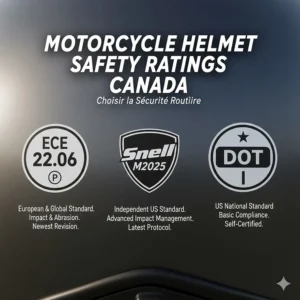
Navigating helmet certifications feels like decoding alphabet soup—DOT, Snell, ECE, SHARP, FIM. Here’s what actually matters for Canadian riders, backed by Transport Canada regulations and international safety research.
DOT (Department of Transportation) – The Minimum Legal Standard
All helmets sold for on-road use in Canada must meet DOT FMVSS 218 standards. This certification focuses on impact attenuation, penetration resistance, and retention system strength. However, DOT testing involves relatively soft impacts compared to real-world crashes.
Crucially, DOT certification is self-certified by manufacturers. While the National Highway Traffic Safety Administration (NHTSA) conducts random compliance checks, the honor system creates opportunities for substandard helmets to slip through.
Canadian Regulation: DOT certification is accepted in all provinces and territories under provincial highway traffic acts.
SNELL M2020 – The Performance Standard
The Snell Memorial Foundation, a non-profit organization, maintains one of the most rigorous testing protocols worldwide. Snell M2020 (updated from M2015) includes:
- Multiple impact testing at the same location
- Harder impact velocities than DOT
- Shell penetration tests
- Extensive retention system evaluation
Unlike DOT, Snell testing is conducted by independent labs. Helmets undergo destructive testing—literally destroyed to measure their protective capabilities.
ECE 22.06 – Europe’s Advanced Standard
The latest European standard, ECE 22.06, introduced revolutionary changes in 2020. For the first time, rotational impact testing became mandatory. This addresses the type of brain injuries that linear impact testing misses entirely.
ECE 22.06 also requires manufacturers to submit 50 random samples from production runs for batch testing, ensuring consistency across all helmets sold—not just the prototypes sent for certification.
SHARP – Independent Consumer Testing
The UK’s Safety Helmet Assessment and Rating Programme (SHARP) represents the most comprehensive consumer-focused testing available. Since 2007, SHARP has tested over 500 helmets, conducting 32 different impact tests per model.
What makes SHARP unique:
- Helmets are purchased anonymously from retailers
- Testing exceeds all regulatory requirements
- Results use a simple 1-5 star rating
- Impact zone mapping shows which areas offer superior protection
According to SHARP’s research, their rigorous testing has likely contributed to the 40% reduction in UK motorcyclist fatalities since the program’s inception.
Key Insight: A £100 helmet with 5 SHARP stars provides better protection than a £500 helmet with 3 stars. Price reflects materials, comfort, and features—not necessarily safety.
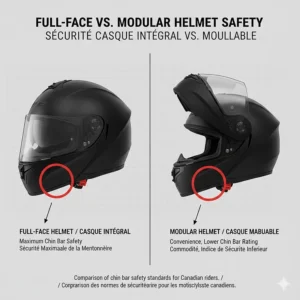
🧠 Rotational Impact Protection: The Safety Feature You Can’t Ignore
Linear impacts—where your head hits something straight on—get all the attention in traditional safety testing. But rotational impacts cause some of the most severe brain injuries, and until recently, helmets weren’t specifically designed to address them.
How Rotational Impacts Damage Your Brain
When your helmet strikes the pavement at an angle (the most common scenario), your head experiences both linear deceleration and rotational acceleration. Your brain, suspended in cerebrospinal fluid, twists inside your skull. This twisting motion stretches and shears brain tissue, causing diffuse axonal injury—a leading cause of coma and long-term disability.
Research published in the National Institutes of Health database demonstrates that rotational acceleration can cause significant brain damage even in impacts that would otherwise be survivable.
MIPS Technology Explained
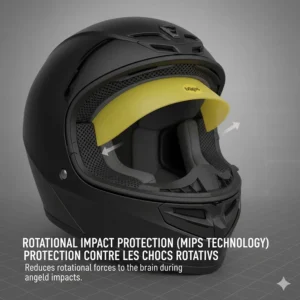
Multi-directional Impact Protection System (MIPS) introduces a low-friction slip plane between the helmet liner and the comfort padding. During an angled impact, this layer allows the helmet to rotate slightly relative to your head, reducing the rotational forces transmitted to your brain.
Think of it as your helmet taking the punch instead of your brain taking the full rotational force.
Other Rotational Impact Systems
- AGV’s 5-Density EPS: Different foam densities handle various impact angles
- Shoei’s Multi-Ply Matrix: Shell design distributes rotational forces
- Arai’s Spherical Shell: Smooth, round shape encourages glancing impacts
Canadian riders should prioritize helmets incorporating at least one rotational impact protection system, especially for sport riding or track use where high-speed crashes are more likely.
🍁 Canadian Helmet Regulations: What’s Legal in Your Province
Canada takes a federalist approach to motorcycle helmet laws—each province sets its own requirements, though most align on the basic standards.
Universal Canadian Requirements
All Canadian provinces and territories require:
- Motorcycle operator and passenger must wear approved helmets
- Helmet must display appropriate certification label
- Helmet must be properly fastened
Accepted Certifications by Province
Ontario, British Columbia, Alberta, Saskatchewan:
- DOT FMVSS 218
- Snell M2020, M2015, M2010, M2005
- ECE 22.06 or 22.05
Quebec:
- Same as above, plus CSA D230 and BSI standards
Maritime Provinces:
- Primarily DOT and Snell
- Some provinces accept ECE and BSI
Important Considerations for Canadian Riders
The Government of Canada doesn’t mandate a specific helmet standard at the federal level. Provincial regulations govern helmet requirements, typically found in provincial traffic safety acts.
Temperature Extremes: Canadian riders face unique challenges. Summer temperatures in the southern Prairies can exceed 35°C, while spring and fall riding often occurs near freezing. Your helmet must ventilate effectively yet seal against cold air penetration.
Collision Response Times: In rural areas of Northern Ontario, Saskatchewan, or British Columbia, emergency response times can exceed 30 minutes. Helmets with emergency quick-release systems become particularly valuable in these regions.
🛒 How to Choose the Safest Motorcycle Helmet for YOUR Head
Safety ratings matter, but a 5-star helmet that doesn’t fit properly offers less protection than a 3-star helmet that fits perfectly. Here’s your step-by-step guide to finding the safest helmet for your specific needs.
Step 1: Determine Your Head Shape
Motorcycle helmets come in three basic internal shapes:
Long Oval: Front-to-back measurement significantly exceeds side-to-side (Arai specializes in this fit)
Intermediate Oval: Slightly longer front-to-back than side-to-side (most common—AGV, Shoei, HJC cater to this)
Round Oval: Nearly equal measurements all around (less common, but some AGV and Shark models fit well)
Measure your head circumference one inch above your eyebrows. Then have someone measure front-to-back and side-to-side. The ratio reveals your shape.
Step 2: Prioritize Safety Certifications
- Minimum: DOT FMVSS 218 (legally required)
- Better: SNELL M2020 (rigorous independent testing)
- Best: SNELL M2020 + SHARP 4-5 stars + rotational impact protection
Step 3: Consider Your Riding Style
Commuting/Touring: Prioritize noise reduction, ventilation, and comfort. HJC i10, Shoei RF-1400
Sport/Track: Lightweight construction, aerodynamics matter. HJC RPHA 11 Pro, AGV K6
Adventure/Dual-Sport: Peak visor compatibility, enhanced ventilation. Bell Qualifier DLX MIPS, LS2 MX helmets
Urban/Casual: Visibility, quick-release visors. Any well-rated full-face or modular helmet
Step 4: Test the Fit
Visit a Canadian retailer (GP Bikes, FortNine showroom, motorcycle dealerships) and try on helmets:
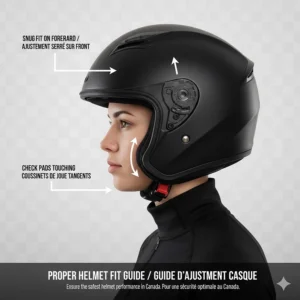
- Put the helmet on—it should feel snug, not painful
- Shake your head vigorously—the helmet should move WITH your head, not independently
- Try to push the helmet forward off your head—if it rotates easily, it’s too large
- Wear it for 30 minutes—pressure points should remain comfortable, not painful
Step 5: Verify Canadian Pricing and Availability
Amazon.ca carries many helmets, but specialty retailers like FortNine, GP Bikes, and Royal Distributing often stock a wider range of sizes and provide expert fitting assistance.
Budget Allocation:
- Entry-level safety: $200-$350 CAD (HJC i10, LS2 models)
- Mid-range protection: $400-$650 CAD (Bell Qualifier DLX MIPS, HJC RPHA series)
- Premium safety: $700-$1,200 CAD (Shoei RF-1400, AGV K6 S, Arai Corsair-X)
Remember to factor in GST/HST/PST depending on your province—helmet prices don’t include sales tax.
💡 Common Helmet Safety Myths Debunked
Myth 1: “Expensive Helmets Are Always Safer”
Reality: Safety ratings prove otherwise. The HJC i10 at $230 CAD has a SHARP 5-star rating and Snell M2020 certification. Some $700 helmets score only 3 stars. You’re paying for materials, weight savings, and features—not necessarily superior protection.
Myth 2: “DOT Certification Is Good Enough”
Reality: DOT sets minimum standards. It’s better than no certification, but Snell M2020 and ECE 22.06 require significantly more rigorous testing. For Canadian riders, the peace of mind from a Snell-certified helmet is worth the modest price increase.
Myth 3: “Helmets Last Forever If Not Crashed”
Reality: The Snell Foundation recommends replacing helmets every 5 years. UV exposure, temperature fluctuations (especially harsh Canadian winters in garages), and simple aging degrade the EPS foam’s protective properties. A 10-year-old helmet, even if never crashed, offers less protection than a new one.
Myth 4: “Half Helmets and Open-Face Are Fine for City Riding”
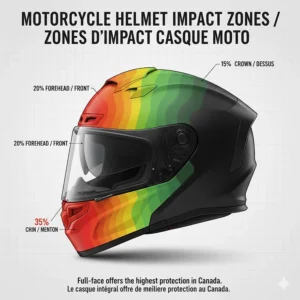
Reality: According to the Insurance Institute for Highway Safety, 35% of impacts occur in areas a full-face helmet protects but a half helmet doesn’t. Urban riding actually increases chin and face impact risk due to lower speeds and more frequent intersection collisions.
Myth 5: “My Head Shape Doesn’t Really Matter”
Reality: An improperly fitted helmet can rotate during impact, exposing unprotected areas of your head to direct collision. Fit is as critical as safety rating.
✨ Don’t Miss These Exclusive Deals!
🔍 Take your motorcycle safety to the next level with these carefully selected products available in Canada. Click on any highlighted helmet to check current pricing and availability on Amazon.ca or specialty retailers. These helmets will provide authentic protection your family wants you to have!
❓ Frequently Asked Questions About Safest Motorcycle Helmets in Canada
❓ What safety certification should I look for when buying a motorcycle helmet in Canada?
❓ How much should I spend on a safe motorcycle helmet in Canada?
❓ What is MIPS and do I really need it in my helmet?
❓ Are SHARP 5-star helmets available in Canada?
❓ How often should I replace my motorcycle helmet in Canada's climate?
Conclusion: Your Brain Deserves the Best Protection
After analyzing safety ratings, testing methodologies, and real-world performance data, one truth emerges: the safest motorcycle helmet is the one that fits your head perfectly AND carries legitimate safety certifications.
For Canadian riders in 2026, my top recommendations based on budget and use case:
Best Overall Value: HJC i10 – SHARP 5-star, SNELL M2020, and exceptional comfort at $230-$270 CAD make this the smart choice for most riders.
Best Premium Protection: Shoei RF-1400 – SNELL M2020 certification, multi-density EPS, and proven track record justify the $800-$950 CAD investment.
Best Lightweight Option: AGV K6 S – At 1,298 grams with SHARP 5-star rating and ECE 22.06 certification, this helmet minimizes neck strain on long Canadian touring rides.
Best Rotational Impact Protection: Bell Qualifier DLX MIPS – $350-$430 CAD brings MIPS technology to an accessible price point.
The helmet market in Canada offers excellent options across all price points. Don’t fall into the trap of assuming expense equals safety—verify certifications, check SHARP ratings, and prioritize fit above all else.
Remember: you can replace motorcycles, jackets, and boots. You can’t replace your brain. Invest in the best protection available, ensure proper fit, and ride with confidence knowing you’ve taken the single most important step toward surviving a crash.
Stay safe out there, and I’ll see you on the road 🏍️
Recommended for You
- 7 Best DOT Approved Helmets Canada 2026 – Safety First Guide
- 7 Best Arai Helmet Canada Models: Expert Reviews 2026
- 7 Best AGV Helmet Canada 2026: Premium Italian Design
Disclaimer: This article contains affiliate links to Amazon.ca and specialty retailers. If you purchase products through these links, we may earn a small commission at no additional cost to you.
✨ Found this helpful? Share it with your friends! 💬🤗
