
In This Article
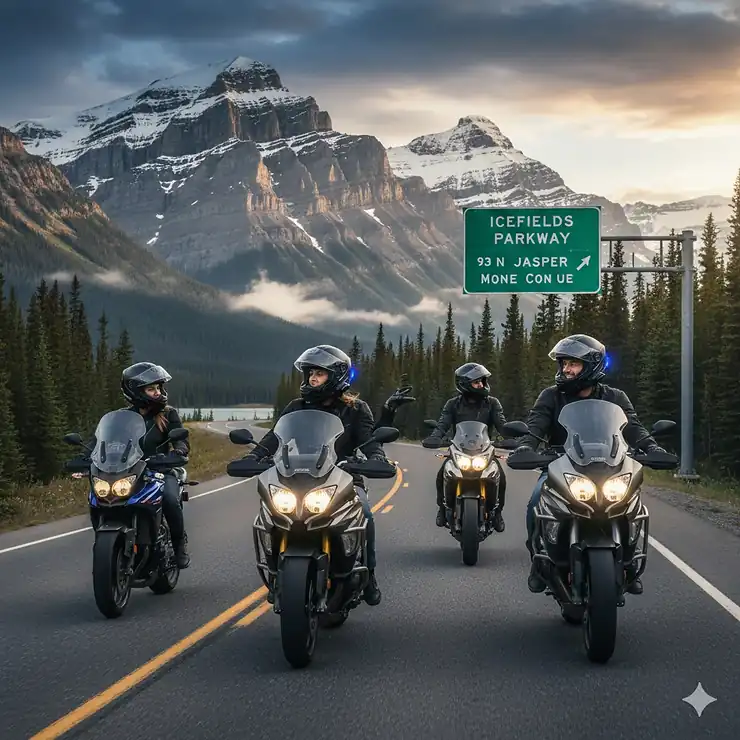
Picture this: You’re cruising through the Canadian Rockies on a crisp autumn morning, and you need to warn your riding buddy about a moose crossing ahead. Or maybe you’re commuting through Toronto’s rush hour and need GPS directions without fumbling for your phone. This is where a bluetooth helmet system transforms your riding experience.
Bluetooth technology has revolutionized motorcycle communication, allowing riders to stay connected safely and legally. Unlike handheld devices—which violate distracted driving laws across every Canadian province—bluetooth helmet systems enable hands-free operation through voice commands and tactile buttons. These systems aren’t just about convenience; they’re about safety, compliance, and enhancing your overall riding experience.
In Canada, helmet communication systems have gained massive popularity as riders discover the benefits of staying connected without compromising safety. Whether you’re coordinating with group rides across British Columbia’s Sea-to-Sky Highway or navigating Quebec’s scenic Route 132, the right bluetooth helmet system can make all the difference. The market offers everything from budget-friendly options under $100 CAD to premium systems exceeding $800 CAD, each designed for different riding styles and needs.
What is a Bluetooth Helmet System?
A bluetooth helmet system is a wireless communication device that integrates with your motorcycle helmet to provide hands-free audio connectivity. These systems utilize short-range radio technology to pair with smartphones, GPS devices, and other riders’ helmets without requiring cables or physical connections. Most modern systems feature helmet-mounted speakers, microphones, and control units that attach magnetically or via adhesive mounts.
The core functionality revolves around three main uses: rider-to-rider intercom communication (typically ranging from 500 metres to 1.6 kilometres), smartphone connectivity for calls and music streaming, and GPS audio integration for turn-by-turn navigation. Advanced models incorporate mesh networking technology, allowing groups of 5 to 15 riders to maintain constant communication even as the group spreads out along the highway.
Quick Comparison Table
| Model | Type | Price (CAD) | Intercom Range | Battery Life | Water Resistance |
|---|---|---|---|---|---|
| Cardo Packtalk Edge | Standalone | $540+ | 1.6 km | 13 hrs | IP67 |
| Sena 50R | Standalone | $440+ | 2 km (Mesh) | 13 hrs | IP45 |
| FreedConn FX | Standalone | $120-180 | 1.2 km | 30 hrs | IP67 |
| LEXIN G2P | Standalone | $90-140 | 1 km | 15 hrs | IP67 |
| Sena Impulse | Full Helmet | $830+ | 2 km (Mesh) | 12 hrs | DOT/ECE |
| IASUS XS2.1R | Drop-in | $130-160 | N/A (Bluetooth only) | 10 hrs | IP65 |
| Cardo Packtalk Neo | Standalone | $380-450 | 1.6 km | 13 hrs | IP67 |
💬 Just one click – help others make better buying decisions too! 😊
Top 7 Bluetooth Helmet Systems: Expert Analysis
1. Cardo Packtalk Edge – Premium Choice for Serious Riders
The Cardo Packtalk Edge represents the pinnacle of motorcycle communication technology currently available in Canada. This premium system delivers exceptional performance through its second-generation Dynamic Mesh Communication (DMC), enabling seamless connectivity with up to 15 riders simultaneously.
Key Specifications:
- Bluetooth 5.2 with DMC Mesh technology
- 1.6 km intercom range in open terrain
- Sound by JBL with 45mm speakers
- Natural voice operation (“Hey Cardo”)
Canadian riders consistently praise the Cardo Packtalk Edge for its reliability in harsh weather conditions—a crucial consideration for year-round riding across our diverse climate zones. The magnetic Air Mount system makes helmet swapping incredibly convenient for riders who maintain separate helmets for street and touring use. Priced around $540 CAD for a single unit on Amazon.ca, it’s an investment that pays dividends through superior audio quality and rock-solid connections.
✅ Pros:
- Crystal-clear JBL audio even at highway speeds (120+ km/h)
- IP67 waterproof rating handles Canadian winters
- Seamless cross-brand compatibility with Sena devices
❌ Cons:
- Premium pricing may exceed budget riders’ comfort zone
- Learning curve for advanced features
Canadian customer feedback: “Used these from Vancouver to Halifax—never lost connection with my riding partner, even in the Rockies!”
2. Sena 50R – Harman Kardon Audio Excellence
The Sena 50R brings professional-grade audio to the motorcycle communication market through its partnership with Harman Kardon. This system excels in both Bluetooth intercom and Mesh 2.0 networking, offering flexibility for riders who connect with mixed-brand groups.
Key Specifications:
- Mesh 2.0 and Bluetooth 5.1 dual connectivity
- 2 km mesh intercom range
- Premium Harman Kardon speakers
- Multi-device connection (smartphone + GPS simultaneously)
The Sena 50R dominates in audio quality, which becomes immediately apparent when streaming music from Spotify or Apple Music during long highway cruises. Canadian retailers like FortNine and GPBikes stock the dual-pack around $880 CAD, making it competitive with Cardo’s offerings when purchasing for two riders. The Sena Utility App provides extensive customization options, though some users report occasional firmware update challenges.
✅ Pros:
- Exceptional audio fidelity for music enthusiasts
- Extensive customization through mobile app
- Reliable mesh networking in groups
❌ Cons:
- Slightly bulkier profile than competitors
- Battery life decreases at extreme cold temperatures
Canadian customer feedback: “The Harman Kardon speakers make a huge difference—I actually enjoy listening to podcasts on my Montreal to Quebec City commute now.”
3. FreedConn FX – Best Value for Canadian Riders
For budget-conscious Canadian riders, the FreedConn FX delivers impressive functionality without the premium price tag. This system proves that effective helmet communication doesn’t require breaking the bank, with dual packs available under $250 CAD on Amazon.ca.
Key Specifications:
- Bluetooth 5.1 connectivity
- 1.2 km intercom range
- 6-rider group intercom capability
- 30 hours talk time
The FreedConn FX stands out in the budget category through its exceptional battery life and reliable performance for casual riders. While the audio quality doesn’t match premium Cardo or Sena systems, it’s more than adequate for GPS navigation and occasional music streaming. The glove-friendly controls work well even with heavy winter riding gloves—a practical consideration for Canadian riders facing temperature swings from -20°C to +30°C across riding seasons.
✅ Pros:
- Unbeatable price-to-performance ratio
- Massive 30-hour battery life
- IP67 waterproofing for all-season riding
❌ Cons:
- Speaker quality adequate but not exceptional
- Firmware updates require manual USB connection
Canadian customer feedback: “Perfect for weekend warriors like me—does everything I need without the premium price tag.”
4. LEXIN G2P – Feature-Rich Mid-Range Option
The LEXIN G2P occupies the sweet spot between budget and premium categories, offering advanced features like music sharing and noise cancellation at mid-range pricing. Canadian riders can find dual packs around $180-220 CAD, making it accessible for couples or riding partners.
Key Specifications:
- Bluetooth 5.0 with music sharing capability
- 1 km intercom range (6 riders maximum)
- Advanced noise cancellation (CVC)
- FM radio functionality
What sets the LEXIN G2P apart is its music sharing feature, allowing two riders to listen to the same playlist simultaneously—perfect for couples enjoying scenic rides through Canadian wine country or the Cabot Trail. The FM radio capability ensures you stay updated on weather alerts and traffic conditions, crucial for navigating Canada’s sometimes unpredictable riding conditions. Installation takes about 15 minutes per helmet, and the universal compatibility works with full-face, modular, and three-quarter helmets.
✅ Pros:
- Music sharing enhances couples’ riding experience
- Excellent noise cancellation for highway cruising
- Universal helmet compatibility
❌ Cons:
- Range limitations in densely forested areas
- Music sharing only works between LEXIN units
Canadian customer feedback: “My wife and I love the music sharing feature for our Sunday rides through Algonquin Provincial Park!”
5. Sena Impulse Smart Helmet – All-in-One Solution
The Sena Impulse takes a different approach by integrating bluetooth communication directly into a DOT/ECE-certified modular helmet. This eliminates installation hassles and provides a streamlined, purpose-built solution for Canadian riders seeking simplicity.
Key Specifications:
- Mesh Intercom and Bluetooth technology built-in
- Harman Kardon premium speakers and microphone
- Retractable sun visor and Pinlock anti-fog lens
- Integrated LED tail light for visibility
Canadian retailers price the Sena Impulse around $830-870 CAD, positioning it as a premium option that combines helmet and communication system costs. The intermediate oval fitment suits most head shapes, though trying before buying remains essential—several Canadian motorcycle shops like GPBikes and Blackfoot Online offer in-store fitting. The built-in LED tail light adds a safety element particularly valuable during Canadian winters when daylight hours shrink dramatically.
✅ Pros:
- Zero installation required—ready to ride
- Premium Harman Kardon audio system
- Pinlock lens included for Canadian weather conditions
❌ Cons:
- If helmet doesn’t fit, entire system becomes unusable
- Heavier than standalone communication units
Canadian customer feedback: “Crossed Canada with my buddy—both wearing Impulse helmets. The integrated approach just works!”
6. IASUS XS2.1R Ultra-Thin – Minimal Profile Solution
For riders who prefer minimal external hardware or have helmets with limited space, the IASUS XS2.1R offers an ultra-thin drop-in speaker solution. This system prioritizes discretion and comfort over maximum range or group connectivity.
Key Specifications:
- 40mm ultra-thin speakers (10mm profile)
- Bluetooth 5.2 connectivity
- Transparency mode for ambient awareness
- IP65 waterproof rating
The IASUS XS2.1R excels for riders using premium helmets (Shoei, Arai, AGV) who want to maintain the helmet’s aesthetic integrity. Priced around $130-160 CAD on Amazon.ca, it provides excellent smartphone connectivity for music and calls without the bulk of traditional intercom systems. The transparency mode represents a genuine innovation, allowing riders to hear ambient traffic sounds while enjoying music—a safety feature particularly relevant for urban Canadian riders navigating busy Toronto, Vancouver, or Montreal traffic.
✅ Pros:
- Minimal profile preserves helmet aesthetics
- Transparency mode enhances safety awareness
- Compatible with virtually all helmet brands
❌ Cons:
- No rider-to-rider intercom capability
- Limited to smartphone connectivity only
Canadian customer feedback: “Perfect for my Shoei RF-1400—maintains the premium look while adding Bluetooth convenience.”
7. Cardo Packtalk Neo – Balanced Mid-Premium Option
The Cardo Packtalk Neo delivers many premium features of the Packtalk Edge at a more accessible price point. Available for $380-450 CAD on Amazon.ca, it represents Cardo’s entry into the competitive mid-range segment.
Key Specifications:
- Second-generation DMC Mesh networking
- 40mm HD speakers with JBL sound
- Natural voice operation
- Universal connectivity with other brands
The Cardo Packtalk Neo shines for Canadian riders who want Cardo’s renowned mesh technology without paying flagship prices. The 40mm JBL speakers provide excellent audio quality—noticeably superior to budget options though not quite matching the 45mm speakers in the Packtalk Edge or Pro models. The system’s ability to connect seamlessly with Sena devices makes it ideal for Canadian riding groups with mixed equipment preferences.
✅ Pros:
- Accessible pricing for mesh technology
- JBL audio quality exceeds expectations
- Cross-brand compatibility for group rides
❌ Cons:
- Slightly shorter battery life than competitors
- 40mm speakers adequate but not exceptional
Canadian customer feedback: “Got the Neo after my riding buddies bought Senas—they connect perfectly, and I saved $200!”
✨ Don’t Miss These Exclusive Deals!
🔍 Take your riding experience to the next level with these carefully selected products available in Canada. Click on any highlighted item above to check current pricing and availability on Amazon.ca. These communication systems will help you create safer, more connected rides across Canada’s spectacular highways!
Understanding Bluetooth Technology for Helmet Communication
Bluetooth technology, named after 10th-century Danish King Harald Bluetooth who united Danish tribes, serves a similar unifying purpose in modern helmet communication. The wireless standard operates on radio frequencies in the 2.4 GHz ISM band, transmitting data over short to medium distances without requiring line-of-sight connectivity.
Modern bluetooth helmet systems utilize Bluetooth 5.0 or newer specifications, offering significantly improved range, speed, and stability compared to earlier versions. The technology enables multiple simultaneous connections—your helmet can pair with your smartphone, GPS device, and riding partners’ helmets all at once, automatically prioritizing audio sources based on pre-configured settings.
How Mesh Networking Revolutionizes Group Riding
Beyond traditional Bluetooth, premium systems incorporate mesh networking technology—a game-changer for Canadian group rides. Unlike point-to-point Bluetooth connections that drop when riders separate beyond range, mesh networks create a self-healing web of connectivity. If one rider moves out of range, the network automatically reroutes communication through other connected riders, maintaining group cohesion even across challenging terrain like the Trans-Canada Highway’s mountain passes.
Key Features to Consider in Canadian Climate
Weather Resistance Standards
Canadian riders face unique environmental challenges, from torrential British Columbia rainforest downpours to Alberta’s sudden summer hailstorms and Quebec’s spring slush. Look for IP67 or IP65 waterproof ratings minimum—these standards ensure your communication system survives genuine Canadian weather conditions, not just light drizzle.
The IP rating system indicates dust and water protection levels. IP67 means complete dust protection and submersion resistance up to 1 metre for 30 minutes. IP65 offers complete dust protection and resistance to water jets from any direction. Both standards adequately protect against Canadian weather, though IP67 provides extra insurance for riders caught in severe storms.
Battery Performance in Cold Weather
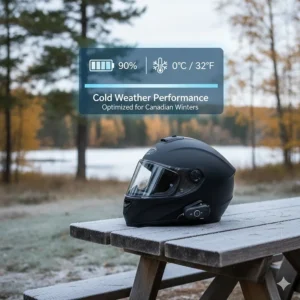
Temperature dramatically affects battery performance—a reality Canadian riders understand intimately. Lithium batteries lose approximately 20% capacity at 0°C and up to 50% at -20°C. Premium systems from Cardo and Sena incorporate battery management technology that mitigates cold-weather performance degradation, but expect reduced runtime during winter riding.
Plan for 30-40% shorter battery life during Canadian winters. A system rated for 13 hours in summer conditions might deliver only 8-10 hours at freezing temperatures. For multi-day touring through northern regions, consider bringing USB power banks or investing in systems offering quick-charge capabilities.
Speaker Quality and Volume Output
Highway wind noise becomes the enemy of clear communication, particularly when riding at speeds exceeding 100 km/h on Canadian highways. Premium systems from Cardo (JBL speakers) and Sena (Harman Kardon) deliver sufficient volume and clarity to overcome wind noise even in modular or open-face helmets with increased ambient sound intrusion.
Legal Considerations for Canadian Riders
Provincial Helmet Laws and Bluetooth Systems
All Canadian provinces and territories mandate helmet use for motorcycle riders and passengers. According to Canadian legal requirements, helmets must meet DOT, Snell, or ECE certification standards. Bluetooth communication systems don’t interfere with helmet certification as long as they attach externally or install within approved mounting locations.
Ontario’s distracted driving legislation specifically exempts hands-free communication devices, making bluetooth helmet systems the legal solution for staying connected while riding. British Columbia, Alberta, and other provinces maintain similar provisions allowing hands-free operation. However, riders must still exercise judgment—even hands-free communication can become distraction if used irresponsibly.
Hands-Free Operation Requirements
Canadian distracted driving laws prohibit handheld device use while operating vehicles, including motorcycles. Bluetooth helmet systems satisfy legal requirements by enabling voice-command operation and physical button controls that don’t require removing hands from handlebars. Systems offering natural voice activation (Cardo’s “Hey Cardo” or Sena’s voice commands) provide the safest operation method, allowing riders to maintain full control while communicating.
Installation Guide for Canadian Riders
Choosing the Right Mounting Location
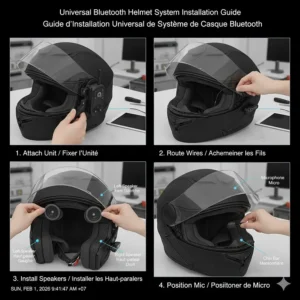
Most bluetooth communication units mount on the helmet’s left side to keep the right side clear for potential accessories like camera mounts or additional lighting. The mounting position should allow easy button access while wearing gloves but shouldn’t interfere with helmet removal or storage. Test fit the mount before permanent installation—most systems use adhesive backing that bonds strongly to helmet shells, making repositioning difficult.
For full-face helmets, position speakers aligned with ear pockets for optimal sound delivery. Many Canadian helmet manufacturers like HJC and Bell design helmets with communication system accommodation, featuring pre-formed speaker pockets and wire routing channels. Modular helmets require careful speaker placement to avoid interference with the chin bar mechanism.
Cable Management for Canadian Weather
Proper cable routing protects wires from moisture infiltration and mechanical damage. Route speaker cables through helmet liner channels rather than exposing them to elements. Use the provided cable clips or velcro straps to prevent excess movement that could fatigue connections over time. For systems with detachable boom microphones, ensure the connection point sits protected from direct rain exposure.
Smartphone Pairing and GPS Integration
Connecting Your Device
Initial smartphone pairing follows standard Bluetooth procedures but varies slightly between manufacturers. Most systems enter pairing mode automatically when powered on for the first time, indicated by flashing LED lights (typically alternating red and blue). Access your phone’s Bluetooth settings, locate the device name (e.g., “Cardo Edge” or “Sena 50R”), and select it to complete pairing.
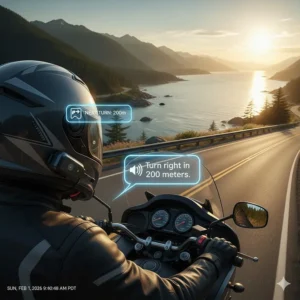
Advanced systems support multi-device pairing, simultaneously connecting to your smartphone and GPS unit. This allows seamless audio mixing—GPS directions can interrupt music playback automatically, resuming after the navigation prompt completes. Priority hierarchies ensure critical communications (phone calls, rider intercom) override background audio sources.
GPS Audio Integration
Modern smartphone navigation apps (Google Maps, Apple Maps, Waze) transmit audio prompts through Bluetooth connections, eliminating the need for dedicated GPS units. However, some Canadian riders prefer standalone GPS devices like Garmin Zumo or TomTom Rider series for their superior battery life, glove-friendly interfaces, and offline mapping capabilities crucial for remote area navigation.
GPS audio integration quality depends on the communication system’s audio mixing capabilities. Premium units from Cardo and Sena offer sophisticated mixing that lowers music volume automatically when GPS prompts arrive, then restores full volume afterward. Budget systems may simply pause music entirely, creating a less polished user experience.
Wireless Intercom Range Explained
Real-World Range Expectations
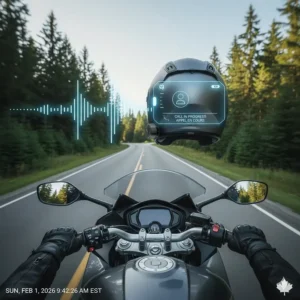
Manufacturers advertise intercom ranges under ideal conditions—flat, open terrain with clear line-of-sight between riders. Canadian riding conditions rarely match these ideals. Dense forests (think British Columbia’s inland highways or Ontario’s northern routes) reduce effective range by 30-50%. Urban environments with building interference create similar degradation.
Budget systems typically deliver 500-800 metre practical range in mixed conditions. Mid-range options extend to 1-1.2 kilometres, while premium mesh systems can maintain connectivity beyond 1.5 kilometres in favorable terrain. For comparison, that’s roughly the distance from Highway 1’s Rogers Pass summit to the Glacier National Park eastern boundary—substantial but not unlimited.
Mesh vs. Traditional Bluetooth
Traditional Bluetooth creates point-to-point connections between paired devices. When riders separate beyond range, communication drops entirely until they close distance. Mesh networking revolutionizes this limitation by creating a dynamic network where each connected rider acts as a relay point. In a group of six riders, the lead and sweep riders might be too far apart for direct connection but remain linked through the middle riders’ systems automatically forwarding signals.
This technology proves invaluable on Canadian highways where groups naturally spread out over several kilometres, particularly on multi-lane routes or during passing maneuvers. Mesh systems from Cardo and Sena support 8-15 connected riders, creating robust networks that maintain communication even as group formation changes throughout the ride.
Battery Life and Charging Solutions
Realistic Battery Expectations
Manufacturer specifications list maximum battery life under minimal usage scenarios—typically standby mode with occasional Bluetooth music streaming. Real-world use combining intercom communication, GPS audio, and music streaming reduces runtime by 40-60%. A system rated for 13 hours might realistically deliver 6-8 hours of active mixed-use riding.
Canadian touring riders should plan charging stops accordingly. Premium systems offer quick-charge capabilities, delivering 2-3 hours runtime from 20-minute charges—enough to reach the next rest stop or campground. USB-C charging has become standard on newer models, allowing use of common smartphone chargers and portable power banks during multi-day tours across Canada’s vast distances.
Cold Weather Battery Management
Lithium-ion batteries powering bluetooth helmet systems suffer significant capacity loss in cold temperatures. At -10°C, expect 30% reduced runtime; at -20°C, reduction exceeds 50%. Store helmets with communication systems indoors overnight when possible during winter riding. If unavoidable, consider insulating the battery compartment with thin foam or keeping systems powered off until immediately before riding.
Some Canadian riders report success using handlebar-mounted USB charging during winter rides, maintaining battery temperature through continuous trickle charging. This approach requires weatherproof USB ports (available as motorcycle accessory installations) and proper cable routing to prevent interference with controls.
Noise Cancellation Technology
CVC vs. DSP Noise Reduction
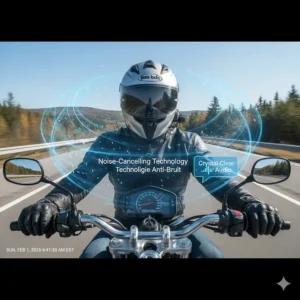
Advanced bluetooth helmet systems incorporate noise cancellation technology to combat wind and engine noise. Clear Voice Capture (CVC) technology analyzes incoming audio streams and filters background noise before transmission, ensuring your riding partners hear your voice clearly even at highway speeds. Digital Signal Processing (DSP) works similarly but uses different algorithms to achieve comparable results.
Premium systems combine multiple microphone inputs with sophisticated processing to differentiate voice from ambient noise. The boom microphone captures your voice, while secondary microphones sample ambient sound, allowing the system to subtract background noise mathematically. This technology works remarkably well up to approximately 120 km/h but struggles at higher speeds common on Canadian highways where wind noise intensity increases exponentially.
Adaptive Volume Technology
Smart volume systems automatically adjust audio output based on ambient noise levels. When accelerating onto the highway, the system detects increased wind noise and boosts speaker volume accordingly. Slowing for urban traffic triggers automatic volume reduction, preventing audio blasting when environmental noise decreases. This feature enhances both communication clarity and user comfort during varied riding conditions typical of Canadian commutes mixing highways and city streets.
Group Riding Communication Strategies
Optimal Group Size for Mesh Systems
Mesh networking technology theoretically supports 8-15 connected riders, but practical group sizes differ. For casual recreational rides, 4-6 riders represents the sweet spot where everyone contributes meaningfully to conversations without creating communication chaos. Larger groups benefit from designated leaders who relay important safety information while background chatter remains filtered.
Canadian motorcycle touring groups often span multiple provinces, requiring coordination across vast distances. Mesh systems excel in this scenario, allowing the lead rider to communicate turn-by-turn decisions that automatically propagate to all following riders. The sweep rider can alert the group to hazards from the rear, with mesh networking ensuring everyone receives the message regardless of their position in the formation.
Communication Etiquette for Canadian Roads
Establish group communication protocols before departing—constant chatter becomes exhausting over long distances. Many Canadian riding groups adopt push-to-talk protocols for general conversation while maintaining open channels for safety communications. This hybrid approach balances social connection with practical road awareness.
Consider language preferences in bilingual Canadian provinces. Quebec riding groups might switch between French and English, requiring communication systems with excellent audio clarity to prevent misunderstandings across language transitions. Test your system’s audio quality with representative group members before embarking on multi-day tours.

Maintenance and Care Tips
Cleaning and Storage
Remove communication units from helmets before cleaning to prevent water damage to electronic components despite waterproof ratings. Clean helmet exteriors with mild soap and water, avoiding harsh chemicals that might degrade adhesive mounts. Speaker covers accumulate sweat, dirt, and debris—remove them periodically for cleaning with isopropyl alcohol wipes.
Canadian winters present storage challenges for riders in seasonal climates. Store bluetooth communication systems at room temperature (15-25°C) with batteries charged to approximately 50% capacity. Lithium batteries degrade faster when stored either fully charged or completely discharged, while temperature extremes accelerate degradation. Remove units from helmets during long-term storage to prevent adhesive mount aging under compression.
Firmware Updates
Manufacturers regularly release firmware updates addressing bugs, improving performance, and occasionally adding new features. Premium systems from Cardo and Sena support over-the-air updates through smartphone apps, eliminating the need for computer connections. Budget systems might require manual USB updates—check manufacturer websites quarterly for new releases.
Firmware updates sometimes improve cold-weather performance or extend battery life through more efficient power management algorithms. Canadian riders should prioritize updates before winter riding seasons, as manufacturers often optimize cold-weather performance in annual fall releases timed with northern hemisphere autumn.
Troubleshooting Common Issues
Connection Drops and Pairing Problems
Intermittent connections usually stem from interference rather than hardware failure. The 2.4 GHz frequency band used by Bluetooth competes with WiFi networks, tire pressure monitoring systems, and other wireless devices. In urban areas, electromagnetic interference from power lines or industrial equipment can disrupt connections. Moving to open areas typically resolves these temporary issues.
Pairing problems often result from devices remaining connected to previously paired equipment. Before initiating new pairings, ensure all previously connected devices are powered off or outside Bluetooth range. Factory reset procedures vary by manufacturer but typically involve holding specific button combinations for 10-15 seconds until LED indicators confirm the reset.
Audio Quality Issues
Muffled or distorted audio usually indicates speaker positioning problems. Speakers must align directly with ear canals for optimal sound delivery—even 5mm misalignment significantly degrades quality. Remove helmet liner if necessary to adjust speaker placement, using the provided velcro or adhesive pads to secure optimal positioning.
Wind noise intrusion suggests inadequate helmet fit or damaged seals. While bluetooth systems incorporate noise cancellation, they cannot overcome excessive wind noise from poorly fitting helmets. Premium helmets from manufacturers like Shoei, Arai, or AGV provide superior acoustic sealing that dramatically improves communication system performance at highway speeds.
How to Choose the Right Bluetooth Helmet System in Canada
1. Assess Your Riding Style and Distance Needs
Solo commuters prioritizing smartphone connectivity and GPS navigation require different systems than group touring riders coordinating multi-day trips. Daily commuters covering 30-50 km might prioritize battery life and quick charging, while weekend recreational riders emphasize audio quality and reliability. Long-distance touring riders crossing multiple provinces need mesh networking capabilities and extended range for group coordination.
2. Determine Your Budget Range
Budget systems ($80-150 CAD) provide basic functionality adequate for occasional riders. Mid-range options ($200-400 CAD) deliver balanced performance suitable for regular weekend riding. Premium systems ($500-900 CAD) offer exceptional audio quality, advanced features, and superior weather resistance justifying higher investment for serious enthusiasts logging 10,000+ kilometres annually.
3. Evaluate Climate and Weather Requirements
Southern Ontario or Lower Mainland BC riders face moderate weather requiring IP65 minimum protection. Prairie riders confronting severe temperature swings and northern riders dealing with extreme cold need IP67-rated systems with proven cold-weather battery performance. Coastal riders in humid maritime climates should prioritize corrosion-resistant materials and sealed connection points.
4. Consider Group Riding Requirements
Solo riders need only smartphone connectivity and basic features. Couples riding together benefit from dual-pack pricing and music sharing capabilities. Group riders require mesh networking or traditional intercom supporting 4-6+ simultaneous connections. Verify cross-brand compatibility if your riding group uses mixed equipment brands.
5. Match to Your Helmet Type
Full-face helmets accommodate virtually any communication system. Modular helmets require careful speaker placement to avoid chin bar interference. Open-face and three-quarter helmets need boom microphones rather than internal wire microphones. Half helmets might require specialized mounting kits sold separately from base communication systems.
6. Test Audio Quality and Controls
If possible, test systems before purchasing through Canadian retailers offering demo units or generous return policies. FortNine, GPBikes, and other major retailers occasionally run demo days allowing hands-on testing. Verify button ergonomics with your riding gloves—controls must operate reliably with heavy winter gloves, not just summer lightweight alternatives.
7. Research Warranty and Canadian Support
Prioritize manufacturers offering Canadian warranty support and English/French customer service. International warranties sometimes exclude Canadian purchasers or require expensive return shipping for warranty claims. Established brands like Cardo, Sena, FreedConn, and LEXIN maintain Canadian support infrastructure ensuring reasonable warranty response times.
❓ Frequently Asked Questions
❓ What is the typical price range for bluetooth helmet systems in Canada?
❓ Can I use my bluetooth helmet system while crossing the Canada-US border?
❓ How long do bluetooth helmet system batteries typically last?
❓ Are bluetooth helmet systems legal in all Canadian provinces?
❓ Can I connect my bluetooth helmet system to multiple devices simultaneously?
Conclusion
Choosing the right bluetooth helmet system transforms your Canadian riding experience from isolated journeys into connected adventures. Whether you’re navigating Vancouver’s busy streets, touring the scenic Cabot Trail, or crossing the Prairies’ endless highways, these communication systems enhance safety, convenience, and enjoyment.
Premium options like the Cardo Packtalk Edge ($540+ CAD) and Sena 50R ($440+ CAD) deliver exceptional performance justifying higher investment for serious riders. Mid-range solutions including the LEXIN G2P ($180-220 CAD) and Cardo Packtalk Neo ($380-450 CAD) balance features and affordability for regular recreational riders. Budget-conscious Canadians find excellent value in the FreedConn FX ($120-180 CAD) and similar systems offering solid basic functionality.
Remember that the “best” system depends entirely on your specific riding style, climate conditions, and budget constraints. Solo commuters need different capabilities than group touring riders. Consider your typical riding scenarios—daily commutes, weekend recreation, or multi-day touring—and match system capabilities accordingly. Canadian weather demands robust weather resistance and proven cold-temperature performance that cheaper systems might not deliver reliably.
Invest in quality communication equipment appropriate for your needs, maintain it properly, and enjoy safer, more connected riding across Canada’s spectacular landscapes. From the Atlantic provinces to British Columbia’s coastal highways, the right bluetooth helmet system keeps you connected to what matters most: your riding companions, navigation, and the road ahead.
Recommended for You
- 7 Best Pinlock Visor Inserts Canada 2026 – Clear Vision Guaranteed
- 7 Best Half Helmet with Sun Visor Canada 2026 – DOT Approved
- 7 Best DOT Approved Half Helmets Canada 2026
Disclaimer: This article contains affiliate links to Amazon.ca. If you purchase products through these links, we may earn a small commission at no additional cost to you.
✨ Found this helpful? Share it with your friends! 💬🤗
