

In This Article
Picture this: you’re cruising through the Canadian Rockies with your riding partner, spotting wildlife, navigating hairpin turns, and trying to coordinate your next rest stop. Without a reliable helmet intercom for 2 riders, you’re stuck with awkward hand signals and missed moments. That’s where modern motorcycle intercom systems come in—they’re not just convenient; they’re game-changers for safety and enjoyment.
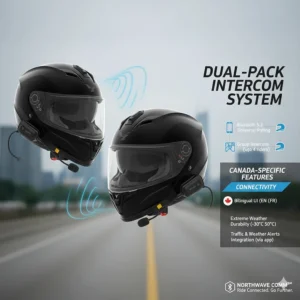
Canadian riders face unique challenges that make quality communication even more critical. Our weather can shift from sunshine to downpour in minutes, our highways span vast distances where cellular coverage disappears, and coordinating group rides becomes essential when exploring remote routes across provinces. Whether you’re navigating Toronto traffic with a passenger, touring the Cabot Trail with a buddy, or exploring backcountry trails in British Columbia, the right communication system transforms your riding experience.
The helmet intercom for 2 riders market has exploded in 2026, with options ranging from budget-friendly units under $100 CAD to premium systems exceeding $600 CAD. According to motorcycle safety experts, hands-free communication devices enhance rider safety by keeping attention focused on the road rather than fumbling with devices. This comprehensive guide examines seven top-performing systems available on Amazon.ca, helping you find the perfect match for your riding style and budget.
Quick Comparison Table
| Product | Range | Battery Life | Price (CAD) | Best For |
|---|---|---|---|---|
| Fodsports FX-S | 1000m | 15 hours | $60-80 | Budget riders |
| LEXIN G2P | 1000m | 20 hours | $80-120 | Value seekers |
| Moman H2S | 1000m | 20 hours | $90-130 | All-weather riders |
| Fodsports M1S Pro | 2000m | 20 hours | $130-170 | Long-distance touring |
| LEXIN B4FM | 2000m | 18 hours | $160-200 | Tech enthusiasts |
| Cardo Freecom 4X | 1600m | 13 hours | $280-340 | Premium features |
| Sena 50S | 2000m | 13 hours | $450-550 | Professional riders |
💬 Just one click – help others make better buying decisions too! 😊
✨ Don’t Miss These Exclusive Deals!
🔍 Take your motorcycle communication to the next level with these carefully selected products available in Canada. Click on any highlighted item to check current pricing and availability on Amazon.ca. These tools will help you create authentic riding experiences your friends will love!
Top 7 Helmet Intercom for 2 Riders: Expert Analysis
1. Fodsports FX-S – Best Budget-Friendly Choice
The Fodsports FX-S has become Canada’s go-to entry-level motorcycle intercom system Canada for riders seeking reliable two-way communication without breaking the bank. This compact unit delivers impressive performance at an unbeatable price point of $60-80 CAD.
Key Specifications:
- Bluetooth 5.4 technology for stable connections
- IP67 waterproof rating (essential for Canadian weather)
- Dual microphone options (boom and button mic)
Canadian buyers consistently praise the Fodsports FX-S for its straightforward setup and reliable performance in varying conditions. One Alberta rider noted that it performed flawlessly during a rainy ride through Jasper, maintaining crystal-clear communication despite challenging weather.
Pros:
✅ Exceptional value under $80 CAD
✅ CVC noise cancellation handles highway speeds well
✅ Compatible with most helmet types
Cons:
❌ Limited to 2-rider communication only
❌ Range decreases in densely wooded areas
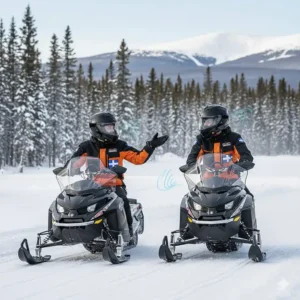
2. LEXIN G2P – Best Value for Money
The LEXIN G2P strikes the perfect balance between affordability and features, making it ideal for Canadian riders who want room to grow. Priced at $80-120 CAD on Amazon.ca, this helmet intercom for 2 riders supports up to 6 riders while delivering excellent sound quality.
Key Specifications:
- Qualcomm Bluetooth 5.1 chip for enhanced stability
- 40mm Mylar HD speakers with DSP/CVC noise reduction
- 800mAh battery (25 hours music, 20 hours talk time)
What sets the LEXIN G2P apart is its customization options—6 interchangeable metallic shells let you match your helmet’s aesthetics. Canadian customers appreciate the large, glove-friendly buttons that remain easy to operate even with thick winter gloves during shoulder-season rides.
Pros:
✅ Expandable to 6-rider groups
✅ Excellent battery life for multi-day tours
✅ FM radio for weather updates
Cons:
❌ Music sharing limited to 2 units
❌ 1000m range may be limiting on open highways
3. Moman H2S – Best All-Weather Performance
Canadian riders know that weather doesn’t wait for perfect conditions, which is why the Moman H2S has gained such popularity. Available for $90-130 CAD, this rider to rider communication system features triple noise cancellation technology specifically designed to combat wind noise at highway speeds.
Key Specifications:
- DSP, CVC, and ENC triple intelligent noise reduction
- Dual-version BT5.3 and 5.1 chips
- Windproof headset for physical noise cancellation
One Saskatchewan rider shared that the Moman H2S maintained clear audio even at 120 km/h on the Trans-Canada Highway—a testament to its advanced noise reduction. The audio multitasking feature allows simultaneous GPS navigation and intercom conversations, crucial for coordinating navigation on unfamiliar routes.
Pros:
✅ Superior noise cancellation at speed
✅ One-tap music sharing between units
✅ Three colour options for customization
Cons:
❌ Cannot pair with other brands
❌ Learning curve for advanced features
4. Fodsports M1S Pro – Best for Long-Distance Touring
When Canadian riders plan cross-province adventures, the Fodsports M1S Pro becomes the obvious choice. Its 2000m range and multi-rider mesh network capability (up to 8 riders) make it perfect for group touring through the Maritimes or across the Prairies. Expect to pay $130-170 CAD on Amazon.ca.
Key Specifications:
- Bluetooth 5.0 with 2000m maximum range
- 900mAh battery (20 hours continuous operation)
- Universal pairing compatible with most brands
Canadian touring groups praise the Fodsports M1S Pro for its reliability on extended rides. One Quebec rider reported using it successfully during a 10-day Maritime tour without a single dropped connection during group coordination.
Pros:
✅ Exceptional 2000m range in open terrain
✅ Music sharing enhances passenger experience
✅ Voice command activation (Siri/Google Assistant)
Cons:
❌ Bulkier than simpler 2-rider units
❌ Requires careful mounting on smaller helmets
5. LEXIN B4FM – Best Tech-Forward Features
Tech-savvy Canadian riders will appreciate the LEXIN B4FM’s advanced capabilities. This group communication helmet kit supports up to 10 riders and includes music sharing, FM radio, and universal pairing—all for $160-200 CAD. It’s the sweet spot between mid-range and premium.
Key Specifications:
- Qualcomm chip for superior connectivity
- IP67 waterproof and dustproof rating
- Mylar coaxial speakers with premium audio
The LEXIN B4FM excels in simultaneous conversation capability, allowing natural group discussions rather than walkie-talkie-style back-and-forth. British Columbia riders particularly appreciate this during technical mountain passes where continuous communication improves safety.
Pros:
✅ 10-rider capability at competitive price
✅ Crystal-clear audio even at 120 km/h
✅ Fast charging with long battery life
Cons:
❌ Best performance limited to 4 active riders
❌ App required for some advanced settings
6. Cardo Freecom 4X – Best Premium Mid-Range Option
Stepping into premium territory, the Cardo Freecom 4X delivers professional-grade performance for $280-340 CAD. Cardo’s reputation in the motorcycle intercom system Canada market is well-earned, and the Freecom 4X demonstrates why discerning riders accept the higher price tag.
Key Specifications:
- Natural voice operation (“Hey Cardo” commands)
- JBL 40mm speakers for superior sound
- IP67 waterproof with 13 hours talk time
The Cardo Freecom 4X integrates seamlessly with the Cardo app, allowing firmware updates and customization. Canadian customers highlight its exceptional clarity during highway riding and appreciate the automatic volume adjustment that responds to ambient noise levels.
Pros:
✅ Voice-activated controls keep hands on bars
✅ JBL audio quality surpasses competitors
✅ Firmware updates ensure longevity
Cons:
❌ Premium price may exceed some budgets
❌ 1600m range lower than some alternatives
7. Sena 50S – Best Professional-Grade System
For riders who demand the absolute best, the Sena 50S represents the pinnacle of helmet intercom for 2 riders technology. Priced at $450-550 CAD, this flagship model features Mesh 2.0 technology, providing virtually unlimited rider connections within a 2km range.
Key Specifications:
- Mesh 2.0 with Open Mesh and Group Mesh modes
- HD speakers optimized for comfort and audio quality
- WiFi-enabled firmware updates via included cable
Professional riders, tour guides, and serious enthusiasts across Canada rely on the Sena 50S. One Ontario-based motorcycle tour operator reported that his fleet of rental bikes equipped with Sena units has significantly improved customer satisfaction and safety during guided tours.
Pros:
✅ Most advanced mesh technology available
✅ Superior sound quality and audio multitasking
✅ Robust construction for professional use
Cons:
❌ Highest price point in category
❌ Feature-rich interface requires learning time
Understanding Helmet Intercom Technology
Before diving deeper, let’s clarify what makes a great helmet intercom for 2 riders. These devices use Bluetooth wireless technology to connect riders’ helmets, enabling hands-free communication, music streaming, GPS navigation, and phone calls. According to safety regulations across Canadian provinces, helmet modifications must not compromise the helmet’s protective capabilities—all intercoms featured here attach externally or fit within existing speaker pockets.
Modern systems fall into three categories: basic Bluetooth (2-4 riders), advanced Bluetooth (up to 10 riders), and Mesh networks (unlimited riders). For most Canadian riders seeking a helmet intercom for 2 riders, basic to mid-range Bluetooth systems provide excellent performance at reasonable costs. The key is matching the technology to your specific riding scenarios.
Bluetooth vs. Mesh: Which Technology Wins?
Bluetooth Systems work like a chain—each rider connects to the next in sequence. They’re perfect for couples riding together or small groups of 2-4 riders who stay relatively close. Range typically extends 800-2000m in open terrain, though Canadian forest environments and urban buildings reduce this significantly.
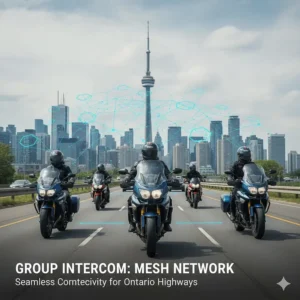
Mesh Systems create a dynamic network where every rider connects to all others simultaneously. If one rider moves out of range temporarily, the network automatically adjusts and reconnects when they return. This technology shines during large group rides through varying terrain, like navigating the Icefields Parkway where riders spread out.
For dedicated two-rider scenarios—rider and passenger, or two separate motorcycles—standard Bluetooth systems offer better value. Save mesh technology for when you regularly ride with larger groups or need professional-grade reliability.
Key Features to Consider for Canadian Riders
Weather Resistance Matters
Canadian weather patterns demand robust waterproofing. Look for minimum IP67 rating, which ensures protection against rain, snow, and road spray. Winter riders should verify operational temperature ranges—some units struggle below -10°C, while premium models function reliably down to -20°C.
Battery Life for Long Rides
Canada’s vast distances between cities mean battery life becomes critical. A system claiming “15 hours talk time” may only deliver 8-10 hours in cold weather. Budget an extra 20-30% capacity for Canadian conditions, and consider units with USB-C fast charging for quick top-ups during fuel stops.
Noise Cancellation Technology
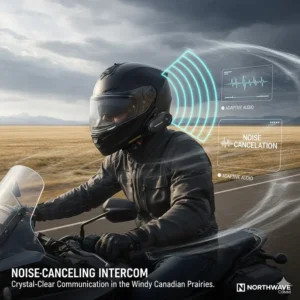
Highway wind noise at 100+ km/h challenges communication systems. Advanced CVC (Clear Voice Capture) and DSP (Digital Signal Processing) technologies filter out wind while preserving voice clarity. Canadian riders consistently rate noise cancellation as the make-or-break feature for enjoyable long-distance communication.
Installation Compatibility
Full-face, modular, and open-face helmets require different mounting approaches. Most systems include both boom microphones (for open/modular helmets) and button microphones (for full-face helmets). Verify compatibility with your specific helmet model before purchasing—some premium helmets like Arai or Shoei may require adapter plates.
Top Features Comparison
| Feature | Budget Models | Mid-Range | Premium |
|---|---|---|---|
| Range | 800-1000m | 1200-2000m | 2000m+ |
| Riders | 2-4 | 4-10 | Unlimited (Mesh) |
| Battery | 12-15 hours | 15-20 hours | 13-18 hours |
| Noise Cancellation | Basic CVC | CVC + DSP | Advanced DSP/ENC |
| Music Sharing | Limited/None | 2 units | Multiple units |
| Voice Commands | No | Limited | Full integration |
| Price (CAD) | $60-100 | $120-250 | $280-600 |
Installation and Setup Tips
Getting your helmet intercom for 2 riders operational shouldn’t require an engineering degree. Here’s how Canadian riders typically approach installation:
Step 1: Prepare Your Helmet
Clean the mounting area with alcohol wipes to ensure adhesive mounts stick properly. Cold Canadian temperatures reduce adhesive effectiveness, so perform installation indoors at room temperature.
Step 2: Position Speakers Correctly
Speakers sit in helmet ear pockets. Thinner speakers (8-10mm) offer better comfort during long rides. Test positioning before final installation—speakers too far from ears require excessive volume, while too-close placement causes pressure points.
Step 3: Mount the Main Unit
Clamp or adhesive mounts attach to the helmet’s left side (industry standard). Ensure the unit doesn’t interfere with your field of vision or snag on jacket collars during head checks.
Step 4: Route the Microphone
Boom mics extend from the unit to your mouth. Button mics affix inside the chin bar area. Canadian riders recommend boom mics for better wind noise performance during highway riding.
Step 5: Initial Pairing
Follow manufacturer instructions carefully. Most systems require both units powered on simultaneously while holding specific buttons for 3-5 seconds. Once paired initially, subsequent connections happen automatically.
✨ Ready to upgrade your ride?
🎯 These helmet intercom systems transform ordinary rides into connected adventures. Every product highlighted here is currently available on Amazon.ca with fast shipping across Canada. Click any bolded product name to check today’s pricing and customer reviews!
Real-World Performance Across Canada
Urban Riding in Toronto and Montreal
City riding presents unique challenges—frequent stops, heavy traffic, and building interference. Mid-range systems like the LEXIN G2P perform excellently, maintaining connections through downtown cores while filtering out traffic noise. The FM radio feature proves invaluable for traffic updates during rush hour commutes.
Highway Touring Through the Prairies
Open highways demand maximum range and wind noise management. The Fodsports M1S Pro and LEXIN B4FM excel here, maintaining clear communication even when riders separate by 500+ metres. Saskatchewan riders report successfully coordinating rest stops and fuel stations across vast distances without cellular coverage.
Mountain Riding in British Columbia
Tight switchbacks and varying elevations test communication systems. The Sena 50S’s mesh technology shines, automatically compensating when riders temporarily lose line-of-sight around hairpin corners. The auto-reconnect feature eliminates the frustration of manual re-pairing.
Maritime Coastal Routes
Salt air, frequent rain, and high humidity challenge electronics. IP67-rated systems like the Moman H2S withstand these conditions reliably. New Brunswick riders recommend regular cleaning of speaker grills to prevent salt buildup that degrades audio quality over time.
Pricing and Value Analysis
| Price Range | What You Get | Best Use Case |
|---|---|---|
| $60-100 CAD | Basic 2-rider Bluetooth, standard speakers, 1000m range, essential features | Occasional riders, short commutes, budget-conscious beginners |
| $120-200 CAD | Multi-rider capability (4-10), enhanced audio, music sharing, longer range | Regular riders, weekend warriors, small touring groups |
| $280-400 CAD | Premium audio (JBL), voice commands, advanced noise cancellation, smartphone app | Serious enthusiasts, frequent group riders, year-round riders |
| $450+ CAD | Mesh technology, unlimited riders, professional features, HD audio | Professional riders, tour operators, large group coordinators |
The sweet spot for most Canadian riders falls between $120-200 CAD, where you get substantial features without premium pricing. However, riders logging 10,000+ kilometres annually often find premium units justify their cost through superior durability and performance.
Maintenance and Care for Canadian Conditions
Extend your investment’s lifespan with proper maintenance:
Winter Storage: Remove batteries if storing motorcycles for winter. Extreme cold degrades lithium batteries rapidly. Store units indoors at moderate temperatures.
Regular Cleaning: Use compressed air to clear speaker grills monthly. Wipe external surfaces with slightly damp microfibre cloths—avoid harsh chemicals that degrade rubber seals.
Software Updates: Manufacturers release firmware updates improving performance and fixing bugs. Check quarterly and update via manufacturer apps or desktop software.
Battery Care: Don’t let batteries fully discharge. Charge to 50-80% for storage. In Canadian winters, consider removing rechargeable batteries from units stored in cold garages.
Safety Considerations and Legal Compliance
All Canadian provinces require motorcycle helmet use, but regulations regarding Bluetooth devices vary slightly. According to Transport Canada guidelines, helmet modifications must not compromise safety certifications. External mount systems like all featured products comply with these requirements.
Key Safety Points:
- Never adjust settings while riding—use voice commands or stop safely
- Keep volume at levels allowing ambient traffic awareness
- Test your system in controlled environments before highway use
- Ensure emergency contacts can reach you via connected phone
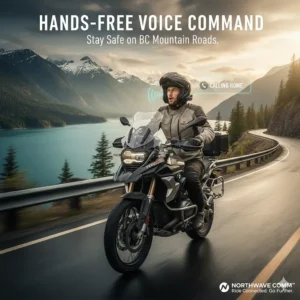
Distracted driving laws apply to motorcycles. Voice-activated systems like the Cardo Freecom 4X and Sena 50S help maintain legal compliance by eliminating the need to physically interact with devices while riding.
FAQ
❓ Can I use a helmet intercom for 2 riders in extreme Canadian winter temperatures?
❓ What is the realistic range for motorcycle intercom systems in Canadian terrain?
❓ Are budget intercoms worth buying or should I invest in premium systems?
❓ Can different brands of helmet intercoms communicate with each other?
❓ How long do helmet intercom batteries last and can they be replaced?
Conclusion
Choosing the right helmet intercom for 2 riders transforms your Canadian motorcycle adventures from isolated experiences into connected journeys. Whether you’re navigating Vancouver’s Sea-to-Sky Highway with a passenger, coordinating fuel stops across the Trans-Canada with your riding buddy, or simply enjoying music during your daily commute through Calgary, the right communication system enhances safety and enjoyment.
For budget-conscious riders, the Fodsports FX-S delivers exceptional value under $80 CAD. Those seeking the best balance of features and price will appreciate the LEXIN G2P or Moman H2S at $80-130 CAD. Serious touring enthusiasts should consider the Fodsports M1S Pro or LEXIN B4FM for their extended range and multi-rider capability. Professional riders and those demanding absolute best performance will find the Sena 50S worth its premium price tag.
Remember that the “best” system depends entirely on your riding style, budget, and specific needs. A $60 system perfectly suits a Toronto commuter riding with a passenger, while a $500 mesh system becomes essential for tour operators managing groups across the Rockies. Consider how many kilometres you ride annually, typical group sizes, weather conditions you encounter, and features you’ll actually use.
All products featured remain readily available on Amazon.ca with reliable shipping across Canada. Take advantage of seasonal sales—Black Friday, Boxing Day, and spring riding season sales often reduce prices by 20-40%. Read current customer reviews specific to Canadian conditions, and don’t hesitate to contact manufacturers with questions about compatibility with your specific helmet model.
Your next ride awaits, and it’s time to stay connected. Choose your helmet intercom for 2 riders wisely, install it properly, and enjoy the enhanced communication that makes every ride safer and more enjoyable.
Recommended for You
- Best Bluetooth Helmet System Canada 2026: 7 Top Picks
- 7 Best Pinlock Visor Inserts Canada 2026 – Clear Vision Guaranteed
- 7 Best Half Helmet with Sun Visor Canada 2026 – DOT Approved
Disclaimer: This article contains affiliate links to Amazon.ca. If you purchase products through these links, we may earn a small commission at no additional cost to you.
✨ Found this helpful? Share it with your riding friends! 💬🤗
