
In This Article
Picture this: you’re carving through a pristine trail somewhere in Ontario, the temperature has dropped to a bone-chilling −25°C, and suddenly — your visor fogs up. Just like that, your entire field of vision is gone. It’s not just annoying; it’s genuinely dangerous. That’s exactly why a heated helmet visor has become one of the most essential pieces of gear for Canadian riders and snowmobilers alike.

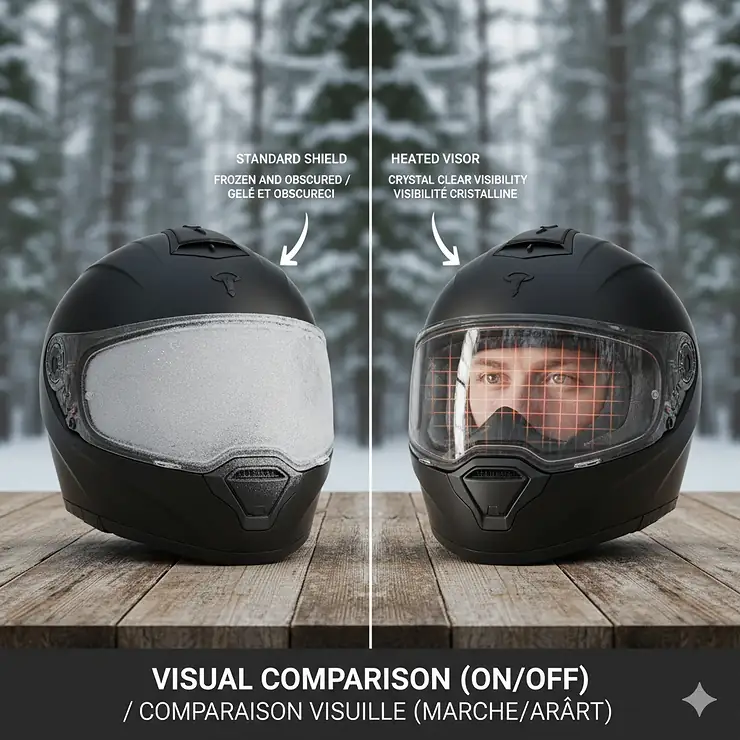
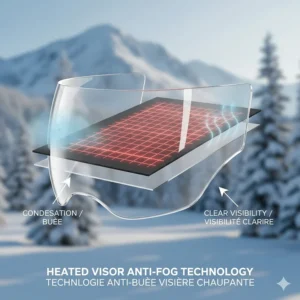
A heated helmet visor is a visor or insert equipped with an electrical heating element that actively warms the shield’s surface, preventing condensation, frost, and ice from forming. Unlike passive anti-fog coatings that lose effectiveness in extreme cold or low airflow conditions, a heated visor system uses a thin, transparent layer of conductive material to keep your sightline crystal clear — no matter how brutal the weather gets.
Canada is no stranger to harsh winters. From the icy trails of Quebec to the frozen landscapes of Manitoba, riders here face conditions that riders in warmer climates simply never encounter. That’s why choosing the right heated helmet visor isn’t just a nice-to-have — it’s a safety priority. In this guide, I’ve handpicked the 7 best options available in Canada right now, tested across budget, mid-range, and premium tiers. Whether you’re a casual weekend snowmobiler or a dedicated trail rider, there’s a heated visor on this list built just for you. 🍁
Quick Comparison Table
| Product | Type | Heating Tech | Price (CAD) | Power Source | Best For |
|---|---|---|---|---|---|
| GMAX MD04 Vault (Electric Shield) | Helmet | Dual-pane electric | $210–$350 | 12V sled power | Budget riders |
| FXR Torque X Prime (E Shield) | Helmet | Heated dual-layer | $380–$500 | 12V sled power | Mid-range all-rounders |
| 509 Delta R3L Ignite | Helmet | ITO dual-pane | $449–$549 | 12V sled power | Versatile trail riders |
| 509 Delta R4 Ignite | Helmet | ITO dual-pane | $499–$599 | 12V sled power | Modular fans |
| CKX Mission AMS (Electric Shield) | Helmet | Electric shield + AMS | $639–$899 | 12V sled power | Premium trail riders |
| Ski-Doo Oxygen Heated Helmet | Helmet | Amplified heated visor | $649–$799 | eLinQ magnetic | Ski-Doo loyalists |
| VISIN Universal Heated Visor Insert | Insert | ITO battery-powered | ~$300 | Rechargeable Li-ion | Universal retrofit |
💬 Just one click – help others make better buying decisions too! 😊
Top 7 Heated Helmet Visors: Expert Analysis
1. GMAX MD04 Vault Modular Helmet (Electric Shield) — The Budget-Friendly Starter ⚡
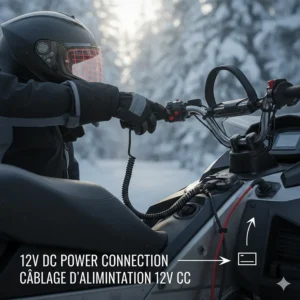
If you’re dipping your toes into the heated visor world without draining your wallet, the GMAX MD04 Vault is a rock-solid entry point. Available with an optional electric shield upgrade at most Canadian retailers like Revco.ca and FortNine, this modular helmet comes equipped with a 100% UV400-protected anti-fog double lens face shield. The electric shield version adds a heated dual-pane visor that plugs directly into your snowmobile’s 12V accessory port.
The MD04 features GMAX’s signature D.E.V.S. (Dual Exhaust Venting System), which helps manage internal humidity — a nice complement to the heated shield. The lightweight ABS shell keeps things comfortable on longer rides, and the push-to-open chin bar mechanism works beautifully even with thick winter gloves.
Canadian riders on forums have noted that the connector fit isn’t always the tightest, so consider picking up a universal magnetic connector adapter (widely available on Amazon.ca for under $25 CAD) to secure things during vibration-heavy rides.
✅ Affordable entry into heated visor territory
✅ Modular design with glove-friendly operation
✅ Wide colour selection across Canadian retailers
❌ Connector compatibility can be finicky
❌ Shell is ABS, not composite — heavier than premium options
Price: ~$210–$350 CAD |
Available at: Amazon.ca, Revco.ca, FortNine
2. FXR Torque X Prime Helmet with E Shield & Sun Shade — The Reliable Mid-Range Pick 🔧
FXR Racing is a Canadian brand through and through, and the Torque X Prime is one of their standout offerings for riders who want serious heated visor performance without crossing into premium pricing. The electrically heated dual-layer face shield comes with lock-and-seal technology, meaning once you snap it into position, it’s not going anywhere — a detail that matters when you’re hitting bumps at speed.
The helmet weighs in at just 1,670g (±50g) under both DOT and ECE standards, making it impressively light for a full-featured heated helmet. The integrated drop-down sun shade is a genuine bonus on bright, snowy days when glare becomes a real issue. The adjustable fit breath box and dual-density EPS liner round out a thoughtfully designed package.
Canadian snowmobilers on FXR’s own site have praised the comfort and airflow. One reviewer noted they wore sunglasses underneath without any fogging — a testament to the ventilation design working hand-in-hand with the heated shield.
✅ Canadian-designed with proven trail performance
✅ Lightweight at 1,670g with DOT/ECE dual certification
✅ Integrated sun shade for variable light conditions
❌ Power cord required — no battery option
❌ Replacement electric shields can be pricey
Price: ~$380–$500 CAD |
Available at: FXR Racing Canada (fxrracing.ca), Latulippe
3. 509 Delta R3L Ignite Helmet — The Three-in-One Powerhouse 🏆
The 509 Delta R3L Ignite is where things start getting seriously impressive. This helmet offers three distinct configurations — dual sport, full face, and open face — and pairs that versatility with 509’s proprietary Ignite heated ITO dual-pane electric shield. The weatherproof Shield Lock system creates a near-perfect seal, keeping cold air, moisture, and snow firmly out of your line of sight.
509’s Ignite technology uses Indium Tin Oxide (ITO) coating on the shield, which conducts a small current to generate uniform warmth across the visor surface. The result? A fog-free, ice-free view even when temperatures plummet well below −30°C. The helmet is DOT/ECE dual safety certified with dual-density EPS foam for solid impact protection.
Trail riders across Canada — particularly in Quebec and Ontario — have consistently praised the Delta R3L for its seal quality. One rider on Hardcore Sledder mentioned running it for an entire season without a single fogging issue during cold-weather rides, which is high praise indeed.
✅ Three riding configurations in one helmet
✅ Ignite ITO heated shield eliminates fog and ice
✅ Excellent seal system with Shield Lock technology
❌ Requires 12V connection to the sled
❌ Some riders report needing to replace shields after multiple seasons
Price: ~$449–$549 CAD |
Available at: Amazon.ca, Up North Sports, Extrême Limite
4. 509 Delta R4 Ignite Helmet — The Flip-Up Modular Evolution 🔄
Think of the Delta R4 as the Delta R3L’s more refined, modular sibling. The signature feature here is the oversized flip-up face shield that lifts with the push of a single glove-friendly button — no fumbling, no frustration. Underneath, the same Ignite dual-pane heating technology keeps things fog-free and ice-free in sub-zero conditions.
509 has paired this with a climate control ventilation system featuring a two-stage front chin vent, adjustable forehead vents, and exhaust vents. The Fidlock® magnetic strap buckle is another standout — it snaps shut magnetically with one hand, even while wearing heavy winter gloves. The helmet shell starts at just 1,900g under ECE standards, which is respectable for a modular design of this calibre.
The included arctic chin curtain and breath box further seal out cold air intrusion, making the Delta R4 particularly well-suited to Canada’s most frigid riding conditions. Multiple shield options — including polarized, mirror, and photochromatic lenses — give you genuine flexibility.
✅ Intuitive flip-up modular design with button release
✅ Fidlock magnetic buckle for one-handed glove operation
✅ Excellent climate control ventilation system
❌ Premium price point for mid-tier budgets
❌ No internal sun visor in some configurations
Price: ~$499–$599 CAD |
Available at: Amazon.ca, Up North Sports, GP Bikes
5. CKX Mission AMS Helmet with Electric Shield — The Air Management Innovator 💨
CKX, a Quebec-based brand with deep roots in the Canadian snowmobile community, brought something genuinely different to the table with the Mission AMS. The headline feature isn’t just the electric heated shield — it’s the AMX air management system. This patent-pending technology actively wicks moist air away from inside the helmet to the outside, working in tandem with the heated shield to create a condensation-free environment.
The fiberglass composite shell keeps the weight at around 1,680g (electric version), and the oversized visor opening lets you sip water or chat with riding companions without pulling the helmet off entirely. Canadian riders have been particularly vocal about the Mission’s performance in temperatures between −10°C and −20°C, with several noting they never needed to activate the electric shield thanks to the AMS system alone.
That said, in truly extreme cold (below −25°C), the electric shield becomes essential. The combination of both systems working together is where the Mission truly shines.
✅ Patent-pending AMX air management reduces fogging passively
✅ Lightweight fiberglass composite at 1,680g
✅ Oversized visor for easy mid-ride access
❌ Higher price reflects premium materials and tech
❌ Some users report moisture build-up near the chin in extreme cold
Price: ~$639–$899 CAD |
Available at: Amazon.ca, FortNine, Euromoto.ca, Peakboys.ca
6. Ski-Doo Oxygen Heated Helmet with Electric Visor — The Premium Ski-Doo Experience 🌟
If you ride a Ski-Doo and want a helmet that feels like it was purpose-built for your machine — because it was — the Oxygen is hard to beat. Manufactured by BRP (Bombardier Recreational Products), this helmet features an amplified heated visor with a pivot contact system, meaning the visor stays electrically connected as you open and close it. No unplugging, no worrying about losing power mid-ride.
The M-Forge® lightweight composite shell offers panoramic field of vision, and the retractable amber sun visor handles bright, snowy days beautifully. What really sets this helmet apart is the remote control with visor heat indicators — you can adjust the heated visor output right from your gloved hand. The NCS (Noise Control System) reduces wind noise significantly, and the helmet is even compatible with prescription glasses.
Ski-Doo’s eLinQ magnetic connection system makes the power hookup quick and secure, which Canadian riders have consistently praised for its reliability in cold weather.
✅ Amplified heated visor with pivot contact — stays connected while opening
✅ Remote control with heat indicators — adjust while riding
✅ M-Forge composite shell with panoramic vision
❌ Best paired with Ski-Doo sleds for full system compatibility
❌ Premium pricing reflects the feature set
Price: ~$649–$799 CAD
|Available at: Ski-Doo Official Store (ski-doo-shop.brp.com/ca)
7. VISIN Universal Heated Visor Insert Kit — The Smart Retrofit Solution 🛠️
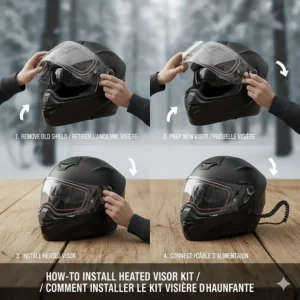
Already love your helmet but wish it had a heated visor? The VISIN insert is the only battery-powered, universal heated visor accessory on the market — and it’s a genuinely clever piece of engineering. Made by Diamond Coatings, VISIN uses ITO (Indium Tin Oxide) coating deposited onto a thin film insert that attaches to your existing visor with self-adhesive tabs. It’s literally a five-minute install.
The rechargeable lithium-ion battery pack delivers up to 8 hours of continuous use and clears a fogged visor within 20 to 60 seconds. There’s also a 40-second boost mode that cranks the heat output to 2.5× normal power for those truly brutal moments. VISIN operates effectively between −20°C and 60°C, covering the vast majority of Canadian riding conditions.
The main trade-off is availability — VISIN ships from overseas (primarily the UK and USA), so factor in shipping times of 1–2 weeks to Canada. Still, for riders who want heated visor capability without buying an entirely new helmet, it’s an exceptionally smart option.
✅ Universal fit — works with virtually any helmet brand
✅ Battery-powered with 8-hour run time and boost mode
✅ No need to replace your entire helmet
❌ International shipping adds time and cost
❌ Not available directly on Amazon.ca — order via Diamond Coatings or select retailers
Price: ~$300 CAD (including shipping) |
Available at: diamondcoatings.com, select online retailers
How Does a Heated Helmet Visor Actually Work? 🔬
The science behind heated helmet visors is surprisingly elegant. Most modern systems rely on a material called Indium Tin Oxide (ITO) — a transparent conducting oxide that’s been used in touchscreens, solar cells, and energy-efficient windows for decades. ITO is both optically clear and electrically conductive, which makes it the perfect candidate for a heating application that can’t compromise your line of sight.
Here’s the basic process: a thin layer of ITO is deposited onto the visor’s surface (or onto an insert film). When a small electrical current is passed through this coating, it generates a gentle, uniform heat. That heat warms the visor’s inner surface just enough to prevent moisture from condensing — which is exactly how fog forms in the first place. The result is a visor that stays clear even when your warm breath meets freezing outside air.
There are two main power delivery methods in the Canadian market. Sled-powered systems plug directly into your snowmobile’s 12V accessory port via a wired cord, drawing power continuously while you ride. Battery-powered systems, like the VISIN insert, use a compact rechargeable pack that clips onto your helmet or jacket — these are more versatile but limited by battery life.
Why Canada’s Winter Climate Makes Heated Visors Essential 🍁❄️
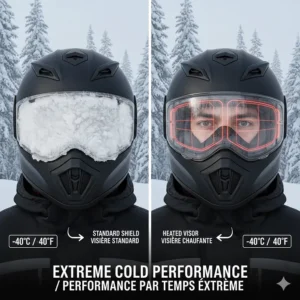
Canada’s climate is, to put it mildly, extreme. Temperatures in provinces like Manitoba, Saskatchewan, and northern Ontario regularly drop below −30°C during peak winter months. At those temperatures, a standard anti-fog coating on your visor becomes almost meaningless — the sheer cold causes moisture to freeze on the lens faster than any passive coating can handle.
According to Statistics Canada, impaired visibility was a contributing factor in 46% of fatal snowmobile incidents between 2013 and 2019. While darkness and dusk were primary causes, fog and frost on helmet visors are a well-documented secondary factor that riders themselves frequently cite. A fogged or iced-up visor doesn’t just slow you down — it genuinely puts your life at risk.
The Government of Ontario specifically recommends that riders always wear a face shield or goggles, noting that they protect against windburn, frostbite, and sun blindness. A heated visor takes this recommendation a step further by ensuring your face shield actually remains functional throughout your entire ride.
How to Choose the Right Heated Visor System for You
Picking the right heated helmet visor comes down to a few key factors. Here’s a straightforward checklist to guide your decision:
- Identify your primary use case. Snowmobiling, motorcycling, and ATV riding all have different requirements. Snowmobile helmets dominate the heated visor market in Canada for good reason — they’re designed for the coldest, most demanding conditions.
- Consider your power source. Sled-powered visors are more reliable for continuous riding but require a working 12V outlet on your machine. Battery-powered inserts offer more flexibility but come with a limited run time.
- Check helmet compatibility. Brand-specific heated visors (like Ski-Doo’s eLinQ system or 509’s Ignite shields) only work with matching helmets. Universal inserts like VISIN bypass this limitation entirely.
- Match the temperature range. Most heated visors perform well down to −20°C to −30°C. If you’re riding in northern Canada where temperatures can hit −40°C, look for helmets with dual ventilation systems and superior sealing.
- Factor in safety certification. In most Canadian provinces, helmets must meet DOT, ECE, or CSA standards. Always verify your helmet’s certification before purchase — consult Kimpex’s helmet safety certification guide for a clear breakdown of each standard.
- Budget realistically. Heated helmet visors in Canada range from roughly $210 CAD (budget modular helmets with electric shield) to $900+ CAD (premium carbon fibre options). The sweet spot for most riders sits between $400 and $600 CAD.
Heated Visor vs. Anti-Fog Coatings: Which One Wins? 🏅
This is one of the most common questions from Canadian riders who are new to the heated visor world — and the answer is pretty clear-cut. Anti-fog coatings are a passive solution. They apply a thin moisture-repellent layer to the visor’s surface that works well in mild conditions or when airflow through the helmet is strong. The moment you’re sitting still in −20°C weather, though, that coating starts losing the battle.
| Feature | Heated Visor | Anti-Fog Coating | Dual-Lens (Non-Heated) |
|---|---|---|---|
| Effectiveness at −30°C | ✅ Excellent | ❌ Limited | ⚠️ Moderate |
| Works while stationary | ✅ Yes | ❌ Often fails | ⚠️ Depends on airflow |
| Requires power source | ✅ Yes (12V or battery) | ❌ No | ❌ No |
| Cost | 💰💰💰 | 💰 | 💰💰 |
| Maintenance | Low | Medium (reapplication) | Low |
| Long-term reliability | ✅ High | ⚠️ Degrades over time | ✅ High |
The verdict? For casual summer motorcycling, an anti-fog coating is perfectly fine. But for serious Canadian winter riding — especially snowmobiling — a heated visor system is the only solution that consistently delivers fog-free and ice-free visibility in all conditions.
✨ Don’t Miss These Exclusive Deals!
🔍 Take your heated helmet visor game to the next level with these carefully selected products available across Canada. Click on any highlighted product name to check current pricing and availability on Amazon.ca or your preferred Canadian retailer. Stay safe and stay clear all winter long! 🍁
Understanding Battery Power Requirements and Electrical Heating Elements ⚡🔋
One of the practical questions riders always ask is: how much power does a heated visor actually draw? The good news is, not much. Most sled-powered heated visor systems draw between 2 and 5 amps at 12 volts — that’s roughly 24 to 60 watts of power. Your snowmobile’s electrical system can handle this comfortably alongside your headlight, tail light, and other accessories, provided your battery is in good shape and your charging system is functioning properly.
For battery-powered systems like VISIN, the rechargeable lithium-ion pack is designed to deliver a low, sustained current over several hours. The 8-hour run time on a single charge means you can do a full day of riding without worrying about your visor going dark mid-trail.
It’s worth noting that cold temperatures affect battery performance. Lithium-ion batteries lose efficiency below 0°C, and performance drops further as temperatures decrease. If you’re riding in extreme cold, keep your battery pack close to your body (inside a jacket pocket, for example) when you’re not actively using it to preserve charge.
Defrost Functionality: What to Look For in Canadian Winters 🧊
Defrosting and de-fogging are related but distinct challenges, and the best heated helmet visors in Canada tackle both simultaneously. De-fogging prevents condensation from forming on the visor’s inner surface. Defrosting, on the other hand, actively melts ice that has already formed — usually from riding through snow or freezing rain.
The key to effective defrost functionality is uniform heat distribution. ITO-coated visors excel here because the conducting layer covers the entire shield surface, generating heat evenly from edge to edge. This means there are no cold spots where ice can stubbornly cling. Systems with dual-pane construction add another layer of protection: the air gap between the two lenses acts as an insulator, reducing heat loss from the outer pane to the environment.
If defrosting capability is a priority for your riding conditions, look for helmets with anti-scratch coatings on the outer lens as well. Ice crystals can scratch unprotected polycarbonate visors, permanently degrading clarity over time.
Safety Standards You Need to Know in Canada 🛡️
Helmet safety in Canada is regulated at the provincial level, but the standards are broadly consistent. According to research published in the Canadian Paediatric Society, riders across most provinces are required to wear helmets that meet one of the following certifications: DOT (FMVSS 218), ECE (Regulation 22), CSA (CAN-3-D230), or Snell. The majority of helmets on this list carry both DOT and ECE dual certification — the gold standard for Canadian riders.
It’s important to understand that these standards apply to the helmet shell and impact protection — not specifically to the heated visor system. The heating element itself doesn’t require separate certification, but the overall helmet must still pass the applicable safety tests. Always confirm that your helmet carries a visible certification sticker before purchasing.
Provincial regulations also dictate when helmet use is mandatory. In Ontario, for example, helmets are required for all snowmobile operators and passengers on public lands. British Columbia, Alberta, and Newfoundland are notable exceptions with fewer helmet mandates, though wearing one is always strongly recommended regardless.
Maintenance Tips to Keep Your Heated Visor Running All Season 🔧
A heated helmet visor is an investment, and like any piece of gear, it benefits from regular care. Here are a few simple tips to keep your system performing at its best throughout the Canadian winter season:
Clean the visor gently. Use a microfibre cloth and mild soap solution. Avoid abrasive cleaners or paper towels — they can scratch the ITO coating or the anti-fog layer, reducing both clarity and heating effectiveness over time.
Inspect the power cord regularly. For sled-powered systems, the cord between your helmet and the snowmobile is the most vulnerable component. Check for fraying, exposed wires, or loose connectors before every ride. Cold weather makes cables stiffer and more prone to cracking.
Store your helmet wisely. Keep it in a cool, dry place away from direct sunlight. UV exposure can degrade visor coatings over time. A helmet bag or a padded storage box works perfectly.
Charge battery packs fully before rides. For battery-powered systems, start each riding day with a full charge. If you’re planning multiple rides in a week, charge overnight between sessions to maintain battery health.
Price Range & Value Analysis 💰
| Tier | Price Range (CAD) | What You Get | Best Examples |
|---|---|---|---|
| Budget | $210–$350 | Heated electric shield, basic modular design | GMAX MD04 Vault |
| Mid-Range | $380–$600 | Dual-pane ITO heating, DOT/ECE certified, modular options | FXR Torque X Prime, 509 Delta R3L/R4 |
| Premium | $639–$900+ | Advanced air management, carbon fibre shells, magnetic connections | CKX Mission AMS, Ski-Doo Oxygen |
| Retrofit | ~$300 | Universal battery-powered heated insert for any helmet | VISIN Insert Kit |
For most Canadian snowmobilers, the mid-range tier delivers the best value. You get proven ITO heating technology, solid safety certifications, and enough features to handle a wide range of winter conditions — all without the sticker shock of premium helmets.
Benefits vs. Traditional Alternatives
| Feature | Heated Visor Helmet | Standard Dual-Lens Helmet | Open-Face + Goggles |
|---|---|---|---|
| Fog prevention in extreme cold | ✅ Superior | ⚠️ Moderate | ⚠️ Moderate |
| Ice/frost removal | ✅ Active defrost | ❌ Manual only | ❌ Manual only |
| Field of vision | ✅ Full panoramic | ✅ Full panoramic | ⚠️ Goggle-limited |
| Comfort in −30°C+ | ✅ Excellent | ⚠️ Acceptable | ❌ Challenging |
| Price range (CAD) | $210–$900+ | $150–$500 | $100–$300 |
| Maintenance level | Low–Medium | Low | Medium |
FAQ ❓
❓ How long does a heated helmet visor last before it needs replacing?
❓ Can I use a heated helmet visor on a motorcycle in Canada?
❓ Do heated helmet visors work in temperatures below −40°C in Canada?
❓ What is the battery life of a heated helmet visor in Canada?
❓ Is a heated helmet visor required by law in any Canadian province?
Conclusion
Riding through a Canadian winter without a heated helmet visor is a bit like driving in a rainstorm without windshield wipers — you can do it, but why would you? The technology has matured significantly in recent years, and the options available to Canadian riders in 2026 are genuinely impressive. From budget-friendly modular helmets like the GMAX MD04 Vault to premium systems like the Ski-Doo Oxygen with its remote-controlled heated visor, there’s something on this list for every rider and every budget.
The bottom line is simple: if you’re riding in Canada between November and April, a heated helmet visor isn’t a luxury — it’s one of the smartest safety investments you can make. Fog and ice on your visor can happen in seconds, and in the middle of a trail at speed, there’s no time to fumble. A heated visor takes that problem off your plate entirely, so you can focus on what matters: enjoying the ride.
✨ Don’t Miss These Exclusive Deals!
🔍 Ready to upgrade your winter riding setup? Click on any of the product names highlighted throughout this article to check current pricing and availability at Amazon.ca and other trusted Canadian retailers. Stay warm, stay clear, and ride safe this season! 🍁🛡️
Recommended for You 📚
- 7 Best Helmet Intercom for 2 Riders Canada 2026
- Best Bluetooth Helmet System Canada 2026: 7 Top Picks
- 7 Best Pinlock Visor Inserts Canada 2026 – Clear Vision Guaranteed
Disclaimer: This article contains affiliate links to Amazon.ca and other Canadian retailers. If you purchase products through these links, we may earn a small commission at no additional cost to you.
✨ Found this helpful? Share it with your friends! 💬🤗
